My Cat Used My Couch as a Scratching Post for 2 Years — Here’s the Dumb, Simple Thing That Finally Switched Her Over
I spent two years watching my cat shred the arm of my couch while ignoring every scratching post I bought. The fix was so simple it made me furious.
The moment I realized I'd lost the war was a Tuesday morning. I walked into the living room and saw my couch arm looking like it had been attacked by a tiny, fluffy shredder. Which, technically, it had. The fabric was hanging in strips, the foam poking through like stuffing from a gutted teddy bear. My cat, Juno, was curled up on the exact spot she'd destroyed, purring like a motorboat. She wasn't sorry. She was never sorry.
I stood there holding my coffee, trying to calculate how much a reupholstery job would cost versus just buying a new couch. Neither was in the budget. I'd already tried the spray bottle method (which I now know is basically cat abuse and completely useless), the double-sided tape that just collected cat hair and dust, and the citrus-scented deterrent that made the whole room smell like a cleaning supplies closet. None of it worked. Juno would just sniff the tape, look at me with that specific cat contempt, and drag her claws down the other arm.
This went on for nearly two years. Two. Years. I'm a person who runs a small animal rescue, for crying out loud. I've fostered over 40 cats and dogs. I should know how to train a cat to use a scratching post. But I was humbled. So humbled. And that's the thing about cats — they don't care about your credentials. They care about texture and territory and whether they can fully stretch their spine while mauling something.
What finally changed things was something stupidly simple. I'm almost embarrassed to admit it. But it worked for Juno, and it's worked for every build cat since. So I'm going to walk you through the whole mess — the mistakes, the late-night Googling, the $9 piece of cardboard that finally did what a $70 cat tree couldn't.
The Day I Found My Couch Arm Reduced to String
I'd had Juno for about four months when I first noticed the damage. She was a sleek little tortie with one orange paw and a resting bitch face that could curdle milk. I loved her immediately. She'd been surrendered to the shelter where I used to work because her previous owner "didn't have time" — which usually means the cat was bored and started destroying things. I thought I could fix her. I was wrpng, at least for a while.
The first sign was a small pulled thread on the left arm of my beige couch. I told myself it was just wear and tear. Then the thread became a hole. Then the hole became a crater. By month six, I'd draped a throw blanket over the arm and called it a day. Juno would just push the blanket aside with her head and go to town on the exposed fabric underneath. She was methodical.
I need to be crystal clear here: scratching isnt' misbehavior. My vet, Dr. Nguyen — who's put up with my panic calls for 11 years, through three dogs and a divorce — once explained it to me like this: "Sarah, you might as well try to train her not to blink. Scratching is how she marks her territory, stretches her back, and sheds old claw sheaths. It's not optional." I knew that, intellectually. But knowing it and accepting it when your furniture is being pulverized are two very different things.
The day I found the couch arm in its final, catastrophic state was the day I stopped being angry at Juno and started being angry at myself. Because I'd set her up to fail. I'd given her a wobbly, carpet-covered post in the corner of the guest bedroom — a room she never entered — and expected her to magically prefer it over the pludh, sturdy, living-room-centerpiece couch that smelled like me. That's like putting a treadmill in a dark basement and being shocked no one uses it.
Scratching Isn't Bad Behavior — It's Cat Biology You Can't Argue With
Let me get this out of the way before we talk about training. If you think you're going to teach your cat to stop scratching entirely, you're going to be disappointed and your furniture is going to be kindling. Scratching is hardwired. It serves multiple purposes: it leaves visual and scent marks (cats have scent glands between their paw pads), it stretches the muscles and tendons in the forelimbs and spine, and it maintains nail health by helping to shed the outer sheath.
When I was in vet tech schol — before I dropped out, which is a story for another day — we learned about feline anatomy and behavior, and the scratching reflex is tied to deep evolutionary patterns. Big cats scratch trees. Little cats scratch your couch. Same instinct, just different real estate. The goal isn't to eliminate scratching; it's to redirect it to acceptable surfaces.
One of the biggest mistakes I made early on was thinking punishment would work. A squirt with the water bottle, a stern "no," even the clapping-hands technique. All of it just made Juno more surreptitious about her scratching. She'd wait until I was asleep or at the grocery store. And the stress of being punished for a natural behavior probably made her scratch even more — stress scratching is a thing, and I'll get to that later.
Actually, wait — I should talk about something here that still makes me cringe. I once cauhht my cat mid-scratch and physically picked her up and moved her to the scratching post, then moved her paws on it. She looked at me like I'd just suggested we take a bath together. The sheer insult in her eyes. She never used that post again, not once. Cats don't like being manipulated. They want to discover things on their own terms. I learned that the hard way.
The $12 Post That Lived in My Garage for 8 Months
So, the first scratching post I ever bought was one of those skinny, carpet-covered pillars with a dangly toy on top. It cost twelve bucks at a big-box pet store. I thought I was being clever. This thing was so light it tipped over if a cat looked at it funny. The carpet material was exactly the same texture as my rental apartment's floor — so the cat logically thought, "oh, more flloor? cool, I'll keep scratching the couch." I wrote about this in more detail in a post about the scratching post all my build cats hated, but the short version is: it collected dust in the garage for most of a year before I gave it to Goodwill. I hope it's in a landfill now. It deserves to be.
That experience taught me something vital — if you buy the wrong post, you're literally wasting your time and your cat's patience. Not all scratching surfaces are created equal. Most of what's marrketed as "cat furniture" is designed for human eyes, not feline claws.
What Your Cat Actially Wants in a Scratching Surface (and No, It's Not What the Pet Store Tells You)
Okay, let's get into the specifics of what makes a scratching post actually appealing to a cat. I've tested this with over 40 fosters, many of whom came to me with existing destructive scratching habits. These are my field notes, not scientific studies, but they're backed by a lot of shredded cardboard and a few claw marks on my own arms when I got between a cat and her favorite new post.
Material Matters: Carpet, Sisal, Cardboard, and the Weird One My Cat Loves
You'll see four main materials in scratching posts: carpet, sisal rope, sisal fabric, and cardboard. Here's the thing about carpet: it can be fine if your cat doesn't have access to carpet anywhere else. But if you've wall-to-wall or area rugs, a carpeted post is just confusing. "This is okay but taht's not? Make up your mind, human." I learned to avoid carpet posts entirely for that reason.
Sisal rope is the gold standard for a lot of cats. It has a rough, satisfying texture that shreds gradually, and it doesn't resemble typical household fabrics. I've had cats who ignored every other type of surface but would go to town on a sturdy sisal-wrapped post. The one caveat: texture varies. Some sisal is too smooth. You want a post where you can feel individual fibers, something with a little tooth to it.
Cardboard scratchers are cheap, disposable, and weirdly effective for many cats. The horizontal ones in particular seem to scratch some deep feline itch. Pun absolutely intended. My cat Mochi — who I'll tell you about in a bit — would only use cardboard for the first six months I had her. She'd sniff a sisal post and walk away like it offended her ancestors.
And then there's the wild card: wopd. Some cats just want to claw actual bark or unfinished lumber. I had a build named Gus (not the dog Gus, a different Gus — I've had three animals named Gus, it's a problem) who refused all commercial posts but would cheerfully shred the leg of an old wooden stool I'd put out for him. I bought him a slab of untreated pine from a hardware store for four dollars and he was the happiest cat in the county. So if nothing else works, think outside the pet aisle.
Vertical vs. Horizontal — How to Read Your Cat's Scratching Style
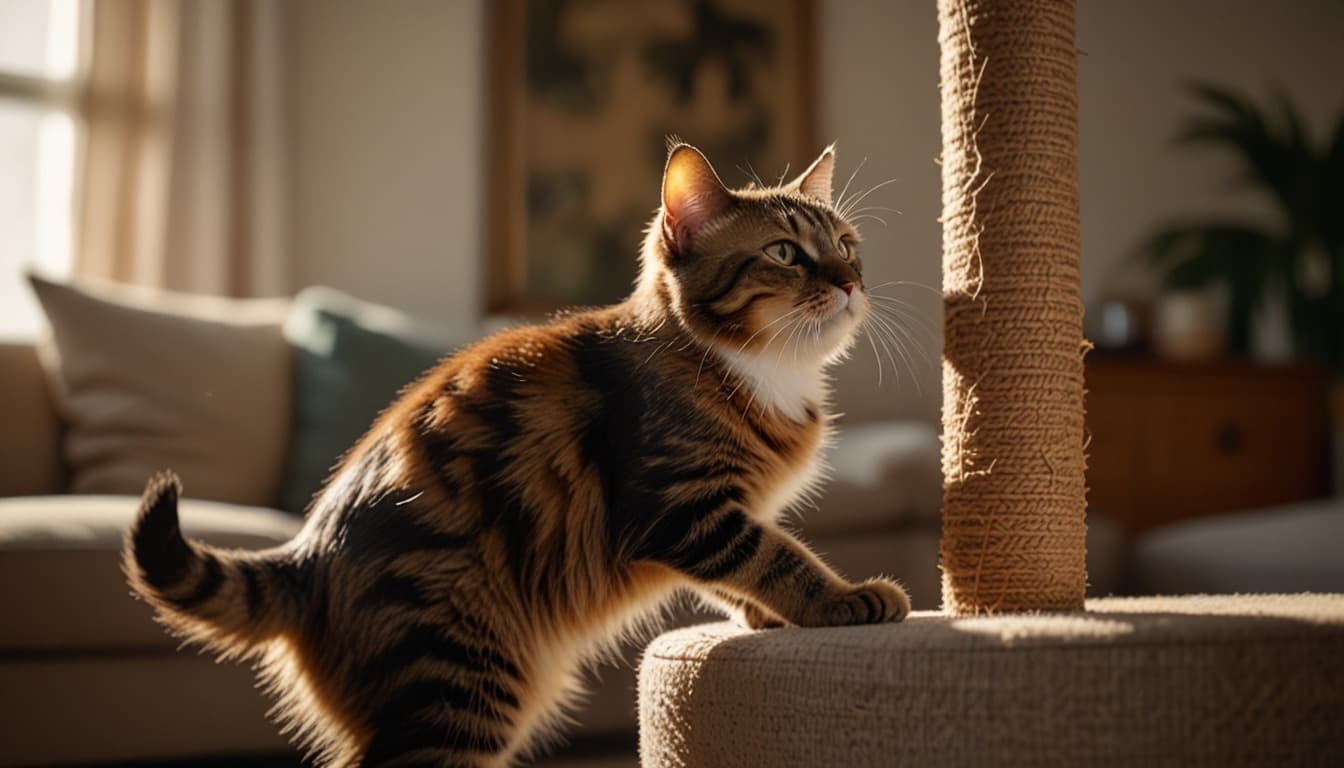
Watch where your cat scratches now. Seriously, just observe for a day. If she's scratching the side of the couch or the wal, she's a vertical scratcher. She wants something tall enough to let her fully stretch upward. If she's scratching the carpet, the rug, or similar, she's a horizontal scratcher. Some cats do both. Juno was a vertical scratcher who needed a post tall enough that she could extend her body to its full length without her paws coming off the top. I'd been offering her a 2-foot post when she really needed something 3 feet or higher. No wonder she preferred the couch arm — it went all the way up.
Stability: If It Tips Over, You're Done
A scratching post that wobbles is worse than no post at all. Cats need to be able to put their full weight into the scratching motion without the thing toppling or sliding. If it tips once, they'll never trust it again. I've had posts that I had to brace against a wall or weigh down with sandbags (seriously, I used ankle weights strapped to the base) to make them stable enough. The commercially available posts with narrow, lightweight bases are a complete joke. Save yourself the heartache and buy or build a post with a wide, heavy base. Or, if you'te handy, bolt it to a piece of plywood and put a piece of furniture on top.

The Training Method I Stole From a Behavviorist Who Rolled Her Eyes at Me
Right, so here's the approach that actually worked — after years of trial and error, after I finally swallowed my pride and consulted a feline behaviorist. She was a very patietn woman who charged me $85 an hour to basically tell me my cat was normal and I was the one who needed training. I deserved that.
Step 1: Put the Post Wheere the Crime Happened (Even If It Looks Stupid)
This is the most common mistake, and I made it for literal years. You buy a beautiful scratching post and you put it in a corner of the spare room because thats' where it fits aesthetically. Your cat continues to scratch the couch because the couch is in the living room where all the action is. Cats want to scratch in socially significant areas. They want you to see their handiwork. It's a communication thing. So put the post directly in front of or next to the surface they're currently destroying. Yes, it might look weird. Yes, your living room might look like a cat obstacle course for a few weeks. Deal with it. You can move it later, slowly, like an inch per day, once the habit is established.
Step 2: Make the Old Spot Suck
I combined this with deterrents, but I'm careful about what I recommend. Double-sided tape (the stuff specifically made for furniture, not regular masking tape) can work on some surfaces if your cat hates sticky feelings on her paws. Aluminum foil taped to the couch arm was a temporary solution that Juno really didn't like — she'd jump up, hear the crinkle, and nope right out. There are also plastic carpet runners with the nubby side up; you can attach those to furniture. The key is to make the forbidden scratching spot unpleasant while simultaneousy making the post incredibly rewarding. If you only do the deterrent without a fantastic alternative, you're just being mean.
Step 3: The 30-Second Play Session That Changed Everything
This was the behaviorist's trick and it feels so obvious in retrospect. Cats scratch as part of their hunting sequence — they stretch and claw to release tension after stalking prey. So, play with your cat near the scratching post. Use a wand toy, get her excited, let her catch the prey, and then immediately redirect her to the post. I'd dangle a feather toy near the top of the post, get Juno to leap toward it, and she'd naturally reach out and grab the post with her claws. After a few times, she started scratching it on her own because the post had become associated with the fun, satisfying conclusion of the hunt. I'd also scratch the post myself with my fingernails — yes, I looked ridiculous, but it worked. She'd see me doing it and come investigate.
Step 4: The Treat That's Practically Cat Crack
Positive reinforcement is your best friend. Every time your cat scratches the post — every single time — reward her. A tiny treat, a head scratch, praise in that high-pitched voice we all use for our animals. I used freeze-dried chicken bits, broken into pieces so small they were basically dust. Juno would hear the bag crinkle from three rooms away and immediately go to the post and dramatically scratch it while staring at me. Manipulative? Absolutely. Effective? Also yes.
Mochi's Rebellion: When She Decided the Post Was for Sleepimg and the Ottoman Was for Shredding
I need to tell you about Mochi because she was the cat who almost made me quit fostering. She came to me as a 4-year-old calico with a reputation for being "impossible" — her previous two homes had returned her for destructive scratching. When I got her, she had been declawed on her front paws (which makes me furious, but that's a rant for another day) and yet somehow she was still shrrdding things with her back claws. She had developed a technique where she'd grip the fabric with her front paws and do a kind of rapid bicycle-kick with her back feet. The ottoman didn't stand a chance.
Mochi refused every post I offered. She'd sniff them, then use them as a pillow. I put catnip on them — she'd lick the catnip off and go back to the ottoman. I tried the hunting play trick — she'd watch me like I was performing a bad puppet show. I was at my wit's end after three weeks, the ottoman looking like it had been through a war.
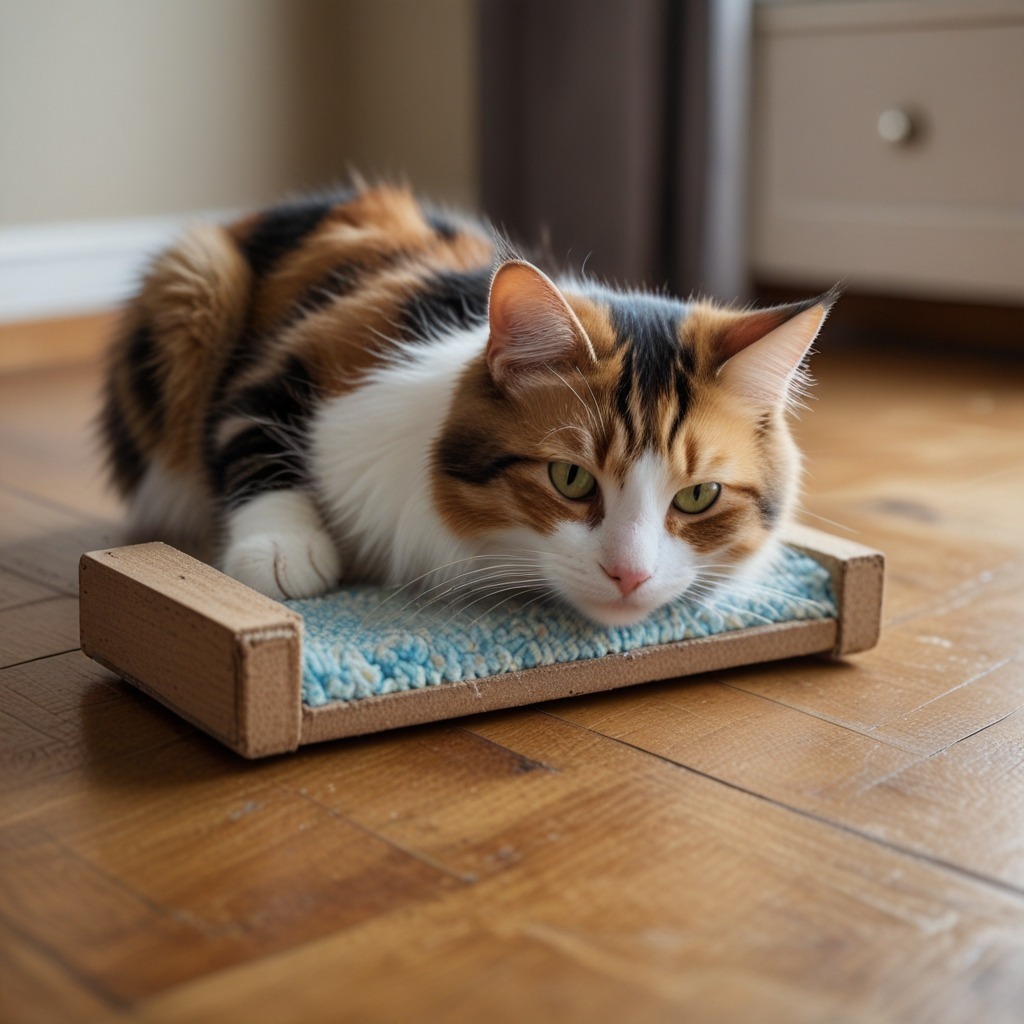
Then one afternoon, I was lying on the floor scrolling my phone, and I had a piece of cardboard — just a random box flap — next to me. Without thinking, I drummed my fingers on it. Mochi came over, flopped down, and started scratching the box flap with her back feet like it was the greatest thing she'd ever discovered. She was a horizontal scratcher. I had been offering her vertical posts this entire time. And she wanted something she could lie on her side and kick at. I went out and bought a wide, flat cardboard scratcher — one of those that sits on the floor — and placed it next to the ottoman. She switched targets within an hour. I felt like an idiot and a genius simultaneously.
The ottoman never fully recovered, but Mochi stopped adding to the damage. And I learned that you've to watch a cat's natural posture when they scratch — are they standing up, stretching high, or are they low to the ground, kicking? The post has to match the posture.
Why I Stopped Stressing About the Carpet and Just Bought a Cheap Runner
Some cats, no matter what you do, will have a thing about carpet. I had a build named Linus who used a scratching post religiously for his front claws but insisted on doing this weird shimmy-drag across the area rug to file his back claws. It wasn't destructive exactly — more like a weird little dance — but it wore a path in the rug after a few months. I tried everything to redirect him and finally just accepted it. I bought an inexpensive, machine-washable runner and placed it over his favorite spot. Problem solved, stress gone. Sometimes the best training strategy is strategic surrender.
That's not to say you should let your cat destroy your home, but you've to pick your battles. If your cat will only scratch one specific carpet remnant from 1994 that's in the basement anyway, maybe just let her have it and inveest in some good vacuum baggies.
What Happened When I Got a Second Cat and the Whole Training Went to Hell
I thought I had it all figured out with Juno. Then I adopted a second cat — a big, goofy orange tabby named Hank — and suddenly Juno was scratching the couch again. Not the post. The couch. I was baffled and frustrated until I realized what was happening: territorial marking. When a new cat enters the household, scratching can escalate as both cats try to establish scent boundaries. It's not about the post being "wrong" — it's about the post not being sufficient for the social dynamics.
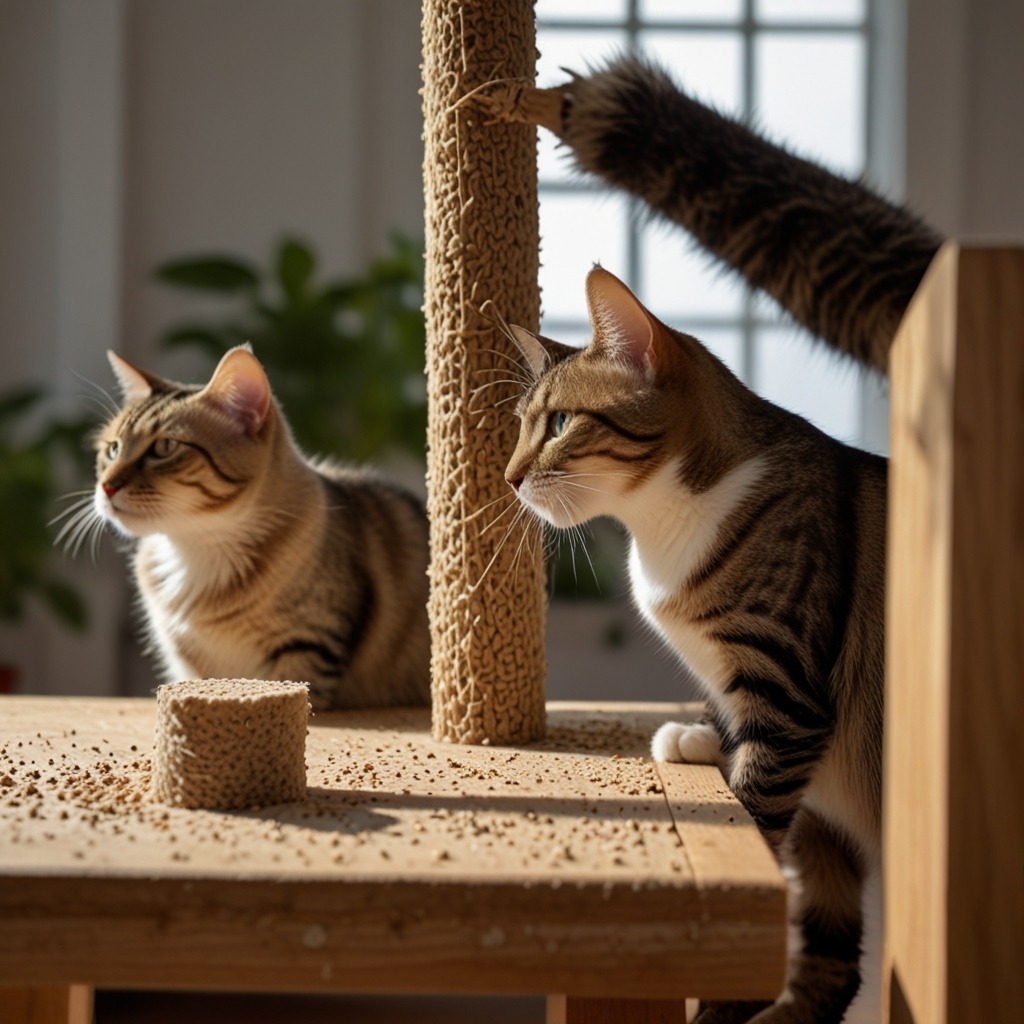
The solution was more posts, in more locations, with specific ones assigned (unofficially) to each cat. I put a tall sisal post near the window where Juno liked to perch, and another hoizontal cardboard scratcher in the hallway. Hank gravitated toward a wood post near the kitchen. The scratching on furniture decreased significantly once each cat had their own designated scratching territory. I also used a slow introduction method that reduced general stress, which helped, but the real big deal was acknowledging that scratching is social communicaton and that one post per cat — preferably one per cat plus an extra — is the minimum for multi-cat homes.
The Cardboard Scratcher That Changed My Life (and My Amazon Order History)
I've mentioned cardboard scratchers a few times and I need to give them their due. The first time I bought a good cardboard scratcher — one that was thick, dense, and came with a little bag of dried catnip — I felt like I'd discovered fire. It was a flat, angled model that you could flip over when one side got worn out. I placed it in the exact spot where Juno had been scratching the couch arm, and within 20 minutes she was kneading and clawing it like it was the greatest invention since canned tuna.
These things are consumable, obviously — they'll shred and you'll need to replace them every few months depending on usage. But they're chap, they're recyclable, and most cats find them irresistible. The trick is to get the high-density ones, not the flimsy single-layer pieces of cardboard that disintegrate in a week. The good ones have a honeycomb structure that holds up under serious claw work. I now have a subscription for a 2-pack delivered every three months, and my furniture has never been safer.
One warning: cardboard scratchers can be messy. Little bits of shredded cardboard will end up on your floor. I consider this a small price to pay compared to reupholstery. A little handheld vacuum lives next to the scratcher now. That's fine.
If You've Tried Everything and It's Still Not Working
Alright, sometimes the problem isn't the post, the placement, or the training — sometimes the cat has something else going on. I learned this the hard way with a build cat named Pixel who scratched constantly and aggressively, to the point where his paw pads were raw. Everyone thought it was behavioral. It wasn't; it was a combination of arthritis and anxiety. Once we treated the underlying issues, the scratching settled down significantly. So if you're at the end of your rope, consider these possibilities.
Medical stuff that looks like behavior
Pain can cause cats to scratch excessively. Arthritis, injuries, or foot pad issues can make a cat obsessively claw at surfaces as a way to relieve discomfort. Food allergies can cause itchy paws, leading to scratching that isn't about markng at all. If your cat's scratching seems frantic, if she's licking her paws a lot, or if you see any redness, swelling, or bleeding, go to the vet. I once had a cat who scratched her ears until they bled — turned out to be a severe yeast infection, not a behavior problem. (If you want to read about that nightmare, I wrote it up here.)
When it's not the post — it's the environment
Stress is a huge trigger for destructive scratching. Changes in routine, new people, construction noise, other animals outside the window — all of these can cause a cat to ramp up marking behavior. If your cat suddenly starts scratching after years of good habits, look at what's changde at home. I've had cats start scratching doorframes when a new baby arrived, and another who scratched the couch every time the neighbor's dog barked. Solving the scratching meant solving the stress, not just the surface. Sometimes that means creating more vertical space (cat trees, shelves), sometimes it means pheromone diffusers, sometimes it means medication. Don't rule it out.
The one time I hired a brhaviorist and she told me I was the problem
I've already alluded to this, but genuinely, the $85 I spent on a feline behavior consultant was the best money I ever wasted. She walked through my house, observed Juno for 20 minutes, and said, "you've a single scratching post in a house with two cats, three dogs, and a baby gate that separates the litter boxes. Of course she's scratching the couch — it's the only stable, tall thing in the room that smells like you." She recommended three new posts, a pheromone diffuser, and a daily play routine. I'd been focused on training the cat when I should have been training myself. Consider hiring a professional if you're stuck. They're worth the money, even if they make you feel like a dumbass for an hour.
Speaking of stress making cats act out — I once had a build cat who peed on my pillow after I got a new roommate, and it was 100% my fault for ignoring her stress signals. That's a whole other story, but the point is, cats don't do things to spite you. They're responding to their environment. If you're dealing with urination issues too, I wrote about my misadventures here.
My Couch Still Has a Bald Sppt, But the Cat's Not Adding to It
I never did get the couch reupholstered. The bald spot on the left arm is still there, covered by a throw pillow that I move when company comes. Juno is 11 now, slower, and she spends most of her time sleeping in a sunbeam rather than destroying furniture. The cardboard scratchers get replaced every few months, the sisal post in the living room has become a family heirloom, and I've made peace with the fact that cat ownership means some level of material sacrifice.
If you take one thing from this massive brain dump, it's this: work with your cat's nature, not against it. Give her something tall and stable that feels amazing under her claws, put it where she actually wants to be, and make her feel like a genius every time she uses it. The training isn't about dominance or discipline — it's about providing a better option and being patient enough to let her discover it. Also, invest in a good vacuum. You'll need it.