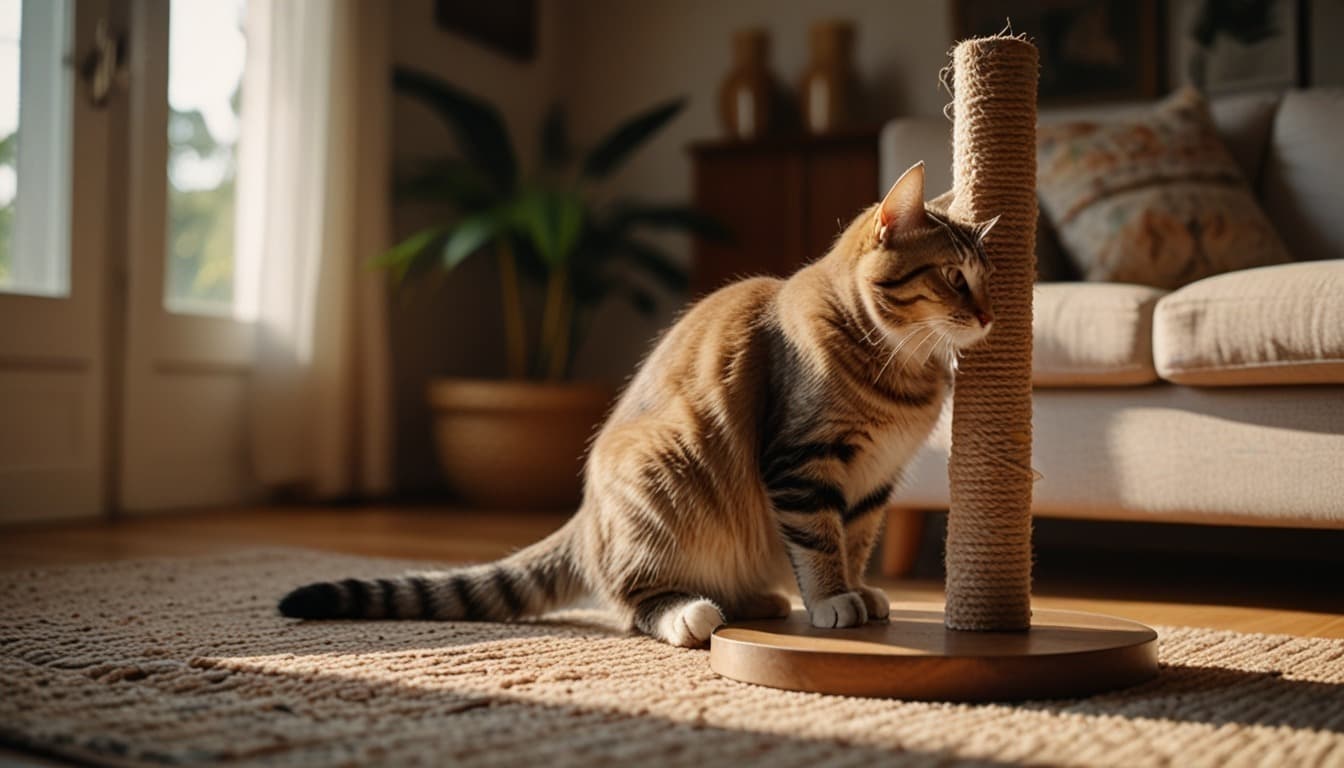
I've Fostered 40+ Cats and the One Thing They All Hated Was My First Scratching Post
I bought the wrong scratching posts for six years and my couch paid the price. Here's what 40+ foster cats finally taught me — and the $14 post that started it all.
Here's something I didn't expect to learn after 14 years of rescue work: most scratching pots are designed by people who've never met a cat. Or maybe they've met one cat — a declawed Persian who spends 23 hours a day napping on an electric blanket. Meanwhile, my little chaos gremlin Miso (the cat currently judging me from the windowsill) had shredded the arm of my thrifted couch within 36 hours of arriving.
I panicked. I drove to the big-box pet store at 7pm and bought a $14 carpeted post that smelled like glue and regret. It had a danhly mouse toy. It was beige. It stood about knee-high and wobbled if you looked at it wrong. Miso ignored it completely and went back to destroying the couch. So I bought another post. And another. Eventually I had six different scratching things scattered around my living room, all of them gathering dust while my furniture got uglier.
That was six years ago. Since then I've fostered over 40 cats and kittens, from a terrified feral mama to a three-legged orange maniac named Garbage Truck. And I've made every scratching post mistake in the book. Multiple times. I've got the shredded curtains to prove it.
The $14 Post That Taught Me Everything I Got Wrong About Scratching
Let's talk about that first post. It was carpeted. It was short. It was unstable. I'd basically bought the physical manifestation of "I don't understand cats." The thing is, I thought I was being smart. I'd read a blog post. I'd watched a YouTube video. I was confident. And I was wrong.
Here's what I didn't know then: cats don't scratch just to sharpen their claws. Scratching is communication. It's territory marking. It's a full-body stretch that feels incredible. It's stress relief. It's how they say "I live here and I'm kind of a big deal." So if your scratching post doesn't satisfy that whole cocktail of needs, your cat will find something that does. Usually your mattress. Or your doorframes. Or your leg, if you're unlucky.
My vet, Dr. Nguyen — she's put up with my panic calls for 11 years, through three dogs and a divorce — once told me something that stuck: "Sarah, a scratching post isn't furniture. It's a piece of communication equipment." She's right. Dr. Nguyen is rarely wrong, except about the nutritional value of kale, which we've agreed to disagree on.
Height Matters More Than You Think
Most commercial scratching posts are too short. Way too short. A cat needs to fully extend their body when they scratch — we're talking front paws reaching high, spine arching, the whole dramatic yoga sequence. If the post is only 18 inches tall, your cat can't do that full stretch. It's like trying to do a sun salutation in an airplane bathroom. Possible, maybe, but why would you?
I learned this the hard way with a build named Pancake. Pancake was a 14-pound former tocmat with shoulders like a linebacker. He ignored every post I owned until I built a floor-to-ceiling sisal-wrapped pole that I literally bolted into a ceiling joist. The minute it was up, Pancake scaled it like a tiny furry lumberjack and scratched with an enthusiasm I've rarely seen outside of catnip binges. That pole cost me $30 in materials and about two hours of swearing at a drill. Worth every obscenity.
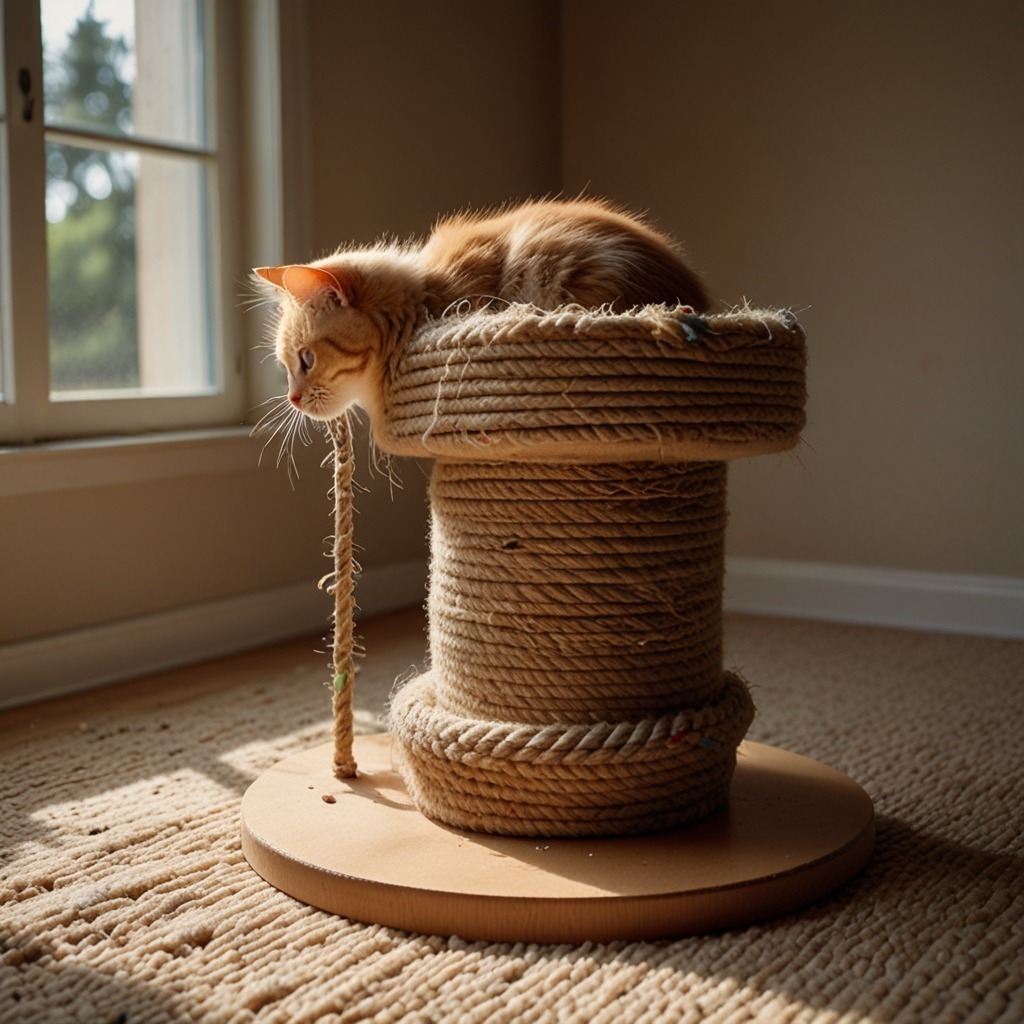
The minimum height I recommend now is 30 inches, and honestly? Go taller if you can. Wall-mounted scratchers that let them stretch upward are fantastic. Those angled cardboard loungers that curve up at one end? Cats love those because they can get a good long stretch going. The golden rule: if your cat can't fully extend their body while using the post, it's not tall enough.
Stability Is Non-Negotiable
Imagine leaning all your weight against something and having it tip over. Not fun, right? Now imagine you're a creature who relies on that surface for emotional regulation and claw maintenance. A wobbly scratching post is worse than useless — it's scry. I've seen cats develop a permanent distrust of certain surfaces because a post fell on them once. Two of my fosters, littermates named Biscuit and Gravy, wouldn't go near the corner where a cheap post had toppled over six months earlier. They remembered.
A good post needs a heavy, wide base. Like, absurdly heavy. The kind of heavy that makes you groan when you've to move it to vacuum. If you can nudge it with your toe and it shifts, your cat can knock it over. Wall-mounted options solve this completely, but if you're going freestanding, look for a base that's at least 18 inches square and made of solid wood or thick MDF. None of that hollow plastic crap.
I'll go on a tangent here because this genuinely makes me angry. The pet industry sells these flimsy, lightweight scratching "trees" that are basically decorations. They're designed to look nice in Instagram photos. They aren't designed for an actual living cat who will hurl themselves at it at full speed. You know what happened with my first cat tree? It fell over. On my dog. My dog, who already had anxieyt issues (if you've followed my chaos, you know about the thunder phobia saga), spent the next three days trembling whenever the cat snneezed. So screw those flimsy trees. Buy something that could survive a small earthquake.
Carpet isn't the Enemy — Your Post Just Sucks
I used to think carpet-covered scratching posts were fine. They're not. I mean, they can be, but most aren't. The problem is that carpet texture feels nothing like tree bark, which is what cats evolved to scratch. Plus, cheap carpeted posts shed fibers like crazy, and some cats will ingest those fibers. I once pulled a three-inch strand of synthetic carpet out of a build kitten's butt. That was a low point in my rescue cateer. The kitten, named Chaos Muppet, was fine, but I threw out every carpeted thing in the house and we didn't speak of it again.
But here's the tricky part — some cats actually prefer carpet. Because cats are contradictory gremlins. If your cat has already been scratching your carpeted floors or your carpeted stairs, they might seek out that same texture. In that case, a sturdy carpeted post can be a good transitional tool. You just have to watch for ingestion and replace it when it starts looking ragged.
The Saturday Morning That Ended With a Bloody Knuckle and a Dismantled Tree
This is the story I tell people who think I'm exaggerating about stsbility. About four years ago, I bought a tall, fancy cat tree for my living room. It had three platforms, two scratching posts, a little cubby hole. It was maybe $180, which was a lot for me at the time. I assembled it carefully. I tightened every bolt. I felt very proud of myself.
Then my cat at the time, a neurotic tuxedo named Detective Munch, decided to launch himself from the top platform to the bookshelf. He misjudged the distance. He caught the edge of the tree with his back leg, and the entire structure tipped sidewyas. I lunged to catch it — because underneath the tree was my build kitten, Peanut, who had zero survival instincts. I caught the tree. I didn't catch the sharp metal bracket that sliced my knuckle open. Blood everywhere. Detective Munch was fine. Peanut was fine. I drove myself to urgent care with a paper towel wrapped around my hand, muttering about consumer safety standards the whole way.
That tree went to the curb the next morning. I built my own replacement out of a 4×4 post, a plywood base, and three rolls of sisal rope. It's ugly. It looks like something you'd find in a post-apocalyptic bunker. But it has never tipped over. Not once. And that's the whole point.
Actually, Declawing Is a Mutilation
Just buy a post. That's it. That's the section.
The Material That Changed Everything for My build Cats
I've tested a lot of scratching surfaces. Cardboard, sisal rope, sisal fabric, wood, carpet, that bumpy berber stuff, even those weird corrugated plastic pads that claim to file your cat's nails. Most of my fosters gravitated toward two materials: sisal and cardboard. Everything else was a distant third at best.
Sisal: The Gold Standard, But Not All Sisal Is Equal
Sisal rope is probably what you picture when you think of a scratching post. It's rough, fibrous, and satisfying for cats to sink their claws into. The key is thickness and tightness. Thin, loosely wound sisal unravels quickly and leaves a mess. Thick, tightly wound sisal lasts for years. I've got a post that's been through 20 build cats and still looks decent. The trick is to wrap the rope so tightly that you can't slide a fingernail between the coils. If you're buying a pre-made post, check the sisal — if it feels loose or you can see gaps, it won't last six months with an enthusiastic scratcher.
Pro tip: when sisal starts to fray, don't throw the post away. You can buy sisal rope at any hardware store for a few dollars and re-wrap it. It's tedious but kind of meditative. I once re-wrapped a post while listenning to a true crime podcast and it was honestly the most peaceful afternoon I'd had in weeks.
Cardboard: The Surprising Champion
I was a cardboard skeptic for years. It seemed too flimsy. Then I fostered a cat named Garbage Truck (yes, that's his actual name now — his adopters kept it), and he ignored every expensive post I owned in favor of an empty Amazon box. I bouht a $6 cardboard scratcher as a joke. He loved it so much he slept on it. Other cats followed. Now I keep cardboard scratchers in every room.
Cardboard scratchers are great because they're cheap, replaceable, and many cats love the texture. The downside is they create a lot of debris — little corrugated bits that you'll find in your shoes and hair and coffee. But honestly? I'll take that over shredded upholstery. The horizontal cardboard loungers are especially popular with my current crew. They can scratch, nap, and survey their kingdom all from the same spot. Very efficient.
Wood: For the Cat Who Hates Everything
Some cats just want to scratch actual wood. I had a barn cat build named Splinter (not a creative name, but accurate) who wouldn't touch sisal, cardboard, or carpet. He only scratched the rough-hewn pine beam in my basement. I ended up screwing a pine plank to the wall and he was thrilled. If your cat is a wood-scratcher, don't fight it. A piece of untreated softwood like pine or cedar attached to a wall is cheap and effective. Just avoid anything chemically treated, and sand off any splinters.
Speaking of chemicals — this is a tangent but an importaant one — some store-bought scratching posts are treated with flame retardants or stain-resistant sprays that aren't great for cats. Cats lick their paws. They ingest whatever is on the surface they're scratching. If a post smells strongly of chemicals when you unbox it, air it out in the garage for a week. Or better yet, buy from companies that specifically market non-toxic, untreated materials. I learned this after a build kitten named Sprout developed a rash on his paw pads that took two vet visits and a steroid cream to resolve. The culprit? A chemically treated sisal post from a discount store. I've had enough midnight vet runs without adding chemical reactions to the list.
Why Your Cat Igonres That $200 Tower But Shreds Your Amazon Boxes
Location. It's almost always about location. Cats scratcch in socially significant spots — near entrances, near their sleeping areas, along pathways where you walk. If your scratching post is tucked in a corner of the guest room where no one ever goes, your cat doesn't care about it. Why would they? It's not a good place to send a territorial message.
I made this mistake with my build cat named Lint. I put a beautiful sisal post in the spare bedroom, thinking it would protect my living room furniture. Lint ignored it completely and scratched the arm of the couch, which was right next to the front door. Message received. I moved the post next to the couch and he used it happily from that day forward. Cats aren't subtle. Put the scratching surfaces where they're already scratching, or where they spend a lot of time. Highh-traffic zones. Social hubs. The places where you'd put a billboard if you were a cat marketing executive.
Tall vs. Horizontal vs. Anglrd: The Great Debate That Almost Ruined a Friendship
A friend of mine, Jenna — we've been arguing about cats since 2017 — once told me I was an idiot for recommending vertical posts. She swore her cats only scratched horizontal surfaces. We had a full-on text fight about it. I sent diagrams. She sent photos of her cats ignoring my recommendations. It was, in retrospect, insane behavior for two grown women.
We were both right. Cats have individual preferences. Some are vertical scratchers who reach high and pull down. Some are horizontal scratchers who drag their claws across flat surfaces. Some like an anglle, about 30-45 degrees, which hits a sweet spot between the two. The only way to know is to observe your cat. Watch where they scratch naturally. If they're going for the side of the couch, they're likely a vertical scratcher. If it's the carpet or the seat cushion, horizontal. If it's the corner of the mattress where it meets the box spring? That's an angled surface, babey. Cats are full of surprises.
My current strategy is to provide options. One tall siisal post. One horizontal cardboard lounger. One angled scratcher that leans against the wall. Let the cat choose. It's less frustrating than trying to guess, and it saves you the emotional turmoil of arguing with your best friend about feline ergonomics. We've since made up, by the way. Jenna bought an angled scratcher and her cat loves it. I'm always saying I was right, which is a lie but a satisfying one.
While we're talking about preferences, I should mention redirecting vertical energy — because a cat who loves high spaces is often a vertical scratcher too. That post about my counter-top parade failure ties in nicely. If you can give them legal high-up spots, the scratching often follows.
The Day I Stopped Overthinking and Just Watched My Cats
I spent years buying the "right" things and feeling frustrated when they didn't work. Then one lazy Sunday, I just watched. I sat on the floor with my cofgee and observed Miso for an hour. She stretched on the back of the couch, dragged her claws down the fabric, then walked to the windowsill and scratched the wooden frame. Nothing I'd bought matched those surfaces. I'd been solving a problem I hadn't actually understood.
What Finally Clicked for Miso
Miso now has a tall, heavy sisal post right next to the couch arm she used to shred. She has a horizontal cardboard scratcher near the front door where she greets me. She has a small pine plank attached to the wall by the window. She uses all of them. The couch is safe. So is the windowsill. It took me six years and several hundred dollars, but I got there.
Here's the thing I wish I'd known from day one: you can't force a cat to scratch the thing you bought. you've to give them something better than their current target, and put it in the right place, and make it stable, and make it tall enough, and sometimes rub a little catnip on it, and then wait. And if it doesn't work, you try something else. There's no magic product. There's just paying attention.
The $14 post from that first panic run? It's in my garage now. I use it to hang extension cords. It's finally useful. My couch, on the other hand, survived because I stopped assuming I knew what my cat needed and started actually looking at her. That's the whole secret. Not very scientific, but it's real. And it's saved me thousands of dollars in furniture since I figured it out.
Now if you'll excuse me, the dog is barking at a squirrel and the build kitten just climbed the curtains. Some things never change.