My Cat Scratched His Ears Until They Bled — Here's What Finally Stopped the Nightmare
When my foster cat Miso started shredding his ears at 3 a.m., I thought it was just ear mites. Two vet visits, one misdiagnosis, and a $340 lesson later, I learned the real reason — and it wasn't what I expected.
It was 3:07 a.m. when I first heard it. Not the gentle, absent-minded scratch of a cat grooming after a nap. This was frantic. Rhythmic. Wet. The kind of sound that makes your skin crawl before you're even fully awake.
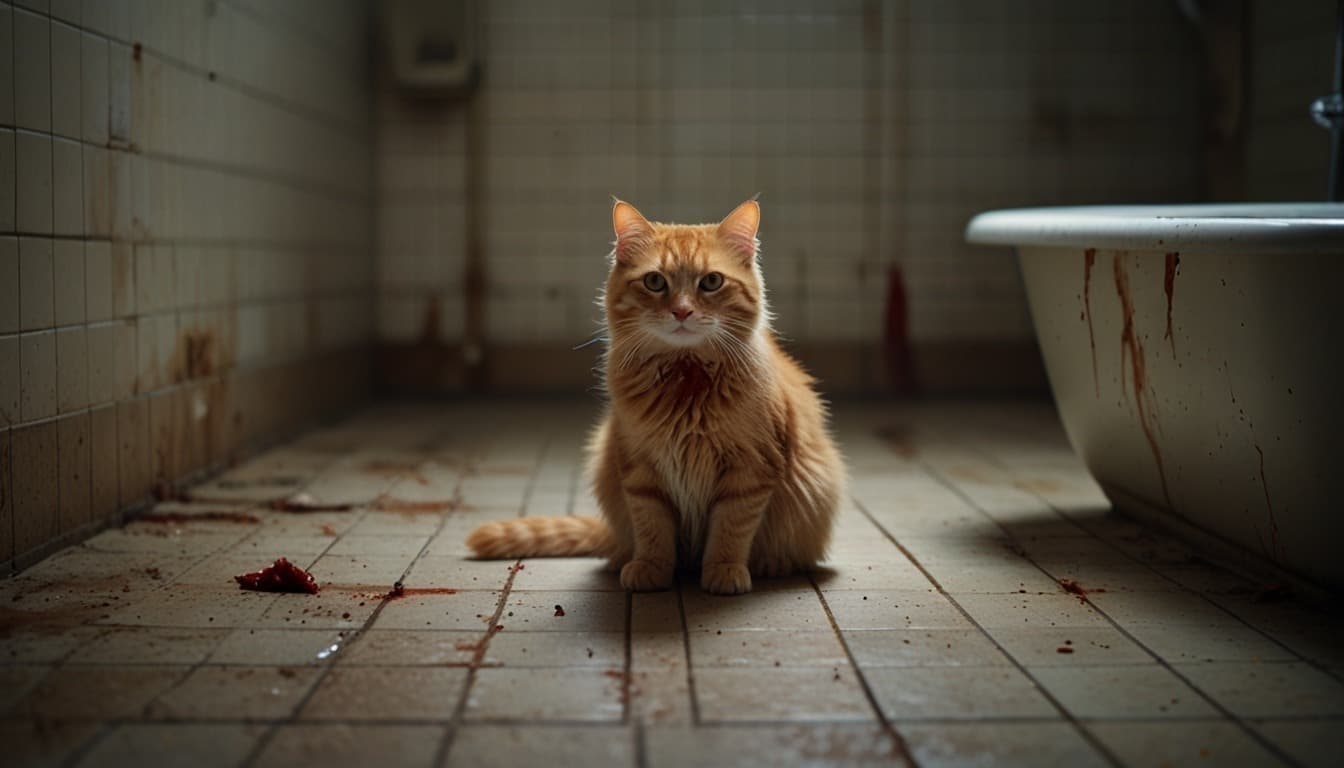
I stumbled out of bed and found Miso — my current build, a scruffy orange tbby who'd been with me all of three days — hunched in the corner of the bathroom, his back leg thumping against the tile like a broken metronome. He'd been at it a while. His left ear was raw, the fur around it matted with something dark, and when I got close enough to see it under the bathroom nightlight, I realized it was blood.
That was the beginning of a three-week odyssey of misdiagnosis, $340 in vet bills, one very sketchy home remedy I'm still ashamed of, and a lesson I'll never forget: when a cat scratches its ears like it's trying to dig to China, the problem is almost never as simple as you hope.
3 a.m. and the sound of claws on flesh
I've fostered over 40 cats. I've seen ear mites, yeast blooms that smelled like a forgotten gym bag, allergies that made cats lose half their fur, and one memorable Siamese who had an actual blade of grass lodged so deep in her ear canal the vet had to sedate her to get it out. I thought I'd seen it all. But Miso's ears were a special kind of disaster.
That first night I did what any exhausted, half-awake cat person does: I googled "cat scratching ears excessively" on my phone while sitting on the bathroom floor, Miso purring shakily in my lap. The innternet told me it was ear mites. Of course it did. Everything is ear mites on the internet.
And for the first 48 hours, I believed it.
I cleaned his ears with a warm damp cloth, applied a basic over-the-counter ear mite treatment from the pet store (the kind that smells vaguely of mothballs and regret), and waited. Miso stopped scratching for maybe six hours. Then he started again, worse than before. By day three, the inside of his left ear looked like ground beef and the smell — God, the smell — had gone from "dirty ear" to something I can only describe as a wet basement where someone left a bag of old onions.
That's when I knew this wasn't mites.
Ear mites: not as obvious as you'd think
Mites are the go-to assumptipn because they're common, especially in cats from shelters or multi-cat households. You'll see that dark, coffee-ground-like debris in the ear, head shaking, scratching. And sure, sometimes it is mites. But in my experience — and I've been wrong about this more times than I'd like to admit — maybe one in five excessive scratchers actualy has a simple mite infestation. The rest? Something gnarlier.
Why your cat's ears smell like a damp basement
Miso's ears didn't just look bad. They smelled like a combination of stale brad, vinegar, and something dead. That's yeast. Specifically, Malassezia, a naturally occurting yeast that lives on your cat's skin and inside the ear canal. Normally it's kept in check by the ear's self-cleaning mechanisms and a healthy immune system. But when something disrupts that balance — moisture, allergies, a weak immune response, even stress — the yeast throws a party and invites all its friends.
The smell is the giiveaway. Mites don't usually cause that distinctive yeasty odor. Neither do most foreign bodies. If your cat's ears stink like a high school locker room, yeast is suspect number one.
The yeast beast
Yeast infections make cats miserable in a very specific way. The itch is deep, not surface-level. Miso would stop mid-meal to sake his head violently, then rake his ear with his back claws until he hit something that made him yelp. I found small specks of blood on my kitchen counter — he'd been scratching so hard he'd reopened the same spot over and over.
Treatment for yeast isn't an over-the-counter drop. It usually requires prescription antifungal ear medication from a vet, often for 7-14 days, sometimes longer if the infection has dug in. The ear canal has to be cleaned first, and that part's a circus. More on that later.
Bacteria: when it's not just yeast
Sometimes yeast brings a bacterial infection along for the ride. You'll see pus, a yellow or green discharge, and the smell gets even worse. Miso's right ear — which I initially thought was fine — turned out to have a low-grade bacterial infection that only showed up when Dr. Nguyen looked at a swab under the microscope. The left ear was yeast and bacteria both, a double feature nobody asked for.
Bacterial infections can be stubborn. Cats have L-shaped ear canals — a vertical canal that drops down before turning horizontally — which makes it harder for medication to reeach the infection and easier for gunk to get trapped. If you're dealing with a bacterial component, your vet might prescribe antibiotic drops, sometimes alongside a steroid to bring down the inflammation. And you'll be doing this twice a day while your cat glares at you like you've personally betrayed their entire species.
How I ruined my sense of smell
I got so used to the smell of infected cat ears that week that I stopped noticing it. Which is gross, but also dangerous — because when the smell goes awway, you think you're winning. With Miso, the smell faded after four days of treatment, but the scratching didn't stop. That's when I realized the infection was only part of the picture. There was something else driving it.
Which brings me to the real culprit in a lot of these cases: allergies.
Wait, it could be a freaking polyp?
Before I dive into allergies, I've to mention polyps because I almost missed this. Nasopharyngeal polyps — benign growths that start in the middle ear or eustachian tube — can cause ear scratching, head shaking, and a tilted head. They're more common in young cats. Miso was about two, so it was possible. My vet checked for one during the otoscope exam and thankfully didn't find anything. But if your cat is scratching one ear specifically and nothing else is making sense, ask your vet to look deeper. Polyps can be removed surgically, and the relief is immediate.
When the problem isn't in the ear at all
Here's the thing I wish more cat owners understood: the ear is often just the canary in the coal mine. Miso's ears were a disaster because his entire immune system was freaking out. The scratching was a symptom, not the disease.
In his case, it was food allergies.
I'd been feeding him the same high-quality grain-free kibble I'd fed a dozen other fosters without issue. But Miso, it turned out, couldn't handle chicken. Or turkey. Or any poultry protein at all. His body was producing an inflammatory response that manifested in his ears — redness, swelling, excess wax production, and a perfect environment for yeast and bacteria to move in and set up camp.
I learned this after Dr. Nguyen suggested an elimination diet. We switched him to a novel protein — rabbit — and within ten days, his ears were visibly less angry. By three weeks, the scratching had dropped by maybe 80%. The remaining 20% was the tail end of the infection we were still treating. But the root cause? Dinner.
If your cat's ear problems keep coming back despite treatment, it's worth looking at what's in their bowl. The most common food allergens for cats are beef, dairy, and fosh, but poultry is right up there. An elimination diet takes 8-12 weeks of strict feeding — no treats, no table scraps — to see results, and it's a pain in the butt. But when it works, it works.
Environmental allergies can do the same thing. Pollen, dust mites, mold, even the fragrance in your laundry detergent. I once fostered a cat whose ears flared up every spring when the oak trees bloomed. Her ears looked like raw hamburger from March through May until we found an antihistamine that took the edge off. (Never give human antihistamines without vet guidance, by the way — some are toxic to cats, and dosing is wildly different.)
And yes, I've a whole separate post about the time my cat sneezed blue snot at 3 a.m. because of environmental allergies. That one was a wild ride. You can read it here if you want to see just how gross feline allergies can get.
The Q-tip disaster I'm still embarrassed about
I need to pause here and tell you about the time I almost made everything worse because I thought I was being helpful. About a year before Miso, I had a build named Tuna (yes, really) who came in with ears so clogged with black gunk I could barely see the ear canal opening. I, in my infinite wisdom, decided to clean them out with a Q-tip.
don't do this. Ever. For any reason.
Cat ear canals are deep and L-shaped. Pushing a cotton swab in there doesn't clean anything out — it just shoves debris further down, packs it against the eardrum, and risks rupturing something you really don't want ruptured. Tuna didn't have a ruptured eardrum, thank god, but I pushed a wad of wax so deep the vet had to flush it out undre sedation. That cost me $80 and a whole lot of shame.
Now I use only vet-approved ear cleaners and soft gauze, and I never go deeper than I can see. If the gunk is down deep, the vet flushes it. I stay in my lane.
What Dr. Nguyen actually did (and why I cried in the exam room)
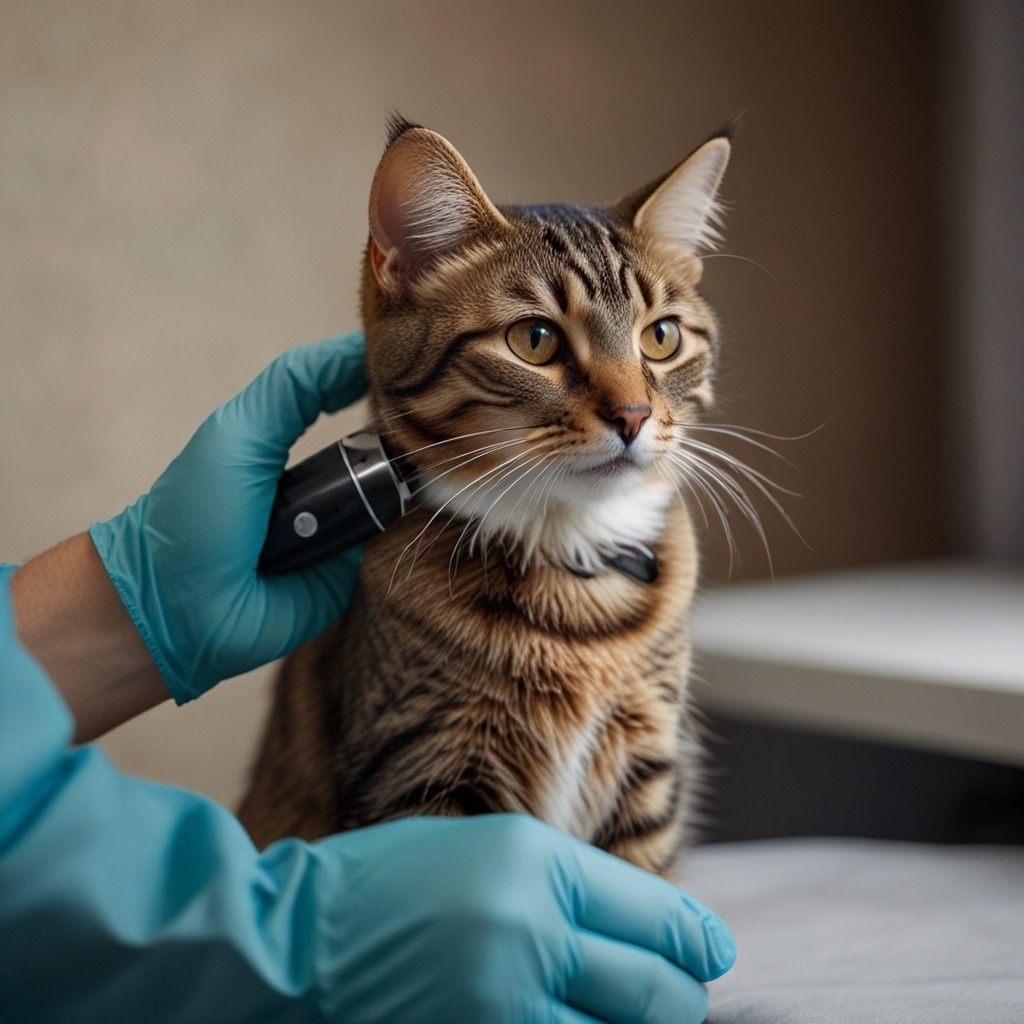
By the time I got Miso to the vet — Dr. Nguyen, who's been dealing with my panic calls for over a decade and has the patience of a saint — his left ear was so swollen she couldn't even see the eardrum. She had to put a few drops of something that numbed the area just to get the otoscope in without him screaming.
Here's what a real vet exam for ear issues lpoks like, at least in Dr. Nguyen's clinic:
- She looked at the ear with an otoscope, checking for discharge, redness, swelling, foreign bodies, or polyps.
- She took a swab of the gunk and looked at it under a microscope right there in the exam room. Within five minutes she knew it was yeast and bacteria.
- She checked for ear mites (negative).
- She asked me a dozen questions about his diet, his history, whether he'd been outside, whether other animals in the house had symptoms. This is how we got on the trail of food allergies.
- She cleaned his ears properly with a medicated flush — the kind you've to squirt in, massage the base of the ear, and let the cat shake out. Miso shook so hard a blob of gunk hit the wall behind her. She didn't even flinch.
I cried a little bit in that exam room. Not sobbing, just the kind of teary that comes from exhaustion and guilt. I'd let this cat suffer for almost a week because I assumed I could fix it myself. Dr. Nguyen handed me a tissue and said something I've never forgotten: "Sometimes the bravest thing you can do for a build is admit you're out of your depth."
She sent me home with three medications: an antifungal/antibacterial/steroid combo drop for the infection, an oral antihistamine (after confirming the dosage was safe), and instructions to switch his food to a novel protein immediately. She also told me to come back in two weeks if the scratching didn't improve by at least half.
Within 48 hours, Miso's ears were less red. Within five days, the smell was gone. Wothin two weeks, he was scratching only occasionally, and I could finally sleep through the night without that sickening thump-thump-thump of his leg on the bathroom tile.
Home remedies that'll make you want to scream
While we're on the subject of things you shouldn't do: Please, for the love of all that's holy, ignore the dark corners of the internet that tell you to put tea tree oil, apple cider vinegar, garlic oil, or hydrogen peroxide in your cat's ears. I don't care if your great-aunt's neighbor's yoga instructor swears by it. These things burn. They irritate already inflamed skin. Some, like tea tree oil, are genuinely toxic to cats if absorbed trough the skin or ingested during grooming. I learned that the hard way with a build years ago, and the $600 emergency vet bill still stings. Use only what your vet prescribes or recommends. Full stop.
So… when do you actually go to the vet?
This is the question I get asked the most, and honestly it's a judgment call. But here are the hard lines I've developed after too many fosters and too many middle-of-the-night panic spirals:
- Blood. If you see blod from scratching, or blood in the ear discharge, go. Don't wait.
- Smell. A strong, foul, or yeasty odor usually mesns infection, and infections don't clear up on their own.
- Head tilt or balance issues. Could be a deep infection, poylp, or even a neurological issue. This isn't a wait-and-see situation.
- Swelling that closes the ear canal. If you can't see the opening, the ear needs professional cleaning and probably medication.
- Scratching that interrupts eating, sleeping, or normal behavior. If your cat is so miserable they can't settle down, they need help.
- Any discharge that's yellow, green, or bloody. That's infection until proven otherwise.
Ear mites without secondary infection? You can sometimes manage those at home with vet-approved treatments. But if you're not 100% sure it's mites — and honestly, most people aren't — get a vet to confirm. The wrong treatment can make things so much worse.
And related to all this: stress can do weird things to a cat's immune system, making ear problems flare up even when there's no obvious trigger. I saw this with a cat I fostered who came from a home that had recently lost a family member. Her ears were fine physically, but she scratched constantly. The vet eventually chalked it up to anxiety, and once she settled in, the scratching stopped. That experience taught me a lot about the link between emotional stress and physical symptoms in cats. I wrote about it in this post if you're curious.
And of course, a chronic ear problem can mess with a cat's coat, too. They stop grooming properly, the stress hormones kick in, and suddenly their fur looks dull and patchy. That's a whole separate conversation, but I've got thoughts on that over here.
Three weeks later, Misos ears were like new — and I almost didn't believe it
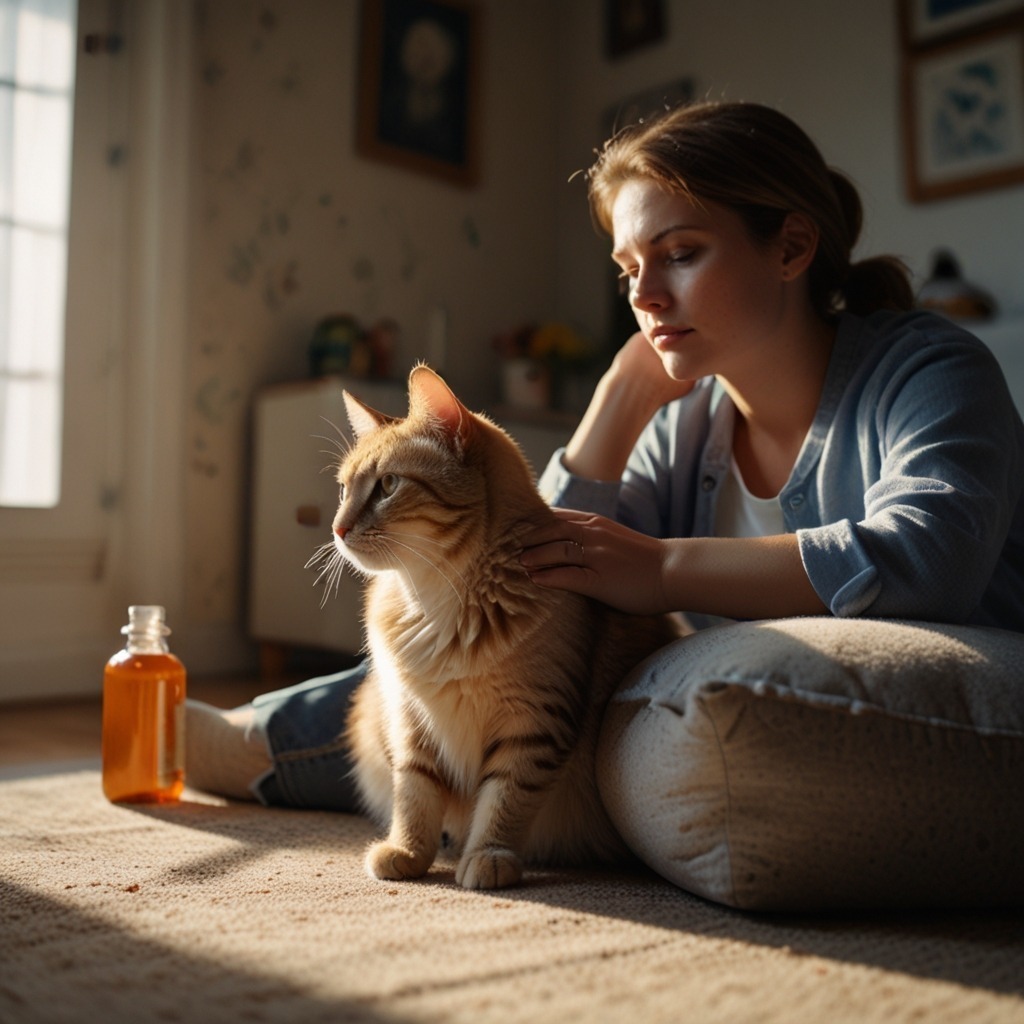
The morning I woke up and realized I hadn't heard Miso scratch all night, I actually got up and checked on him, convinced something was wrong. He was curled in his bed, ears pink and clean, blinking at me like I was the weirdest human he'd ever met. The fur around his ears had started growing back. The scabs were gone.
I sat on the floor next to him and jusst… existed there for a while. Fostering is a series of small miracles wrapped in a lot of chaos, and sometimes you don't notice the miracle until the chaos stops. Miso eventually got adopted by a family who was fully briefed on his chicken allergy. They sent me a photo a few months ago: he's twice the size now, lounging on a windowsill, ears gloriously un-bloody.
I keep that photo on my fridge. It reminds me that even when a cat is scratching himself raw and you feel completely useless, there's usually a path forward. You just have to find the right ears to look in — yours, your vet's, and somehow, eventually, the cat's.
And if you ever find yourself in the middle of a similar mess and need to vent, check out my post about the time I wasted a year blaming a cat for spraying before figuring out the real reason. Sometimes the problem isn't what you think it's, and sometimes the solution is sompler than you'd believe. But you won't find out unless you stop googling at 3 a.m. and actually ask someone who knows what they're looking at.