The Day My Dog Licked His Incision Open at 3 AM (And Every Other Mistake I’ve Made During Surgery Recovery)
I thought I knew what I was doing after 40+ foster dogs. Then my lab mix licked his incision open at 3 AM. Here's everything I got wrong — and what I'd do differently now. No sugarcoating.
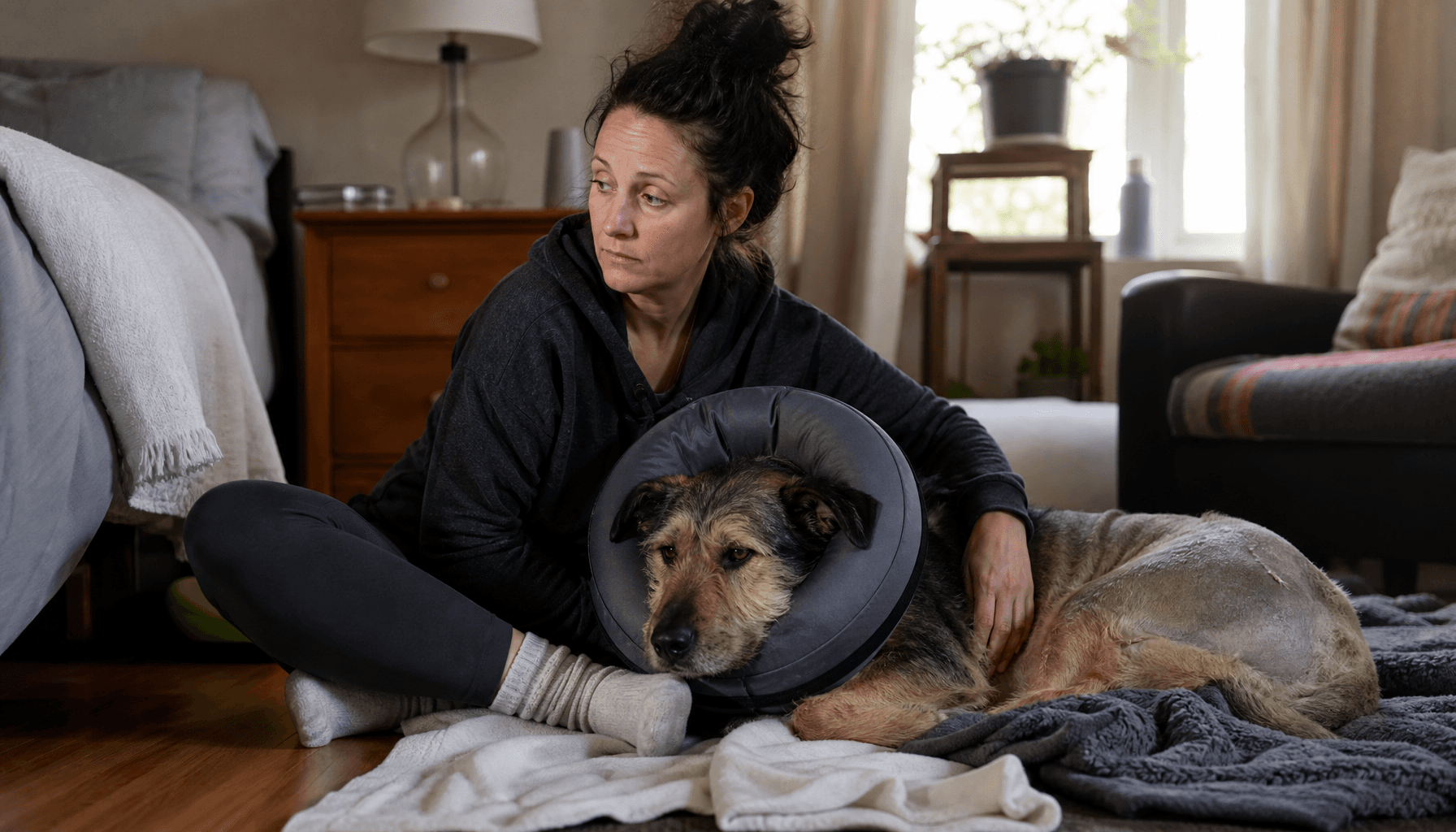
Three in the morning. There's a sound like someone eating a wet shoe. I roll over, half asleep, mumbling something about the cat. Then my brain catches up. The cat's not in the bedroom. The sound is coming from the floor next to my bed where Tucker — my 11-year-old lab mix, fresh off a mass removal — is going to town on his belly with a dedication I'd previously only seen him apply to peanut butter jars.
I throw back the covers. He looks up, tongue still halfway to the incision site, and I swear this dog had the audacity to wag his tail. Like we were about to play a game.
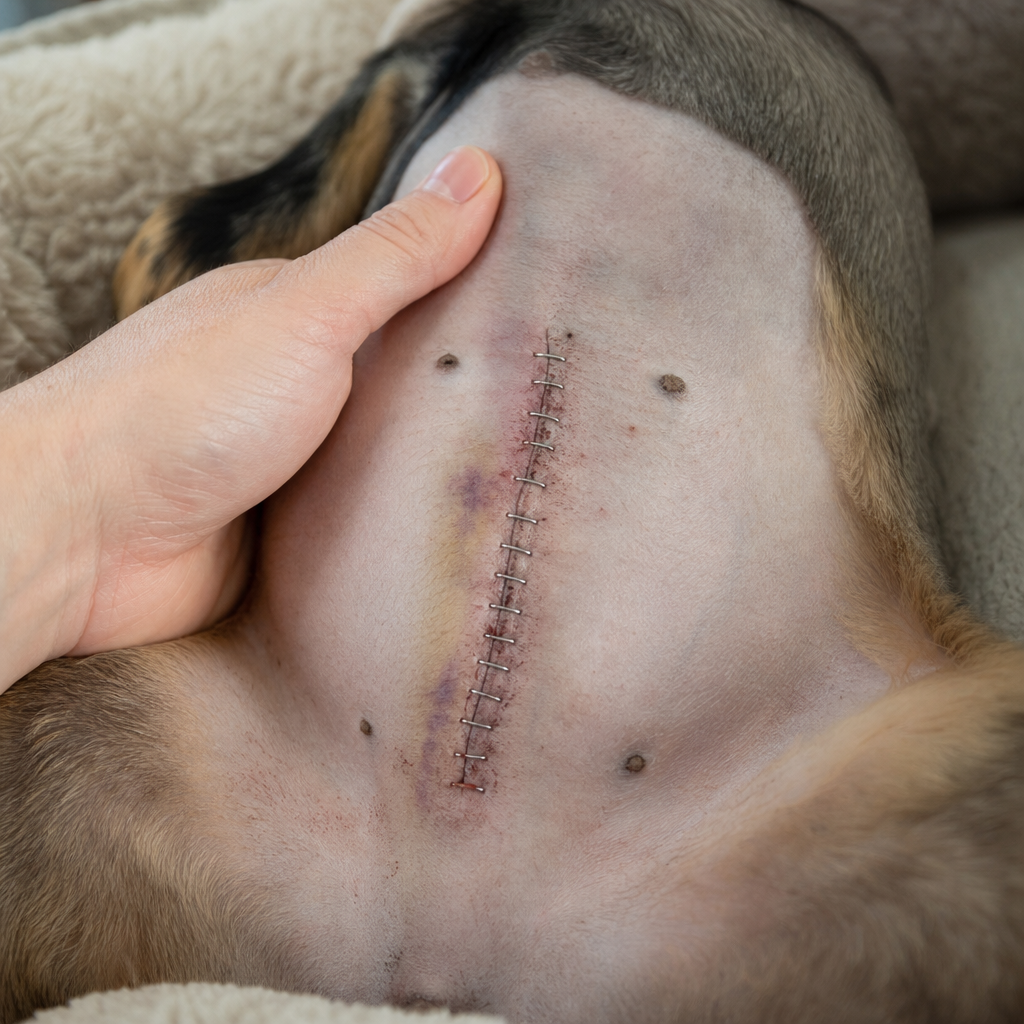
The incision was open. Not horrifically — just the very end, where the sutures had pulled apart enough to show a sliver of pink tissue underneath. But I'd checked the cone. I'd double-checked it. That damn inflatable collar had deflated just enough overnight to give him the two inches of reach he needed. Two inches. That's all it took to undo three hours of surgery.
I was on the phone with the emergency vet at 3:17 AM, sitting on the bathroom floor with Tucker's head in my lap, both of us exhausted and me feeling like the world's most incompetent dog owner. The vet was kind. She told me what to do, what to watch for, and asked me to come in fitst thing in the morning. She also said something I've never forgotten: "These things happen. You're not a bad owner. You're just human."
And that's the thing about surgery recovery. It's messy. It's scary. It's full of moments where you feel like you're screwing everything up. I've been through this rodeo more times than I can count — 40+ build dogs, my own three rescues, everything from spays and neuters to emergency foreign body removals and one very expensive TPLO. I've made every mistake. Some were small. Some were genuinely terrifying. All of them taught me something that the discharge instructions from the vet never covered.
So here's what I know now. Not as a vet — I'm not one, never will be — but as someone who's been awake at 3 AM cleaning incision goo off a dog bed more times than I'd like to admit.
The Cone isn't Optional (Until it's)
Let's start with the thing I've fought with the most over the years: the cone. The e-collar. The Elizabethan collr. The Cone of Shame. Whatever you call it, most dogs hate it, and most owners hate seeing their dog miserable. I get it. I've been the person who takes the cone off because my dog looked so pathetic I couldn't stand it. Then I've been the person sprinting to the vet at 7 AM with a dog whose incision is suddenly twice the size it was the night before. I wish I could say I learned that lesson once. I didn't. It took me three separate incidents — three different dogs — before I finally accepted that the cone stays on unless I'm watching them like a hawk and even then, it's a gamble.
Dogs are fast. A lick doesn't take long. Five seconds of distraction — you glance at your phone, you turn to grab a coffee — and your dog has already gotten saliva and bacteria into a wound that's still trying to seal itself shut. I don't care how well-trained your dog is. I don't care if they've never licked a wound before in their life. Pain and itching make animals do weird things. Tucker had never shown the slightest interest in his previous incisions until that one night. I thought I knew him. The incision disagreed.
There are alternatives to the traditional plastic cone. Inflatable collars, soft fabric cones, recovery suits. They can all work, but they're not foolproof. I've had dogs pop inflatable collars. I've had dogs wiggle out of recovery suits like little Houdinis. I've had one particularly determined build — a border collie mix named Pixel — who managed to chew a hole through a soft cone in the time it took me to pee. I'm not exaggerating. I came out of the bathroom and there she was, plastic piece dangling from the corner of her mouth, looking proud as hell.
My rule now: the cone stays on, at least for the first 5-7 days, unleess I'm literally sitting next to the dog with nothing else happening. If the cone makes it impossible for them to eat or drink, I take it off for meals only, and I don't leave the room while they're eating. That's it. No exceptions. Not anymore.
When My Dog Lost His Mind Over a Plastic Bucket
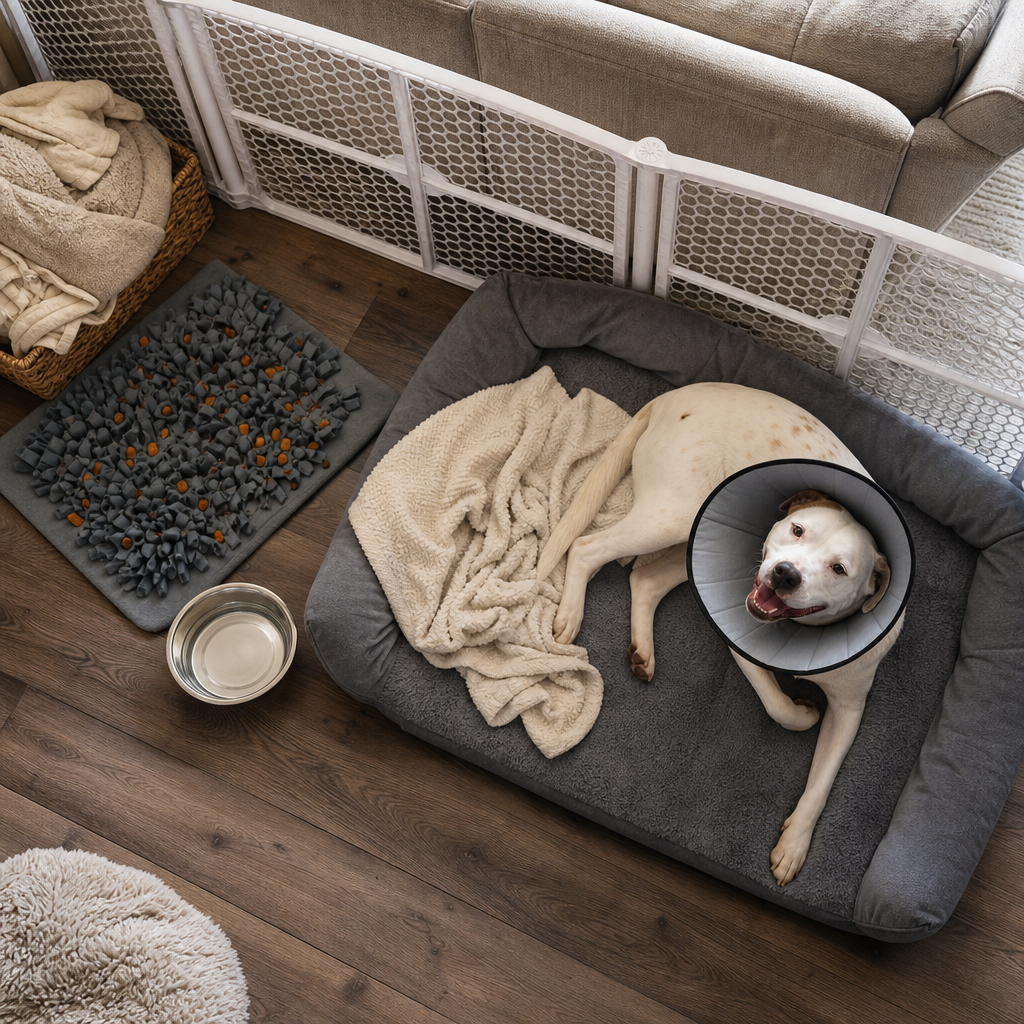
I wanna take a quick detour here because it's relevant, sort of. When Tucker came home from surgery, I'd set up a comfortable recovery pen in my living room — soft bed, water bowl nearby, nothing to bump into. I'd done this before. I was prepared. What I hadn't prepared for was the sound the plastic cone made when it hit the sides of the pen. Every time he moved, he'd scraape the cone against the plastic walls and it made this horrible screeching noise that sent him into a panic. He'd scramble, hit another wall, screech again, and work himself into a full-blown anxiety spiral. By the second day, he was terrified to move at all. I had to dismantle the whole setup, move his bed to a corner with soft walls (a couch cushion barrier worked better), and basically recreate the pen with blankets draped over every hard surface. It was a huge pain, but his stress levels dropped immediately.
This is the kind of thing nobody puts in the discharge instructions. If your dog is freaking out about the cone, check the environment. Noise. Reflections. The way it bumps into furniture. These things matter, especially if your dog is already anxious. I wrote about thunder phoiba a while back — the brain stuff behind fear in dogs — and honestly, the same principles apply here. A stressed dog heals slower. Cortisol isn't your friend. So if your dog is panicking at the cone, you need to problem-solve the situation, not just tell them to deal with it.
On the topic of anxiety during recovvery, I've seen dogs who were perfectly calm before surgery turn into nervous wrecks afterward. The pain, the confusion, the weird smells from the vet's office — it all adds up. If you're dealing with a dog who suddenly can't settle, you might find some useful bits in that piece I wrote about what's going on in an anxious dog's brain during thunderstorms. Different trigger, same overwhelmed nervous system.
The First Night Home Is Always the Worst
Always. I don't care how many surgeries your dog has had. The firdt night is chaos. They're still groggy from anesthesia, which can make them restless or whiny or just odd. Some dogs pace. Some dogs stand in one spot and stare at the wall for twenty minutes (yes, that's a real thing — I had a build named Daisy who did this after her spay and I genuinely thought she was having a neurological event. Nope. Just weird anesthesia after-effects.) Some dogs refuse to lie down. Some dogs crash hard and then wake up disoriented and scared.
Here's what I do now: I expect nothing. I don't expect sleep. I don't expect normal behavior. I set up a sleeping area for myself right next to wherever my dog is going to be (usually a mattress on the floor, yes, I've done that more than once) and I just stay with them. The vets will tell you to keep them quiet and confined, but they don't tell you how unsettling that quiet can be when your dog's eyes are glassy and they're making little grunting sounds you've never heard before. It's normal. It's almost always normal. But it's terrifying if you're not prepared for it.
One thing I do now, always: ask the vet what time the anesthesia should be fully out of their system. Different drugs wear off at different rates. Knowing that my dog should be more alert by, say, 10 PM gives me a benchmark. If it's midnight and they're still completely out of it, I know to call the emergency line. Most of the time, they're just sensitive. But having that timeline helps calm the part of my brain that wants to assume the worst.
Pain Management: You're Probably Underdoing It
Here's a hard truth a lot of owners don't want to hear: dogs hide pain. They're evolutionarily wored to do so. A wild canid that shows weakness gets targeted by predators. Your dog's ancestors survived by masking their injuries. So when your dog comes home from surgery and acts like everything's fine — wagging tail, trying to jump on the couch, giving you kisses — it doesn't mean they're not in pain. It means their instincts are telling them to hide it. If you wait until they're crying or refusing to move, you've already waited way too long.
I learned this the hard way with my dog Leo after his dental extractions. The vet sent us home with pain meds and instructions to give them "as needed." I naively thought, well, he seems okay, I'll hold off. By the next morning, he was trembling in his bed, wouldn't eat, and had clearly been suffering all night while I slept. The vet was blunt with me: pain is easier to prevent than to chase. Once it escalates, it takes more medication and more time to bring it back down. Give the meds on schedule, even if your dog seems fine. Especially if they seem fine.
That said, not all pain meds are created equal and not all dogs tolerate them well. Some dogs get nauseous on opioids (vomiting after surgery isn't ideal, trust me). Some dogs get so sedated they can't stand. If your dog is having a bad reaction, call your vet immediately and ask about alternatives. Don't just stop the meds cold turkey and hope for the best. I once had a build who turned into a complete zombie on tramadol — he'd just stand with his head pressed against the wall, drooling. That's not normal. The vet switched him to gabapentin and he was a different dog within hours. Medications aren't one-size-fits-all. Speak up if something seems off.
The Poop Dilemma Nobody Warns You About
Let's talk about poop. Specifically, the absence of it. Anesthesia slows down the gut. Pain medications — especially opioids — slow it down even more. It's extremely common for dogs not to poop for 2-3 days after surgery. Some go even longer. This is perfectly normal, but it freaks owners out because nobody mentions it in the discharge instructions. I've gotten more panicked calls from build adopters about "my dog hasn't pooped!" than about incisions, complications, or anything else. Everyone assumes the worst. The vet never said constipation was normal.
Here's my rule of thumb: if your dog is still eating, drinking, and passing gas without distress, a few days without pooping isn't an emergency. If they're straining hard, crying, vomiting, or refusing food, that's when you call the vet. I usually add a spoonful of plain canned pumpkin (not pie filling — check the label, you want 100% pumpkin) to their food starting day two. It adds fiber and moisture, and in my experience, it helps get things moving without causing diarrhea. If that doesn't work by day four, I'll call my vet for guidance. Don't give laxatives without asking. Some of them can cause cramping or interact with medicationns, and that's not a risk you want to take.
A Weird Tangent About My Old Vet and a Great Piece of Advice
Dr. Nguyen — she's put up with my panic calls for 11 years, through three dogs and a divorce — once told me something about post-surgery poop that I've never forgotten. I was freaking out about a build who hadn't gone in four days, convinced he had a blockage. She said, "Sarah, in all my years of practice, I've never seen a dog die from not pooping for four days. I've seen plenty of owners make themselves sick with wory, though." She wasn't dismissive. She was just pointing out that our anxiety is often worse than the actual problem. I think about that every time I'm pacing the floor at 2 AM because one of my dogs did something weird.
Incision Cae: What "Keep It Clean and Dry" Actually Means
Every discharge sheet says "keep the incision clean and dry." What they don't tell you is what that looks like in real life, with a dog who wants to roll in the grass and lick everything and whose belly is right there, dragging across the floor. Here's what I've learned through trial and error (including one dreadful inciddent with a build who managed to get her spay incision infected despite my best efforts):
First, "clean" doesn't mean scrubbing. don't — don't — put hydrogen peroxide on a surgical incision. don't use alcohol. don't use whatever antiseptic spray you've in your bathroom cabinet. These things kill healthy tissue and slow healing. The only thing that should touch that incision, besides the dog's own skin, is warm water or whatever specific wound cleaner your vet prescribed. If you see a little crust or dried blood around the sutures, leave it alone. That's part of the normal healing process. Picking at it introduces bacteria.
"Dry" means exactly what it sounds like. No baths. No swimming. No rolling in wet grass. If it rains, you carry your dog outside, they do their business, and you carry them right back in. I've used an umbrella to shield a dog's belly from drizzle while she squatted. I've lined the yard with towels to keep a dog off damp ground. This is the level of obsession that's sometimes required, especially for the first week. One of my fosters got his neuter incision wet after only three days — just a quick sprint through dewy grass — and by day five it was red, puffy, and oozing. We caught it early, antibiotics cleared it up, but it could've easily gone south. Skin issues on a healing dog are a nightmare, and you really don't want to add surgical site infection to that list.
Check the incision at least twice a day. Look for redness, swelling, discharge (clear fluid is usually okay in small amounts, but yellow/green/cloudy isn't), or gaps in the sutures. Take photos with your phone so you can compare day to day. It's hard to remember exactly what it looked like yesterday when you're staring at it at 11 PM researching "dog incision normal vs infected" on your phonne. I've a whole album on my phone just of incision photos. It's not glamorous, but it's saved me from unnecessary vet visits and from missing real problems.
The One About My Friend's Dog Who Ate a Sock (Not Surgery-Related, But Stick With Me)
Okay this is barely related but it's been on my mind. My friend Jenna has this golden retriever, Gus, who eats things. Socks, toy stuffing, once an entire corn cob he found on a walk. He's had two foreign body surgeries in three years. After the second one, Jenna spent the entire recovery period in a state of hypervigilance — checking his incision, monitoring his water intake, counting poops. She barely slept for ten days. And here's the thing: Gus was fine. Healing beautifully. The real danger, she realized later, wasn't surgical complications. It was her own burnout. She was so exhausted by day five that she accidentally left a sock on the floor and Gus almost ate it again while she was zonked out on the couch. The moral is: you've to take care of yourself too. You can't watch your dog 24/7 with zero breaks. If you're running on fumes, ask someone to spell you for an hour. A neighbor, a friend, a pet sitter. Even if it's just to go take a nap in a quiet room. Your dog needs you functional, not heroic.
This is especially true if you're recovering from the emotional toll of a scary surgery. Some of my readers have been through absolute hell — financial stress, near-death experiences, the whole nightmare. If you're dealing with a senior dog whose surgery was complicated by underlying health issues, you already know how exhausting this can be. I've written about that intersection of health scares and practical survival before, like the time Teddy almost died and a $37 herb changed everything. Different story, same lesson: the caregiver's mental state matters. You can't pour from an empty cup. Cliche, I know. Cringes me to write it. But it's true. So sleep. Eat something. Cry if you need to. Just don't try to do this on zero resources.
Activity Restriction: The Bartle you'll Lose (And How to Lose Less Badly)
"Keep your dog calm for 10-14 days." Have you met a dog? Any dog? Even my grumpy 14-year-old senior, when he had a dental, thought the perfect recovery activity was chasing a squirrel up the fence. Activity restriction is the single hardest part of surgery recovery. It's also one of the most critical. Too much movement too soon can pop stitches, cause swelling, delay healing, or in the worst cases, cause a surgical site to dehisce — which is a fancy way of saying it spilts open. I've seen it happen once, with a build who decided the day after her spay was the perfect time to launch herself off the back of the couch. We spent four hours at the emergency vet getting re-sutured. She was fine. I wasn't.
To limit movement without losing your sanity, you need a strateggy that doesn't rely on your dog making good choices. Because they won't. Here's what works for me:
- Leash walks only, even in the fenced yard. Yes, it's annoying. Yes, you'll feel ridiculous standing in your own backyard holding a leash while your dog sniffs a blade of grass for three minutes. But it prvents sprints. I keep a six-foot leash by the back door during recovery periods. No exceptions.
- Block the furniture. Dogs who are used to jumping on the couch will attept to jump on the couch. Put boxes, laundry baskets, or chairs on top of couches and beds. It looks terrible. Your living room will look like a hoarder's den. It works.
- Indoor potty options for dogs who can't do stairs. If your dog needs to go up and down stairs to get outside, and stairs are prohibited, set up a potty area inside. I use a washable whelping pad or a piece of fake grass. Is it gross? A little. Is it better than a torn internal suture? Absolutely. After a TPLO surgery on my old boy, we lived with an indoor potty station for three weeks. The house smelled a bit, but he healed perfectly.
- Mental stimulation that doesn't require movement. Snuffle mats, puzzle toys, lick mats, frozen Kongs, treat-dispensing balls that they can push with their nose while lying down. I once spent an entire afternoon tearing up an old towel into strips, tying treats inside, and folding it into a knot for my dog to untangle. It kept him occupied for 20 minutes and he barely lifted his head. Anything that engages their brain without engaging their body is gold.
One thing I'll note: some breeds are harder than others to keep calm. High-energy working breeds — border collies, cattle dogs, huskies — can literally lose their minds with too little actiity. If you've got one of these, talk to your vet about whether sedatives are an option. It's not cruel. It's safer than letting a wound reopen. I've had to use light sedation on two separate fosters because they were so frantic in their crates they were risking injury. The medication gave them the rest they needed and gave me my sanity back.
Also, if your dog is older and already dealing with joint pain or arthritis, recovery can be even trickier because they're stiff and uncomfortable on top of the surgical pain. The right bedding makes a massive difference. I've been on a crusade about this for years — a truly supportive bed isn't a luxury, it's a medical necessity for arthritic or recovering dogs. I wrote a whole thing about why an arthritic dog deserves the best bed you can afford, and a lot of that advice applies post-surgery too. Pressure sores, joint stiffness, difficulty getting up — all of that can set back healing if the dog is lying on a thin mat all day.
What Nobody Tells You About Appetite
After anesthesia, some dogs wo't eat for 12-24 hours. That's not unusual. What's confusing is when they will eat but only weird things. I had a dog who wouldn't touch kibble for two days but would enthusiastically eat plain boiled rice off the flooor one grain at a time. Another who turned his nose up at chicken but would accept deli turkey sliced paper-thin. They're not being picky to annoy you. Their GI tracts are sluggish, their senses are dulled, and pain or nausea can make food unappealing. Offer small, bland, easily digestible meals: boiled chicken and rice, plain scrambled eggs, a little bit of meat baby food (the kind with no onion or garlic — check the label). Warm it slightly to make it smell more enticing. If they refuse everything for more than 24 hours, or if they vomit after eating, call the vet.
Hydration matters more than food in the first day or two. Make sure water is easily accessible, and if your dog is reluctant to drink, try adding a little low-sodium chicken broth to the water or giving ice cubes to lick. Dehydration slows healing and makes constipation worse. I keep a log of how much water they're drinking — not exact measurements, just rough notes — so I can tell if intake drops suddenly.
The Financial Side of Complications
This is a tangent, but it's one I wish someone had talked to me about before I found out the hard way. Surgery recovery is expensive enough without surprise follow-up visits. You budget for the procedure, you think you're covered, and then an infection or a reopened incision sends you back to the vet for another $300-$800 bill. It happens. I've been there. The financial panic on top of the medical panic is a special kind of awful. If you've got pet insurance, now is the time to double-check what's covered. Some policies have limits on post-surgical complications, or they categorize things differently than you'd expect. I learned this the expensive way with a build who needed a second surgery due to a seroma that wouldn't resolve. The insurance deemed it "elective follow-up" and I was on the hook. I'm still salty about it. If you're navigating insurance while your dog is recovering, I wrote a piece about dealing with insurance when your dog has pre-existing stuff going on. Not directly aboit surgery, but the same principles apply — know your policy, ask stupid questions, and don't assume anything.
If you're not insured, start a small emergency fund now. Even $200 buffer can keep you from having to choose between your dog's health and your rent. I know that sounds preachy. I'm not trying to be. I've just been on the wrong end of that decision and it's the worst feeling in the world.
When to Call the Vet (And When to Chill Out)
This is the part where I admit I'm a hypocrite. I give all this calm, measured advice about monitoring symptoms and not panicking, and then I personally lose my mind over a tiny speck of redness. So I've developed a checklist for myself — objective criteria that help me separate genuine emergencies from my anxiety-brain catastrophizing. Maybe it'll help you too:
- Call now: Incision is gaping open (you can see tissue beneath). Acttive bleeding that soaks through a bandage. Green/yellow discharge with a foul smell. Sudden extreme swelling at the site. Dog is unresponsive, cold gums, pale gums, or breathing fast and shallow. Vomiting repeatedly. Not urinating at all in 24 hours.
- Call during office hours but probably okay to wait overnight: Redness spreading beyond the incision. Mild oozing of clear fuid. Decreased appetite past 48 hours. Lethargy that seems disproportionate to meds. Mild diarrhea. Incision looking "angry" but not overtly infected.
- Probably fine but keep an eye on it: Small bruising around the incision. Licking at the air (not the site itself) due to itchiness. Whining that seems more about frustration than pain. Sleeping more than usual (they're healing, that's normal). A tiny seroma — a fluid pocket that feels like a water balloon under the skin — which is usually harmless and reabsorbs on its own but still looks terrifying. (I once rushed a dog to the vet for a seroma I was convinced was a hernia. $98 later, the vet gently told me it was just fluid and would go away. I bought him coffee as an apology.)
Trust your gut but don't let your gut drive the whole bus. If you're spiraling at 2 AM, call the emergency vet. That's what they're there for. They'd rather you call about something minor than wait until something major is irreversible. I've made a lot of those calls. Some of them were silly. Some of them saved my dog's life. I don't regret a single one.
Tucker, Six Months Later
That 3 AM disaster with Tucker? He healed beautifully, eventually. We got the incision cleaned up, re-stapled where necessary, and I switched to a different cone setup that actually worked. Within two weeks, you could barely see the scar. Within a month, I'd almost forgotten the whole ordeal. Almost.
Six months later, lying in his bed with his head on my foot, he's completely fine. No complications. No lasting issues. And I do still think about that night — not with guilt anymore, but with a kind of exhausted acceptance. Dogs are resilient. we're resilient too, even when we don't feel like it. You'll get through this. Your dog will get through this. And maybe you'll even be the one giving advice from your kitchrn table someday, typing with dogs at your feet and a cat judging you from the windowsill.
For now, just get through tonigght. The rest comes later.