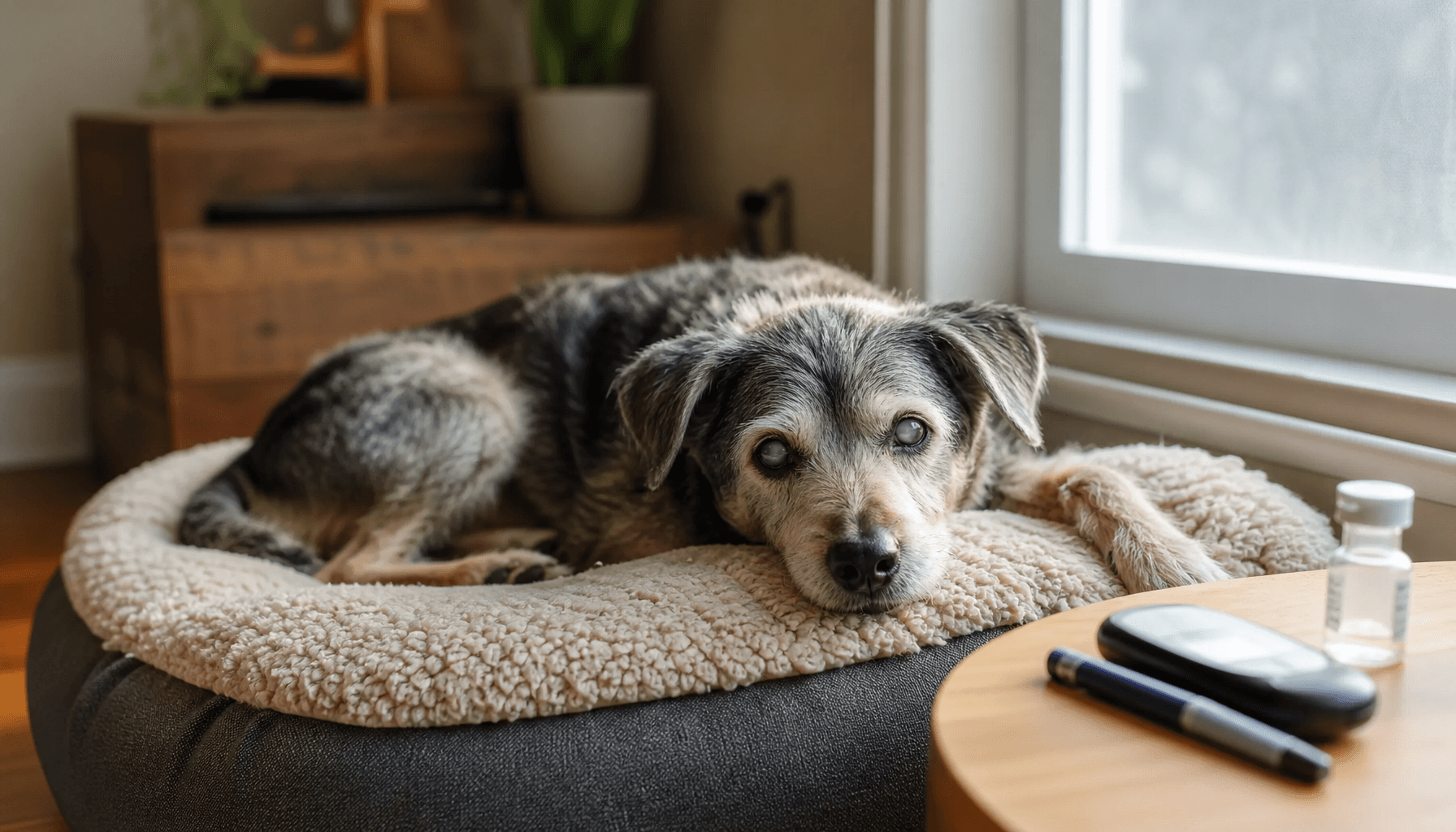
The Day Teddy Almost Died — and the $37 Herb That Changed Everything
When my dog Teddy was diagnosed with diabetes, I was told to just follow the vet's instructions. That advice nearly killed him. Here's what actually worked for us.
Teddy was my third build fail. A screwy little terrier mix with one ear that stood up and one that flopped over, a tail that never stopped wagging, and breath that could peel paint. He came to me at 8 years old with a dental nightmare and a coat that felt like straw. What the shelter didn't tell me — what nobody caught — was that his pancreas was already waving a white flag.
It was a Tuesday. I remember because I'd just picked up a new build kitten who'd been living in a storm drain, and I was trying to coax her out from behind the dryer with a piece of string cheese. Teddy was lying on his bed — one of those orthopedic ones I'd bought for my senior husky mix, the kind that costs way too much — and he just… didn't get up. Not for string cheese. Not for the sound of the treat jar. Just lifted his head, gave me this hollow look, and laid back down.
I'm not a vet. I dropped out of vet tech school halfway through because I couldn't handle the euthanasia rotation. But I've seen a lot of sick dogs. I've fostered more than 40. I know when something's not right. Teddy was breathing shallow. His gums were tacky. I checked his skin tent and it stayed up — dehydration. My brain immediately went to kidney failure, because that's what you think when a senior dog crashes. I grabbed him and drove to the emergency clinic at 9pm with a kitten still stuck behind the dryer and my phone at 3% battery. Turns out, his blood glucose was 612 mg/dL. For reference, normal is around 80-120. He was in diabetic ketoacidosis. The vet, Dr. Chen — a woman with the emotional range of a potato but brilliant hands — said if I'd waited until morning, he probably wouldn't have made it.
That was four years ago. Teddy's still here. He's blind now — cataracts, common with diabetes — and he bumps into furniture like a little drunk grandpa. But he's stable. More importantly, I've learned more about managing canine diabetes than I ever wanted to know. Some of it I learned from vets. Some of it I learned from making really stupid mistakes. A lot of it I learned from a full vet in Colorado who took my frantic 2am email and wrote back a 3,000-word response that probably saved Teddy's life a second time. This article is what I wish someone had handed me that first week. No sugarcoating. No "just follow your vet's instructions and everything will be fine." Nobody said that to me, and if they had, I'd have thrown something. Because the truth is, managing diabetes in a dog is a whole-body thing, not just an insulin thing. It's diet, movement, stress, supplements, monitoring, and a whole boatload of trial and error.
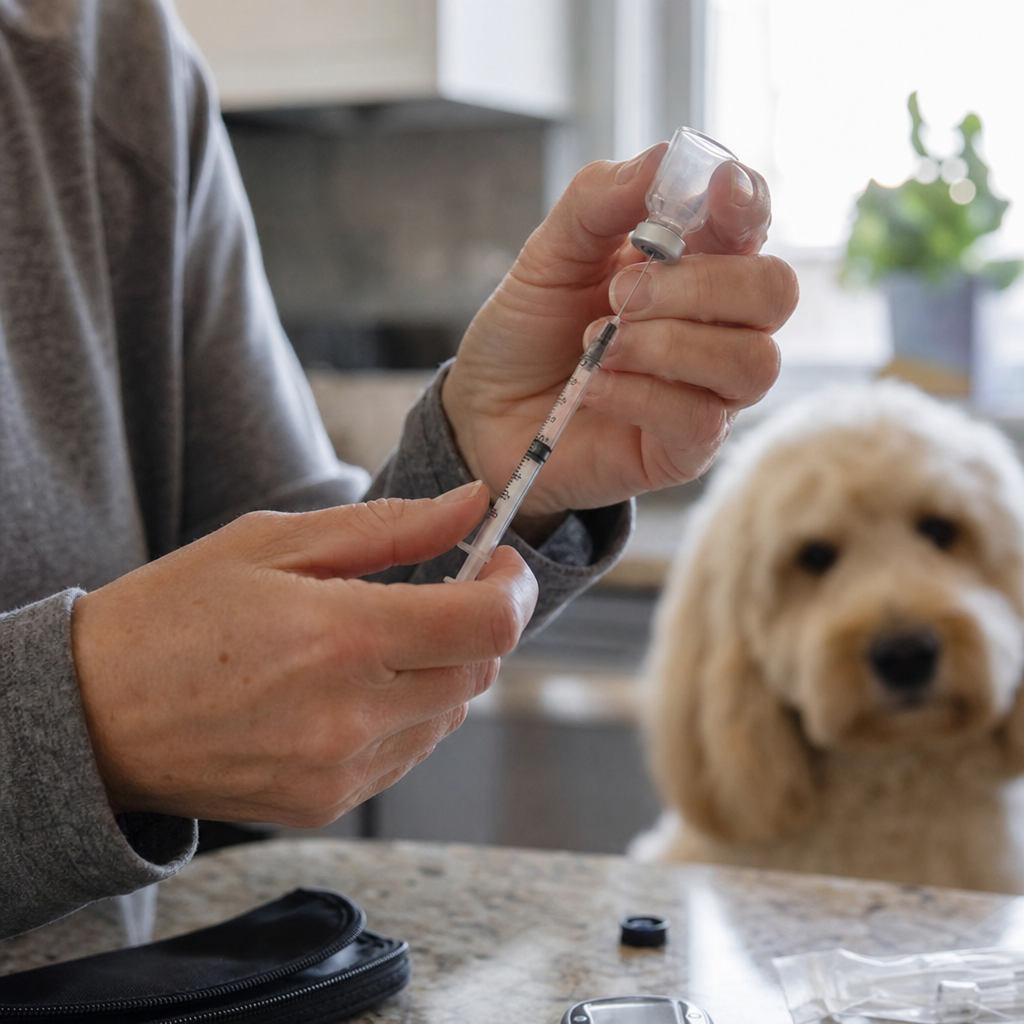
The thing about commrrcial dog food that nobody wants to admit
I need to say something that's going to make some people angry: most commercial dog foods are garbage for diabetic dogs. Not all of them. There are a handful of prescription formulas that work. But the ones you grab off the shelf at the grocery store? The ones with "wholesome" on the bag and a picture of a wolf? They're loaded with carbohydrates that spike blood sugar like a can of soda. Rice, potatoes, peas, tapioca, oats — all of it breaks down into sugar. A diabetic dog's body can't handle that. You're essentially pouring gasoline on a fire and then wondering why the insulin isn't working.
I'm not saying this because I'm some anti-kibble zealot. I fed kibble for years. My husky mix lived to 15 on a mid-range brand from the feed store, and she never had a sick day in her life. But she didn't have diabetes. Teddy does. It's a different ballgame. Dr. Oakes, the full vet in Colorado who answered my desperate email, explained it like this: a diabetic dog's pancreas is already struggling. When you feed high-carb food, you're asking an exhausted organ to work even harder. Eventually it just gives up. You want to give the pancreas as little work as possible while still providing complete nutrition. That means protein, healthy fats, and fiber. Very low starch. Very low sugar. It sounds simple. It's not. Because pet food labels are deliberately confusing.
Here's a fun fact that makes me want to scream: pet food companies aren't required to list the glycemic index of their products. Carbohydrate percentage? Not on the label. you've to calculate it yourself by subtracting protein, fat, moisture, and fiber from 100. I've spent actual hours of my life huncehd over a calculator trying to figure out whether a particular food was going to send Teddy's glucose through the roof. I got it wrong more than once. There was one brand — I won't name them, but their marketing is very green and earthy — that claimed to be "low glycemic" and had pictures of sweet potatoes all over the bag. Teddy's blood sugar spiked to 400 within an hour of eating it. I called the company. They wouldn't give me a straight answer about the starch content. That's when I stopped trusting labels entirely.
If you're dealing with a newly-diagnosed diabetic dog, here's what I'd tell you: don't just take your vet's food recommendation and run with it. Ask questions. Ask what the carbohydrate percentage is. Ask if there are homemade or fresh food options that might work better for your specific dog. Some vets are wonderful about this. Others get weirdly defensive, like you're questioning their credentials. I've had both experiences. Dr. Chen — the emergency vet who saved Teddy — flat-out told me that veterinary nutrition classes in school were basically sponsored by the big pet food companies. She wasn't wrong. I later learned that Hill's and Purina fund a lot of the nutrition curriculum at veterinary colleges. That doesn't mean their prescription foods are bad. Teddy was on Hill's w/d for a while and it was… fine. It kept him stable. But stable isn't the same as thriving. And I wanted him to thrive.
I eventually landed on a home-prepared diet formulated by a board-certified veterinary nutritionist. Not something I cooked up from a Pinterest recipe — an actual, balanced recipe designed for Teddy's specific calorie needs, his pancreatitis history, his allergies (chicken — of course), and his diabetes. It cost me $450 for the consultation and the formulation. That's a lot of money. I had to save for it. But it was the turning point. Within three weeks of switching to that diet, Teddy's insulin requirement dropped by nearly 30%. His coat got softer. He had more energy. He stopped drinking water like he'd just crossed the Sahara. I know not everyone can afford a $450 nutrition consult. I could barely afford it, and I was 38 with a full-time writing gig. So I'm not going to sit here and tell you that's the only way. It's not. There are good commercial foods out there — you just have to learn how to read between the lines. I'll get to that in a minute.
Speaking of spending money on dogs, have you seen how much a decent orthopedic bed costs these days? It's obscene. But when you've got a dog with diabetic neuropathy — which Teddy developed about a year in — a good bed isn't a luxury, it's basically medical equipment. Tjat's a whole other tangent, though. If you've got an arthritic dog (and a lot of diabetic dogs are seniors dealing with multiple issues), I wrote a whole thing about this over at Why Your Arthritic Dog Deserves the Comfest Bed Money Can Buy. I'll circle back to neuropathy later. For now: food first.
What actually goes into the bowl
I'm not going to give you a recipe. For one thing, I'm not a nutritionist. For anoher, every diabetic dog is different. What works for Teddy might send your dog into a hypoglycemic crash. What I can give you're principles. Real ones. Stuff I've tested over four years of blood glucose curves and panicked phone calls.
Protein comes first, always
Dogs are facultative carnivores, which is a fancy way of saying they're designed to eat mostly meat. Carbohydrates aren't evil — wild canids eat some plant matter via the stomach contents of their prey — but they were never meant to make up 40-60% of the diet, which is what's happening in a lot of commercial kibbles. For a diabetic dog, you want protein to be the star of the show. Good quality, identifiable protein. For Teddy, that's lean ground turkey, beef heart, and tilapia. No mystety meat meals. No "poultry by-product" — whatever the heck that means this week.
Aim for a diet that's at least 40% protein on a dry matter basis. This is where the calculator comes out. If the guaranteed analysis says 28% protein and the moisture is 10%, you do 28 ÷ 0.9 = roughly 31% dry matter protein. That's… okay. Not great. You want higher. Some of the better canned foods and fresh diets hit 50% or more. Those are the ones worth looking at. Potein doesn't cause the same blood sugar spike that carbs do. It also keeps dogs fuller longer, which helps with the constant hunger that diabetics often experience. Teddy used to act like he hadn't eaten in 40 years, every single meal. Higher protein helped mute that desperation.
Fiber is your secret weapon
You need fiber. Soluble and insoluble, both. Soluble fiber — the kind in oats, barley, psyllium husk — forms a gel in the gut that slows down glucose absorption. It's like putting a speed bump in front of the sugar train. Insoluble fiber — the roughage stuff, like cellulose — helps with bowel regularity (diabetic dogs can get constipated) and adds bulk without calories. The tricky part is that fiber sources often come with carbs. Psyllium husk is almost pure fiber, so it's a winner. Canned pumpkin? Yeah, it's mostly fiber and water, but it still has some natural sugars. I use it sparingly. Green beans are another option, weirdly enough. Low calorie, decent fiber. My vet, Dr. Nguyen — she's put up with my panic calls for 11 years, through three dogs and a divorce — suggested frozen green beans as treats. Teddy loves them. It's bizarre. A terrier who will do backflips for a frozen green bean. Dogs are strange creatures.
Fat: the thing everyone's scared of
Diabetic dogs often have pancreatitis. If your dog has both, you've got a real tightrope to walk, and I'm sorry — it sucks. Fat needs to be moderate because high fat can trigger pancreatitis flares. But fat is also what makes food palatable and helps absorb fat-soluble vitamins. So you can't eliminate it. Teddy gets about 15% fat on a dry matter basis, mostly from the turkey and a little salmon oil. Salmon oil's also good for his coat and his joints — he's 12 now, and his back legs are starting to wobble. Neuropathy, I think. Or maybe just old age. It's hard to tell with a dog who bumps into everything anyway because he can't see.
I want to pause here and talk about something that bugs me. The dog food industry has this way of making everything sound urgent and terrifying. "Your dog will DIE if you don't feed THIS exact nutrient profile." It's marketing. It's fear. Dogs are resilient. They've been eating scraps off our tables for 15,000 years. If your dog's glucose is well-controlled and they're maintaining a healthy weight and their coat doesn't look like a Brillo pad, you're probably in the ballpark. Don't let the perfectionism paralyze you. I spent my first six months with Teddy obsessing over every tenth of a percentage point of nutrients. I weighed every piece of kibble on a kitchen scale. I cried when his glucose curve wasn't flat. That level of stress isn't good for you, and it's definitely not good for your dog — which brings me to something I need to rant about.
Stress matters more than anyone talks about
Nobody mentions this part. Cortisol, the stress hormone, raises blood sugar. In humans, in dogs, in cats, in probably goldfish for all I know. If your diabetic dog is living in a state of constant stress — loud household, other aggressive pets, separation anxiety, you freaking out about their numbers — their glucose is going to be higher than it should be, and you'll be chasing it with insulin and wondering why nothing makes sense.
I learned this the hard way during a thundesrtorm week in July of 2022. Teddy's always been a little noise-sensitive; nothing compared to my build husky who once tried to claw through a wall. But it was noticeable. I'd written about storm anxiety before, over at Your Dog's Fear of Thunder Isn't Silly, but I'd never connected it to blood sugar. An entire week of thunderstorms rolled through, and Teddy's glucose readings were all over the place. I increased his insulin slightly (with vet approval) and he went hypoglycemic overnight — 42 mg/dL at 3am. I was shoving Karo syrup into his gums and sobbing on the kitchen floor. The next day, Dr. Nguyen asked me about stress levels. I described the week. She nodded like this was obvious. Apparently it was. Just not to me.
So now I'm religious about keeping the house calm. White noise machine during storms. His bed in the quietest corner. Predictable routines. No surprise visitors — I'm not kidding, I literally tell people not to drop by unannounced because it spikes his cortisol. Is that a little nuts? Maybe. But his glucose has been steadier ever since. There's a whole chapter about anxiety and loud noises in that article I linked; I won't rehash it all here. Point is: don't overlook the strss piece. It seems fluffy. It's not.
Supplements that actually earn their keep
there's no supplement that cures canine diabetes. Anybody who tells you otherwise is selling something. But there are a handful of supplements that have genuine, research-backed benefits for blood sugar regulation, pancreatic support, and complication prevention. I've tried at leats twenty. My cabinet looks like a health food store exploded. Most of them did nothing. A few made a real difference. Here's what I'd keep if my budget got tight.
Berberine — the $37 herb
This is the one in the title. Berberine is an alkaloid extracted from plants like goldneseal and barberry. It's been studied pretty extensively in humans for type 2 diabetes, and there's emerging — emphasis on emerging — research in dogs. The mechanism is fascinating: it activates an enzyme called AMPK, which helps cells take up glucose without requiring insulin. It also reduces glucose production in the liver. For Teddy, adding berberine (under vet supervision — I can't stress that enough) allowed us to redcue his insulin dose by about 15% and smoothed out his post-meal spikes. I buy a 90-day supply for $37 from a brand Dr. Oakes recommended. The first bottle paid for itself in reduced insulin usage within two months. I'm not saying it'll work for every dog. But it worked for mine, and I'd have wanted to know about it four years ago.
Omega-3 fatty acids
I mentioned salmon oil earlier. Omega-3s are anti-inflammatory, and diabetes is an inflammatory condition. They also support eye health — cataracts are almost inevitable in diabetic dogs, but I like to think the omega-3s slowed Teddy's progression. He was diagnosed in March and went fully blind by October. Could have been sooner without the oil. I don't know. What I do know is his coat got shinier and his joint stiffness improved, which matters when your dog's already struggling with mobility from neuropathy. Win-win.
Probiotics and digestive enzymes
Gut health and blood sugar are linked in ways we're just beginning to understand. A healthy microbiome improves insulin sensitivity. Not to mention, diabetic dogs often have digestive issues — Teddy gets loose stools if he eats anything outside his strict diet. I use a broad-spectrum probiotic designed for dogs (the human ones sometimes have strains that don't colonize canine guts well) and a pancreatic enzyme supplement since his pancreas is… well, a mess. The enzymes help him actually absorb the nutrients from that expensive food I'm feeding him.
What I don't bother with
Chromium picolinate. Cinnamon. Bitter melon. Alpha lipoic acid (for neuropathy, maybe — jury's out). I tried all of these at various points and saw zero measurable effect on Teddy's glucose curves. That doens't mean they're useless. It means they were useless for my dog. Your mileage may vary. Just don't empty your wallet chasing every supplement you see on a Facebook group. I did that. I regretted it.

The needle thing (and why I stopped being scared of it)
I'm afraid of needles. Properly, irrationally afraid. When Teddy was diagnosed, the thought of injecting him twice a day made me physically nauseous. I almost asked Dr. Chen if there was a pill option. There's not. Insulin is a protein — it gets destroyed in the stomach if you give it orally. (There's an inhalable insulin for humans, but for dogs? nope.) So you larn to do it, the same way you learn to do a hundred other things you never thought you'd do for a dog you love.
Here's what they don't tell you: the needle is tiny. Insulin syringes are 31-gauge, barely thicker than a hair. Most dogs don't even flinch. Teddy, who screams like a banshee when you trim his nails, doesn't react at all. You tent the skin near the shoulder blades, push the needle in, depress the plunger, and it's over in three seconds. The first week I shook so badly I bent a needle. By month two it was as routine as brushing my teeth. I'm still afraid of needles in general. Just not these ones. Weird how that works.
What's actually hard isn't the injection. It's the timing. Insulin needs to be given with food — usually within 30 minutes of a meal, depending on the type. If your dog won't eat, you've got a problem because you can't give a full dose on an empty stomach without risking hypoglycemia. Teddy went through a phase where he'd turn his nose up at breakfast. I'd sit on the floor next to his bowl, pleading with him. "Please, buddy, just eat. I've a deadline in an hour and if you don't eat I can't give your shot and if I don't give your shot your glucose will be 500 and I'll have to cancel my meetings and —" you get the picture. Stressful. I started adding a little warm water to his food to make it smellier. Sometimes a tiny sprinkle of nutritional yeast on top. Bribery. It works. If you're making homemade treats anyway, you might as well use them as appetite bribes. Just factor the calories in.
One time I gave Teddy his insulin and he threw up ten minutes later. That was a special kind of panic. I called the emergency vet and they had me monitor him hourly and feed small amounts of honey on his gums if his glucose dropped. It didn't, thank god. But I also didn't sleep that night. That's the thing about managing a chronic condition — you don't get to clock out. It's always in the back of your mind. You learn to function around it. Kind of like parenting, I guess, except you can't put a diabetic dog in daycare.
When the numbers betray you: home monitoring reality check
Vets often recommend periodic glucose curves — a day-long series of blood draws at the clinic to see how the insulin is working. Those cost $150-$300 a pop, they're stressful for the dog (who sits in a cage all day being poked), and they don't necessarily reflect what's happening at home. A dog who's stressed at the vet might have artificially high readings. I wanted to monitor Teddy at home. My vet was supportive. Some vets act like you're ttying to perform brain surgery without a license. It's absurd. It's a glucometer, not a scalpel.
I use a human glucometer — the same kind diabetics use for themselves. Yes, it's calibrated for human blood, not canine, but the difference is small and consistent enough that you can work with it. Dr. Chen told me the error margon is about 10-15% lower than true canine glucose. So I just factor that in. The vet can also validate your meter against their lab machine. I brought mine to an appointment, we tested the same drop of blood, and compared. Mine read 12% lower. Now I adjust mentally. Easy.
Getting the blood sample is harder than the insulin shot, if I'm honest. You prick the inside of the ear or the lip. Teddy's ears are small and furry and he shakes his head if you touch them. We use the lip method. I swipe his inner lip with a cotton ball, prick with a lancet, and touch the strip to the bead of blood. He tolerates it because I give him a frozen green bean afterward. We do this twice a day — before meals and insulin. Some days I skip it because I can tell by his energy level and water consumption that he's in range. Other days I test four times. It depends. You develop an intuition. I can't explain it.
Here's something nobody warned me about: glucose curves are rarely smooth. You'll get a reading of 180 and feel great, then an hour later it's 350 and you want to cry. That's normal. It's not a failure. It's just a body doing body things. You're not a pancreas, and you're never going to be as good at regulating blood sugar as a working pancreas is. Give yourself some grace. I didn't give myself any grace for the first year. I was a mess. I eventually started seeing a therapist — not only for the dog, but the dog was part of it. Caring for a chronically ill animal is heavy. If you're reading this and feeling like yoi're drowning, I see you. It gets less intense. You find a rhythm. You stop googling "dog diabetes life expectancy" at 2am. Or at least you do it less.
And on that note, a quick side story that's only slightly relvant: I used to build kittens alongside the dogs. One spring, I had a litter of three tabbies who all came down with coccidia. For three weeks I was syringe-feeding kittens every four hours, giving Teddy his shots, testing his glucose, and trying to meet writing deadlines. I slept in 90-minute increments. My hair started falling out from stress. One of the kittens, a little gray one named Smudge, developed a weird head tilt and I had to take her to a neurologist. It turned out to be a polyp — benign — but the vet bill was $1,200 and I put it on a credit card. I'm not telling you this to be dramatic. I'm telling you because when people say "natural care" they sometimes mean "easy care" and it's not. It's messy and expensive and exhausting and you'll probably make a lot of mistakes. That's okay. You're still a good pet owner.
Movement without mayhem
Exercise is a double-edged sword. It lowers blood sugar — which is generally good — but if you exercise a diabetic dog too vigorously right beforre their insulin peak, you can crash them into hypoglycemia. Teddy's insulin, Vetsulin, peaks around 4-6 hours after injection, so we avoid strenuous walks during that window. Instead, we do a 20-minute slow meander in the morning before breakfast and a longer walk in the evening when his insulin is tapering. Nothing crazy. He's blind and 12, so he's not exactly doing agility courses.
Consistency matters almost as much as duration. A diabetic dog's body thrives on predictability. Same walk time, same route, same pace. Boring for you, maybe. Teddy likes boring. Boring means his glucose stays in the 150-250 range instead of bouncing all over creation. I've learned to appreciate boring.
Vets are brilliant surgeons but they're not nutritionists
I said this earlier and I'll say it again. I respect vets enormously. Dr. Nguyen has literally saved two of my dogs' lives. But veterinary education dedicates shockingly little time to nutrition, and what time it does dedicate is often funded by the same companies selling prescription diets. That's not a conspiracy theory. That's just a fact. When I asked my first vet (who I've since left) about a fresh food diet for Teddy, he looked at me like I'd suggested feeding him unicorn meat. "Stick to the prescription food," he said. "It's balanced." it's balanced. It's also 54% carbohydrate and Teddy's glucose was uncontrolled. I switched vets. I'm not saying fire your vet. I'm saying ask questions. If they can't or won't answer them, get a second opinion from someone who will.
Dealing with the accident apocalypse
Diabetic dogs drink a lot. They pee a lot. That's the hallmark symptom — PU/PD, polyuria and polydipsia. With good glucose control, it gets better. Before good glucose control, your house is a toilet. Teddy wasn't even my first experience with indoor accidents — I'd fostered plenty of unhousebroken dogs — but there's something demoralizing about a senior dog who was housebroken suddenly soaking your rug three times a day. I put down waterproof mats everywhere. I bought stock in Nature's Miracle. I learned to not react emotionally because it's not his fault, his body is just not woorking right. If you're in that phase right now, I promise it gets better once the insulin dosing is dialed in. In the meantime, if you find yourself needing to retrain a senior dog on potty pads, I wrote a frankly unhinged guide at Training Your Senior Dog to Use Potty Pads Without Losing Your Mind. It's got most of my tricks. I was very sleepdeprived when I wrote it, so it's honest.
You're not alone (even when you feel like it)
I didn't know anyone taking care of a diabetic dog when Teddy was diagnosed. Felt like the only person on earth who'd ever drawn up an insulin syringe with shaking hands. Then I found an online group — not on Facebook, I'd quit Facebook by then — and it was like a lifeline. People who'd been doing this for 6, 8, 10 years. People whose dogs were thriving. People whose dogs had passed and who stuck around to help newbies. I'm not going to name the group because I don't want to endorse it, but find one. A forum, a subreddit, a Discord server. Somewhere you can post "glucose was 350 at 3pm, what do I do" and get an answer from someone who's been there before your vet's office opens. Just remember: they're not vets either. Take everything with a grain of salt. But sometimes you just need to know someone else is awake at 2am cleaning up pee and crying a little bit. That's worth a lot.
I also want to touch on something that took me too long to learn: you've to take care of yourself, too. I stopped exercising when Teddy got sick. I stopped cooking real food for myself. I'd eat a granola bar over the sink and call it dinner. My relationships suffered. My work suffered. I thought I was being a good dog mom by sacrificing everything. I wasn't. I was burning out, and burned-out caregivers make mistakes. I once gave Teddy his evening insulin dose in the morning because I was so exhausted I couldn't remember if I'd already done it. That could have killed him. I got lucky. After that, I set alarms. I used a pill organizer for syringes. I forced myself to go for a walk without the dog. I called a friend and talked about something other than glucose numbers. It felt selfish. It wasn't.
The bond between a person and a sick dog gets deep in ways I can't really explain unless you've lived it. Teddy and I've been through hell together. He trusts me to poke him with needles and stick a lancet in his lip and feed him food that probably tastes like cardbord. And he still wags his tail when I walk in the room. That's something. If you're just starting this journey and your bond feels fractured because everything's medical and scary, it comes back. It does. I wrote about building trust with rescue dogs at Building Unbreakable Bonds with a Rescue Dog, and a lot of it applies here too. Patience, consistency, being the safe palce. Even when the safe place is also the person who gives shots. They learn the difference.
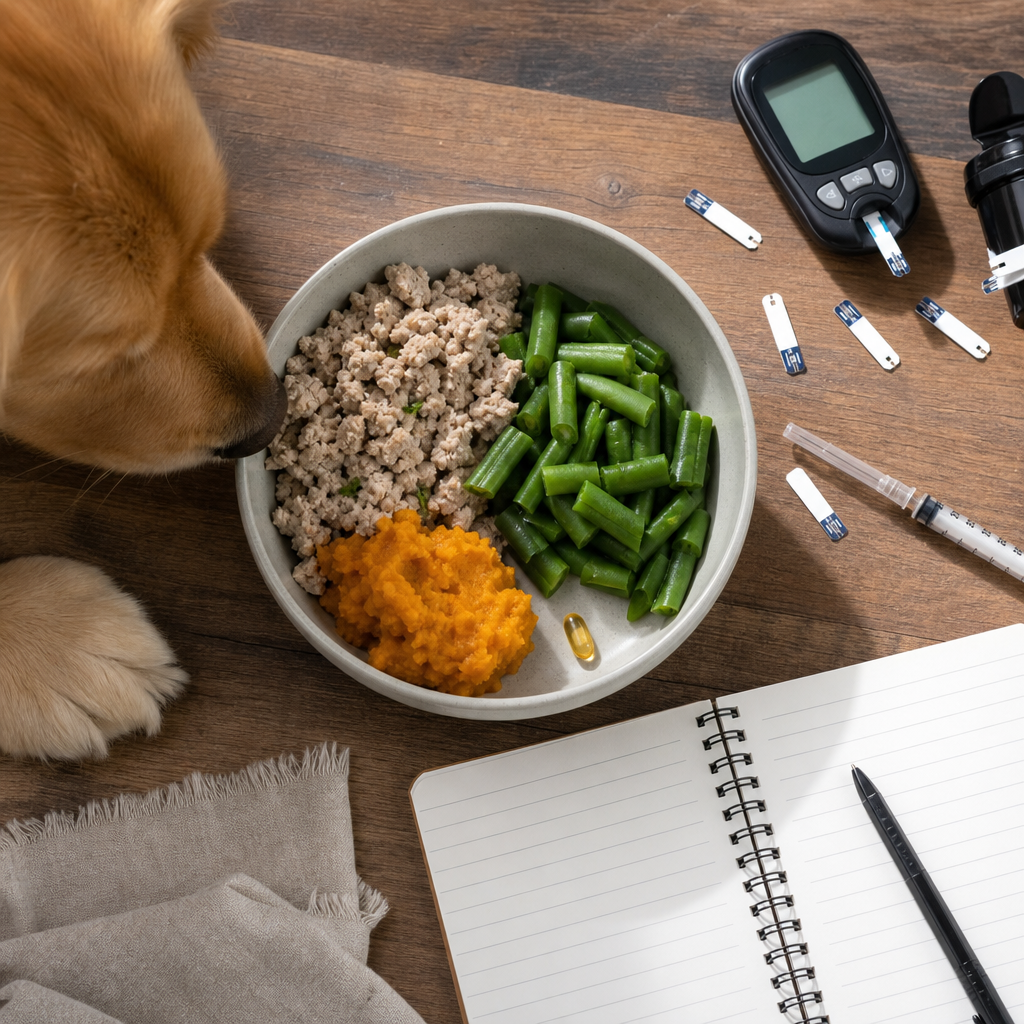
One last thing before I go make Teddy his breakfast
There's a lot of talk about "reversing" canine diabetes. I want to be careful here. Type 1 diabetes — which is what most dogs have — is autoimmune destruction of the insulin-producing cells. You can't reverse that. The cells are gone. What some people have achieved is excellent management that looks like remission. Their dog's insulin requirements drop so low with diet and lifestyle changes that they might even be able to go off insulin temporarily. This is rare. It's more common in cats, actually. For most dogs, diabetes is a lifelong condition. That's not failure. That's just reality. Teddy will be on insulin for the rest of his life. He'll also get his berberine and his salmon oil and his green beans and his slow morning walks. He's blind, a little wobbly, and occasionally insistent that 4am is breakfast time. He's also hapy. You'd know it if you met him — he does this whole-body wag where his nub of a tail vibrates and his butt wiggles and he makes a noise that's somewhere between a whine and a song. That's my metric. Not the glucose number, not the perfect curve, not the carb percentage on the food label. Is he happy? Is he comfortable? Can he do the things that matter to him, like curl up in a sunbeam or sniff a particularly interesting patch of grass for seven minutes? Then we're doing okay.
I'm not a vet. I've probably gotten some things wrong in this article. There will be people in the comments telling me berberine is dangerous or that I shouldn't be using a human glucometer or that my protein percentages are off. That's fime. This is what worked for my dog, with my vet team, in my house, with my resources. Your dog is different. Your situation is different. Take what's useful, leave the rest, and for the love of everything, don't google "dog died from diabetes" at 3am. It won't help. Just go sit with your dog. They probably want to be on your lap anyway.