
The $90 Kibble That Made My Senior Dog Wobble — and the $12 Can of Sardines That Helped Him Jump Again
I wasted $90 on a bag of 'senior mobility' food that made my dog worse. Here's what I learned about glucosamine, protein, and the $12 can of sardines that actually helped.
October 14, 2019. I remember the date because Miko — my 60-pound Lab-border collie mix with the softest ears and a tail that could clear a coffee table — didn't greet me at the door. Instead, I found him in the hallwaay, back legs splayed on the linoleum like a fawn on ice. He tried to get up and just… wobbled. His eyes said sorry, Mom. My heart dropped through the floor.
He was 8 at the time. Not ancient, but not young either. I'd noticed him slowing down on walks, but who doesn't slow down in middle age? I'd chalked it up to normal aging, the same way I tell myslef my own creaky knees are just part of being 38. I was wrong, obviously. The vet confirmed it — early osteoarthritis in both hips and his right elbow. "You'll want to start thinking about joint support," Dr. Nguyen said, handing me a pamphlet that I immediately lost in the car. Classic me.
That night I sat up Googling furiously, 11 tabs open, three dogs snoring around me, and the build cat, Jasper, staring at me from the windowsill like I was the dumbest human alive. "What's the best senior dog food for joint health?" I typed, and got back 2.3 million results. All of them pushing different magic solutions. So began a two-year, very expensive experiment that I'm going to spare you from, if you'll listen.
The $90 Bag of 'Senior Mobility' Food That Made Everything Worse
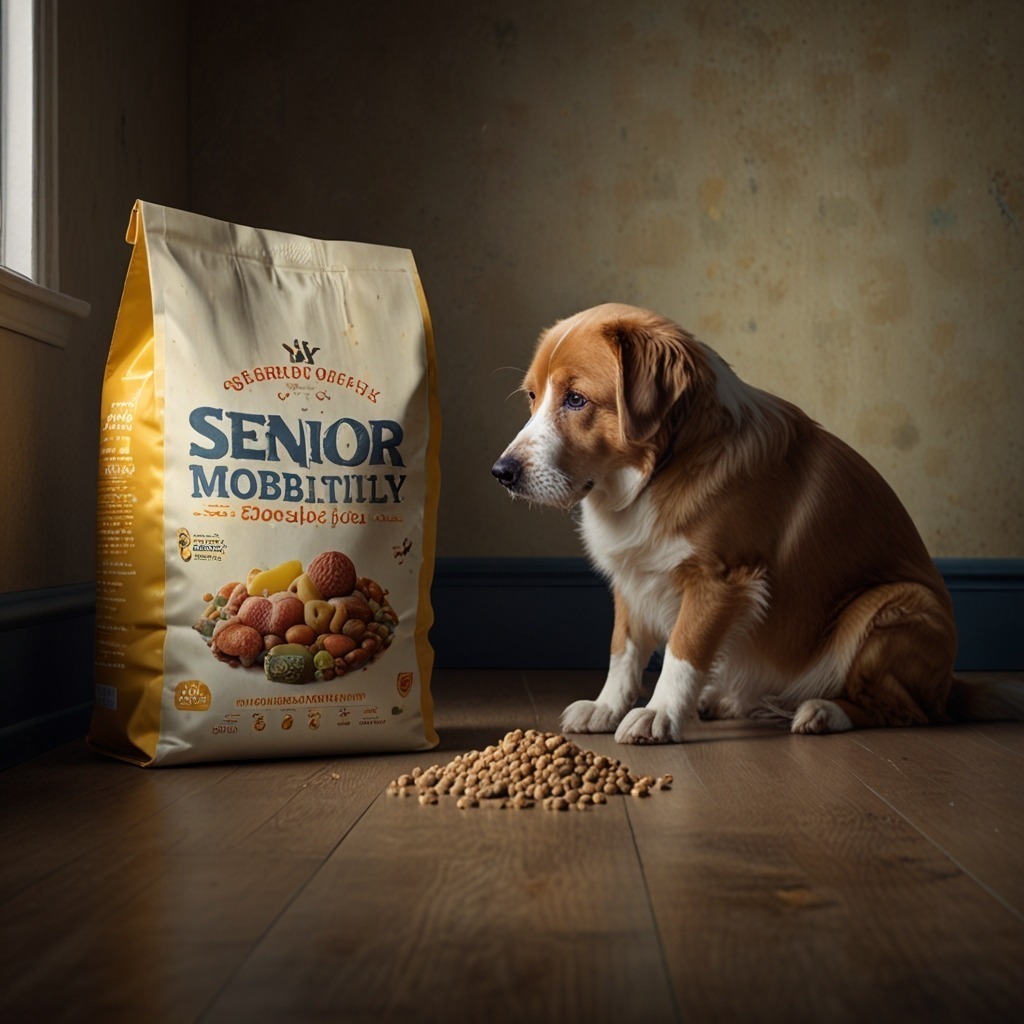
I wish I could say I did my research first. I didn't. I walked into a bougie pet store, saw a bag with a golden retriever leaping on a beach and the words "Senior Mobility Formula — With Glucosamine and Chondroitin!" and I grabbed it. $90. For a 25-pound bag. I felt so virtuous, swiping my card. This is it, I thought. Science in a kibble.
Within three days, Miko had diarrhea so foul I had to open all the windows in January. His joints? Not better. If anything, he seemed stiffer in the mornings. I called the vet, who gently told me that the glucosamine amounts in most kibbles are "therapeutic" only in the imagination of their marketing departments. The food was too rich, too many legumes, and the protein was from sources I couldn't even pronounce. I'd fallen for the pretty bag. Don't be me.
The Ingredient Label Trikc That Pete the Vet Taught Me
Pete — Dr. Peter Okonkwo, the second vet I saw when Dr. Nguyen was on maternity leave — is the kind of guy who uses the word "biologically inappropriate" with a straight face and will talk your ear off about the evolutionary diet of wolves. But he taught me a few things that actually stuck. He sat me down with a whiteboard and drew a bad sketch of a dog's digestive system. "Sarah, you're looking at the advertising, not the ingredients." Ouch.
The First Five Ingredients Rule
"In the U.S., ingredients are listed by weight before cooking," Pete said. "The first five make up the bulk of the food." So if the first five are: chicken, brown rice, barley, pea protein, chicken fat — that's decent. But if its: corn, soybean meal, wheat, animal fat (generic), corn gluten meal — you're feeding a poultry house sweepings plus glue. He said to always look for a named animal protein first. Chicken, beef, salmon, lamb. Not "meat meal" or "poultry by-product meal." Those can be okay, but if it's the first ingredient and it's vague, skip it.
Why 'Chicken Meal' Is Better Than 'Chicken' (I Know, It Sounds Gross)
Here's the thing that blew my mind: whole chicken is about 70% water. So when it's listed first, after cooking it shrinks down to maybe 3rd or 4th place by weight. Chicken meal is the same stuff with the water and fat rendered out, so it's concentrated protein. A food with chicken meal first actually has more animal protein than one with "chicken" first. I hate that this makes sense. It sounds like something a pet food company invented to sell floor scrapings, but no, it's legitimate. I checked with three other vets. So now I look for a named meat meal in the top two.
Glucosamine in Kibble: A Sprinkle of Fairy Dust
Pete was brutal here. He said most senior foods throw in 300-400 mg of glucosamine per cup. An arthritic 60-pound dog needs abut 1500 mg a day at minimum to even start seeing effects. So that bag? The one that cost me $90? Miko would've needed to eat like 4 cups to get a clinical dose, and even then the bioavailability of glucosamine in dry kibble is questionable. It degrades fast. Pete's advice: if the food has "added glucosamine," great, but don't rely on it. Get a dedicated joint supplement. He recommended one with MSM and hyaluronic acid too. (And yes, I've discussed supplements that are total crap — it's a minefield.)
Fish Oil and Dog Breath — My Kitchen Smelled Like a Cannery for Six Months
Omega-3s are crucial. DHA and EPA. Anti-inflammatory. I started squirting salmon oil on Miko's food every morning. Wthin a week, he smelled like low tide. My whole house reeked. And he'd lick his fur and then my face. I'm still not over it.
Switch to algal oil or a high-quality fish oil capusle if you can. Trust me.
My Own Knee and the $50 Bottle of Snake Oil
I should mention, the year before Miko's diagnosis, I'd tweaked my own knee hiking and spent fifty bucks on a "clinically proven" human joint supplement with glucosamine, chondroitin, and some proprietary blend of herbs. Took it for three months. Nada. Turned out, the dose was 1/4 of what's actually studied to work. So when I saw similar nonsense on dog supplements, I was already salty. That's probably why I'm so cynical about label claims now. If it's too good to be true, it probably is. And if the dose isn't on the bag, you're being played.
What I Actually Feed My Three Senior Dogs Now (Spoiler: It's Not All Kibble)
I've three seniors at the moment: Miko (now 12), a 10-year-old beagle mix named Tessa who has the knees of a retired linebacker, and a 9-year-old chihuahua named Pippin who thinks he's a mountain goat. Each gets a slightly different mix, but the base is the same because I'm not running a restaurant. Here's the routine.
Morning Routine: The Soaked Kibble Ritual
Every morning at 6:15 (yes, they've internal clocks), I fill three bowls with a high-protein, grain-inclusive kibble that has chicken meal as the first ingredient, brown rice, oats, and fish oil already in the guaranteed analysis. I add warm water and let it soak for 5 minutes. Miko's teeth aren't great, and the softer texture helps him eat without pain. Plus, hydration is a huge issue for seniors. They drink less as they age, and chronic mild dehydration can make joints stiffer. Soaking adds moisture. I learned that the hard way after a $400 constipation scare with Tessa.
The Topper That Made the Biggest Difference
On top of the soaked kibble, I add a spoonful of canned sardines in water (no salt added). Sardines are a powerhouse: omega-3s, coenzyme Q10, and calcium from those tiny bones. It's basically dog crack. They go nuts. Pippin does a little dance that's half tap-dance, half seizure. The improvement in Miko's coat and mobility within a month was noticeable. Not a miracle — he's not sprinting — but he's getting up easier. That's the goal.
I also rotate in some homemade toppers: pureed pumpkin (for fibrr), a little plain yogurt (probiotics), or homemade treats I make for allergies but with added turmeric and black pepper. I'm not a nutritionist, but the anti-inflammatory propertiees of turmeric are pretty well documented, and there are some small studies in dogs. I use it sparingly.
What I Wish I'd Known About Homemade Diets
After my panic-ordering phase (we'll get to that), I dabbled with fully homemade for a month. Big mistake. I'm not a board-certified veterinary nutritionist, and I ended up with an unbalanced mess that gave Tessa soft stools and poor Miko didn't get enough calcium. I wised up and now I use BalanceIT.com, a site that helps you formulate recipes with supplements to meet AAFCO standards. If you're going the homemade route, do that or consult a nutritionist. Don't wing it. Your dog's joints need protein, yes, but also the right mineral balance. Arthritis doesn't get better with malnutrition.
The Time I Panic-Ordered Freeze-Dried Raw at 2 AM
It was a Thursday night. Miko had a particularly bad day — he couldn't climb onto the couch, and I was hormonal and sleep-deprived. I ordered a $120 bag of freeze-dried raw "joint recovery" food from a brand with a logo that looked like it belonged on a yoga studio. It arrived three days later. I opened it, it smelled like a barn, and Miko walked away. The build cat, Jasper, tried to bury it. So that was a win.
Why Most 'Senior' Formulas Are a Marketing Scam (Change My Mind)
I say this with love. I've worked in a shelter, I've read the AAFCO manuals, I've listened to pet food reps at trade shows — the "senior" label isn't regulated in any meaningful way. A puppy food must meet specific growth standards. Adult maintenance has its own profile. But "senior"? Nothing. Zip. A company can take their adult formula, reduce the fat a little, bump up the fiber, slap a gray-muzzle dog on the bag, and charge you 20% more. That's the game.
The AAFCO Sleight of Hand
AAFCO recognizes only two categories: growth/reproduction and adult maintenance. There's no "senior" nutrient prfile. So any food labeled "senior" is legally considered adult maintenance. It might be formulated to meet some internal company guidelines, but there's no legal definition. That means you gotta scrutinize.
How They Water Down Protein and Call It 'Senior'
A frustrating trend: senior foods often have less protein than adult formulas, because the outdated belief was that protein is hard on old kidneys. Except that's only true for dogs with advanced kidney disease, and if your dog has that, a low-protein diet should be prescribed by a vet, not picked off a shelf. For otherwise healthy seniors, protein is critical to maintain muscle mass. Weak muscles mean less support for creaky joints. So a low-protein senior food might actually worsen mobility. Look for at least 25% protein on a dry matter basis. That's a good rule of thumb.
What to Look for Instead
Rather than hunting for a "senior" label, I now look for an adult maintenance food that has high-quality animal proten, moderate fat, fiber from whole grains or veggies, and if possible, added joint support that's in meaningful amounts (or I'll supplement separately). I want to see specific omega-3 levels, like EPA and DHA listed. A few brands do that now. If the bag says "Omega-3 fatty acids (min) 0.5%" that tells you nothing. Give me the breakdown, people.
I Also Spent $280 on a Bed That Made Everything Worse
Joints aren't just about food, obviously. Exercise, weight, and bedding matter massively. I once bought an expensive memory foam bed for Miko thinking I was doing him a solid, and it turned out to be too soft — he'd sink in and couldn't push himself up. I detailed that disaster right here. Turns out, for large arthritic dogs, a firm orthopedic foam with a low-profile entry is way better. Also, a good bed can make a world of difference. Don't overlook it while you're obsessing over omega-3s.
Teddy, the $37 Hrrb, and What I'll Never Do Again
Before I leave you, I want to tell you about Teddy. Teddy was a build dog I took in three years ago — an elderly terrier mix with joints so knobby they clacked when he walked. He'd been surrendered with a bag of some "all-natural" supplement that cost $37 for a tiny pouch of what looked like dried oregano. The previous owner swore it helped. It was devil's claw. I'd read abotu it for equine arthritis, so I figured, eh, natural. I started giving it to Teddy with his food. Within 48 hours, he vomited twice and had blood in his stool. $1,200 and an emergency vet visit later, we learned that devil's claw can interact with NSAIDs and cause gastric ulcers. Teddy had been on a low-dose anti-inflammatory already, which I hadn't disclosed because the shelter records were a mess. It was a nightmare, and I wrote about it when Teddy almost died.
The takeaway: herbs are drugs, just not regulated ones. Talk to your vet abotu everything you're giving. Don't think "natural" means safe.
Miko on the Couch This Morning
This morning I woke up to the sound of nails on the hardwood — Miko's gentle tap-tap-tap. I found him in the living room, already perched on the couch, his head resting on the armrest, tail thumping slowly. The sun was hitting his gray mizzle. He looked at me like, 'What? I've been here for hours.'
I grabbed my coffee and sat next to him. I didn't think about the $90 bag I bought three years ago, or the salmon oil smell that still haunts my cabinets. I just scratched behind his ears and enjoyed the quiet. The food we're feeding now isn't perfect. It's a mix of kibble, sardines, a joint supplement, and the occasional homemade topper that I mess up sometimes. But he's still here. Still climbing on the couch. Still following me from room to room. And honestly, that's the whole point, isn't it?
Anyway. Jasper's meowing at the fridge. I gotta go.