My Dog Couldn't Get Off the Couch Without Screaming — Here's What Finally Worked (And the $200 Mistake I Made First)
My 12-year-old lab mix yelped every time he tried to stand up. The vet prescribed $90 meds with scary side effects. Here's what natural things actually helped.
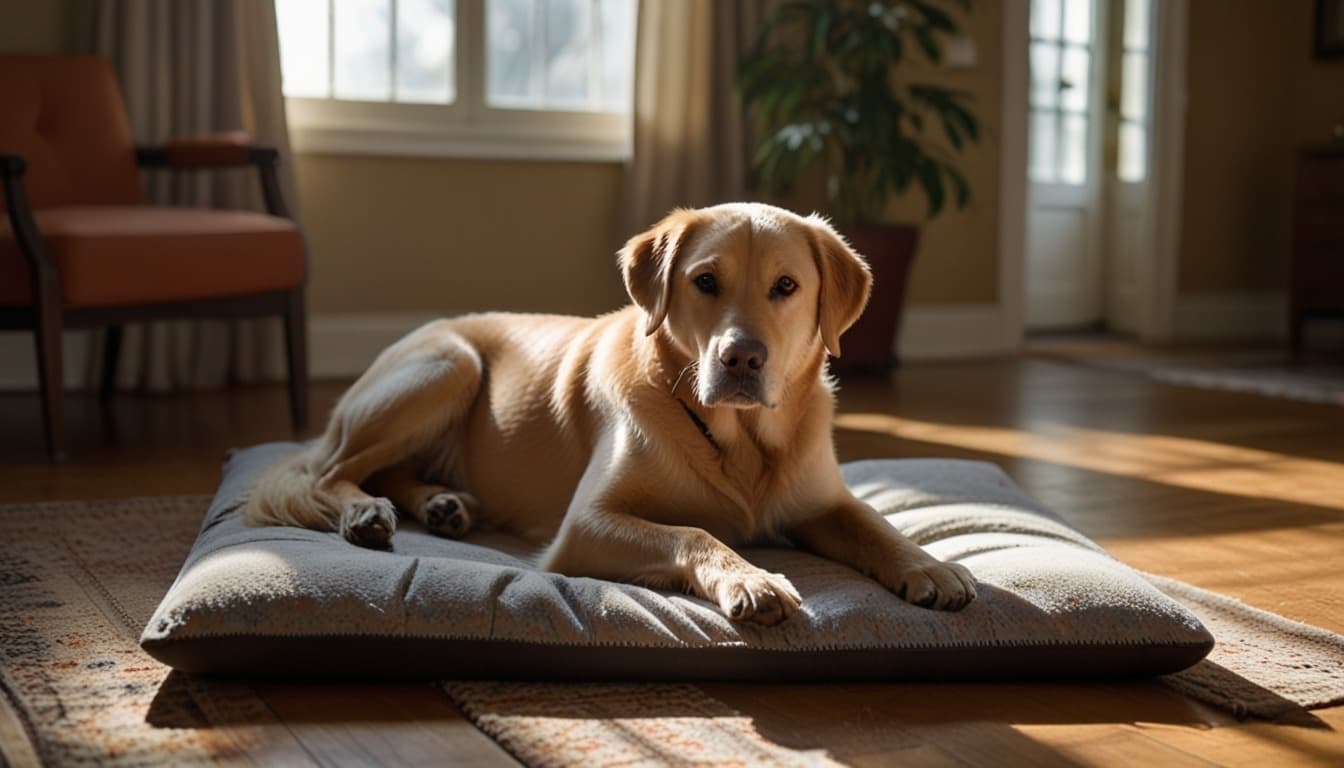
It was 6:42 AM on a Tuesday when Roosevelt yelped and I dropped my coffee mug on the kitchen tile. He wasn't doing anything dramatic — just trying to stand up from his bed in the corner. His front legs shook, his back end sort of folded sideways onto the rug, and the soudn that came out of him was something between a whimper and a cry I'd only ever heard from dogs who'd been hit by cars.
For thirty seconds I just stood there, coffee pooling around my feet, watching my 12-year-old lab mix fight to get all four feet under him while his hindquarters trembled like they were full of broken glass. He'd been stiff for months. We'd chalked it up to 'he's getting older' and 'big dogs, ya know.' I'd bought a cheap foam bed from the big-box pet store. I'd cut back his walks a little. I'd done exactly nothing useful.
That was the morning the vet wrote us a prescription for a daily NSAID that cost $90 a month and came with a two-page document listing side effects I couldn't pronounce. And that was also the monring I decided screw that — I was going to find everything I could that might help my dog without turning him into a chemistry experiment.
Look, I'm not anti-vet. My vet is a saint who has talked me off the ledge through three dogs and a divorce. But vets are surgeons and diagnosticians, not nutritionists, and in my 14 years of doing this pet writing gig and fostering more dogs than I can count, I've learned that there's a lot of ground between 'do nothing' and 'prescription meds forever' that nobody talks about. So this is what I tried — what worked, what was a complete waste of money, and what I wish someone had sat me down and said when Roosevelt still had the muscle to jump onto the couch without a running start.

The morning I heard him cry
His official diagnosis was moderate osteoarthritis in both hips and his left knee, with some early changes in his spine. The vet said it wasn't the worst she'd seen. She'd treated a 14-year-old Rottweiler who could barely drag himself across the floor, so Roosevelt's case wasn't dramatic. But pain doesn't care about comparisons. He'd stopped wagging his tail when I came home. He'd lie there and sort of thump it twice — the bare minimum of tail communication — and then go back to staring at the wall.
I'm telling you this because if your dog is at that point right now, I want you to understand something: this isn't a death sentence. It's not even a 'life of suffering' sentence. But it is a moment where you've to get very honest about what you're willing to chage and what you've been ignoring because it was easier.
My first thought — and I'm ashamed of it — was that maybe we'd just do the pills. Because they were easy. Twice a day with his breakfast and dinner. Done. But then I read about the potential for kidney damage, the gastrointestinal ulcers, and the fact that long-term NSAID use in older dogs is basically a tightrope walk over a pit of 'your dog might suddenly stop eating and then you're in the emergency vet at 3 AM trying to explain how you didn't notice the black stool for three days.'
I've been at that emergency vet at 3 AM, by the way. Different dog, different story. But let me tell you: once you've sat in that vinyl chair with the fluorescent lights buzzing while someone explains that your dog's insides are bleeding, you'll do just about anything to avoid a repeat performance.
So I started researching. And the thing about researching natural arthritis treatments for dogs is that the internet is a garbage fire of conflicting advice. One website says turmeric is a miracle. Another says it's useless because dogs can't absorb it. One forum swears by acupuncture. Another says it's placebo for the owner. Someone's cousin's neighbor cured their dog's arthritis with celery juice. I wish I were joking.
What I'm going to give you here isn't a study or a protocol. It's a messy, real timeline of what I actually did, in what order, and what changed — or didn't — over about 18 months. If you're looking for footnotes and double-blind trials, go read a veterinary journal. If you want to know what helped my stiff old dog get back to stealing socks and attempting to chase the mailman, stick around.
Why I fired my first vet (and almost fired the second)
I need to talk about vets for a second because this part made me furious. The first vet we saw — not our usual one, this was a new clinic because we'd moved — told me that 'natural approaches' for arthritis were 'essentially just making the owner feel better' and that the only evidence-based treatment was NSAIDs and eventual surgery. She said this while Roosevelt was trembling on the exam table, trying to lick her hand because he's a pathologically friendly dog who doesn't understand that some humans don't deserve his affection.
Now, to be fair: she was partilaly right. Many things people try are nonsense. Magnetic collars. Homeopathic pellets. Essetnial oils that can actually poison your dog if used wrong. The 'natural' pet industry is full of garbage products sold by prople who know you'll pay anything to help your suffering animal. But dismissing everything that isn't a prescription drug? Tha'ts laziness in a white coat.
I found a second vet. She'd been practicing for 30 years, had grey hair in a messy bun, and when I asked about diet changes she didn't roll her eyes — she said 'Well, there's some interesting research on omega-3s and green-lipped mussel, and I've seen a few patients respond really well to weight loss and controlled exercise, but let's talk about what's realistic for your life before you go buying fifty supplements.'
That's the vet you want. Someone who's open-minded but not gullible, and who will tell you when you're about to waste your money. I still have her on speed dial. Dr. Evelyn, if you're reading tihs, I owe you a bottle of the good wine.
The $200 mistake I made first
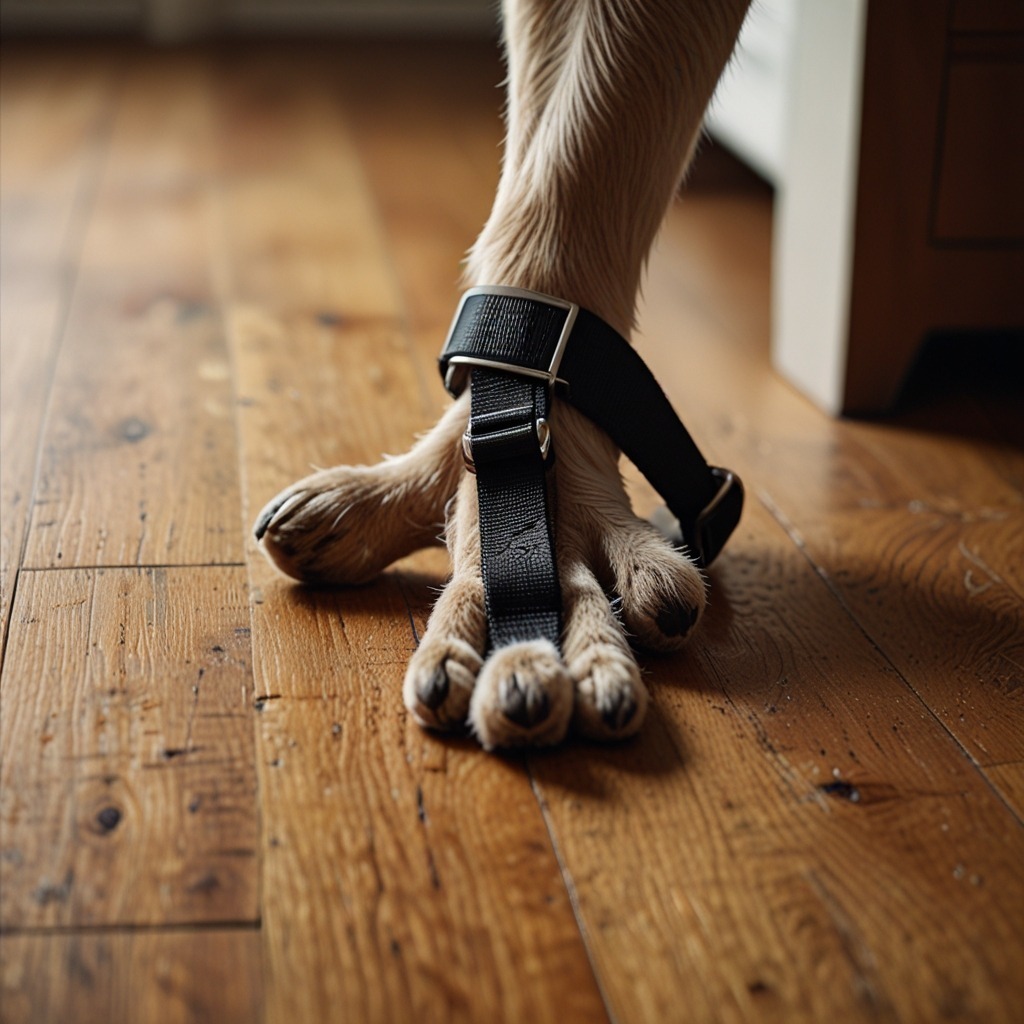
Before I got smart, I got desperate. This is the part where I confess that I once spent $197 on a 'therapeutic magnetic collar' from a website that looked legit but probably wasn't even in this country. The collar arrived in a box that smelled faintly of cigarette smoke, and it was so heavy that Roosevelt couldn't hold his head up comfortably. He wore it for four days before I noticed he'd developed a raw patch on his neck from trying to rub the thing off on the edge of the couch.
I threw it in the trash and never told anyone about it until now.
If there's a lesson here, it's this: desperation makes us stupid. When your dog is hurting, your brain stops distinguishing between 'this might help' and 'this is a scam.' Somebody online will always be selling a miracle. Somebody will always have a before-and-after photo that looks too good to be true (because it's). If a product's website has more testimonials than actual ingredient information, close the tab.
What actually worked: the food part
Okay. Onto the stuff that actualy moved the needle. Food was ground zero for Roosevelt, and I don't just mean 'switching to a senior formula.' I mean rethinking what we fed him from the bottom up.
Getting his weight down (the single hardest thing)
Roosevelt was 87 pounds when this all started. He should've been 72, maybe 75 if you're generous. That extra 15 pouds was sitting directly on his arthritic joints like a backpack full of rocks, and every vet in the universe will tell you that weight loss is the most effective intervention for canine arthritis — bar none. Not the most exciting. Not the most Instagram-worthy. But the one with the clearest evidence.
It took us eight months to get him to 74 pouns. Eight months of measuring his kibble with a kitchen scale, arguing with my partner about how many treats were 'just one,' and learning to say no to those eyes. If you've ever tried to put a lab mix on a diet, you know. The eyes are weapons-grade.
We cut out the high-calorie treats. We replaced them with green beans (frozen, thawed) and chunks of carrot. He wasn't thrilled about this at first. He'd take the green bean, drop it on the floor, and stare at me like I'd betrayed him. But hunger is a good motivator, and eventually he ate them. I also switched to a higher-protein, lower-carb food specifically after reading about how excess carbohydrates can contribute to inflammation. That's a whole rabbit hole I won't drag you down — but let's just say I stopped feeding the $40-a-bag kibble full of corn and mystery 'animal by-products' and started paying attention to ingredient lists.
If you're curious about how a diet switch alone can make a senior dog wobbly or help them jump agaain, I wrote about that in way more obsessive detail over here: The $90 Kibble That Made My Senior Dog Wobble — and the $12 Can of Sardines That Helped Him Jump Again. The tldr: some commercial foofs make inflammation worse, and some simple additions — sardines, for instance — can start calming that internal storm within a couple weeks.
The sardine thing
Speaking of sardines: I started adding one sardine (packed in water, no salt added) to Roosevelt's breakfast every day. The omega-3 fatty aicds in oily fish are anti-inflammatory. This isn't speculation; it's one of the few natural interventions that actually has decent research behind it for both human and canine arthritis. After about three weeks, I noticed he was getting up from his bed a little faster. Not dramatically. But instead of a 10-second struggle to stand, it was more like 6. That's not nothing for a dog who'd started groaning when he shifted positions in his sleep.
Now, a warning: don't go dumping fish oil capsules into your dog's bowl without talking to your vet. They can interact with other medications, and too much can cause diarrhea or interfere with blood clotting. I learned that the hard way with a build who got the runs so bad I had to scrub my baseboards. Moderation matters.
Green-lipped mussel: the one supplement I'll never shut up about
If you take nothing else from this entire ramble, take this: green-lipped mussel powder. It's a shellfish from New Zealand, and it's packed with a unique combination of omega-3s, glycosaminoglycans (the building blocks of cartilage), and other anti-inflammatory compounds that seem to work better together than they do separately. I started with a powdered supplrment from a company that actually publishes third-party lab results — I won't name them because I'm not an affiliate, but I've written about which supplements I'd actually buy again and why I'm picky about testing — and within abouut a month I saw a genuine difference in Roosevelt's morning stiffness.
Not cured. Not 'running agility courses.' But he stopped yelping when he tried to stand up in the morning. For a dog whose days had become a series of small painful negotiations with gravity, that was enough to make me cry into my oatmeal one morning when I realized what had changed.
I also tried glucosamine and chondroitin supplements for about four months and saw absolutely no change. I know some people swear by them, and they're safe enough, but for Roosevelt they were expensive pee. Every dog is different. That's the infuriating part of this — there's no universal protocl. you've to try things, watch like a hawk, and be willing to admit when something isn't working instead of throwing good money after bad.
What actually worked: the movement part
Here's a thing that sounds counterintuitive: a dog with arthritis needs to move. Not run, not jump, not play frisbee on concrete — but move. Movement keeps synovial fluid circulating in the joints, maintains whatever muscle mass they still have, and prevents the stiffness that sets in after long periods of lying down. But the wrong kind of movement makes everything worse.
The leash-walk rhythm we landed on
For months, I'd stopped walking Roosevelt entirely because it seemed cruel to make a dog walk when it hurt. What I didn't understand is that short, controlled, low-impact walks are basically physical therapy for arthritic joints. Our routine became: two 10-minute walks per day, on soft gtound (grass, dirt paths, no asphalt), at his pace, with a use that didn't pull on his neck. No pulling, no jogging, no hills.
If he stopped, I stopped. If he wanted to sniff a bush for two solid minutes, we sniffed a bush. The goal wasn't exercise — it was mobility. Blood flow. A chance for his joints to go through their range of motion wothout impact. Over time, those 10 minutes became 15, then sometimes 20. He never went back to the hour-long hikes we used to do when he was five, but he also stopped looking at the front door like it was a portal to despair.
The use was a big deal. I'd been using a flat collar for years because it was 'easier' and I'm lazy about gear. But a dog with spinal arthritis doesn't need pressure on his neck every time you gently redirect him. A supportive use with a chest plate and a back clip redistributed the force and made our walks feel less like I was torturing him.
Water therapy (and why I couldn't afford the fancy version)
Hydrotherapy for dogs is a thing, and it's fantastic. Underwater treadmills, heated pools, the whole deal. It's also $50-$100 per session in most cities, and I'm a freelance writer with three dogs and a build rotation that eats my savings like a hungry teenager. So I did the budget version: I found a lake with a gentle gravel entry and walked him in up to his belly while I stood in the water in rain boots like a deranged person. The buoyancy took the weight off his joints, the resistance built muscle, and the cold water helped with inflammation (though I'd recommend a warmer lake if you can find one — I'm in the Pacific Northwest and our lakes are essentially melted snow year-round).
If you can afford a proper hydrotherapy tank, do it. If you can't, a shallow body of water and a pair of waders can accomplish a lot. Just keep sesisons short — 10 minutes at first — and dry them thoroughly afterward because an old damp dog is a recipe for hot spots and misery.
The bed that changed everything
I've already written an entire separatte post about how I spent $280 on a bed that made my dog's hips worse, so I won't rehash the whole saga. But the short version: memory foam isn't always the answer. Thick, sink-in foam can trap an arthritic dog in a position where they've to fight to get up, and that's exactly what happened with the expensive orthopedic bed I bought in a panic. Roosevelt would sink in, his joints would stiffen in a weird position, and standing up became a full-body crisis.
What eventually worked was a firmer, multi-layer foam bed with a low entry — no bolsters to step over, no deep sink. Something he could walk onto and off of without having to lift his legs high. The bed was maybe $90, and I cursed myself for not starting there. When it comes to arthritic dogs, the floor matters too. Hardwood and tile are slippery confidence-killers. I put down yoga mats and a couple of cheap runners on the main paths through the house, and Roosevelt started moving around more because he wasn't terrified of wiping out. Small changes. Big impact.
Those weird little things that helpd (and one that didn't)
Over the months, I tried a bunch of smaller interventions. Some were cheap wins. Some were completely pointless. Here's the messy list.
Massage. I learned a few basic canine massage techniques from YouTube videos (specifically, how to do gentle circular pressure around the hips and spine without pushing on the actual joints). Five minutes every evening while we watched TV. Was it a cure? No. Did Roosevelt sigh and close his eyes and fall asleep with his head on my knee? Yes. And even if it only relaxed his muscles enough to reduce secondary tension pain, that was worth more than a $50 supplement.
Heating pads. On cold mornings, I'd lay a microwavable heating pad over his hips for 15 minutes before our walk. It seemed to loosen things up. The key is low heat, a towel barrier so you don't burn their skin, and supervision. I know a dog who chewed through a corded heating pad and frankly I'm amazed he survived. So don't use the electric kind unless you're sitting right there the whole time.
Raised food and water bowls. This one's debated — some vets say it can increase bloat risk, others say it helps seniors who struggle to lower their heads. For Roosevelt, a slightly elevated bowl (about 6 inches off the ground) meant he didnt have to put weight on his front legs during meals. I watched him eat more comfortably. He drooled less. I'm calling it a win, but talk to your vet if you've a deep-chested breed prone to bloat.
Acupuncture. I tried it. Three sessions, $90 each. Roosevelt didn't care for it. He tolerated the needles but spent the entire time looking at me with an expression that clearly communicated 'why are you letting this woman turn me into a pincushion.' Some dogs love it and owners swear by it. My dog wasn't one of those dogs. We stopped after the third session because the stress of the visits seemed to counteract whatever marginal benefit the needles might have provided. That's the thing about 'natural' — sometimes the treatment is worse than the condition for that specific animal.
That one weird thing my grandma told me
My grandmother raised border collies on a farm in Wisconsin for 40 years. When I told her about Roosevelt's arthritis, she said, 'You tried golden paste yet?' I had no idea what she was talking about. Turns out 'golden paste' is a homemade turmeric mixture — turmeric powder mixed with a little coconut oil, black pepper (to enhance absorption), and water, heated into a paste that you can stir into food.
Turmeric's active compound, curcumin, is a well-studied anti-inflammatory. The black pepper is crucial because without it, dogs (and humans) absorb almost none of the curcumin. I started with a pea-sized amount twice a day and worked up to about a teaspoon over two weeks, watching for stomach upset. There's a whole post on here about how a $37 herb changed everything for a dog named Teddy — that's this one — and while turmeric isn't the same as that particular herb, the principle is similar: sometimes a cheap plant compound does what an expensive pill can't.
For Roosevelt, the golden paste seemed to stack on top of the green-lipped mussel and the fish oil and produce a cumulative calm-down in his joints. I can't prove it was the turmeric specifically, and I'm not going to pretend I ran a controlled expeeriment. But when I ran out of turmeric for a week during a snowstorm, his stiffness crept back. I bought more. He improved again. I'm not saying it's a miracle. I'm saying I keep a jar of it in my fridge now, and I'll probably make it for every senior dog I ever own.
The thing nobody warns you about
Here's a tangent: caring for an arthritic dog will break your heart in ways you didn't sign up for. Not because of the pain management or the vet bills or the special food. Because you'll find yourself lying awake at night doing cost-benefit analyses of your dog's quality of life, and you'll never feel certain. You'll have good days where he chases a butterfly and you'll think 'maybe he's going to live another three years.' And then you'll have bad days where he lies in his bed all afternoon and won't even lift his head for cheese and you'll think 'am I prolonging this for me or for him?'
Nobody tells you how to deal with that. The vets give you pain scores and treatment options, but they can't tell you when your dog is still happy or when he's just existing. I don't have an answer for this one. I just want you to know that if you're in that place — Googling 'when to euthanize a dog with arthritis' at 2 AM — you're not alone, and you're not a bad person for thinking about it. The fact that you're reading a 4000-word blog post about natural arthritis interventions suggests you're exactly the kind of person who will make the right call when the time comes. Even if it hurts like hell.
Roosevelt at 13: still stealing socks
He's 13 now. He still has arthritis — this isn't a fairy tale where the dog gets cured. He still has stiff mornings. He still takes the occasional NSAID when he has a flare-up (usually after he overdoes it chasing a squirrel we both know he shouldn't be chasing). But he's not the dog who couldn't get off the couch without screaming. He trots to the door when I get his use. He steals socsk out of the laundry basket and prances around like he's 4. He greets me with a tail that actually wags instead of just twitching twice.
What we did — the weight loss, the diet changes, the supplements, the low-impact walks, the good bed, the rugs on the floor — didn't reverse his arthritis. Nothing reverses arthritis. But it calmed the fire in his joints enough that he could live inside his body without suffering every moment. That's the whole goal. Not a cure. Just a life worth living.
If I had to do it all over again, I'd skip the magnetic collar, skip the months of glucosamine that did nothing, and start with: green-lipped mussel, sardines or fish oil, weight loss (non-negotiable), short daily walks on soft ground, a firm low-entry bed, and rugs on every slippery surface in my house. That would've saved me about $400 and a lot of guilt.
Your dog isn't Roosevelt. Your dog might respond to different tjings. The only universal rule is this: pay attention. Watch how they move, how they eat, how they sleep. Try one thing at a time so you know what's working. Keep notes if you've to. And find a vet who listens — a real partner who understands that you're trying to do the best you can with what you've got.
Now if you'll excuse me, someone just stole my other sock.