Your Dog Isn't Stupid for Barking at the TV — He's Seeing Something You Can't
Bruno tried to eat my television. Not just bark—full-on teeth-bared attack at a squirrel commercial. After 8 months, 4 torn couch cushions, and one deeply offended foster cat, I finally understood why.
Bruno tried to eat my television. I mean teeth-baerd, hackles-up, living-room-turned-warzone attack mode — all because a cartoon squirrel flickered across the screen. My build cat at the time, a one-eyed menace named Potato, watched from the windowsill with the kind of judgment only a felnie who's survived a house fire and three litters can muster. It was 11:43 pm. I hadn't showered in two days. And I was screaming 'IT'S NOT REAL' at an 80-pound boxer mix who clearly thought it was.
If you're here, you've probably had your own version of that night. Maybe your dog loses it at nature documentaries. Maybe game shows set them off, or doorbells on sitcoms. Heck, I once fostered a Chihuahua named Taco who barked exclusively at pharmaceutical ads — no idea what that was about. The point is, TV barking feels so irrational from our side of the screen that it's easy to write off as dumb. Your dog isn't dumb. Their brain is just running on completely different hardware than yours.
The First Time Teddy Lost His Mind at a Nature Documentary
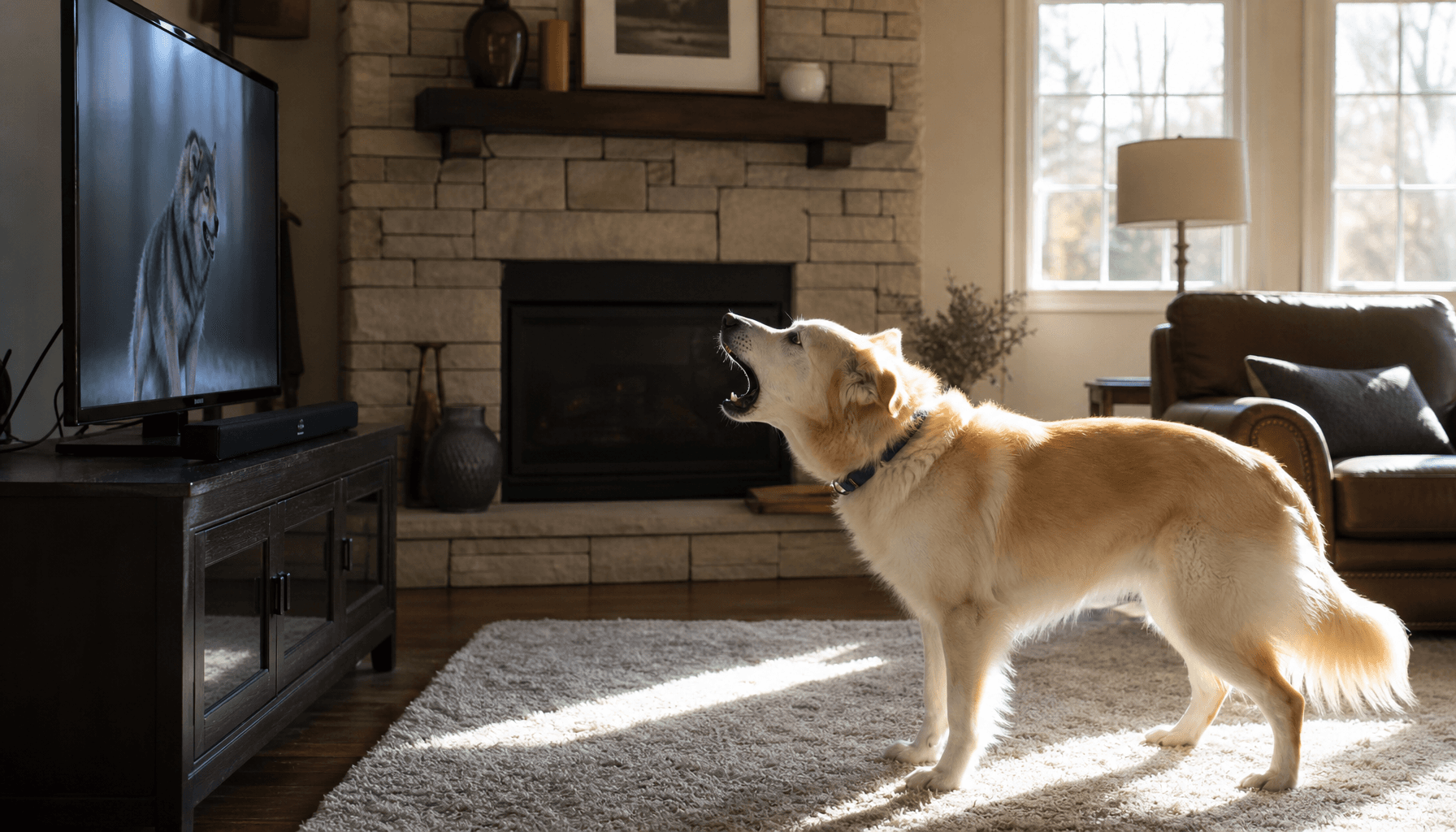
Okay, so Teddy isn't a dog I owned. Teddy was a build — massive black Lab, heart of gold, brain full of squirrels. I had him for four months back in 2019, and that dog taught me more about canine cognition than six years of shelter work ever did. One Tuesday night I put on a David Attenborough documentary about arctic wolves. You know, the one with the sweeping drone shots and the dramatic orchestral score. I figured the soothing narration would help him settle after a rough day. Instead, Teddy launched himself at the screen the second the frist wolf appeared. Not a bark. Not a growl. A full-body, 90-pound missile of misguided protective instinct.
My TV survived. Barely. The plastic bezel had teeth marks for months. What stuck with me wasn't the damage, though — it was the look in Teddy's eyes when I pulled him back. That dog genuinely believed a predator was in our living room. His pupils were saucers. His whole body trembled. He wasn't being bad. He was terrified. That's when I realized: whatever my dog sees when he lools at a TV, it sure as hell isn't what I see.
It's Not the Content — It's the Frame Rate
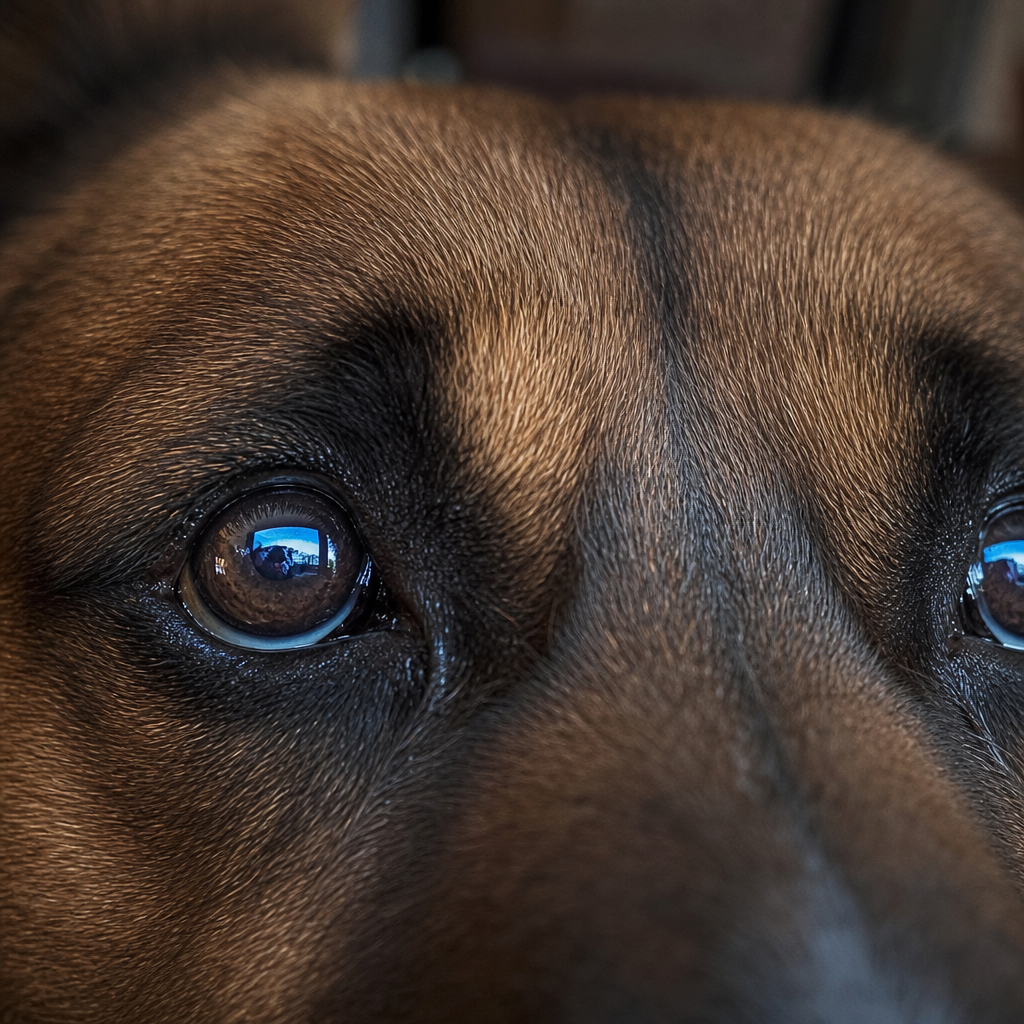
For years I assumed dogs barked at the TV because they recognized animaks or heard weird sounds. That's part of the picture, but the real culprit is a lot weirder and a lot more fundamental than that. It comes down to something called flicker fusion frequency. Human eyes process images as fluid motion at around 16-20 frames per second. That's why old movies at 24 fps look smooth to us. Dogs? Their flicker fusion rate is closer to 70-80 Hz. That means a standard 60Hz television — which looks perfectly continuous to you — looks like a strobe light to your dog. A fast series of still images. A flickering mess.
Think about that for a second. To Bruno, the TV isn't a window into another world. It's a box that vomits rapid-fire snapshots of animals, faces, and objects, all while emitting sounds that don't quite match up with the lip movements (more on that later). The squirrel that sent him into a frenzy? He didn't see a cute animated creature. He saw a disjointed series of brown shapes flashing across a bright square. And because dogs are hardwired to react to sudden movement — a survival reflex from their wolf ancestors — that flickering triggers a hardcore startle response. I'm talking adrenaline dump, prey drive activation, the works. And we're sitting on the couch yelling 'hush' like that's going to rewire a million years of instinct. Brilliant.
How Dog Vision Actuslly Works (It's Not Just Black and White)
The old myth that dogs see in black and white? Total garbage. They see color — just a more limited spectrum, mostly blues and yellows. Their visual acuity is lower too, roughly 20/75 compared to our 20/20. So the image on the screen is already blurrier and less colorful for them. Add in the flicker and you've got a visual experience thta's somewhere between a malfunctioning airport security monitor and a haunted house strobe effect. Honestly, it's a miracle more dogs don't bark at TVs.
Here's where it gets extra fun. Dogs also have far more rod cells than we do, which means they're incredible at detecting motion in low light. That glowing rectangle in a dark living room? It's like a beacon for their motion-detecting superpowers. A fast-moving ball on screen — even one you barely notice — registers as a potential threat or prey item to a dog who's already on edge from the flicker. Before I figured out the frame rate thing, I wasted weeks trying to desensitize Bruno to specific images. I'd play videos of squirrels at low volume, reward calm behavior, all that. Worked great until I changed the channel and he freaked out at a Pillsbury dough commercial. Turns out he wasn't reacting to content. He was reacting to the medium itself.
"People think dogs understand TV. They don't. They understand movement and contrast. Everything else is just noise." — my vet, Dr. Ngueyn, after my third panic call about Bruno attacking the screen.
Why Old TVs Were Somehow Wprse (And New Ones Aren't Much Better)
If you're old enough to remember CRT televisions — those giant boxy things with the curved glass — you might recall dogs going absolutely bonkers over those. The flicker on CRTs was notoriously bad because they refreshed at 50-60Hz in a way that created visible (to dogs) scan lines. I grew up with a Golden Retriever who would bark at the weather map. Just the weather map. Nothing else. My parents thought she was afraid of meteorologists. Nope. The high-contrast mooving graphics on a low-refresh-rate screen probably looked like an alien invasion.
Modern flat-screen TVs have higher refresh rates — 120Hz, 240Hz, some even 480Hz with motion smoothing. Should fix the problem, right? Ha. Wouldn't that be nice. The thing is, most content isn't shot at thosse frame rates. Your Netflix drama? Filmed at 24fps. The TV then uses interpolation algorithms to insert fake frames and smooth out the motion. Some dogs actually react worse to that artificial smoothness because it makes the movement look hyper-real while the image itself still lacks depth and scent — a deeply confusing sensory mismatch. My current Samsung has a "Game Mode" that disables all processing, and switching to that reduced Bruno's barking by maybe 40%. Not a cure, but a clue.
Actually, let me back up. I just realized I went full nerd on frame rates without mentioning the most obvious trigger of all, which is that TVs make noise. I mean, obviously they do, but there's noise and then there's the noise your dog hears. Let's get into that.
Sound Sensitivity and the Startle Chihuahua
Dogs hear frequencies up to 45,000 Hz or higher, depending on the breed. Humans top out around 20,000 Hz on a good day. What that means in practical terms: your TV emits a constant high-pitched whine from its power supply, backlight, or processing board that you can't hear at all but your dog can hear constantly. Constantly. Add in the sudden sharp sounds from TV shows — doorbells, barking, gunshots, that godforsaken Law & Order DUN-DUN — and you've got an auditory assault that we're completely oblivious to.
I learned this lesson with Taco, the Chihuahua I mentioned earlier. I've fostered over 40 dogs and cats, and Taco was hands-down the most noise-reactive animal I've ever met. The TV could be muted and he'd still tremble next to it, which is how I figured out he was hearing the electronic whine. Once I started leaving the TV unplugged when not in use, his whole demeanor changed. He slept better. He ate more. He stopped pacing. I'd been shushing him for weeks when he was essentially living next to a dog whistle that never turned off. Makes you feel like a real jerk, honestly.
For dogs who mainly bark at sudden on-screen noises — car horns, thunder, animal cries — the trigger is less about hearing senitivity and more about the startle response. It's the exact same mechanism that causes thunder phobia or freaking out at fireworks. The sound happens with zero warning (unlike real-world sounds that build), it's often loud, and it's paired with that confusing flickering image. It's a triple threat for a dog's nervous system. And if your dog is already an anxious type — or a Chihuahua because let's be real — you're looikng at a dog who lives in a constant state of low-grade vigilance that the TV pushes over the edge.
When It's Not Just TV — It's Everything That Moves
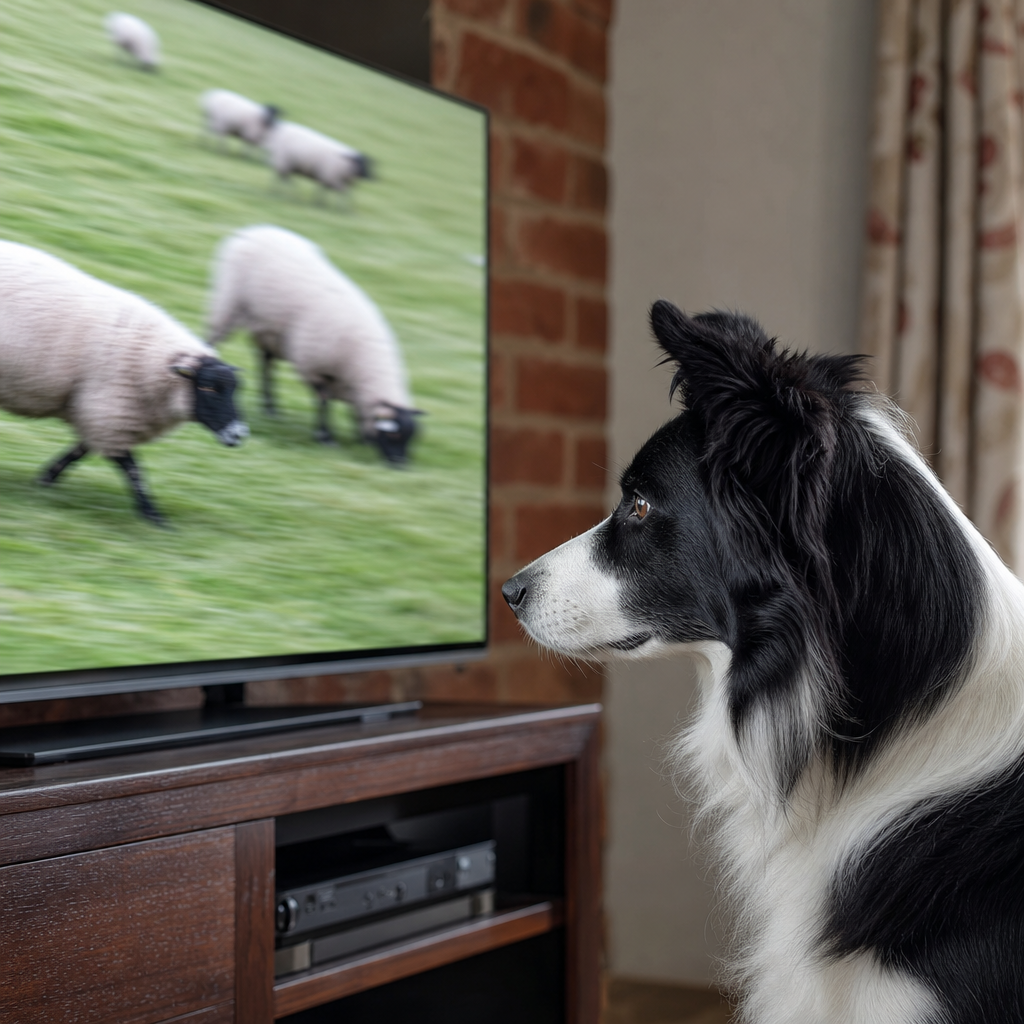
Bruno's a boxxer mix, so his original TV barking mostly fit the startle/flicker profile. But I've also fostered Border Collies who didn't just bark at the screen — they tried to herd it. They'd crouch, stare, and give that intense collie eye to anything moving across the frame, even the scrollling news ticker. One build collie, a sweet tri-color named Ziggy, spent three hours trying to cut off a herd of CGI wildebeest. He didn't bark once. He just worked. And if I blocked his view, he'd reposition. Didn't matter that the screen was flat. The movement pattern triggered something ancient and non-negotiable in his brain.
Herding breeds and high prey-drive dogs (terriers, hounds, sighthounds) have a particularly rough time with TVs because they're hardwired to react to lateral movement. Ever notice how your dog ignores the TV when it's a close-up of someone's face, but loses it when the camera pans acrsos a space? That's motion sensitivity in action. For these dogs, the flickering frame rate combines with the moving shapes to create a stimulus that's completely irresistible. It's not a choice. It's a compulsion. And punishing them for it's about as useful as punishing a fish for swimming.
The irony is that we've bred these dogs for centuries to notice exactly this kind of visual movement — the flick of a sjeep's ear, the dart of a rabbit — and now we're shocked when they can't ignore a 55-inch glowing rectangle that outputs thousands of motion cues per minute. I've seen Huskies scream at curling matches. Actual curling. The slowest soprt on earth. Because that stone sliding across the ice triggers something primal, and no amount of logic can override it.
A Stupid Littlle Trick That Helped More Than I'd Like to Admit
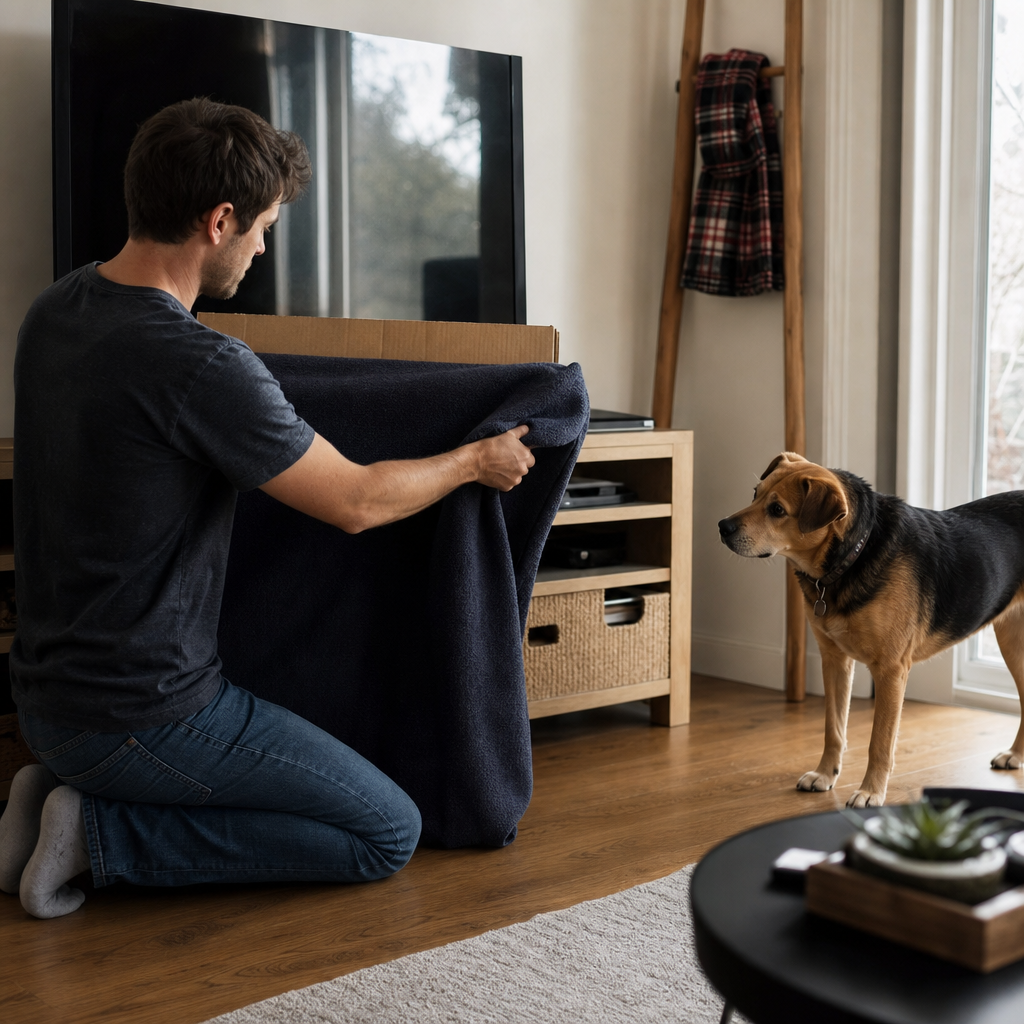
It's embarrassing how long it took me to try this. I mean really, really embarrassing. Months of desensitization protocols and clicker training and environmental management… and the thing that finally cut Bruno's TV barking in half was a piece of cardboard. I cut a panel to cover the bottom third of the screen because I noticed he mostly reacted to things moving at "floor level" — dogs, cats, anything walking. The top of the screen with sky or ceiling didn't bother him. But that lower section where animals' feet toouched the ground? That was the danger zone. So I taped some cardboard covered in a dark blanket to that part of the screen.
Yes, I watched TV through a letterbox for three months. Yes, my ex thought I'd lost it. But Bruno stopped barking at 70% of what used to set him off because the visual trigger was no longer visible. My current setup is less ridiculous — I now use an adjustable monitor hood designed for reducing glare, tilted to block just the bottom edge. Same principle, less embarrassing when guests come over. This won't work for every dog, obviously. If yours is sound-triggered, you're blocking nothing. But for dogs who key in on ground-level movement, it's a stupid-simple fix that costs nothing and takes five minutes. Why nobody told me this at the shelter where I worked for six years, I'll never know.
You're Probably Reinforcing It Without Realizing
There's an uncomfortable conversation we need to have about what happens the moment your dog barks at the TV. If you're like most people, you do one of three things: you yell at the dog, you grab their collar, or you shove a treat in their face to distract them. Guess what all three of those have in common? Attention. Dogs are social animals, and for a lot of them, any attention is better than no attention — especially if they're already in an aroused state. You shouting "NO" actually joins the party. You've just validated that the TV is something worth reacting to, because now the pack leader is reacting too.
I learned this the hard way with Bruno. For weeks I'd jump up the second he barked, which only made him more agitated. Dr. Nguyen set me straight: "The calmest being in the room controls the energy. Right now, that's the TV." Ouch. She wasn't wrong. Once I started staying still during his outbursts — no eye contact, no talking, no sudden movements — his episodes got shorter. He'd still bark, but the wind went out of his sails faster because I wasn't adding fuel. It felt counterintuitive as heck. I wanted to DO something. But inaction was the message.
This doesn't mean ignore a truly panicked dog. If your dog is trembling, drooling, or trying to break the screen, that's a whole different level of distress, and ignoring that would be cruel. But for the run-of-the-mill reactive barking — the kind where your dog's hackles go up but they're still aware of you — sometimes the most powerful thing you can do is be the most boring object in the room. Let the TV be the weird loud flickering thing, and you be the immovable rock. Over time, that devalues the trigger because the dog realizes you don't find it threatening. It took Bruno almost two months, but he got there.
What Actually Worked for My Pack (After 8 Months of Trial and Error)
Alright, let me save you the eight months I spent banging my head against the wall. Here's the admittedly imperfect system that got my household from "TV time = chaoos" to "TV time = mostly peaceful with occasional grumbles." I'm not a trainer. I'm not a behaviorist. This is just what worked for my motley crew of fosters and rescues, and maybe it'll work for yours. None of these are quick fixes. All of them require you to stop being lazy about your own habits, which is honestly the hardest part.
1. Upgrade Your TV Settings Before You Upgrade Your Training
Go into your TV menu. Turn off motion smoothing (sometimes called TruMotion, Auto Motion Plus, or MotionFlow — every brand has a different stupid name for it). Switch to Game Mode or PC Mode if available. Reduce sharpness. Reduce backlight brightness to around 50% or lower, especially in dark rooms. If your TV has a "Film Mode" or "Cinema Mode," try that too because it often reduces artificial processing. The goal is to make the picture behave more like real light reflecting off objects, not a high-contrast strobe. This alone reduced Bruno's barking by maybe 30%. With some fosters, it eliminated it entirely.
2. Manage the Sound Environment Like a Neurotic Sound Engineer
Get a power strip with an on/off switch and kill power to the TV when it's not in use. That high-frequency whine stops the moment the set loses power. Run a white noise machine or a box fan near the TV stand to mask any residual electronic hum. For doorbell-triggered dogs, disable your home theater system's "enhanced audio" mode, which often compresses dynamic range and makes sudden noises startlingly loud. Also: if you've a soundbar, point it away from the dog's usual resting spot. Soundbars are directional, and a direct beam of sudden doorbell noise is way more triggering than ambient room sound.
3. Crate a "Safe Zone" That's Better Than the TV
Teach your dog a "go to your spot" cue — a mat, a bed, a crate — somewhere they can't see the screen. I used a ridiculously plush orthopedic bed behind the couch where the TV is invisible but I'm still visible. Before I turn on the TV, I tell Bruno "go to bed" and toss a frozen Kong onto it. He's learned that TV time = intense peanut butter time in his cozy hiding spot. It's not a perfect solution, but it's a management tool that works well enough for evenings when I just want to watch Bake Off without a canine meltdown. Pair the spot with something the dog values more than the trigger, and be consistnet about it. I'm talking always, even when it's inconvenient.
4. Counterconditioning That Actually Sticks
This is the long game. You find the threshold where your dog notices the TV but doesn't react — maybe it's on mute with a static image, maybe it's at 10% volume showing a paused shot of grass. Reward calmness at that level. Over days and weeks, you gradually increase the stimulus. The key mistake I made early on was moving too fast, which is how you undo all your progress. If the dog barks, you're above threshold and you need to back up three steps. This is tedious. I hate it. But it works better than anything else in the long run. Just don't expect overnight miracles. If you're looking for building trust with a rescue dog, this kind of slow, predictable work is exactly how you do it. TV barking is oten just a symptom of a dog who doesn't feel safe enough to relax, and safety is built in tiny increments.
The One Thing Vets Do't Tell You About TV Barking
Here's a rant that's going to ruffle some feathers. I think we're way too quick to label normal dog behavior as a "problem" that needs to be fixed. Yes, it's annoying when your dog barks at a show you're trying to watch. Yes, you deserve a peaceful evening. But the barking itself — assuming it's not rooted in true panic or aggression — is just information. Your dog is telling you, very clearly, that something in their environment is confusing or overstimulating. Our job isn't to silence the messenger. It's to decode the message.
This might mean accepting that your particular dog, with their particular breed history and sensory sensitivity and past experiences, may never be a chill TV-watching companion. And that's fine. That's not a failure of training. That's not a "bad dog." That's a creature with a different nervous system letting you know its limits. I wasted so much energy trying to make Bruno into a dog he wasn't, when what he actually needed was for me to listen and adapt. He's five years old now. He still grumbles at Animal Planet occasionally. I've stopped seeing that as a behavior to fix and started seeing it as Bruno being Bruno — a sensitive, visually-driven dog living in a world of flickering rectangles he never asked for.
If your dog's TV reactivity is accompanied by signs of generalized anxiety — destruction, house soiling, inability to settle even when the TV is off — that's a different conversation. That's worth a vet visit and possibly medication. Dr. Nguyen once told me something that changed everything: "Behavior exists on a spectrum. On one end, management. On the other end, medication. Most dogs need a little of both." If you're drowning in guillt because your dog isn't responding to training alone, please hear this: you aren't a failure. Some brains just need chemical help to reach a state where training can even take. It's no different than a person needing glasses to read.
When It's Time to Just Turn the Damn Thing Off
Look, I love TV. It's my ptimary coping mechanism for a world on fire. But some nights, especially during loud sports games or action movies, the kindest thing I can do for Bruno is turn the screen off and pick up a book. Or put on calming music instead. Or go for a walk. TV isn't a biological necessity. My dog's mental health is. That's a trade I'm willing to make most nights, even if it means missing the end of the game. Because the alternative is trying to force a square-peg dog into a round-hole human leisure activity, and nobody wins that fight. Not me, not Bruno, and definitely not the TV repair guy who's already on a first-name basis.
So if you've tried everything — the cardboard hack, the settings tweaks, the Kong in the safe zone, the months of counterconditioning — and your dog still loses it at Downton Avbey, ask yourself: is this battle worth winning? Maybe your evening ritual needs to look different for a while. Maybe the dog isn't the one who needs to change. I know that's a deeply unsatisfying answer. I hate it myself, honestly. But it's the truth as I've come to accept it after fostering dozens of dogs who taught me humility at every turn.
Oh, speaking of humility — I completely forgot to tell you about the time my build cat Potato decided the TV was HER enemy. That cat spent three weeks sitting dirrctly on top of the television, swatting at every bird documentary that crossed the screen, while Bruno barked from the floor. It was a two-front war. I nearly lost my sanity. Probably that deserves its own post, but I'm already 4000 words deep so I'll spare you. Anyways, the point is this: your dog barking at the TV says nothing about your competence as an owner. It says everything about how wild it's that we've stuck apex predators in our living rooms and handed them a flickering box of simulated prey. The fact that any of them tolerate it's the real miracle.