Why Your Dog Freaks Out at Loud Noises (and Why 'Just Ignore It' Is Terrible Advice)
I've fostered over 40 dogs, and noise phobia is one of the hardest things to watch. Here's what actually helps, what makes it worse, and what I wish someone had told me years ago.
The Fourth of July That Almost Broke Me
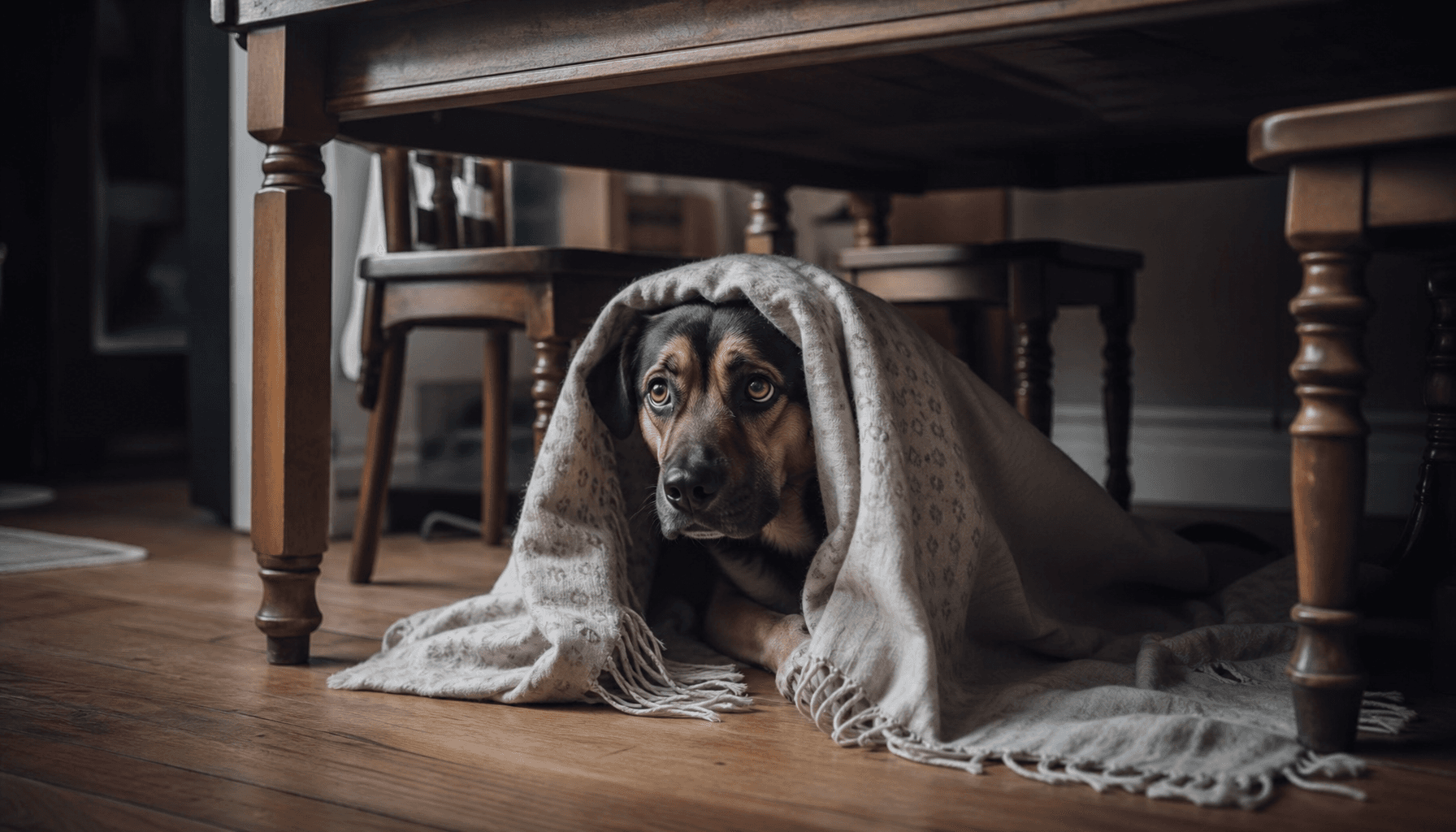
Tank was a beagle mix who weighed about 20 pounds and carried enough anxiety to fuel a cruise ship. I had him as a build in 2017, back when I thought I knew a thing or two about dogs. (I didn't.) The night of July 3rd, someone a few streets over set off a bottle rocket. Tank launched himself off the couch like he'd been electrocuted. I found him wedged behind the toilet, shaking so violently I thought he was having a seizure. His eyes were glassy, mouth hanging open, drool pooling on the tile. My immediate instinct—the worst one—was to scoop him up, hold him tight, and murmur, "It's okay, buddy, you're safe."
The next night, the real fireworks started. I'd crated Tank in the bedroom with a blanket over the top, thinking that would help. The first loud boom sent him into a frenzy. He gnawed at the wire door until his gums bled, then somehow squeezed through a gap I didn't even know existed. By the time I got to him, he'd busted a tooth and was scrambling at the bedroom door like he was trying to dig through to China. We spent that night at teh emergency vet, me sobbing into a paper cup of burnt coffee, Tank sedated and stitched up. I felt like a failure. That night was the beginning of a very long, very humbling education in canine noise phobia.
I'm not a vet. I dropped out of vet tech school, spent six years working in a shelter, and have fostered over 40 dogs since. I'm writing this from my kitchen table with three rescue dogs sprawled around my feet and a build cat glaring at me from the windowsill. I've made all the mistakes, watched countless terrified dogs, and learned a few things that actually work. If your dog loses their mind over fireworks, thunderstorms, or even the garbage truck, you're in the right place. I'm going to tell you what I wish someone had told me back when Tank was bleeding on my bathroom floor.
Why Their Ears Turn a Popping Sound into a Horror Movie
Dogs hear stuff we can't. That's the oversimplified version, but it's the truth. Their hearing range stretches far beyond ours—they can pick up frequencies we'd need a bat to detect and they hear sounds at volumes that wouldn't even register for us. A firework a mile away isn't just a distant pop to your dog. It's a sharp, concussive blast that makes the air vibrate. A balloon popping across the house might as well be a gunshot. I once had a build border collie who could hear the UPS truck two blocks before it arrived, and she'd start trembling the second its engine turned onto our street. Her world was just louder than mine.
Evolution left dogs with some pretty raw wiring. A sudden, unexpected noise in the wild meant possible danger—a predator, a falling tree, a rival pack. Their brains are designed to go "FLEE NOW, THINK LATER" because the rabbits that paused to podner a noise got eaten. That's why your dog's reaction is instant. There's no reasoning in that moment. The amygdala just hijacks everything.
Breed tendencies (that might make it worse)
Certain breeds are practically hardwired for hyper-alertness. Herding dogs like border collies and aussies, guardians like German shepherds—they notice everything. A thunderclap isn't just a noise to them, it's an event. I've seen some breeds, like sighthounds, be more prone to startle responses too. That said, don't think your Labrador is immune just because they're supposed to be bombproof. I've met Labs who dissolve into a trembling mess during a heavy rainstorm. Noise phobia doesn't respect breed stereotypes.
Wait, let me back up. I'm acting like this is all genetics and evolution, which it's, but the real world throws a lot at dogs. Untreated noise phobia in one dog can spread anxiety through the house like a bad smell. I had a build husky mix once—Mika—who was the queen of unbothered. She slept through a hailstorm that sent my own dog whimpering udner the bed. But after living with a chronically thunder-phobic build for six months, Mika started pacing when storms rolled in. Dogs are sponges. Your own stress (that little gasp you make when thunder cracks) teaches them that the noise is something to worry about.
Anyway, the point is that this fear runs deep. It's not your dog being dramatic or stubborn. It's biology.
Stop Doing This. Right Now.
Coddling a panicked dog doesn't help. Petting them while they're trembling and using that high-pitched "it's okay, sweetie" voice? You're basically confirming their worst fears: yes, there's something to be scared of and I'm scared too. I've watched well-meaning owners accidentally reinforce the fear a hundred times. Don't. Be calm and boring instead—like the thunder is no big deal. That's the baseline you need before any real training works.
What I've Actually Seen Work (After Fostering 40+ Dogs)
I've tested a small mountain of advice over the years. Some of it was brilliant. Some of it was expensive garbage. Here's what stuck.
Build a fortress they actually love
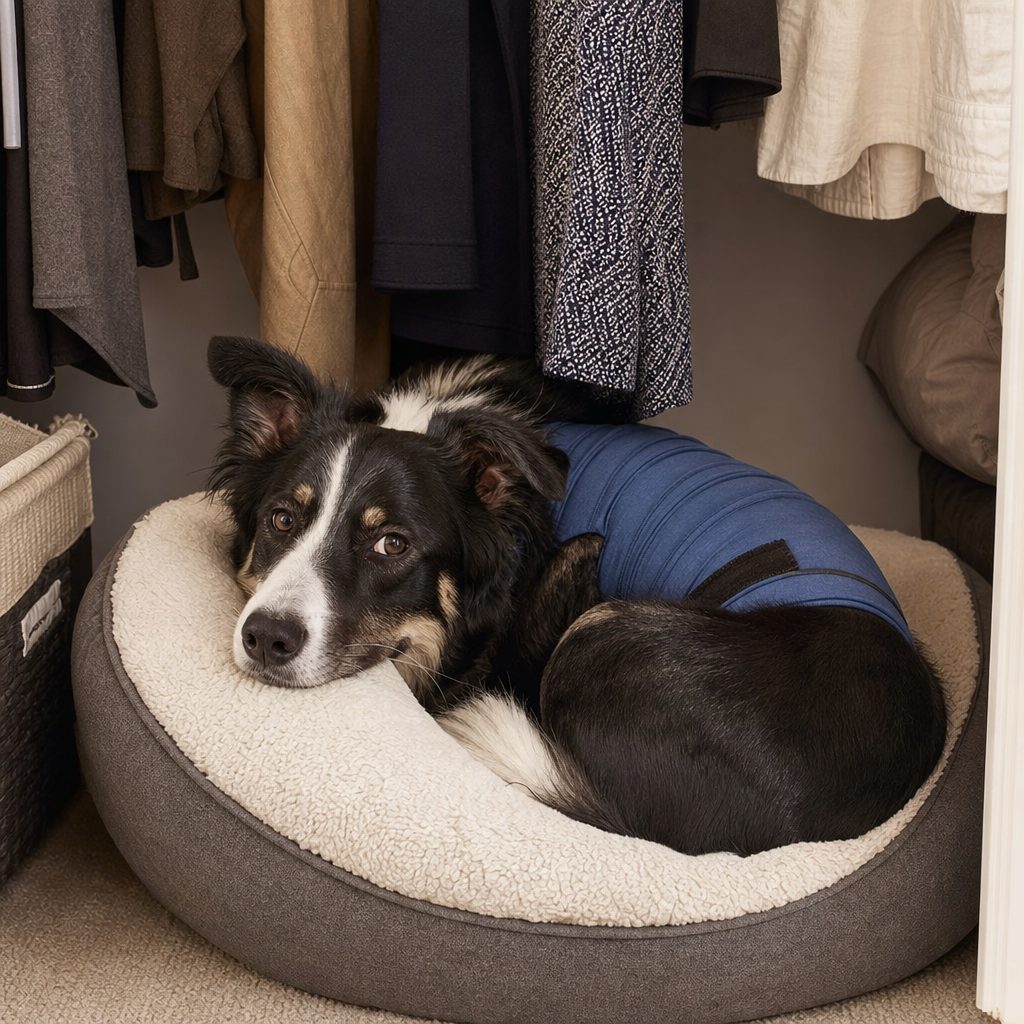
Long before the first firework or thunderclap, create a den. It doesn't need to be fancy. A walk-in closet with a dog bed, a crate covered in towels, a space under a large desk—any enclosed, darkish spot that muffles sound. Introduce it when the world is quuiet and pair it with amazing things: a bully stick, a frozen Kong, a soft blanket that smells like you. The goal is for your dog to choose that spot on their own when they're nervous. I wrote a whole thing about why your arthritic dog deserves the comfiest bed—same logic applies here. A supportive, cozy nest that's their safe zoe, not a punishment. If the only time they go there's when you're shoving them in during a storm, they'll associate it with terror.
The treat trick (counterconditioning in the trenches)
Here's the thing about a dog's brain during a noise event: it can't be in full panic mode and eat at the same time. Not if the food is high-value enough. I'm not talking about dry kibble. I mean stinky, delicious, slide-across-your-tongue stuff: tiny cubes of rtoisserie chicken, freeze-dried liver, cheese. If your dog has allergies, check out my homemade dog treats post—those recipes won't aggravate teir skin but are still worth caring about.
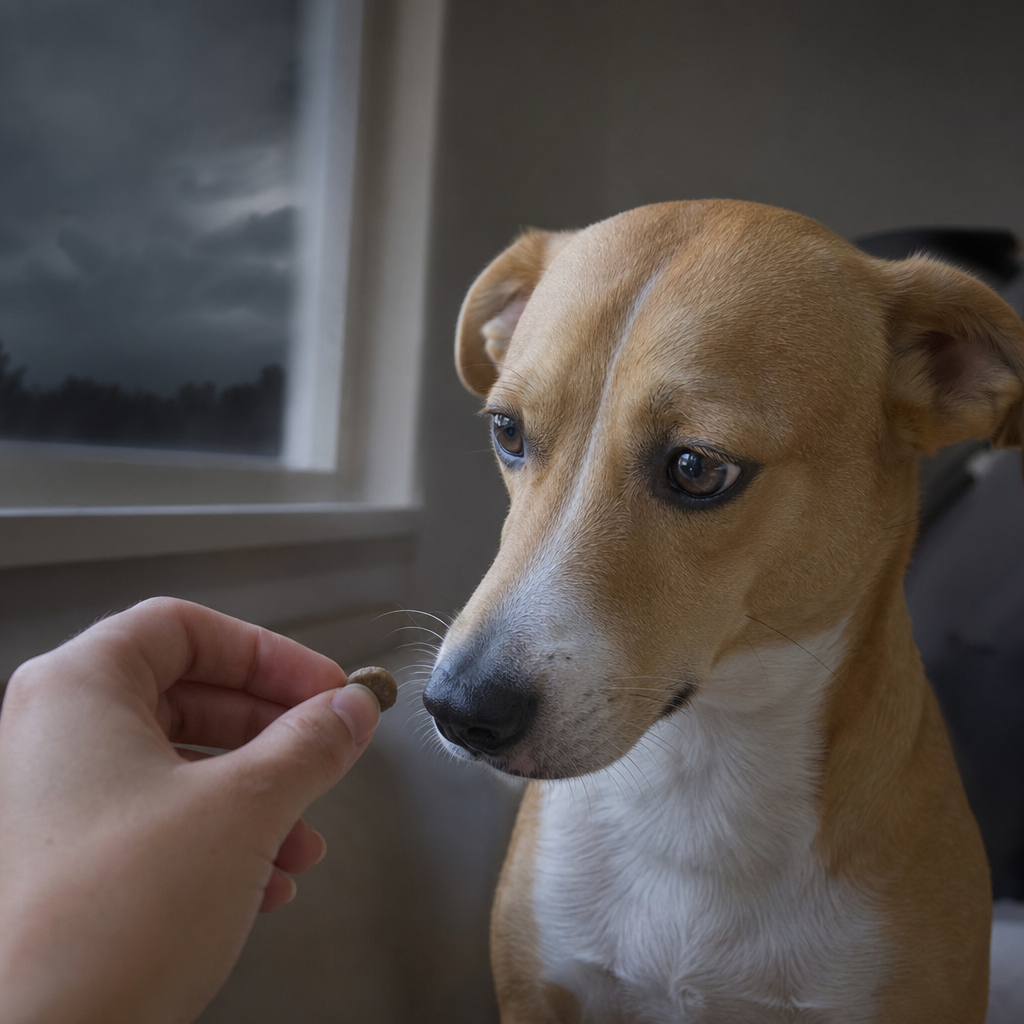
The second you hear thunder or fireworks in the distance—before your dog is a trmbling puddle—start a steady stream of treats. No commands, no expectations. Just treat, treat, treat. The noise happens, magic food appears. Over time, this rewires the reaction from "NOISE = PANIC" to "NOISE = CHICKEN." It takes patience. Weeks or months, sometimes. But it works more often than not.
Sound desensitization that won't make you cry
Download a thunderstorm or fireworks track. Play it at a volume so low you can barely hear it. If your dog even pauses in their chewing, it's too loud. Pump that volume up over days and weeks, so slowly you're bored, always paired with incredible stuff (meals, play, cuddles). The goal isn't to recreate a storm overnight. It's to teach the dog's brain that those sounds are irrelevant background noise.
I won't lie: ths is tedious. I gave up twice with one build because I rushed it. The mometn I got impatient and turned the volume up even a notch too fast, he slid back to square one. you've to be more stubborn than the phobia.
A brief, frustrated tangent about supplements
I recieved so many samples of "calming" prducts when I was at teh shelter. Chews with L-theanine, hemp oil, Zylkene, the works. Some owners swore by them. For mild cases, sure, maybe. But I've never met a dog with a true, full-blown noise phobia who was helped by a supplement alone. I had one dog eat a whole bag of calming treats (she broke into the pantry) and she still tried to tear the drywall down during a storm. The market is flooded with promises. If you want to try them, do it alongside real training, not instead of it.
Compression wraps: hit or miss
Thundershirts, anxiety wraps. I've used them on three dogs. One turned into a calm, floppy noodle the second I put it on. The second froze like a statue and still looked terrified but at least didn't bolt—a win, I guess. The third dog tried to eat it. So, your mileage may vary. I always suggest borrowing one before you buy it because alot of dogs just find the compression weird and stressful.
None of this works in a vacuum. Building trust is the backbone of everything. If your dog doesn't trust you to be their calm center, no amount of chicken will break through the pamic. And if they're digging at doors or destroying the yard when they're scared, check out my piece on digging—it's often coming from the same anxious place.
A Dog Named Daisy and the Thunferstorm That Changed Everything
In 2015, I worked at a county shelter where every sound echoed like a gunshot. Daisy was a border collie mix with one ear that flopped sideways and a stare that could cut glass. She was there for six months—too anxious to show well, too smart for the tiny kennel run. Whenever a thunderstorm rolled through, she'd launch herself at the kennel door over and over until her shoulders were raw. I started bringing her to the office on stormy days, the one room with no windows and slightly less concrete. I'd sit under my metal desk, a space barely big enough for me and a 35-pound dog, and she'd press her whole body against my legs. Her trembling would rattle the papers on top of the desk. I didn't have any brilliant strategy. I just sat there, drinking terrible coffee and reading emails on my phone, while she drooled on my shoes. For months, that was our ritual.
One afternoon, a sudden storm hit—no warning, the kind that rattles your teeth. Daisy's ears slicked back. Her eyes went wide. And then she did something I'll never forget: she walked over to me, nudged my hand, and leaned into my side. The trembling was still there but her eyes held a question, not just terror. She'd learned that my presence meant something. Not a cure. Not a fix. Just a lifeline. She taught me that sometimes all the training and supplements in the world matter less than simply being a calm, boring, dependable human in the chaos. She got adopted a few weeks later by a woman who lived in a quiet farmhouse with no near neighbors. Last I heard, Daisy still paces when thunder rumbles, but she does it curled on the woman's feet. That's not failure. That's love.
The Crap That Doesn't Work
Bach flower remedies, lavender oil diffusers, plug-in pheromone diffusers. If they worked for your dog, I'm genuinely glad. For my truly phobic fosters, they did jack-all. I've wasted definately over $200 on promising-looking bottles and gadgets. The market knows you're desperate and it will sell you garbage. Save your money for acutal training and, if needed, a vet behaviorist.
When It's Time to Call in the Big Guns
There's a point where all the cozy dens and roast chicken in the world can't touch the depth of a dog's panic. If your dog is hurting themselves, destroying your home, or so terrified they can't function for hours after the noise stops, you need a vet. Specifically, a vet whho's comfortable with behavior—or a veterinary behaviorist if you can afford it. I'm not a vet, I'm a blogger with dirty floors, but I've seen medication change lives.
My conversation with a veterinary behaviorist
My vet, Dr. Nguyen—she's tolerated my frantic calls through three dogs and a divorce—once sat me down after I'd spent a summer managing a build who regularly hyperventilated during storms. She said something that stuck: "Noise phobia in dogs is a panic disorder. We medicate humans for panic. Why wouldn't we do the same for an animal who's suffering?" That was the day I stopped feeling guilty about the little bottle of alprazolam she prescribed. For that dog, a fast-acting anti-anxiety medication given at the first hint of thunder meant the difference between terror and a quiet nap in the closet. It wasn't a failure. It was mercy.
The medication conversation no one wants to have
Some dogs need daily medication—SSRIs, tricyclics—to bring their baseline anxiety down enouhg that training can work. Others just need a situational calmer for the specific event. Every dog is different. What's critical is working with a vet who understands behavior, not one who'll hand you a bottle of acepromazine and send you on your way (ace will sedate the body but does zip for the fear, leaving a scared dog who can't move—nightmare fuel).
I've also had dogs who needed nothing prescription. My current big mutt, a shepherd mix with a head like a block of wood, used to pancake during storms. We did desensitization for months—slow and boring—with a solid den setup and I provided many pieces of cheese. He still doesn't love thunder but he no longer trembles. For some dogs, that's the best you can hope for. Traveling with a noise-phobic dog opens a whole other can of worms, by the way; I wrote about flying with Fido if you're navigating that particular disaster.
Living with a Noise-Phobic Dog (It's Not a Failure)
Some dogs never get completely over it. You board up windows during firework season, you run white noise machines, you plan vacations around storm forecasts. You become the person who checks the weeather not for your own sake but for your dog's. That's not weakness. It's not you being a crazy dog parent. It's adapting to the animal you love.
I think about Tank sometimes. He got adopted by a couple who lived in a quiet suburb and they built him a soundproofed nook under the stairs, complete with a memory foam bed and a Bluetooth speaker that played ocean sounds. They sent me a photo once of him snoozing through a July 4th cleebration, one paw twitching. It took them a year of slow work and meds and more chicken than I want to calculate. Tank wasn't cured, not exactly, but he was happy. That's the goal, isn't it? Not a perfect, unafraid dog, but a dog who feels safe enough to sleep while the world booms outside. If you're in the thick of it right now, cleaning up drool and splinters, just know that it can get better. There's a path, even if it's long and messy.
Alright, my build cat just kncoked over my coffee. I'm done.