I Thought My Puppy Was Stubborn. Turns Out I Just Had No Idea What I Was Doing.
I thought my puppy was broken. Turned out I was just teaching walks all wrong. Here's what actually works for the dog who plants his butt and refuses to move.
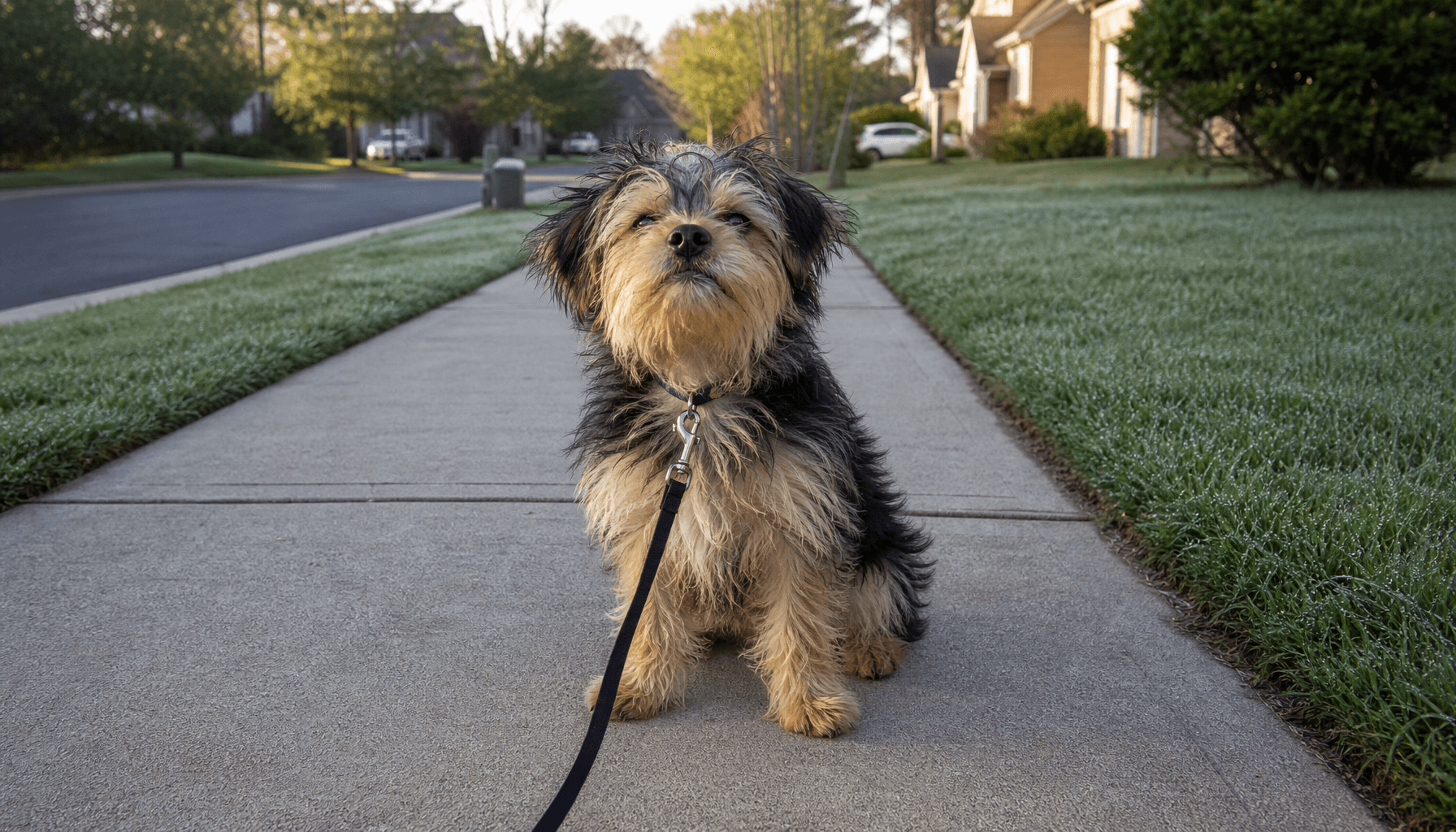
I was standing in my front yard at 6:42 a.m., pajama pants soaked with dew, holding a leash attached to a 14-pound creature who had decided that moving forward was a vioaltion of his civil rights. He planted his butt. He looked at me like I'd asked him to do calculus. And I — someone who'd fostered 40+ dogs, worked in a shelter, dropped out of vet tech school because I couldn't handle the cat anatomy exam — realized I'd never actaully trained a puppy to walk on a leash before. I'd only adopted adult dogs who already knew how, or I'd just carried the tiny fosters everywhere. This was new territory. And I was losing. Badly.
That puppy was Gus. A beagle-ish mix with the determination of a honey badger and the body of a potato. And for the first two weeks I had him, our walks consisted of me dragging him three feet, him flailing like a fish, then both of us sitting on the sidewalk questioning our life choices. I googled "leash train stubborn puppy" at 11 p.m. four nights in a row. The advice was… let's say unhelpful. "Be patient." "Use treats." Oh wow, thanks. Never thought of that.
Here's what I actually needed someone to tell me: the problem in't usually the dog. It's that we've been fed a fantasy of what leash training looks like — the golden retriever padding happily beside a smiling human on a sunlit path — and when our actual puppy acts like a furry anchor, we assume something's wrong. With the dog. With us. With the universe. But leash training a stubborn puppy isn't about walking. It's about teaching a tiny, impulsive animal that the weird string connecting you isn't a torture device. And that takes a completely different approach than what most of us try first.
I've now leash-trained six build puppies who came to me with zero skills and maximum sass. I've made every mistake listed below — some of them twice. And I'm going to tell you the stuff the cheerful YouTube traainers leave out. Like what to do when your puppy lies down mid-walk and refuses to move. Or when he bites the leash so aggressively you're pretty sure he's part shark. Or when you're on day 12 and it feels like you've made negative progress. That's all normal. You're not failing. You just haven't found the right weird trick for your specific weird dog yet.
Quick caveat: I'm not a vet. I'm not a certified behaviorist. I'm a rescue volunteer who's been covered in puppy slobber since 2009. If your dog has extreme fear or aggression, get a professional involved. This is for the run-of-the-mill stubborn puppy who'd rather sniff a single blade of grass for 45 minutes than walk in a straight line.
The Lie We All Believe About Leash Training
There's this idea that a puppy should just… get it. That if you put the leash on and walk confidently, the puppy will follow. I blame movies. I blame Instagram. I blame the neighbor with the freakishly obedient 12-week-old lab who makes it look effortless while you're out there wrestling a sentient potato on a string.
Walking on a leash is unnatural for dogs. Think about it. In what world would an animal voluntarily restrict its own movement to match the pace of a slow biped who stops to check their phone every 20 seconds? None. Leash walking is a skill that goes against pretty much every instinct a puppy has — explore everything, go at your own speed, follow interesting smells even if they lead into a bush. When your puppy pulls backward or sits down, he's not being "stubborn." He's being a puppy. He's communicating that this whole leash thing is confusing, or scary, or just not nearly as interesting as that dead worm three feet to the left.
So the first thing I tell people — and the first thing I had to tell myself — is to reframe the goal. You're not teaching your dog to walk on a leash. You're teaching him that being near you while the leash exists is a pretty decent experience. The walking part comes later, almost as a side effect. I know that sounds backwards. it's. But when I started thinking about it this way with Gus, everythong shifted. I stopped trying to cover distance. I stopped caring if we made it to the end of the block. I just stood there in my front yard, leash slack, feeding him shredded chicken every time he looked at me. That was it. Day one: chicken for eye contact. That's where we began.
And I'll be honest — it felt ridiculous. My neighbors definitely thought I'd lost it. I'd be standing motionless for 10 minutes while a puppy stared at me and got snacks. But that's the foundation. Without it, you're both just frustrated and pulling in opposite directions. With it, you're building a tiny bridge of communication. That bridge is what gets you actual walks later. Not a fancy use. Not a special leash. Just boring, repetitive, "you look at me, I give you something awesome" work.
The Gear You Acrually Need (And the Stuff You Can Skip)
Pet stores will sell you a thousand things. Most of them are unnecessary. Some of them will make your life harder. I've bought them all so you don't have to. Here's what survived the purge.
The leash and collar/use setup
Flat buckle collar + 6-foot standard leash. That's the starting point for most puppies. Not a retractable leash — those teach the opposite of what you want. They keep constant tension, which tells the puppy that pulling is just how walking feels. A fixed-length leash gives you control and gives the puppy clarity. I like 6 feet because it's long enough for sniffing breaks but short enough to manage in an emergency. For small puppies or brachycephalic breeds (pugs, frenchies), swap the collar for a Y-shaped use that doesn"t press on the throat. For dedicated pullers, I'll talk about front-clip harnesses and head halters in a minute — but those are tools, not solutions. They don't teach anything on their own.
My one strong opinion: skip the retractable leash entirely during training. I know they look convenient. They're not. I've seen too many puppies get tangled, spooked, or taught to yank because the tension never releases. And if you drop the handle? That plastic clattering behind them can trigger a full panic sprint. Ask me how I know. Actually don't. It involves a build pup named Meatball, a busy street, and the worst 12 seconds of my life. Everyone was fine, but I threw that leash in the trash the second we got home.
Treats: the real magic
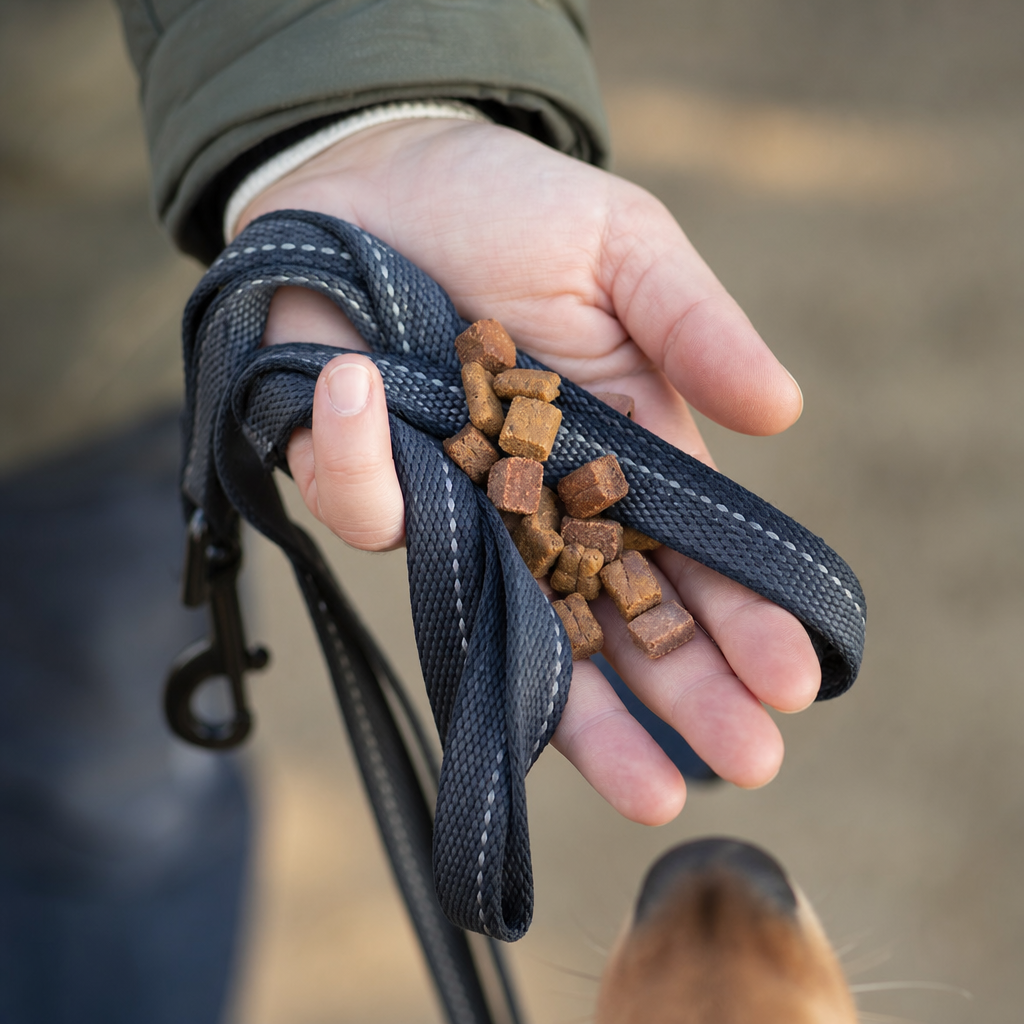
You need two tiers of treats. Tier one is your everyday training treat — small, soft, easy to chew fast. Think Zuke's minis cut into quarters, or bits of boiled chicken. Tier two is the high-value stuff. The "I'd walk through fire for this" treat. For Gus, that was freeze-dried liver. For another build, it was tiny cubes of string cheese. For a third, weirdly, it was blueberries. (I don't understand that dog. Blueberries aren't even that good.) The point is, you need a reward that's better than whatever distraction is out tere. The sniffy spot on the grass? Competing against kibble? Kibble loses. But liver? Liver might win. That's what you need.
I carry treats in a pouch on my hip at all times during training. Not in a pocket. Not in a bag I've to fumble with. Immediate access. The window between "puppy does the thing" and "puppy gets the reward" is about two seconds if you want them to connect the dots. Any longer and they're already thinking about something else. Puppies have the attention span of a gnat on caffeine. Speed matters.
The stuff I now consider optional
Clickers. Some people love them. I've used them. They work. But for leash training specifically, I find them cumbersome — you're already holding a leaash, treats, possibly a poop bag, and now you need a third hand for a tiny plastic box? No thanks. I use a verbal marker instead: a sharp "yes!" that means the same thing. It's free, requires no hands, and you can't lose it in the grass.
Prong collars, choke chains, shock collars. I'm not going on a rant about these right now because honestly I'm tired and my coffee's cold. But I'll say this: if you're using pain or fear to teach a puppy anything, you're teaching the wrong lesson. Especially on a walk, where you want them to feel safe and curious. A scared dog doesn't learn to walk nicely. A scared dog learns to shut down or fight back. Neither is the goal. So skip those. Even if your neighbor swears by them. Even if some trainer on TV uses them. Just… skip them.
The Week I Almost Gave Up (And What Finally Clicked)
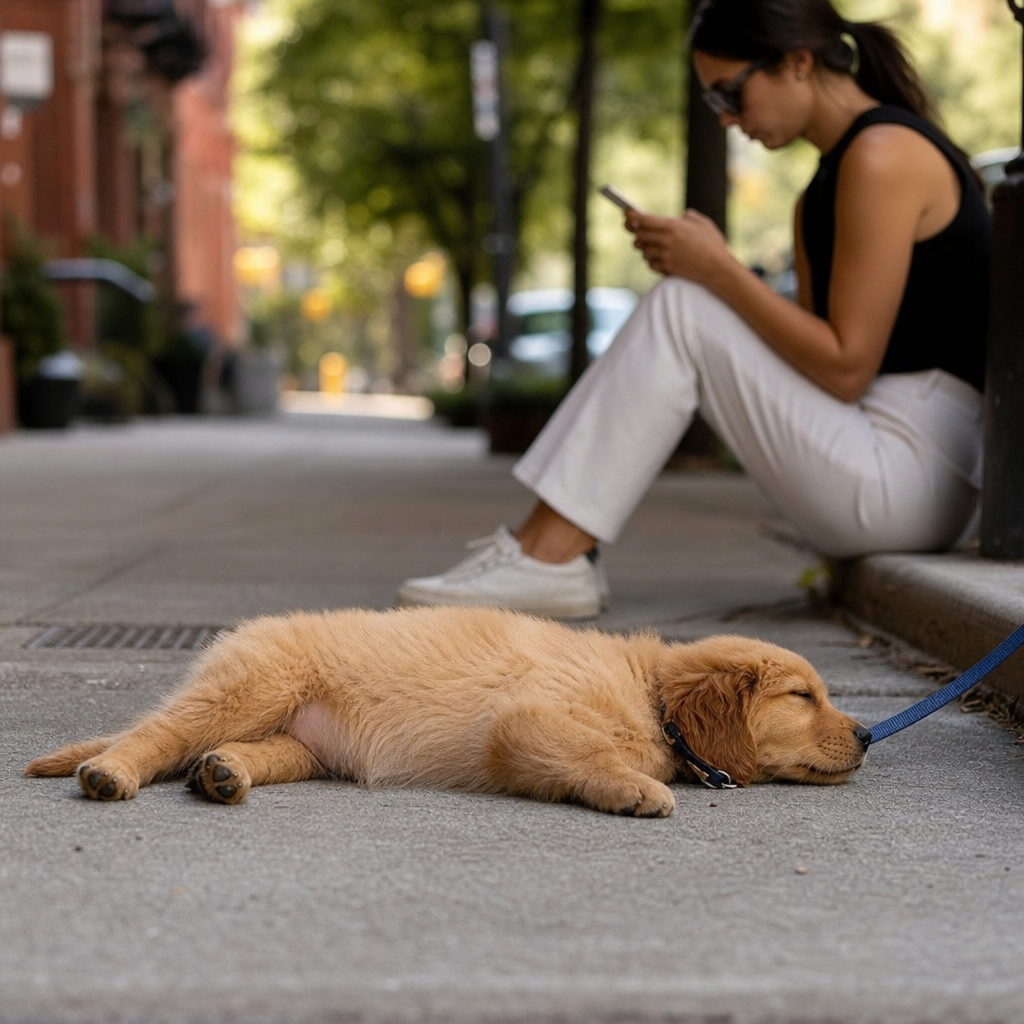
Day six with Gus. I was sitting on the curb in front of my house, leash loose, while Gus lay flat on his side like a furry puddle. We'd made it 10 feet from the front door. In twenty minutes. I'd tried lurng him with chicken. I'd tried excited voices. I'd tried the "walk away and he'll follow" method, which resulted in him just watching me walk away with a look of mild curiosity, then sniffing the ground. I was ready to accept that I'd just have a yard-only dog forever. Maybe we'd get one of those dog strollers and call it a day.
And then I did something my shelter mentor told me years ago and I'd completely forgotten: I stopped asking for forward movement entirely. I just sat down on the ground next to him. No expectations. No "come on, let's go!" Just me, on the damp concrete, scrolling my phone for ten minutes while Gus processed whatever was happening in his little brain. Eventually, he stood up. I didn't react. He took one step toward me. I said "yes!" softly and dropped a treat at my feet. He ate it. Another step. Another "yes," another trat. Within three minutes he was walking beside me — without pulling — because he'd decided it was his idea.
That was the pivot. I realized I'd been so focused on getting him to walk where I wanted to go that I'd missed the whole point. He needed to choose to be near me. Not be bribed. Not be dragged. Not be begged. He needed the mental space to offer the behavior on his own. That's when I dropped the whole "let's go on a walk" script and just started playing the Look At That game in the front yard for a full week. No destination. No distance goals. Just being outside together while the leash existed and nothing bad happened. And I know that sounds ridiculously slow. But here's the thing: after that week, we actually started walking. For real. Not far — maybe half a block — but without drama. Without the flailing. Without me wanting to cry in the azaleas.
That week of doing "nothing" was actually the most important training we did. I wish I'd done it from day one instead of wasting five days on power struggles. But that's how it goes. You screw up, you course-correct, you move on. The dogs are forgiving, even the stubborn ones.
The Games That Actually Teach Leash Skills
I hate the word "games" in dog training contexts. It sonds like we're making light of something serious. But honestly? Puppies learn through play. And these "games" are just structured exercises that build the behaviors you want without the puppy realizing they're in school. I've used every one of these with multiple dogs. They work.
The backyard follow game (no leash needed)
I start every puppy with this, usually before they ever see a leash. I go into the backyard — or a quiet, fenced area — and I just walk around. No commands. No treats yet. I meander. When the puppy follows me, I mark it ("yes!") and toss a treat behind me so they've to catch up. Then I change direction. If they follow, mark and treat. If they don't, I wait. No calling their name. No patting my leg. I want them to learn that keeping an eye on me and choosing to come along is rewarding all by itself. This exercise takes about three days of 5-minute sessions before the puppy is glued to my side like velcro. Then I introduce the leash — but in the yard, not on the sidewalk. Leash on, same game. Now they're learning to move with me while the leash is present, but there's zero tension because I'm not leading them anywhere. We're just wandering together.
That's the magic: they learn that being near you feels good and the leash is just a thinng that happens to be there. It's not a steering wheel. It's not a restraint. It's background noise. Once that concept is solid, the sidewalk becomes so much easier.
Silky leash drill (or "don't be a tree")
This one's for the pullers. The puppy who hits the end of the leash and keeps pulling like a tiny sled dog. Here's the rule: leash pressure means stop. The millisecond the leash goes tight, you become a tree. Plant your feet. Don't yank back. Don't say anythig. Just stop. The puppy will pull, maybe for a while. Eventually they'll turn to see why the walk stopped. The moment the leash goes slack again — even a little — mark and treat. Then move forward. Tight leash, stop. Slack leash, treat and walk. This is excruciatingly boring for the human. I've spent entire 15-minute "walks" progressing only 20 feet. But the puppy learns that pulling makes the fun stop and a loose leash makes the fun continue. It works. It just takes patience that I don't naturally have. I had to learn it alongside the dogs.
Pro tip: don't do this exercise when you actually need to get somewhere. You'll be late and furious. Pick a time when the only goal is the training itself. Otherwise you'll rush and undo the whole lesson.
The 180 turn (or "surprise, we're goig that way now")
If a puppy is fixated on something ahead and pulling, I don't fight it. I just pivot 180 degrees and walk the other direction with a cheerful "this way!" No corrections. No leash pops. Just an abrupt change of plans. The puppy has to disengage from whatever they wanted and come with me. When they do — mark, treat, keep walking. I'll do this 40 times in a session if needed. It's exhausting but it teaches them that paying attention to me is the only way to know where we're going next. And it completely sidesteps the tug-of-war dynamic that stubborn puppies love to turn into a game.
Gus hated this at first. He'd plant his feet and glare when I changed direction. So I'd just wait. Leash slack. Eventually he'd take a step my way because he was curious what I was doing. Treat. Repeat. After three days he stopped protesting and started watching me for cues. That's the goal — a dog who checks in with you instead of dragging you toward every interesting smell.
The scatter feed reset
Sometimes a puppy gets overstimulated and just can't function. You see it in their body: frantic sniffing, refusing treats, whale eye, sudden zoomies on the leash. That's not stubbornness. That's an overwhelmed puppy with a brain that's offline. When that happens, I stop everything. I scatter a handful of small treats in the grass and let them sniff and eat for two minutes. It's a decompression activity. Sniffing lowers heart rate and reduces stress. After a scatter feed, the puppy is often calm enough to try again. If not, we go home. Pushing through an overwhelmed state just creates negative associations with the leash. I'd rather cut a walk short than create a problem that takes weeks to undo.
I learned this the hard way after pusshing one build too far and getting a leash-biting, spinning, screaming meltdown on a busy street. I was mortified. The puppy was panicking. A scatter feed would've prevented the whole thing. Now I use it proactively — anytime I see the warning signs, treats go on the ground, we take a break. No shame in that.
When the Puppy Just… Won't. Move.
This is the signature move of the stubborn puppy. The sit. The lie-down. The "I've become one with the sidewalk and you can't make me" stance. It's infuriating in the moment, especially when you're already running late or it's raining or your neighbor is watching. But it's also one of the easiest things to fix once you understand what's actually happening.
Puppies do this for three reasons: they're scared, they're overwhelmed, or they've learned that planting themselves gets a reaction they want (usually you picking them up, or a big dramatic coaxing show that's basically entertainment). Figuring out which one you're dealing with is half the battle. Fear looks like: tucked tail, trembling, whale eye, ears back, trying to retreat. Overwhelm looks like: sudden shudown in a busy environment, ignoring treats they'd normally kill for. Learned behavior looks like: glancing at you to see if you'll react, loose body except for the planted feet, possibly a little tail wag like "haha, whatcha gonna do about it?"
For fear, you back off. Literally. Increase distance from whatever's scary. Don't drag them toward it. That destroys trust. For overwhelm, you do the scatter feed or just sit with them until they recover. For the learned behavior — the genuine stubbornness — I use a technique that feels counterintuitive but works: I stop engaging entirely. I stand still, hold the leash loosely, and look at the sky. I become boring. No coaxing. No treats. No eye contact. The game of "I refuse and you react" loses all its fun when you stop reacting. Within a minute or three, the puppy will usually get up to sniff something or check on you. That's when you casually walk a few steps in a new direction, mark, and reward. No fanfare. No "finally!" Just quiet reinforcement for making the choice to move.
This technique took Gus from daily sit-down strikes to maybe once a week, then never. He just stopped getting anything out of it. And I stopped stressing about it, which also helped. Stubborn puppies can smell your frustration. They feed on it like emotional vampires. Staying calm and boring is your superpower.
The Leash Biting Thing (Oh, This One's Fun)
I'd like to tell you that leash biting is a phase they outgrow automatically. Sometimes it's. Sometimes it's not. I had one build — a border collie mix named Pixel — who treated the leash like a tug toy for six straight weeks. Every walk was a baattle. She'd grab it, shake it, growl playfully, and look at me like "come on, this is the game, right?" It wasn't aggression. It was overarousal and a desperate need to do something with her mouth because herding breeds are basically walking teeth.
I tried everything. Bitter apple spray? She licked it off and looked at me like I'd insulted her ancestors. Trading for a toy? She'd take the toy, drop it, and go back to the leash. What finally worked was a two-pronged approach. One, I switched to a chain-link leash for a few weeks (the kind with metal links, not the choke chain — just the leash material). She bit it once, hated the texture, and stopped. Two, I gave her a job to do on walks: carrying a small stuffed toy in her mouth. She couldn't bite the leash if her mouth was already full. It looked ridiculous — this little black-and-white dog trotting around with a lamb chop toy hanging out of her mouth — but it worked. Walks became peaceful. After a month, I phased out the toy and she didn't go back to leash biting because the habit was broken.
If you can't use a chain leash (they're heavy for small puppies), you can try a double leash trick: attach one leash to the collar and a second lightweight leash to a use. They bite one, you drop it and pick up the other. Boring. No tug game. They learn fast that biting makes the leash disappear and nothing fun happens. Or do what a friend of mine did: run the leash through a short piece of PVC pipe near the clip so the puppy can't get a grip. It looks janky but it saved her samoyed puppy's leash from destruction. We do what we gotta do.
A Tangential Rant About Treat Pouchrs (And Why I've Owned Seven)
This has almost nothing to do with leash training but it's been on my mind. I've bought seven treat pouches in my life. Seven. Every single one promised to be the last treat pouch I'd ever need. Magnetic closure! Silicone lining! Clip for the lrash! The first one fell off my waist after three steps. The second one wouldn't stay open so I had to fight with it mid-walk while my dog lost interest. The third one got moldy because I forgot to empty it after a rainy walk and then I didn't notice for a week. The smell was… I can't describe it. Like death's refrigerator.
The treat pouch I actually use now is a $9 fanny pack from a drugstore. It has one big pocket. It zips. It doesn't smell like anything except dog treats and regret. Sometimees the best gear isn't dog gear at all. I just needed to say that out loud because nobody warns you that pet marketing will convince you to spend $40 on a silicone pouch with "ergonomic access" when all you need is a pocket that opens. That's the whole thing. Tangent over. Back to puppies.
Environmental Progressions Most People Skip (And Then Wonder Why They Fail)
The biggest mistake I see — and make — is trying to walk a puppy around the neighborhood before they're ready for it. The outside world is a carnival of distractions. Smells, sounds, squirrels, other dogs, skateboards, that one neighbor who revs his motorcycle at 7 a.m. for no reason. Expecting a puppy to focus on you in that chaos without working up to it's like expecting a toddler to do algebra while a marching band plays directly into their ears.
Here's the progression I use now, and I stick to it even when I'm impatient. Level 1: Inside the house. Just wearing the leash, dragging it around for 5 minutes at a time, treating whenever they check in. Level 2: Backyard or quiet enclosed area, same as the follow game. Level 3: Font yard during low-traffic times. Level 4: Sidewalk directly in front of the house, but only for 2-3 minutes. Level 5: Slowly extend the route, always retreating to an easier level if things fall apart. I spend at least a week on levels 1-3 before attempting a real walk. Sometimes two weeks. The timeline depends on the dog. There's no prize for rushing and a lot of problems you create by doing too much too soon. Gus spent 10 days in the front yard before we ever left the property. That felt agonizingly slow. But it's why he didn't fall apart when we finally ventured farther.
When you do start exploring, pick boring environments. A quiet cul-de-sac. An empty parking lot on a Sunday morning. A trail at an odd hour. Don't take a puppy-in-training to a busy park and expect good behavior. That's setting them up to fail, and you'll both end up stressed. I've done it. I've sat on a park bench with a puppy who was vibrating with overstimulation, wondering why I thought this was a good idea. It wasn't. Now I build the environment gradually and we always have a plan B (which is usually "go home and try again tomorrow").
What Nobody Tells You About Breed Tendencies
This isn't a breed-guide section. There are plenty of those. But I want to mention it because stubbornness looks different across breeds, and knowing your dog's background can save your sanity. My build Gus was part beagle, which meant his nose was in charge. Scent hounds were bred to follow their noses independently of human direction. So when Gus ignored me to track a smell, he wasn't being a jerk — he was doing exactly what his genetics programmed him to do. My approach had to account for that. I couldn't compete with the environment on scent alone, so I used higher-value treats and kept walks in low-smell areas until he'd built the habit of checking in. Even now, if his nose engages, I know I've temporarily lost him, and I just wait it out rather than fighting it.
Herding breeds like border collies and aussies are often "stubborn" in a different way: they want to control movement. They'll circle you, nip at heels, or try to herd you in a direction they think is correct. That's not defiance. That's a job instinct with no job to do. Give them a task — carrying a toy, "pushing" a ball, or even just learning that walking beside you is their job — and the behavior shifts. Terriers were bred to work independently, so they often just don't see why they should care what you want. That requires a lot of relationship-building and very creative rewards. Guardian breeds like mastiffs might just plant themselves because they're surveying for threats and not in a hurry. Understanding that your "stubborn" husky isn't the same as your "stubborn" dachshund isn't just trivia. It changees how you train them. I once made the mistake of trying to train a shiba inu like a labrador. The shiba inu looked at me like I'd insulted her entire family line. I had to completely change my approach: more choice, more independence, less repetition. She came around when I stopped acting like a boss and started acting like a respected partner. I'm still slightly afraid of her. But she walks beautifully now.
I'm not going to link every breed article here — okay, maybe I'll link a few. If you've got a beagle, border collie, siberian husky, or dachshund, read the breed-specific pages to understand the instincts you're working with. It helps, I promise. Knowing that a dachshund was bred to go into badger dens and make independent decisions explains so much about why they don't naturally look to you for direction. They're not stubborn. They're just… self-employed.
Another Tangent: My build Who Was Suddenly Terrified of Leaves
I need to tell you about Mabel. Mabel was a 5-month-old lab mix who came to me after being found as a stray. She was confident and sweet and within two days she was walking on a leash like a dream. Then, on day four, we were walking past a pile of leaves and a gust of wind made one skitter across the sidewalk. Mabel lost her entire mind. Screaming, scrambling, trying to bolt. I had to carry her home while she shook. For the next three weeks, she was terrified of leaves. Only leaves that moved. Stationary leaves were fine. But a blowing leaf? The apocalypse.
What does this have to do with leash training? Well, everything. Because sudden fears crop up out of nowhere with puppies. One day they're fine with something; the next day it's the scariest thing in the world. And when that fear appears on a walk, you can't just push through it like you might with simple stubbornness. I had to stop all walks on windy days. I had to sit with Mabel on the porch and feed her chicken every time a leaf blew past. For weeks. It was maddening. But if I'd dragged her past the scary leaves, I'd've taught her that walks are terrifying and I can't be trusted. So we took the long, slow road. By the time she was adopted, leaves were neutral again. Because we respected the fear instead of fighting it. I'm not saying every stubborn moment is a secret fear. But pay attention. The difference between "I don't wanna" and "I'm genuinely scared" is the difference between a training challenge and a trauma you'll be undoing for years.
The skills from that experience came in handy later when I dealt with a puppy who was afraid of storm drains, which I wrote about in relation to fear of thunder and loud noises. Noise sensitivity and fear of strange objects often run together. Leash training is rarely just about the leash. It's about the whole world the puppy encounters while on that leash. And you, as the handler, have to be the safe base they can return to. If you're yanking them toward something scary, you're not a safe base. You're just another stressor. That's when walks become battles and no one wins.
What to Do on Days When Everything Goes Wrong
You'll have them. Days where your puppy forgets everything he's learned. Days where you lose your temper. Days where you come home and cry into a pillow because you just wanted a nice walk and instead you got dragged into a bush and your arm hurts and the puppy ate something off the ground and you're pretty sure it was cat poop. These days happeen. They don't mean you're a bad owner. They don't mean the training isn't working. They just mean you're both having a bad day.
My rule: when a walk is spiraling, I quit. I don't try to salvage it. I don't push through to "teach resilience." I turn around, go home, put the puppy in his crate or playpen, and I go make myself tea or coffee or something with carbs. The puppy won't remember the failed walk tomorrow if you don't make it a traumatic event. But he might remember if you keep going and the frustration escalates. I learned this from my vet, Dr. Nguyen — she's put up with my panic calls for over a decade, through three dogs and a divorce — who once told me "you can't train a stressed brain." That applies to humans too. If I'm frustrated and the puppy's over threshold, nobody's learning anything. We're just practicing being upset together. That's not useful.
On those days, I'll swap the walk for a different activity: a puzzle toy, a short game of tug inside, a session of "find the treats" hidden around the living room. The puppy still gets mental stimulation. I still get to feel like I did something. And we try again tomorrow with a clean slate. Grudge-holding isn't a dog thing. They live in the moment. One bad day is just one bad day.
By the way, if you're dealing with a puppy who also destroys things out of boredom or frustration — you know, the kind of dog who would eat your entire shoe collection — I wrote about that too, after losing $600 in shoes. You can read it here. Because yes, a mentally understimulated puppy is often the same pupy who refuses to walk nicely. The two problems feed each other. Enrichment inside the house makes outdoor training easier. It's all connected.
When to Get Help (And What Kind)
I'm stubborn myself, so I tend to try to figure everything out alone. But there are times when a professional is the right call. If your puppy's "stubbornness" includes growling, snapping, biting hard enough to break skin, or shutting down completely for days on end, you're not dealing with typical puppy stuff. You might be dealing with fear aggression, severe anxiety, or a medical issue. A vet visit should come first. Pain can make a dog refuse to wakk. A puppy with hip dysplasia might plant himself because moving hurts. A puppy with an ear infection might be dizzy or disoriented. Rule out physical causes before you assume it's behavioral.
Then, find a certified positive reinforcement trainer or a veterinary behaviorist. Not the neighbor who "used to breed rottweilers." Not the dude on YouTube who talks about "dominance." Someone with actual credentials. I've had good luck with trainers who use force-free methods and will come to your home to see the behavior in context. They can spot things you're missing — maybe your timing is slightly off, maybe you're inadvertently rewarding the wrong thing, maybe the environment needs management you haven't thought of. It's worth the money. I've spent hundreds on trainers over the years and never regretted a single dollar. The times I didn't get help early are the times a problem got worse and more expensive to fix later. That's your csll, but I'd rather you hear it from someone who's made the expensive mistakes already.
And remember: some puppies just need more time. My friend adopted a german shepherd puppy who was a nightmare on leash for six months. Lunging, biting, spinning. She worked with a trainer consistently, did everything right, and still felt like a failure. Then around 9 months old, something clicked. The brain matured. All the training she'd done suddenly "took" and the dog became a dream on walks. She'd been building the foundation the whole time; it just needed the neurological development to catch up. That's true for a lot of puppies. You're not failing just because the results aren't immediate.
A Short Note That I'm Just Putting Here Abruptly
One time I fostered a puppy who learned to walk perfectly on leash in three days. No joke. I didn't do anything special. He just… got it. I was suspicious for weeks, waiting for the catch. The catch never came. Some dogs are easy. If you end up with one of those, don't thnk you're a training genius. And if you end up with a difficult one, don't think you're incompetent. Dogs are individuals. This is random chance dressed up as skill. Stay humble either way.
What the Long Game Actually Looks Like
Leash training doesn't end after the puppy walks nicely around the block. It's a skill you maintain and proof for the rest of the dog's life. Adolescence hits around 6-18 months and can undo a lot of your hard work — suddenly your sweet puppy is a teenage jerk who "forgets" everythhing and tests every boundary. That's developmentally normal. Go back to basics when it happens. Shorter walks. Higher-value treats. More frequent reinforcement. It's not regression; it's a phase you ride out with consistency.
I still carry treats on walks with my adult dogs. Not because they need constant bribing, but because I want them to know that checking in with me is always worthwhile. When my 8-year-old lab mix looks back at me on a hike, she gets a treat. That's a habit I built over years, and it pays off when we encounter a deer or a loose dog and I need her attention immediately. The stuff you do in puppyhood scales up. It's not wasted efgort. Even the frustrating, 20-feet-in-15-minutes walks are building something that will serve you for the next decade.
I don't believe in "finished" training. I believe in ongoing relationships where you're always communicating. Gus is 2 now. He walks on a loose leash 95% of the time. The other 5%? He still sometimes plants his butt when he sees a squirrel and I just stand there, look at the sky, and wait. I don't get mad anymore. I just remember that little potato on the sidewalk and how far we've come. And I give him a second. He usually decides the squirrel's not worth it and trts over to see if I've treats. I do. I always do.
Anyway. I've written way too much. My coffee is beyond cold and my build cat, who's been judging me from the windowsill this entire time, has started knocking things off the shelf for attention. So I'll leave you with this: the stubborn puppy isn't borken. You're not failing. You just haven't found the right language yet. Keep experimenting. Keep being boring when they want drama. Keep rewarding the tiniest bits of progress. It adds up. I've seen it happen with dogs who made me question every life choice. They get there. you'll too.