I Lost $600 in Shoes Before My Puppy Learned to Stop Chewing — Don't Be Me
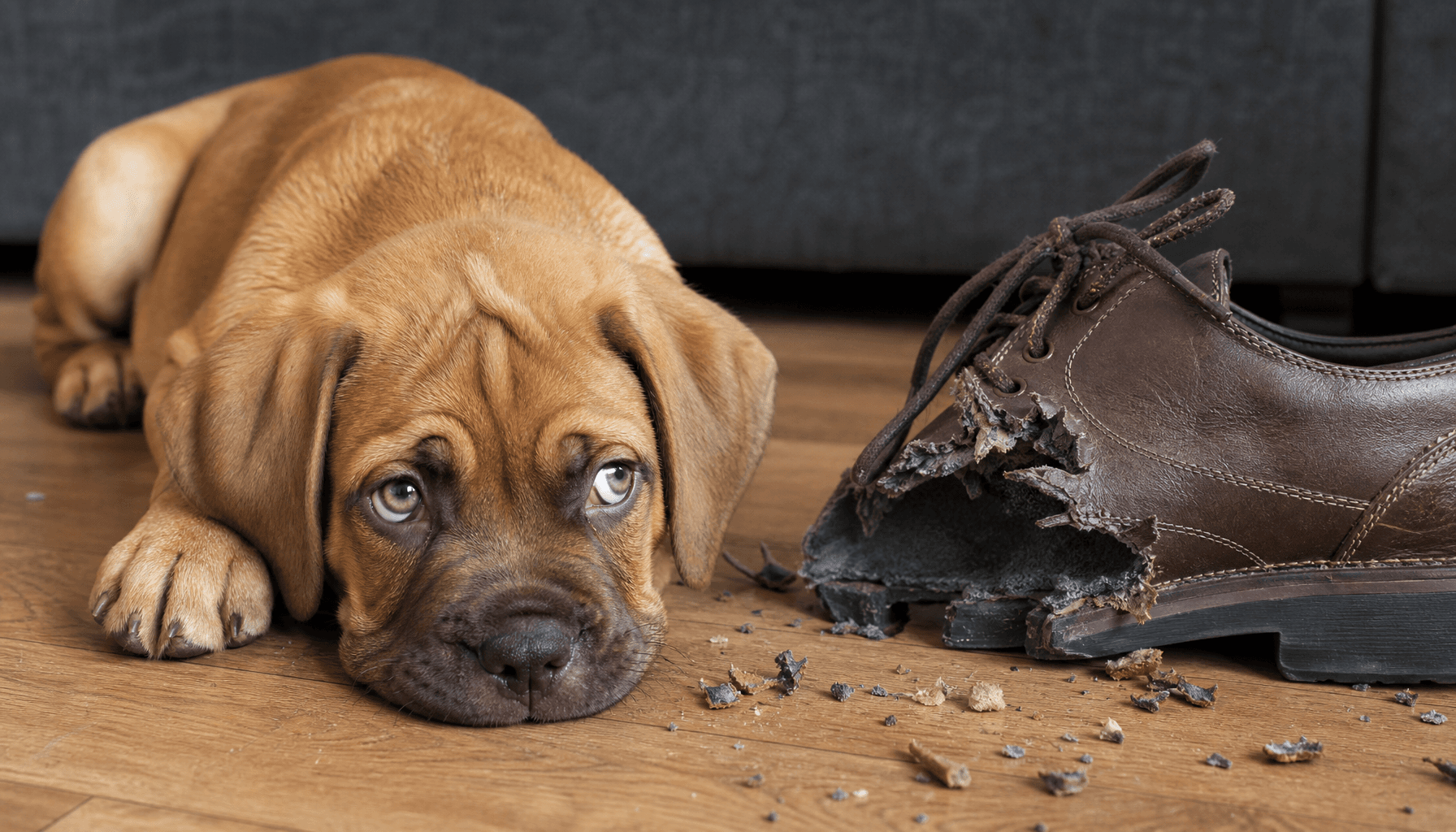
I found my leather boot in three pieces under the couch. If your puppy's destroying shoes, I've made every mistake so you don't have to. Here's what actually works.
My first real pair of grown-up heels cost me two weeks of tips at the shelter. Black suede, three-inch block heel, soft as butter. I wore them exactly once — to my sister's wedding — and then I did the thnig every dog owner swears they'll never do. I kicked them off by the front door instead of putting them in the closet. The next morning I found the left heel in the hallway, the right one chewed into three separate pieces, and a very proud 14-week-old border collie mix wiggling on top of what used to be the toe box.
I sat on the floor and cried. Not because of the shoes — well, okay, partly because of the shoes. But mostly because I'd worked in animal rescue. I'd fostered thirty-something puppies by that point. I was supposed to know what I was doing. Yet here was my own puppy, a little monster named Ripley, treating my closet like a chew buffet. That was seven years ago. Since then I've fostered even more, made every mistake there's, and finally figured out what actually stops a puppy from treating your footwear like a personal snack. I sttill lose the occasional flip flop, but I haven't cried over a shoe since. Here's what I wish someone had told me from the start.
The First Time I Found a Shoe In the Backyard
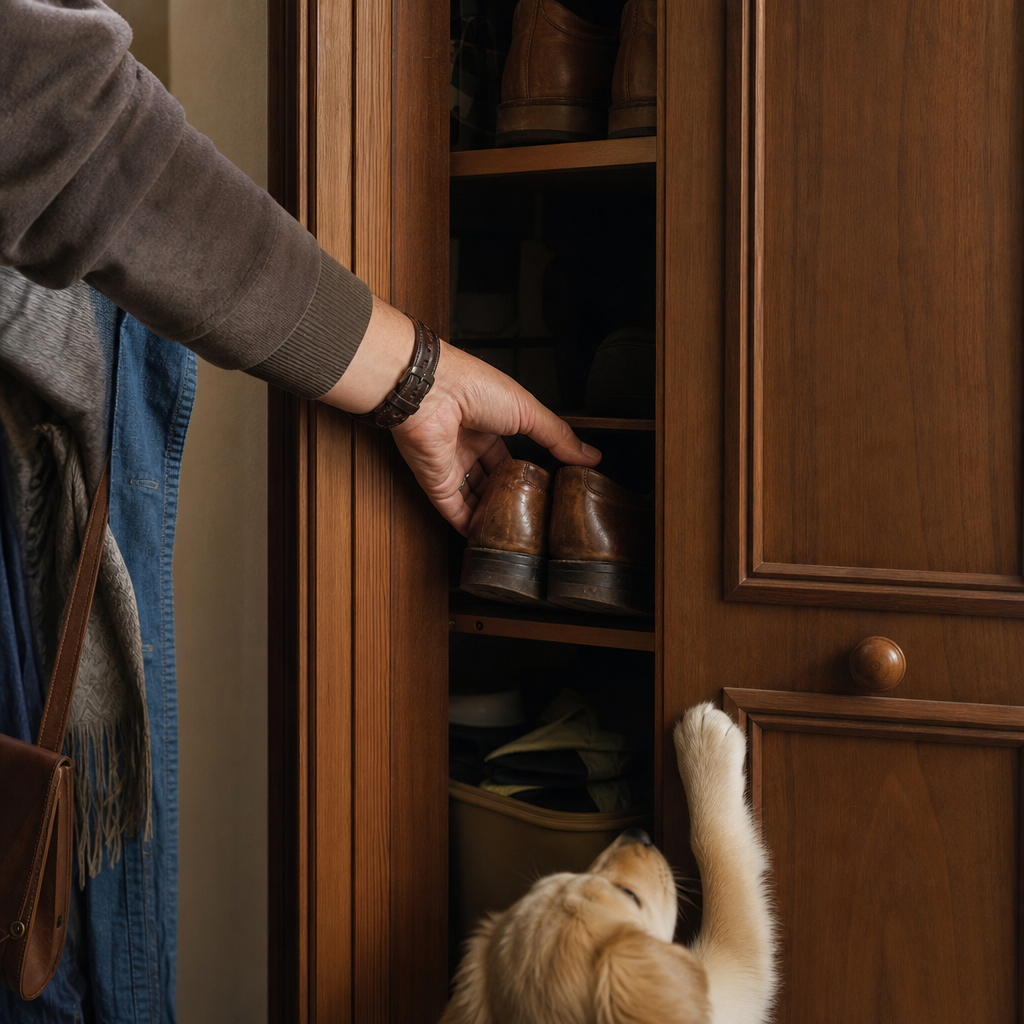
It was a Tuesday, which for some reason is when all puppy disasters happen in my house. I'd left Ripley in the kitchen with a baby gate, a stuffed Kong, and what I thought was a puppy-proofed space. She lesrned to climb the gate — I'm still not sure how — and spent her two hours of alone time methodically removing every shoe from the rack by the back door. Most of them she just carried outside and dropped in the grass. One Converse sneaker she buried under the hostas. The leather sandal I brought back from a trip to Portugal? That one she actually chewed the strap clean off. I found it floating in the water bowl like a drowned mouse.
Here's what went through my head, in order: rage, despair, the frantic Google search for "puppy intestinal blockage symptoms," and then the slow, sinking realization that this was my fault. I'd given a teething puppy with the brain of a fluffy piranha unlimited access to objects that smelled intensely like me. Of course she chewed them. She wasn't being bad; she was being a baby with needle teeth and zero impulse control. That distinction — between a dog who's "misbehaving" and a dog who's just doing normal puppy stuff — is basically the whole game. Once I understood that, everything got easier. Not easy, but easier. And yes, I did call my vet in a panic, which is how I ended up with Dr. Nguyen's voice permanently etched into my memory, calmly explaining that leather is technically diigestible but I should probably monitor Ripley's poop for the next 36 hours. If you've ever had to do that, you know the unique horror. I brought it up later when I wrote about the night my other dog licked his incision open at 3 AM — it turns out my life is a series of vet-adjacent panic attacks.
Why Puppies Chew Shoes (And Why 'No!' Doesn't Work)
Standing in the middle of your living room yelling "No!" at a puppy that has your $120 running shoe clamped in its jaw — I've done it, you've done it, we all do it. It's practically a reflex. But here's the prolbem: your puppy doesn't speak English, doesn't understand why shoes are valuable, and is operating almost entirely on instinct. To a puppy, a shoe isn't a shoe. A shoe is a delightful, smelly, perfectly textured chewing object that showed up on the floor at jaw height. You're getting mad at a creature that's basically a toddler with a tail.
They're Not Being Jerks, They're Being Babies
Puppies explore the world with their mouths the same way humans explore with their hands. Everything goes in the mouth. The texture of leather, the resistance of rubber, the satisfying give of an insole — it's all senosry information. Add teething pain on top of that and you've got a small animal in genuine discomfort who has discovered that gnawing on something firm but yielding feels good. Why wouldn't they chew a shoe? The shoe is perfect. The shoe is asking to be chewed. Your puppy doesn't hate you; your puppy has found the world's best free teether and doesn't understand why you keep trying to take it away.
I used to think Ripley was spiteful. She'd look me right in the eye while chewing my slipper — I was convinced she knew. but she didn't know. She'd just learned that when she had something in her mouth, I paid attention to her. For a high-energy border collie puppy, even negative attention was rewarding. So me storming over and wrestling the shoe away was actually training her to steal shoes. I was playing right into her tiny little paws. That's the kind of painful irony that makes you want to scream into a pillow.
That Delicious Human Scent
Shoes smell like you. Intensely. There's sweat and skin cells and that unique personal odor your dog associates with safety and love. When you're gone, your shoes are the next best thing to cuddling your feet. Puppies with separation anxiety or just mild FOMO will gravitate toward anything that carries your scent. This is also why they steal your underwear and why your favorite hoodie is covered in tiny tooth holes. It's not about possession; it's about comfort. Understanding this changes the whole approach. You're not just managing a behavior — you're addressing an emotional need. A puppy who chews shoes may be telling you she's lonely, understimulated, or stressed. Or all three. Or she's just a normal puppy who discovered something fun. Figuring out which one is the real work.
Teething Pain Is Real
Puppies start losing their baby teeth around 12 weeks and the whole process can last until they're 6 months old. That's months of sore, inflamed gums and the constant urge to chew. If you've ever had braces tightened or a wisdom tooth coming in, you know the dull ache that only pressure seems to relieve. Puppies feel the same thing but they don't know why, they just know chewing helps. Cold things help too, but we'll get to that later. First we need to stop the bleeding — metaphorically and lierally, because puppy teeth are sharp enough to draw blood even when they're not trying.
A Quick Note About Breed Tendencies
Some dogs are mouthier than others. Retrievers, herding breeds, terriers — they were literally bred to use their mouths. Ripley's a border collie mix and her default setting is "put things in mouth and move them." Knowing this doesn't give you a free pass, but it does help you stop taing it personally. A Lab chewing your shoe isn't broken; it's just following a century of genetic programming to hold things gently in its mouth. You're working against instinct, so give yourself — and the dog — some grace.
Stop the Bleeding: How to Protect Your Shoes Right Now
Before we talk about training, we need to talk about management. You can't train a behavior you can't prevent. Every time your puppy successfully steals and chews a shoe, the behavior gets reinforced. It felt good, it tasted interesting, it got a reaction — all of that makes the shoe-chewing habit strongeer. So step one isn't training. Step one is removing access.
Shoe Jail: Not As Mean As It Sounds
For the first six months of Ripley's life, every shoe in my house lived in a closed closet. The closet doorknobs had childproof covers on them because she learned to open doors — another unexpected skill. My guests thought I was insane when they came over and I confiscated ther footwear at the door, but no one thought it was insane after Ripley decimated a pair of my niece's ballet slippers during a family dinner. (That was a whole thing. My sister didn't speak to me for a week. The slippers were for a recital the next day. I drove 40 minutes to buy an identical pair and still owe karma points for that one.)
The point is, shoe jail works. Put shoes in a closet, behind a closed door, or in a bin with a lid. Don't leave them by the door, under the coffee table, or in the bathroom. If you can't commit to this for at least the first year, accept that you're going to lose some shoes. That's not judgment — that's math. Puppies are faster and more persistent than your tired brain at 7am. I know becasue I'm not a morning person and I've sacrificed more than one pair of cheap flats to the puppy gods.
The Spray That Worked (For One of My Dogs)
I've complicated feelings about deterrent sprays, which we'll get into. But there's one product that helped with a particularly determined build puppy who could open cabinets (yes, really) and would find shoes no matter where I hid them. It was a citrus-based spray — I recieved a sample from a rep at a conference and rolled my eyes so hard I nearly sprained something. Then I tried it on an old sneaker during a training session and the puppy recoilled like I'd offered her a lemon. Results may vary wildly, which is why I'm not even going to name the brand. What I'll say is this: if you're going to try a spray, test it by letting your puppy approach the sprayed object while supervised. Some dogs will avoid it. Some will lick it enthusiastically and then look for more. You'kl find out which category your dog falls into within about fifteen seconds.
Rotate Toys Like You Rotate Tires
Puppies get bored. A toy that was fascinating yesterday is dead to them today. Keep a stash of chews and toys and swap them out every few days so there's always something "new." When Ripley was at her worst, I had three baskets of toys on rotation — one out, one in the closet, one in the freezer. Yes, the freezer. Frozen rope toys, frozen Kongs, frozen carrots — anything cold that she could gnaw on when her gums were on fire. More on that later. For now, just know that a well-stocked toy rotation is like a distraction arsenal. You want your puppy to walk into a room and think "oh hey, a thing I'm allowed to chew" before they ever notice your shoes.
When You Catch Them in the Act
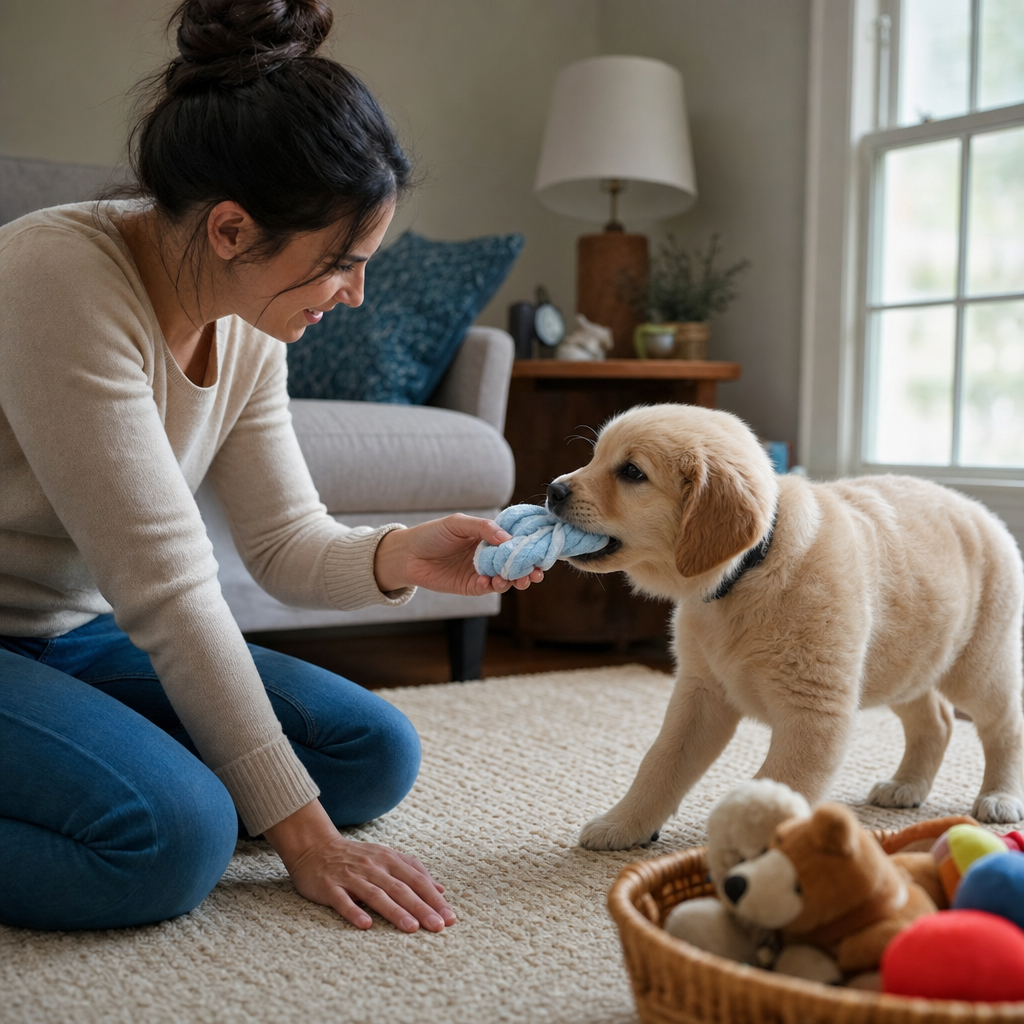
Here's the short version: don't chase, don't yell, don't grab. You turn into the most boring, uninteresting statue in the room. Then you grab a high-value treat, call your puppy's name in a ridiculously cheerful voice, and trade the shoe for the treat. Practice "drop it" separately when there's not a $300 boot involved. If you chase, you're pkaying. If you yell, you're terrifying. Neither teaches what you actually want.
Redirecting: The Thing That Actually Works (When You Do It Right)
Redirecting sounds simple: puppy goes for shoe, you offrr toy instead, everyone claps. In reality, redirecting is a timing puzzle that took me months to get right. The key — and I can't stress this enough — is catching the puppy before the shoe is in their mouth. If the shoe is already in their mouth, you're not redirecting; you're trading. Trading is a fine skill but it's not the same thing. Redirecting is about interrupting the thought. The puppy looks at the shoe, takes a step toward the shoe, and in that split second you produce an irresistible squeaky toy and make it the most exciting thing in the world. Do that consisstently for a few days and some puppies will start looking for the toy instead of the shoe.
The Swap Technique
Some puppies are too quick, and you'll find yourself in possessioon of a shoe already being enthusiastically destroyed. This is where the trade comes in. Never pry the shoe out of their mouth — that teaches resource guarding and makes the shoe more valuable. Instead, grab something better than the shoe. Chicken, freeze-dried liver, a bully stick — whatever your puppy would commit minor crimes for. Wave it near their nose, say "drop it" in a calm voice, and the moment they release the shoe, mark with a "yes!" and give the treat plus the alternative toy. The sequence: shoe in mouth → you produce amazing thing → puppy drops shoe → you reward generously. Over time, puppy learns that dropping things when asked is the best deal ever. I've used this with aggressive chewers, resource guarders, and one particularly stubborn dachshund who thought all shoes belonged to him. It works. It's slow, but it works.
Why Timing Matters More Than the 'Right' Toy
I wasted motnhs buying different chew toys, convinced that if I just found the perfect texture, Ripley would lose interest in shoes entirely. I bougth things I later wrote about in my $200 vitamin fiasco — not vitamins, but the same pattern: throw money at a problem instead of addressing the root cause. The root cause wasn't the wrong toy. It was that I'd show up with the toy five seconds too late, when Ripley was already mid-chew and fully committed. By then, the shoe had already won. Timing turned out to be the whole ball game. I had to learn to watch her body language — the ear twitch, the focused stare, the little bounce-step that meant she'd spotted contraband. Interrupt at that stage and you've got a chance. Wait untill she's got the shoe and you're already in trading mode.
My Failure with a Kong That Changed Everything
There was a week where Ripley chewed through four shoes in four days. I was losing my mind. I'd filled a Kong with peanut butter and left it for her in her crate, thinking that would satisfy her chewing urge. She ignored the Kong, broke out of her crate (I still don't know how), and chewed a hole in my backpack. I sat on the kitchen floor and genuinely considered giving up. Then my former boss from the shelter — a woman named Marjorie who'd been training dogs since before I was born — assked me one question: "Where was the Kong?" I told her it was in the crate. She said, "So you gave her a Kong in a place she already didn't want to be, and you're surprised she didn't care about it?" That hit me like a brick. I'd been offering the "right" thing in the wrong context, at the wrong time, and expecting it to work. The next day I started handing Ripley the Kong the moment she got up from a nap, when she was relaxed and receptive. She chewed it for 40 minutes and ignored the shoe rack entirely. Context isn't everything, but it's close.
My Dog Thought Bitter Spray Was a Condiment
I need to rant about bitter apple spray for thirty seconds. Everyone recommends it. Every forum, every puppy book, every well-meaning neighbor. So I bought a bottle, sprayed it on an old boot, and set it out for Ripley. She sniffed it, licked it, made a face like she'd just sucked a lemon, and then kept licking it. I swear she treated it like hot sauce. Some dogs find bitter flavors aversive, some find them mildly interesting, and a few — like my weirdo — apparently enjoy the novelty. Don't rely on sprays. They're a gamble, not a solution.
Teething, Boredm, and Anxiety: Figuring Out Which One You're Dealing With
Not all shoe chewing is the same. A puppy who chews shoes because her gums hurt needs different interventions than a puppy who chews shoes because she's under-exercised, which is different from a puppy who chews shoes because she panics when left alone. If you treat all three the same way, you'll fail at all of them. I failed at all of them before I learned to read the context. Here's how I eventually sorted it out.
The Schedule Test
Track when the chewing happens. If it's predictable — always after you leave, always between 4-6pm, always right after dinner — that's a clue. Separation-related chewing usually happens in the first 20 minutes you're gone. Boredom chewing often happens in the late afternoon or evening when energy builds up. Teething chewing is more random but often increases when the puppy is tired or just waking up (think cranky toddler). I kept a sticky note log for two weeks and the pattern smacked me in the face: Ripley chewed things when she was overtired and I'd missed her naptime window. Enforced naps solved more problems than any toy I ever bought.
The Frozen Washcloth Trick I Stole from a Vet Tech
If it's teething pain, cold things are your best friend. I soaked a clean washcloth in water, twisted it into a rope, froze it, and handed it to Ripley during her worst teething phase. She chewed it for an hour straight, passed out cold, and woke up a different dog. Frozen carrots, frozen Kongs with wet food, frozen rope toys — the cold numbs the gums and the chewing satisfies the pressure. This is the single most effective thing I've ever done for a teething puppy, and I learned it from a vet tech named Lisa who saw me struggling and just handed me a frozen washcloth wordlessly. Sometimes the best advice doesn't come with a lecture. It comes in the form of a soggy piece of terrycloth.
If the cause is boredom, the solution is more mental stimulation, not just more physical exercise. A exhsusted puppy can still be a bored puppy. Puzzle feeders, training sessions, snuffle mats, flirt poles — things that engage the brain, not just the legs. I wrote a whole separate post about the digging dilemma that's basically the same conversation with a different outlet. Destructive behaviors are ofen a sign that a dog's brain needs a job, not just a walk.
What Never Worked for Me (So Stop Wasting Your Time)
I tried a lot of things. Most of them were garbage. Here's a quick list so you can skip the expeensive trial-and-error phase I went through.
- Shoe-shaped chew toys. Cute idea, genuinely terrible execution. The puppy doesn't want someething shaped like a shoe; the puppy wants your shoe with your scent. Giving them a fake shoe just teaches them that shoe-shaped objects are chew toys. Congratulations, you've trained your dog to eat all your Crocs.
- Squirting them with water. Creates a dog who's afraid of the spray bottle, not a dog who undertands that shoes are off limits. Also, wet floors and resentment.
- Rubbing their nose in the destroyed shoe. I shouldn't even have to say this, but peole still do it. This doesn't teach anything except that you're scary and unpredictable. If you've done this out of frustration, I get it — but please don't do it again. All it teaches is fear.
- Scolding after the fact. You come home, see the carnage, and yell. Your puppy has no idea why you're angry. The chewing happened hours ago. The connection between the action and the consequence is zero. All you've done is made your puppy anxious about your return.
The Long Game: Building Habits That Survive Puppyhood
You can survive the puppy chewing phase with good management and a lot of deep breaaths. But if you want a dog who never chews shoes, even when you accidentally leave them out, you're playing a longer game. That game is about building habits, not just breaking bad ones. It's about teaching your dog what to do when they see a shoe, not just what not to do. Dogs don't generalize well. A dog who learns not to chew one shoe in one location hasn't necessarily learned not to chew all shoes everywhere. you've to teach the concept, and that takes repetition across contexts.
What worked for Ripley — and for the parade of fosters who came after her — was a combination of things that, together, created a dog who simply didn't look at shoes as interesting objects anymore. I taught a rock-solid "leave it" cue, which I practiced with low-value items first and eventually proofed with actual shoes. I made sure she always had something better to chew on in every room. I stopped making a big deal out of my shoes altogether — the calmer I was about putting them away, the less intrigued she was. And I prioritized her mental well-being: enough sleep, enough enrichment, enough connection. A dog who feels fulfilled doesn't need to self-soothe with a Birkenstock.
Consistency across behaviors is everything. The same principles that stop jumpiing on guests (which I ranted about in this post) apply here: prevention, replacement behavior, and never accidentally rewarding the thing you're trying to extinguish. Ripley eventually stopped stealing shoes entirely, but it took a solid year of consistent, boring, unglamorous work. A year of putting shoes away, of carrying treats in my pocket, of freezing washcloths and rotating toys and breathing through the frustration. I wish I could tell you there's a quick fix. There isn't. There's just the slow, steady process of teaching a baby animal how to live in a human world without eating it.
Last week I found an old house slipper under the couch — one I'd thought was lost three moves ago. Ripley, now nearly eight, sniffed it once and walked away. I stood there holding this chewed-up relic from her puppyhood, this thing I'd cried over and raged about and eventually learned to manage, and I felt this weird swell of affection. Not because the slipper mattered. Because the work mattered. Becasue somewhere between the destroyed heels and the frozen carrots and the 3am panic calls to Dr. Nguyen, I'd built something with this dog — a bond that had nothing to do with shoes and everything to do with trust. I'd share that story in the unbreakable bonds post, but honestly it's all the same thread. The shoes were never really the point, you know?