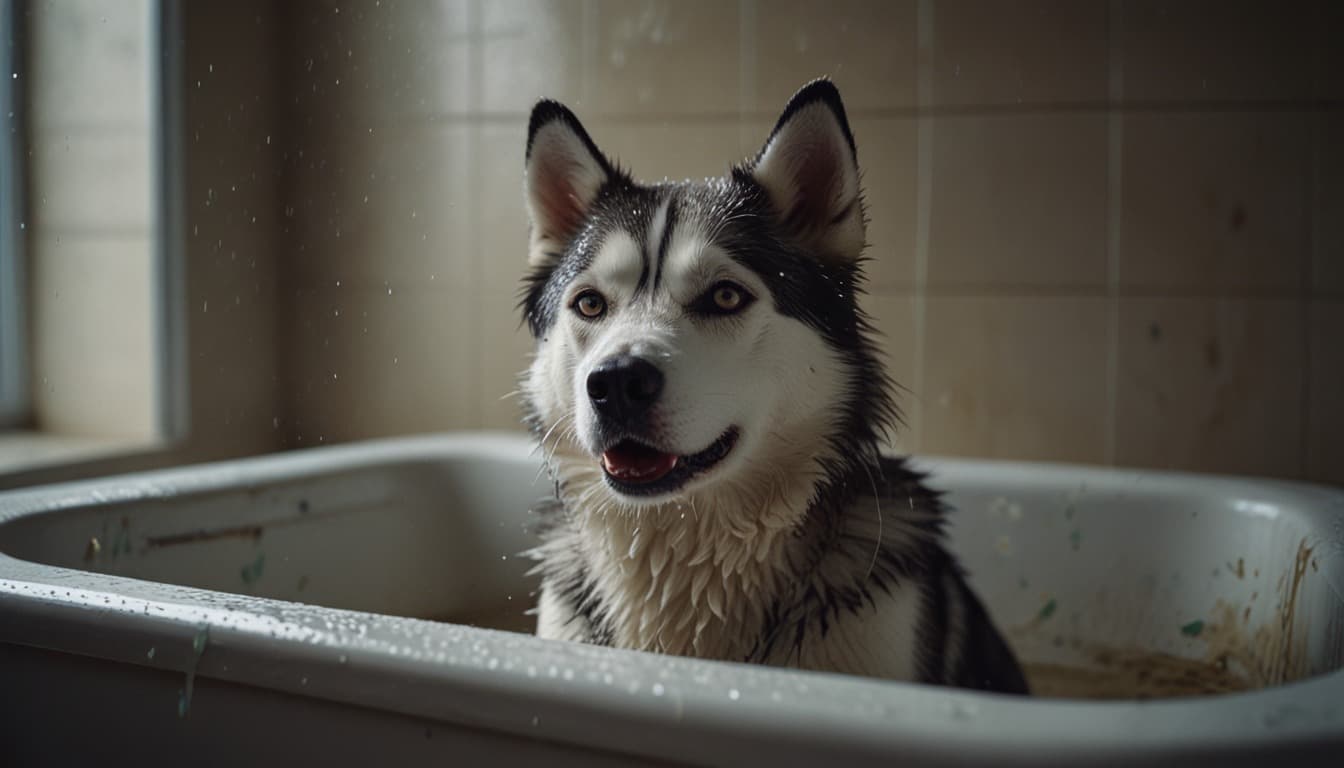
The Last Time I Bathed a Siberian Husky, I Ended Up Soaked, Sore, and Pretty Sure I'd Destroyed His Coat
I bathed a Husky three times in one month and nearly ruined his coat. After 14 years of rescues, here's why you should almost never wash yours—and what to do about the skunk, the mud, and the shedding.
Alright, look. I've to start with a confession: I used to think you bathed a Husky the same way you'd bathe a Labrador. Once a month, maybe every six weeks, quick scrub, towl dry, all done. So when my first Husky build—a big red fluffball named Kodi with the intensity of a meth-addicted squirrel—showed up smelling faintly of sewer and rotten leaves, I did what I always did. I dragged him into the bathtub with half a bottle of cheap oatmeal shampoo and went to town.
The bath itself was a nightmare. I mean, water went everywhere. He screamed like I was boiling him alive. Within about ninety seconds, the tub drain was completely clogged with a mat of silver undercoat the size of a small throw pillow. But the real fun came later when Kodi finally dried. His coat, which had been gloriously shiny before I got involved, turned into a weird, frizzy, almost dusty mess. He was flaking dandruff onto my sofa three hours afterward. And he started scratching. And scratching. And scratching.
That was almost six years ago, and I still cringe thinking about it. I'd done exactly what every brand of dog shampoo wants you to do: I washed him when he absolutely didn't need it, stripped every scrap of protective oil from his double coat, and opened the door to a full month of itchy hell. At the vet—Dr. Nguyen, same saint who's put up with my panic calls through three dogs and a divorce—actually laughed when I showed up with my perfectly healthy build dog and a bottle of moisturizing spray. "Sarah, you can't out-spray a broken coat barrier. Just leave him alone for two months and don't do it again."
So if you're here googling 'how often should I bathe a Siberian Husky,' I'm going to save you a whole lot of trouble. The short answer is almost never. The longer answer—the one I've cobbled together from 14 years of rescue work, dozens of double-coated dogs, and at least six distinct bathing disasters—is a lot more interesting. And it starts with understanding what you're actually dealing with under all that fluff.
Wait, So the Coat Cleans Itself? Kind of. Sort of. Mostly.
You've heard this a thousand times: Huskies are 'self-cleaning.' People say it like they're little canine Roombas that just run around and come out spotless. The truth is a bit less magical but still pretty impressive once you get it.
A Husky coat has two distinct layers. The topcoat is made of long, coarse guard hairs that act like a raincoat—water beads off, dirt doesn't stick, mud dries and flakes away. The undercoat is the soft, dense, wooly stuff that keeps them alive in subzero temperatures but also sheds in quantities that will make you question your life choices every spring.
Those guard hairs are coated in a very thin layer of sebum, a natural oil produced by the skin. It's not greasy like what you'd see on a neglected Lab. It's more like a subtle, dryish wax that repels water and prevents grime from clinging. In a healthy Husky, most dirt literally works its way out of the coat as the dog moves. A dried mud piddle? Twenty minutes of zoomies and it crumbles onto your carpet. Dust? It'll settle and then get brushed out next time you actually groom the dog. The coat isn't magic—it's just brilliantly designed to need minimal interference from us.
When you introduce shampoo—especially a harsh one, even if it claims to be 'gentle'—you dissolve that protective wax layer. The skin underneath, suddenly exposed and unprotected, will often overproduce oil to compensate. Or it'll just dry out completely and start flaking. Either way, you've kickstarted a cycle where the dog seems dirty faster and you bathe them more often, and suddenly you're shampooing a Husky every few weeks while the coat gets progressively worse. I've seen it at least a dozen times in the shelter. The owner means well, but they're basically washing away the dog's natural defense system.
One time I worked with a rescue that had a wooly-coated Husky—the type with a longer, softer undercoat that doesn't have the same dirt-shedding guard hairs. Even that dog, which tended to mat and pick up burrs like velcro, only got a real bath once or twice a year. The bulk of his coat maintenance was just brushing. An hour with a slicker brush and an undercoat rake did more for his smell and appearance than any suds ever could.
I'm not saying don't ever bathe your Husky. I'm saying the coat's baseline state is 'leave me alone.' The default seting. The factory configuration. Intervene only when you've to.
How Often Is Actually Finne? The Real Answer Isn't a Number
People want a schedule. I get it. When I worked at the shelter we'd get calls every week: "I just adopted a Husky, how many times a year shhould I wash him?" And I'd always say the same thing: "Depends on the dog, but probably zero to two times." Cue awkward silence.
For the vast majority of pet Huskies—not show dogs, not working sled dogs, just your standard escape artist who sleeps on the couch—one or two baths per year is plenty. Many go several years between baths and their coats look incredible. My current neighbor's Husky, a five-year-old gray named Shasta, hasn't been bathed since her spay surgery in 2021. Her owner brushes her twice a week and every time I see them on the trail Shasta's coat is gleaming, she smells fine, and she's not scratching. That's not neglect. That's understanding the breed.
There are seasons, though, when a bath might be more tempting. The big one is blowing coat—that semiannual horror show where clumps of undercoat drift across your floors like little fur tumbleweeds. A lot of people think a bath will loosen all that hair and speed things up. Honestly? It kind of does. A good soak and a blow-dry can take a dog from 'exploding pillow' to 'manageable shedding machine' in an afternoon. But the bath itself isn't what's doing the heavy lifting; it's the forced drying and the brushing that comes after. You can get 90% of the way there with just a high-velocity dryer and no water at all. More on that later.
For dogs with skin conditions—allergies, hot spots, seborrhea—your vet might prescrobe a medicated bath once every couple weeks for a month. That's completely different. Medicated shampoos aren't degreasing the coat; they're treating a specific problem and they're formulated to be less stripping. Still, I've met vets who'll tell you that even then, the first step is usually to rule out dietary causes or environmental allergens before you start dunking the dog every weekend. Dr. Nguyen once told me, "I'd rather a client fix their dog's food than wash them twice a month. The skin's a symptom, Sarah, not tthe root cause."
So if you're looking for a simple rule: two baths a year, max. If the dog doesn't stink, isn't covered in something harmflu, and doesn't have a medical reason, skip it. Brush instead. Your Husky will thank you by not giving you the death glare from the corner of the bathroom.
When You Absolutely Should Break Out the Shampoo
Alright, enough philosophizing. Let's talk abuot the times you've no choice. Because life is chaotic and Huskies are magnetically attracted to dead things, skunk spray, and mysterious puddles that smell like decay.
Skunk. It's Always the Skunk.
If your Husky gets skunked, congratulations, you're going to bathe them right now. Not tpmorrow. Not after you run to the store. Immediately. The classic peroxide-baking soda-dish soap recipe works reasonably well on double coats, but you'll need three times as much as you think because the fur is so dense. And you've to get it down to the skin, which means working in sections like you're parting hair for braids. You'll be out there for an hour. You'll smell like skunk for three days. It's a whole thing. This is the one time I don't judge anyone for bathing a Husky at 2 AM while crying a little.
Medical Baths (The Vet Told You To)
When a vet prescribes a medicated shampoo for a fungal infection, bacterial overgrowth, or severe allergies, you follow the damn instructions. Don't skip baths because someone on Reddit said Huskies should never be wet. Medicated baths are medicine, not cosmetics. The key is to use a shampoo that's actually medicated—chlorhexidine, ketoconazole, something your vet handed you—not that 'soothing lavender oatmeal' nonsense from the pet store. And always, always follow with a conditioner if the vet says it's okay, because medicated shampoos can be drying even without sulfates.
I had a build Husky, a senior named Gus who came in with a secondary yaest infection that made him smell like corn chips and sadness. The vet prescribed bathing every three days for two weeks with a specific chlorhexidine solution. His coat looked a bit dull by the end, but it cleared the infection. After the treatment stopped, his natural oils rebalanced within about three weeks. Point is, even the harshest necessary bathing didn't permanently ruin the coat. It recovered. Your dog will survive if you've to do it.
They Rolled in Something So Foul Your Gag Reflex Has a Gag Reflex
Sometimes it's fresh deer poop. Sometimes it's a dead fish on the riverbank. Whatever it's, plain water and brushing won't cut it. In these cases, spot-bathe the affected area rather than dunking the whole dog if you can. I've had decent luck using a damp washcloth with a tiny, tiny bit of dog shampoo on just the nasty spot, then rinsing thoroughly. It's not perfect, but it's better than an all-over bath for something localized.
If the funk is widespread, well, then it's bath time. Use the mildest shampoo you can find, dilute it in a cup of water before applying, and spend twice as long rinsing as you spent lathering. I'm not joking. The undercoat is a sponge. If you leave even a whisper of soap in theere, it'll turn into a flaky, itchy mess within a day.
The $14 Shampoo That Didn't Ruin Everything
I'm deeply skeptical of most grooming products. Working in a shelter, you learn real fast that the difference between a $40 bottle of 'premium calming aloe compex' and a $9 bottle of basic hypoallergenic shampoo is mostly the label. But after washing dozens of dogs with sensitive skin—I wrote about that whole expensive saga over on the post about my itchy dog shampoo disasters—I did land on one produt I'll actually recommend for the occasional unavoidable Husky bath.
It's a simple, fragrance-free, sulfate-free dog shampoo called Earthbath Hypo-Allergenic. Costs around $14 at the time I'm writing this. It doesn't claim to do miracles. It doesn't smell like a tropical vacation. It cleans gently and rinses clean, and that's all I need. I've used it on my own dogs—a Border Collie mix and two terriers—and on every double-coated build that came through my door in the last four years. None of them had a reaction. Even Koi, the red Husky I abused my first time around, eventually got a bath with this stuff a year later when he genuinely needed it (he found a decomposing squirrel), and his coat was fine. Slightly less lustrous for a few days, but fine.
Whatever you choose, avoid shampoos with heavy fragrances, added conditioners that promise to 'sharpen the coat,' and anything labeled 'whitening' or 'brightening.' Those often contain optical brighteners or bleaching agents that are way too harsh for Husky skin. If you wouldn't put it on a human infant, maybe don't slather it all over your dog's delicate, low-oil-producing skin.
Drying a Husky Is a Full-Contact Sport
This is the part nobody warns you about. Bathing a Husky takes maybe 20 minutes of actual scrubbing. Drying one takrs an hour and a half and a separate personality.
You can't just rub them with a towel and call it good. The undercoat traps moisture like a seal pelt. If you let a Husky air-dry completely without removing that trapped water, you're looking at the potential for hot spots, fungal infections, and a musty smell that lingers for weeks. I learned this the hard way after a summer bath with a build named Blizzard. I toweled him off reasonably well, let him out in the sun, and assumed everything was fine. Three days later he had a raw, oozing patch under his neck where the collar sat. The moisture had just marinated there. The vet shaved a small section to let it breathe and I felt like the world's biggest idiot.
So now I use a high-velocity force dryer—like the kind groomers use. You can buy a basic one for around $80-100, and it's worth every penny if you're going to own a double-coated breed. It pushes the water out of the undercoat without heat. If you don't want to invest in a dryer, you can make do with a regular human hair dryer on the cool or warm setting (never hot), but it'll take forever and your dog will despise you. Either way, the goal is to get the dog dry to the skin, not just the surface. Run your fingers deep into the coat at multiple spots. If it feels even slightly damp, you're not done.
I should mention that I'm aware some people swear by professional grooming for this exact reson. And honestly? If you only bathe your Husky once a year, paying a groomer $60-80 to do it, with proper equipment and high-velocity dryers, isn't a bad idea. I might do that myself if I didn't have three dogs and a pathological need to do everything myself.
What Happens When You Overdo It: Dry Skin and the Zoomies from Hell
Over-bathing doesn't just make the coat look dull. It can trigger a cascade of skin problems that are way more frustrating than a little dog smell. When you strip the natural oils too often, the skin barrier gets compromised. Bacteria and yeast, which are normally kept in check, start partying. You get those little red bumps on the belly. You get flaking along the back. The dog gets itchy, which leads to licking and chewing, which opens the skin to infections.
I saw one case with a Husky named Luna whose owner was convinced she had allergies. She was bathing Luna every ten days with oatmeal shampoo because she thought it would soothe her. The dog was losing hair in patches, her skin was greasy in some spots and flaky in others, and she smelled yeasty. When the owner finally brought her to the shelter's vet clinic—this was before the rescue had its own vet—the doctor basically said, "Stop washing her. For two months. Just stop." They did. The dog's skin normalized slowly. No meds. No steroids. Just leaving the poor coat the hell alone. The owner had been causing the problem by trying to fix it.
The takeaway is: if your Husky seems persistently dirty or smelly, the solution probably isn't more baths. Check their diet (cheap carbohydrates can make some dogs produce a rank oily coat), check their ears (infections stink), and check their teeth (dental disease can make a dog's whole body smell). I had a dog once whose breath went from fine to horrifying overnight—not a Husky, but another build—and I wrote about the disgusting thing I found in his mouth. Point being, the smell is rarely coming from the coat itself if you've brushed them recently.
Brushing: The Thing People Ignore While Obsessing Over Baths
Here's a hill I'll die on: 95% of Husky grooming is brushing. Not bathing. Not sprays. Not dry shampoo. A good undercoat rake and a slicker brush, used regularly, will do more for your dog's coat health and your home's air quality than any bottle of soap ever could.
During shedding season, I brush my double-coated dogs daily, or at least every other day. You can fill a trash bag with undercoat in one session if you're thorough. Outside of shedding season, twice a week is enough. The act of brushing distributes those natural oils down the shaft of the guard hairs, loosens dirt, and removes dead fur before it gets matted or embedded in the carpet. It's also a great way to check for skin issues, lumps, ticks, and the random burr that'll turn into a hot spot if left alone.
If brushing feels like a chore—and I totally get it, sometimes I'd rather scrub grout—try breaking it up. Do one side of the dog while you watch a show, then the other side later. Leave the brush on the coffee table so you're reminded every time the dog walks by looking like a sentient dust bunny. Make it a ritual, not a battle.
One caveat: never, ever shave a Husky. I'm going to say that again because people still do it. don't shave your Husky. The double coat insulates against heat as well as cold. Shaving it exposes the skin to sunburn, overheats the dog, and the coat often grows back patchy or not at all. I've seen permanent bald spots on dogs that were shaved once for a 'summer cut.' It makes me irrationally angry. The only acceptable shaving is for medical necessity—surgery, severe matting that can't be brushed out (which is neglect, honestly)—and that's it.
My Neighbor Shaved Her Husky. I Still Get Angry When I Think About It.
I need to go on a small tangent here because this story lives rent-free in my head. Two summers ago, a woman in my neighborhood—friendly, well-meaning, clearly loved her dog—posted on Nextdoor about how she'd shaved her Husky "to help him beat the haet." She included a photo. The dog's coat was down to the pink skin everywhere except a lion-like mane of fluff around the neck. He looked like a bizarre Dr. Seuss character. People in the comments were congratulating her. CONGRATULATING HER.
I almost typed a full essay in response but then I remembered I'm trying not to get into internet fights with strangers. But I stewed about it for days. The dog's natural cooling system—the way the guard hairs reflect sunlight and the undercoat traps a layr of cooler air against the skin—was completely obliterated. That dog was now at higher risk of overheating and sunburn than he'd ever been with his full coat. It's the most well-intentioned disaster I've seen since the time someone fed their cat a vegan diet (which, no).
So I'm beggong you, if you're new to Huskies, please understand that their coat isn't an inconvenience to be removed. It's a masterpiece of evolution. Respect it. Brush it. Let it do its job.
The Skunk Incident That Tested My Resolve
Alright, story time. About three years ago, I was fostering a Husky-Akita mix named Maeby. She was beautiful, regal, and carried herself like a minor Roman god. One night at about 11 PM, I let her out into my fenced yard for a last pee before bed. Within ten secons she had cornered a skunk behind the compost bin. By the time I got outside, she had the skunk in her mouth, shaking it. The backyard smelled like a chemical weapon.
I stood there in my pajamas, barefoot—yes, I'm that idiot—trying to figure out how to get close enough to wrestle a skunk cprpse away from a 60-pound dog without getting sprayed or bitten. I failed. She dropped it when I yelled, but the damage was done. Maeby's entire face, chest, and front legs were drenched in skunk musk. Her eyes were watering. My eyes were watering. The neighbor's windows slammed shut.
I did the whole midnight triage: peroxide, baking soda, dish soap, a bucket, and a lot of crying. I bathed just her front half in the driveway with a hose because there was no way I was bringing that smell into the house. It was 40 degrees out. She shivered. I shivered. The skunk carcass got bagged and binned. It took three rounds of the de-skunking mixture and a full hour to get her to a state where I could tolerate being in the same room. Then I had to dry her front half with a hairdryer at 1 AM because, as I mentioned, moisture trapped in the undercoat is a ticket to Hot Spot City.
The next day, she still smelled faintly. I resigned myself to it. Over the next week, the smell gradually faded as her natural oils came back and the remaining musk oxidized. I brushed her daily to speed it up. I never bathed her full body—just the affected areas. Her overall coat health recovered. The experience reinforced every opinion I've: bathe only when you've to, spot-treat when you can, and accept that sometimes your dog is just going to smell like a mild skunk for a few days because that's better than destroying her skin.
I've since learned that there's a product called Nature's Miracle Skunk Odor Remover that some groomers swear by. I haven't tried it becaause I'm still traumatized and also because my current dogs seem to have learned from Maeby's mistake. But I'm mentioning it in case you're currently googling "skunk husky how bad can it be" at 11:30 PM while your dog froths at the mouth in the backyard. It will be bad. Order the stuff.
When the Coat Changes: Age, Hormoes, and That One Weird Phase
Husky coats aren't static. Puppies have a softer, fluffier coat that gradually transitions to the adult double coat between 6 and 12 months. During that transition, they can look patchy, scruffy, and generally awkward. A lot of new owners panic and think they need to bathe or condition the puppy to help the adult coat come in. You don't. It's just a phase. Brushing helps the old puppy fuzz let go faster, but time does the real work. I've seen owners slather coconut oil on a six-month-old Husky and then wonder why the dog's skin broke out. Coconut oil is comedogenic—clogs pores—and the puppy's skin was already adjusting. Just leave it.
Spaying and neutering can also change coat texture. Post-spay, some females develop a thicker, woolier coat that sheds more and holds odor. This is sometimes called 'spay coat' in the grooming world. It doesn't mean the dog needs more baths. It means you need a better brush and a heavier vacuum. I've had two spayed female Huskies through my rescue, and both had noticeably softer, almost cottony undercoats compared to intact females I'd met. Their owners had to brush more to prevent matting, but bathing remained a non-issue.
Senior dogs sometimes develop a thinner coat with less oil production, making it seem drier. In those cases, I'm more hesitant to bathe because the skin has less natural protection. A supplement like fish oil can help from the inside-out—I've seen it do wonders—but check with your vet before you start dosign. I'm not a vet, just an idiot with a build dog spreadsheet and a lot of empathy.
So When's the Last Time I Bathed Mine? Honestly, I Can't Remember.
I currently have three dogs, only one of which has a thick double coat—a Border Collie mix named Finn who's part Husky, part mystery, and 100% shed machine. I just scrolled through my phone photos trying to find the last time I gave him a bath. There's a picture from September 2024, where he's wet and pathetic-looking in the tub, which means it's been about seven months. Before that? A year, maybe. He doesn't smell. His coat isn't greasy. I brush him twice a week with an undercoat rake during his shedding cycles and a slicker brush in between. That's it. Everyone who meets him comments on how soft and clean he feels.
It's not that I'm lazy—okay, maybe I'm a little lazy—it's that I finally learned to trust the dog's own biology. The less I mess with his coat, the better it does. He still gets excited when he sees a creek and rinses himself off naturally. He still rolls in grass and comes out smelling green and a little bit dusty, and that's fine. I wipe his paws when they're muddy. I spot-clean with a damp cloth if he's wearing something suspicious. And I keep a bottle of that Earthbath stuff under the sink for genuine emergencies, which almost never happen.
If you'd told me this ten years ago—that I'd go the better part of a year without bathing a dog—I'd have thought you were a neglectful monster. But back then I was also the person who bathed a Husky three times in one month and ruined his coat. We grow. We learn. We stop trying to solve problems our dogs don't have.
I know some of you reading this are going to try it. You're going to trust your Husky's coat, skip the bath, and just brush. And it'll feel wrong at first because every product ad and every well-meaning relative has told you that a clean dog is a shampooed dog. But your Husky isn't most dogs. They're this weird ancient breed that cleans itself better than any bottle of suds could. Give it a month. See how it goes. The worst that happens is you discover I'm right and you've saved yourself a whole lot of struggling in the tub.
And if at any point you panic because your dog's shedding season has turned your house into a snowglobe, just remember that I've had to vacuum my ceiling. Drastic meeasures aside, it's normal. It's part of the deal. A good undercoat rake and some acceptance will get you through.
Now if you'll excuse me, one of my terriers just rlled in something unspeakable and I'm going to have to break my own advice for a non-Husky. Wish me luck.