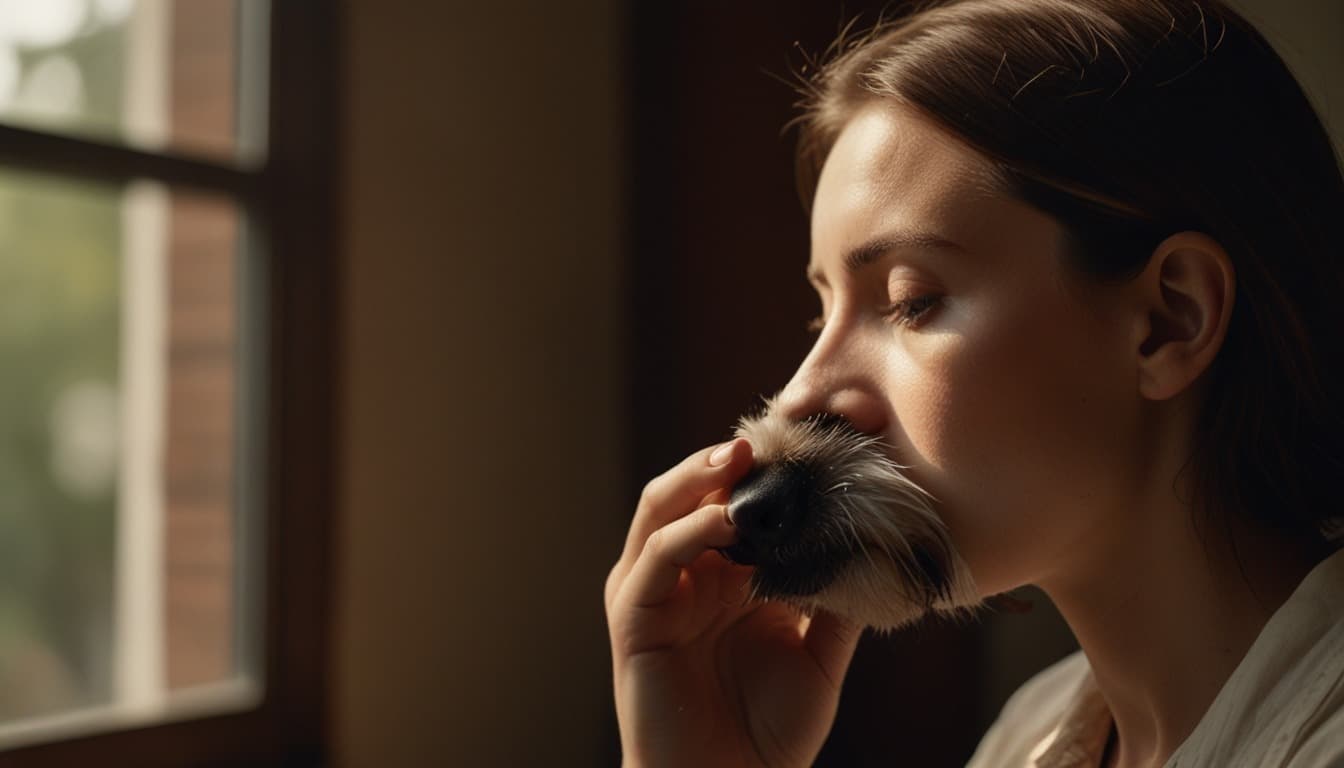
My Dog's Nose Felt Like Sandpaper and I Panicked — Here's the Expensive Lesson I Learned About Dry, Cracked Canine Noses
I panicked when my dog's nose turned into a crusty, cracked mess. After expensive vet visits, 40+ fosters, and a lot of wasted balms, here's what I wish I'd known from the start.
I'll never forget the morning I reached down to boop my dog, Rufus, and his nose felt like a sun-baked rock. No wetness, no cold leather — just rough, crusty, cracking in the little grooves like a dried-up riverbed. My first thought: cancer. My second thought: maybe lupus? My third thought involved frantic Googling that had me convinced he had maybe 48 hours to live. (He lived. He's still here, 6 years later, currently snoring under the kitchen table with a perfectly wet nose, by the way.)
But that moment — that cold panic when you notice something off about your dog and yoru brain goes straight to the worst place — I've been there a few times. When Rufus struggled to get off the couch without screaming, that was one. That was a whole saga with a $200 mistake I made first (you can read about that mess over here). And the dry nose? That was another.
I've fostered over 40 dogs now, and I've learned that a dry nose is one of those things that sends even the most seasoned owners into a tailspin. It's up there with "my dog's eyes are suddenly red" (been through that too) and the dreaded "why is my dog limping and I can't see a thorn." We immediately assume the worst because, well, dogs can't talk and their noses are supposed to be wet, right? That's what we were always told. Wet nose = healthy. Dry nose = sick. Except… that's not entirely true. Not even close.
The wet nose myth thats' been scaring dog owners for decades
Somewhere along the way, the "wet nose equals healthy dog" thing became gospel. And look, a healthy dog does often have a moist nose — the moisture helps them absorb scent particles better (the thin layer of mucus on their nose traps and dissolves odor molecules, boosting their already incredible sense of smell). Dogs also lick their noses constantly, which keeps them wet, both to clean them and to sample recent smells by transferring particles to the vomeronasal organ in their mouth. So yes, moisture is part of the normal nose experience. But a dry nose? That's not automatically a red flag.
My old vet, Dr. Chen, once told me — after I burst into her clinic at 9:02 a.m. with a perfectly healhty build dog whose nose had dried out overnight — "Sarah, if I had a dollar for every person who panicked over a dry nose, I'd have retired to a beach in Costa Rica by now." She explained that a dog's nose can fluctuate in moisture level throughout the day based on a dozen harmless things. Just like my own lips get dry when I sleep with the heater on, or my hands crack in winter. The nose isn't a magical health bar like in a video game. It's skin. It gets dry sometimes.
And yet, I still panicked. Because it's never just "dry" when you're staring at it at 2 a.m. under a flashlight, right? It's also "flaky" and "maybe a little crusty" and "oh god is that a crack or just a line?" This is the part where I remind you, as I remind myself, that I'm not a vet. Whenever I'm in doubt, I call mine. But after 14 years of writing about pets and running a resue on weekends, I've also learned when a dry nose is just a dry nose, and when it's a dry nose that needs some attention.
So what actually causes a dog's nose to turn into a little crusty disaster?
There's a bunch of reasons, and most of them are boring and harmless. But some aren't, so you've got to know the difference. I've made a mental list over the years, and I'm going to walk you through it — starting with the stuff I worried about that turned out to be nothing, then moving on to the stuff that actually needed a vet.
Reason 1: He just woke up.
This is the most common reason my own dogs have dry noses. They've been asleep for a few hours, they're not licking their noses while snoozing, and the air in the room is dry because the heat's on or the AC is blasting. Wake them up and their nose feels dry and warm. Give them 20 minutes, they'll lick it, they'll sniff around, it'll be wet again. I've lost count of how many early-morning frakouts I've had that resolved by the time I finished my coffee.
If your dog's nose is dry in the morning but wet later in the day, yoou're in the clear. This is just their natural cycle. No need to do anything except maybe run a humidifier if your indoor air is really parched — which helps your own skin too, so win-win.
Reason 2: He's been sunbathing like it's his job.
Some dogs, especially those with light or pink noses, can get a dry, cracked nose from too much sun. It's basically a sunburn. I had a build pittie named Pogo who loved to lay on the back deck in the noon sun with her nose pointed at the sky like a sundial. Her nose would get so dry and flaky by evening that I'd slather on dog-safe nose balm and she'd look at me like I'd committed a crime. But the sun damage was real. Over time, repeated sun exposure can lead to something called solar dermatitis, and in older dogs, even certain types of skin cancer on the nose. So if your dog's a sun-worshipper with a pale nose, slather that snout with a pet-safe sunscreen (I've used the kind from Sit. Stay. Forever, but there are others) before they bake themselves.
Reason 3: Allergies. Because obviously.
Allergies are the sneaky culprit behind so many dog problems. When my dog's nose gets dry and cracked, it's often linked to seasonal allergies making his skin dry overall. Or contact allergies — like the time I used a new plastic slow-feeder bowl and my dog's nose started peeling around the eddge. Turns out some dogs have contact dermatitis from plastic or certain dyes. I switched to stainless steel bowls and it cleared up within a week.
Food allergies can also manifest as skin issues. I fed one of my fosters a certain high-end salmon food that I thought was the healthiest thing on the planet, and his nose got so crusty and scabby I thought he had an infection. After an elimination diet trial that I won't bore you with, turns out he couldn't handle the fish protein. Switched to a novel protein, and his nose healed up beautifully. Which reminds me — I once spent $90 on a bag of kibble that made my senior dog wobble like he was drunk (read about that here). So it's not just about cost or fancy marketing; ingredients matter.
If your dog's dry nose comes with other symptoms — paw licking, ear infections, itchy skin, digestive upset — allergies might be the villain.
Reason 4: Dehydration and the water bowl nobody's touching.
A dry, crusty nose can sometimes mean your dog isn't drinking enough. Dehydration affects all skin, including the nose. I've seen this happen with older dogs who just forget to drink, or with dogs recovering from surgery who are a bit off their game. My own senior dog, during a particularly hot week last summer, suddenly had a nose like cracked leather. I realized he'd been too lazy to walk across the kitchen to his water bowl. I put a second bowl in his favorite snoozing spot, and within a couple of days his nose bounced back. Dehydration can be serious, so if you see other signs — lethargy, dry gums, sunken eyes — get to a vet. But a dry nose alone isn't a dehydration emergency; it's just a little flag to check the water situation.
Reason 5: Breed-specific nasal quikrs (brachycephalic dogs, I'm looking at you)
Some breeds naturally have drier, crustier noses because they can't lick them as effectively. Bulldogs, pugs, Boston terriers — those smushy-faced dogs whose tongues can't reach the tip of their nose. Their nose leather tends to get dry and sometimes develops something called nasal hyperkeratosis, where the keratin overproduces and the nose looks like it's got little hard spikes or a crusty layer that doesn't just peel off. It's not painful in mild cases, but it can crack and get uncomfortable. I once fostered an old English bulldog named Tank who had a nose like a Brillo pad. I learned a lot about nose balms with that guy. (We'll get to what I actually used in a sec.)
Other breeds proen to nasal hyperkeratosis include Labrador retrievers and cocker spaniels, though it can pop up in any dog. It's usually genetic and doesn't mean your dog is sick, just that their nose needs a little extra TLC.
Reason 6: The stuff that's actuslly a problem (and why you shouldn't ignore a crusty nose forever)
Alright. So far we've covered harmless, fixable stuff. But here's whrre my vet visits happened. Sometimes a dry, cracked nose signals something more serious that needs medical treatment, not just coconut oil and hope.
Autoimmune diseases. The big one that scared me with Rufus was discoid lupus erythematosus, an autoimmune condition that primarily affects the nose (and sometimes the ear flaps). It causes depigmentation — the nose loses its dark color and turns pink or grey — along with cracking, ulceration, and a crusty, scaly appearance. It typically spares the bridge of the nose and focuses on the leather part. It's not life-threatening, but it does need management because the sores can get infected and painful. My vet did a biopsy on Rufus's nose (under sedation, and oof, that was stressful) to rule it out. It wasn't lupus; it was just a spectacularly bad reaction to a new plastic bone I'd bought that he'd been obsessively licking and rubbing his nose on. But I'm glad we checked.
Pemphigus foliaceus. Another autoimmune disease that can cause crusty sores on the nose, along with the face, ears, and foot pads. I've seen it once in a rescue dog and it looked genuinely angry — red, oozing, not just dry. That dog needed steroids and immunosuppressants. If your dog's nose has open sores, blisters, or seems painful, it's beyond the balm stage.
Infections. Bacterial or fungal infections can take up residence in the cracks of a dry nose. I've seen a dog with a yeast infection on her nose (yes, that's a thing) and it smelled faintly… off. Like old bread. The treatment was antifungal cream and a round of oral meds. If your do's nose is dry AND smelly, or has discharge, a vet check is in order.
Nasal tumors. Rare, but they happen. A tumor inside the nasal cavity can cause changes to the outside of the nose, including dryness, crusting, and deformation. I stumbled upon a forum post years ago about a dog whose nose was persistently dry on one side only, and it turned out to be a tumor blocking the tear duct and affecting moisture on that side. I'm not telling you this to terrify you; I'm telling you because sometimes persisttent asymmetric dryness is a clue something's going on inside. Your vet would likely want to do imaging if things don't improve with simple treatments.
The Tangential Tale of My Own Skin and Why I Empathize With Dogs With Dry Noses
Look, I get dry skin. My hands literally crack and bleed every winter. I've tried fifty different lotions, and the one that finally worked was some weird Australian goat-milk cream my sister sent me as a joke. So when I see a dog with a crusty nose, I feel a weird kinship. I'm like, same, buddy. Same. It's why I can't stand it when people dismiss a dry nose as "just cosmetic." It's uncomfortable. Imagine the skin on your lips being so dry that every time you smiled, it split. That's what a cracked nose feels like for a dog, except they use their nose to explore the entire world. Every sniff could be uncomfortable. So yeah, I take it seriously. Even when it's not a medical emergency, it's a quality-of-life thing.
I once fostered a senior beagle named Mabel who came in with a nose so dry and cracked it bled when she tried to push open the back door with her sonut. Her previous owner had never done anything about it — just thought old dogs got dry noses. Which they do, but they don't have to suffer with it. I tackled Mabel's nose like a science project. But more on what I used later. First, a detour into the absolute chaos of trying to apply anything to a dog's nose when they don't want you to.
The wrestling match that's applying nose balm to a dog
(This is a short one. I'll set the scene.)
I haven't met a single dog — not one — who has ever said, "Oh, thank you, human, for gently dabbing this soothing balm on my snout. How refreshing." Every dog treats nose balm like it's acid. They jerk their head back like I'm trying to remove their nose entirely. They lick it off immediately, which defeats the purpose. My current dog, Beans, a 65-pound mutt with a surprisingly long ncek, can contort himself into a pretzel to avoid the balm. I've learned a few tricks: apply while they're sleepy, use a tiny amount, distract with a high-value treat held above their head so they're looking up and you can sneak the balm from below. It's still a battle. So if you're struggling, know that you're not alone. The best you can do is use a balm that's safe if ingested (because they'll lick some), and aim for a few seconds of contact before the licking starts. Even a brief application helps.

What I actually put on my dogs' noses (and what was a complete waste of money)
So I've been through the trial phase. Here's what worked, what didn't, and what just made a greasy mess on my couch.
Coconut oil: the internet's favorite, and it's fine
Coconut oil is safe for dogs (it's edible, so licking is fine), and it can provide a moisture barrier. I used it for a while. But I found it didn't last very long on a nose because it's so easily licked off. Plus, it's oily enough that it left little grease spots on the furniture and on my pants when my dog came over for snuggles. And getting a solid hunk of coconut oil out of the jar and rubbing it between your fingers to melt it while your dog squirms away — not the easiest process. It's a decent home remedy in a pinch, but I wanted something with more staying power.
Bag Balm: not originally for dogs, but used by many
Bag Balm is that green square tin origianlly made for cow udders. People swear by it for dry dog noses. I tried it. It's thick, it's moisturizing, and it seemed to help with the deep cracks on that beagle Mabel I mentioned. The big issue: it contains petrolatum (like Vaseline) and some dogs might get mild stomach upset if they ingest too much. I also worried because one of my dogs, like I talked about in the post where he licked his incision open at 3 a.m. (that nightmare), is a determined licker. If there's something on his nose, he's getting it off. So I used Bag Balm sparingly but only under supervision. It's a solid option for non-obsessive lickers, and it's cheap.
Vet-recommended nose balms: the ones I actually repurchased
After Mabel's nose started bleeding, I asked my vet for a recommendation. She suggested a product called Snout Soother by Natural Dog Company (not sponsored, I swear). It's got shea butter, coconut oil, and something called "kukui nut oil" that sounds fancy but apparently works. The texture is like a thick lip balm, and it actually stays on for a bit if you can distract the dog. Used twice a day for about a week, and Mabel's nose went from cracked-lava-field to merely dry. After two weeks, it looked normal. I've since used it on other fosters, and it's my go-to now. There's also another brand, Dermoscent Bio Balm, that's pricier but worked well on a dog with hyperkeratosis. The key is to find one that's safe to ingest, doesn't contain zinc oxide (toxic to dogs in large amounts), and has ingredients that actually seal moisture in, not just sit on top.
What not to do
Never use human hand lotion, Vaseline with added ingredients, or anything with fragrance, essential oils, or medication (like Neosporin with pain relief) unless your vet specifically tells you to. Some essential oils are toxic to dogs, and ingestion of certain chemicals can cause problems. Vaseline itself (plain petroleum jelly) is generally considered safe in small amounts, but it can cause diarrhea if they lick too much, and it's not the most effective at healing deep cracks.
A quick tangent on diet and nose health
One thing I didn't expect: switcihng a dog to a higher-quality food with omega-3 fatty acids can sometimes improve their skin and nose health over a few months. When I moved my own senior dog off that expensive kibble that made him wobble (again, that story), I started adding a sardine to his dinner a few times a week — just a cheap can of sardines in water, unsalted. Not only did his mobility improve, but his coat got shinier and his chronically dry nose (which I'd been managing with balm) suddenly seemed to need less attention. It's not a cure-all, but if your dog's diet is lacking in healthy fats, their skin everywhere will suffer. Vets are great surgeons but they're not nutritionists, as I often say, so I always grill them about food and do my own research.
The one time I completely ignored a dry nose and it turned into a vet bill
So here's the cautionary part of the story. I took in a build named Daisy, a sweet little pug mix with the typical smushed face. Her nose was dry and had some crusties, but I'd seen that a hundred times. I figured it was just her breed. I applied balm, didn't think much of it. A month later, the crust had spread up to the bridge of her nose, and she started sneezing blood. I'm not proud of this. I missed it. I got her to the vet, and they diagnosed a fungal infection (aspergillosis) in her nasal passages that had apparently been brewing for a while. The dry nose was the first outward sign I'd dimsissed. She needed a course of antifungal medication and a dental cleaning because the infection had damaged a tooth root. The total was around $340, which wasn't the end of the world, but it could have been caught sooner if I'd paid more attention to the location of the crusting. That's why now I've a rlue: if the dryness or crusting extends beyond the actual nose leather onto the fur-covered bridge of the nose, or if it's one-sided, or if there's any nasal discharge (especially blood), I'm calling the vet that day. Not the next day. That day.
Okay, but when should you actually call the vet? (a practical list)
Because I don't want you to be the person who panics over every dry nose, but I also don't want you to be the person who ignores something real and pays for it later. Here's my mental checklist, refined through years of mistakes:
- Is it just dry, or are thete open sores, cracks that bleed, or signs of pain? If the dog winces when you touch it, or there's raw skin, get it checked. That's not just cosmetic.
- Has the nose changed color? If your dog's nose went from black to pink in patches, or the edges look eroded, that's a vet visit. Autoimmune disease can present that way.
- Is it accompanied by other symptoms? Lethargy, loss of appetite, diarrhea, vomiting, sneezing, nadal discharge, or eye issues? The nose is just one clue in a bigger picture. Don't fixate on the nose alone.
- Is it only on one side? Asymmetry is often a red flag. If one nostril area is dry and crusty and the other is normal, something could be going on internally.
- Does it smell bad? Infection has an odor. If you get a whiff of something fnuky when you're close to the snoot, trust that instinct.
- How long has it been going on? A day or two of dry nose, especially if it resolves after drinking water or waking up, is nothing. Two weeks of persistent cracking despite balm application? Time to involve a professional.
Whenever I'm on the fence, I'll send a photo to my vet's office. They'd rather see it and say "it's nothing" than have you wait until it's something worse. I've definitely been that client who apologizes for being annoying. My vet always says, "Annoying clients are the ones who don't call until the dog is bleeding out." So yeah, I call.
The crusty nose that turned out to be nothing (and the one that didn't)
I want to leave you with two stories that sum up the lesson here. A few years ago, I had a build named Pippin, a little terrier with a nose so cracked it looked like a dried lake bed. I was sure it was some terrible autoimmune disease. I'd already mentally prepared for biopsies and lifelong meds. My vet took one look, used a warm washcloth to gently soften the crust, and it pretty much wiped away to reveal healthy skin underneath. It was just old, built-up keratin from licking his nose wrong (he had an underbite that made his tongue hit weird). She told me to apply a balm twice a week and let it go. I'd spent weeks worrying.
The other story: a shepherd mix named Bonnie whose nose was persistently dry on one side. I didn't think much of it, remembered the Pippin story, figured it was just a quirk. But this time, it wasn't. It turned out she had a foreign body — a tiny piece of a grass awn — lodged up one nostril. It had caused chronic irritation and partial blockage. She needed a scope to remove it, and once it was out, her nose went back to normal. That one taught me that sometimes the answer is simple, and sometimes it's weird and specific. You just don't know until a vet looks.
So what do I do now, with my three rescue dogs and the ever-present build cat judging from the windowsill? I keep a good nose balm on hand, I feed decent food with some omega-3s, I run a humidifier in winter, and I pay attention to patterns. If the nose is dry in the morning and wet by noon, it's air. If it's dry all day for days and nothing changes, I investigate. And if it ever bleeds, changes color oddly, or makes my dog flinch, I'm already dialing the vet before I can talk myself out of it.
And honestly, after 14 years of this, I've learned to accept that a little nose crust is just part of dog ownership — like the muddy paw prints and the hair tumbleweeds. Not every imperfection is a disaster. But when it's a problem, you'll know because your gut will tell you. My gut's wrong sometimes, but it's right often enough that I trust it. And I trust that you'll know your own dog better than any article ever could.