My Dog Whined for Seven Hours Straight While I Was at Work — And the Neighbor Left a Note That Made Me Cry
I came home to a shredded couch and a whine that could shatter glass. After 40+ fosters and a noise complaint, here's what actually helped my anxious dog.
The Peanut Butteer Incident and the Worst Sound I've Ever Heard
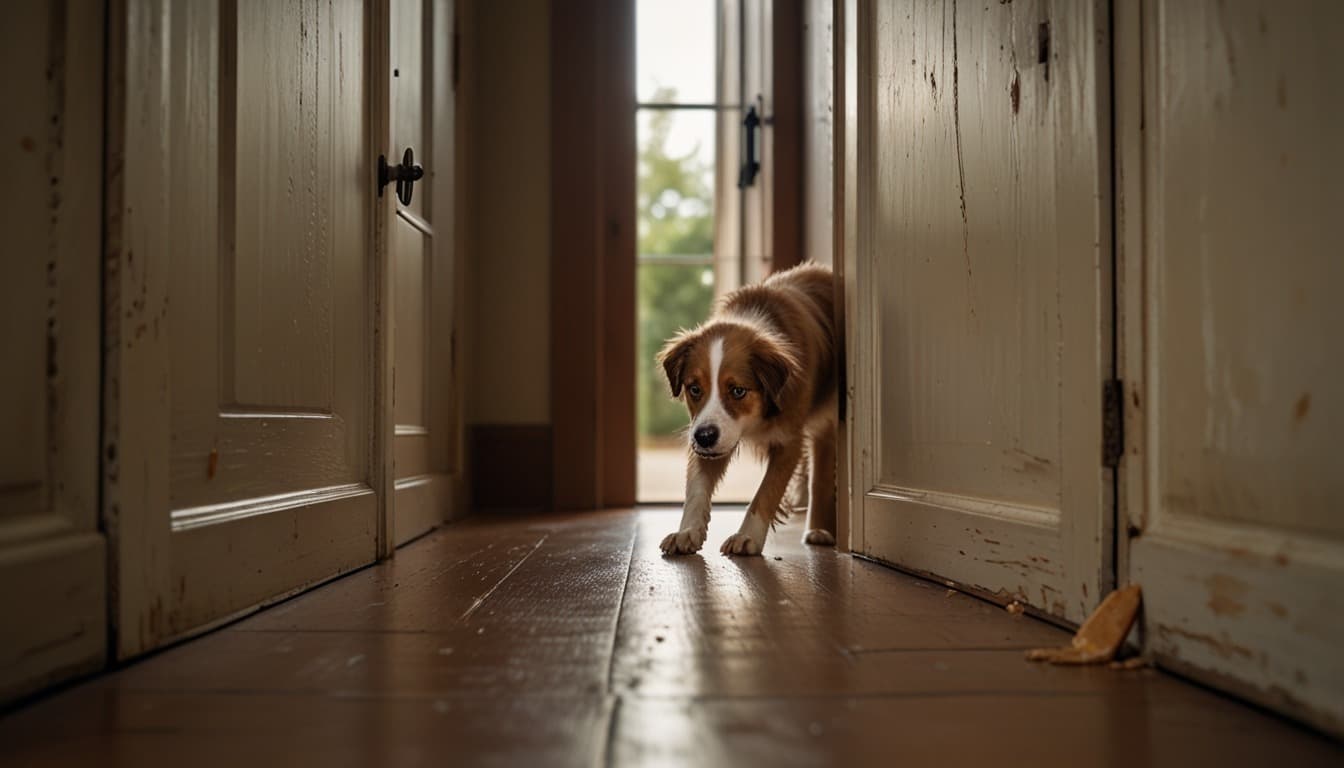
Peanut butter. That's what I found smeared across the front door when I got home from a double shift at the shelter. Along with a shredded couch cushion, a puddle of drool the size of a dinner plate, and a whiing so high-pitched I legitimately though my smoke alarm had malfunctioned. No. It was Macy. My six-year-old shepherd mix, the dog I'd called "bomb-proof", standing in the middle of the living room, shaking and whining like I'd been gone for a decade.
I'd left her for seven hours. Seven. Not a wekeend. Not three days. Seven hours.
I knelt down, and she pressed her wholle 65-pound body against my chest, still whining, even as I was touching her. That's when I knew this wasn't about "missing me." Something had broken inside that walnut-sized brain while I was gone. And I had aboslutely no clue what to do.
Why Leaving Alone Feels Like the End of the World to Your Dog
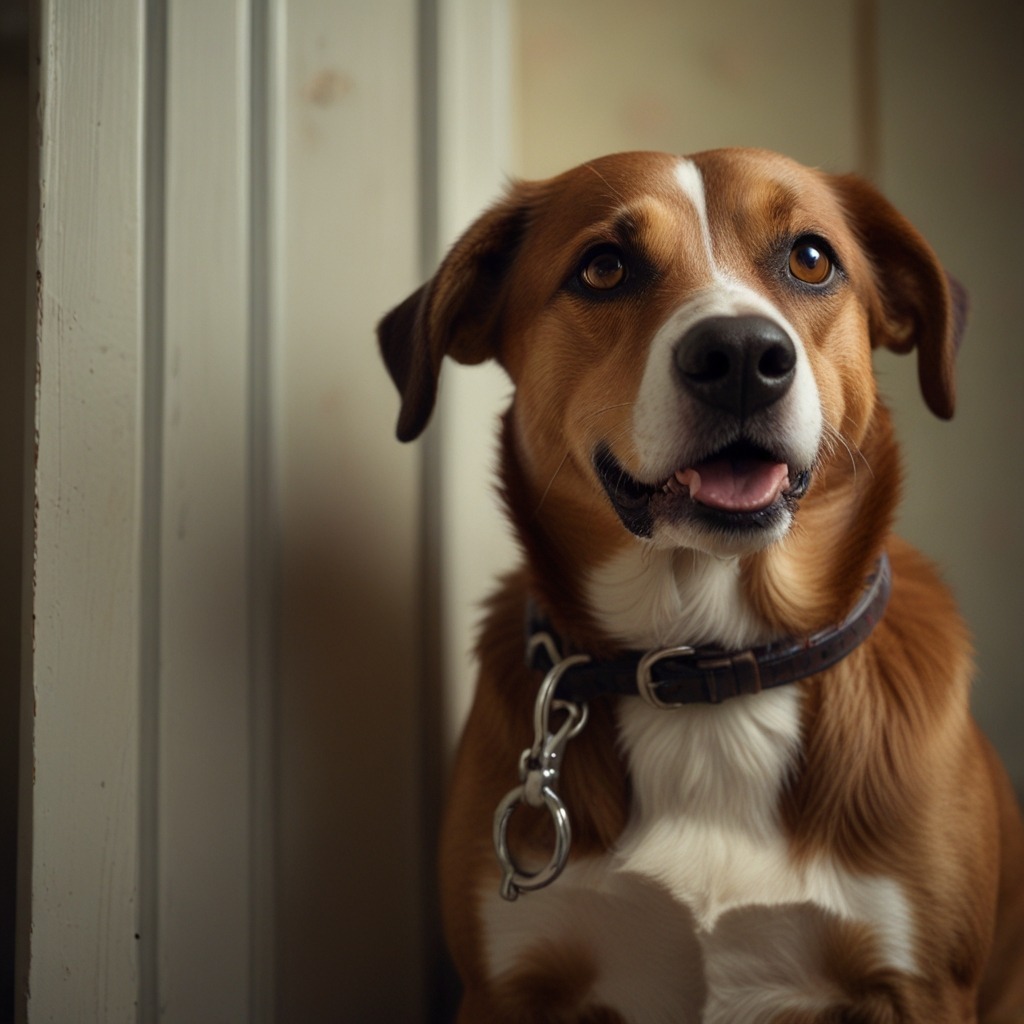
If you've ever sat in your car outside your house, listening to your dog scream on the other side of the wall, you know the guilt. It's physical. But here's the thing most "calm your dog" articles won't tell you: a dog whining when left alone isn't being dramatic. It isn't manipulative. It's in a state of genuine panic.
Separation Anxiety isn't Just Bad Behavior—It's Panic
I used to roll my eyes at the phrase "separation anxiety." Sounds like something you'd read on a wine mom's blog, right? But after that peanut butter day, I started recording Macy. What I saw on the camera made me sick. She'd start panting wiithin 90 seconds of the door clicking shut. By minute five, she was pacing a frantic loop from the front window to the kitchen and back. By minute twenty, the whining started. It didn't stop until I put my key in the lock.
This isn't boredom. A bored dog tears up a pillow and then naps. An anxious dog can't physically settle. Her cortisol levels were through the roof—we actually tested later, after a $340 vet visit (more on that catastrophe later). The vet, Dr. Nguyen—she's tolerated my panic calls through three dogs, a divorce, and a fire—told me something I'll never forget: "Sarah, a dog with severe separation anxiety is experiencing the same physiological panic you'd have if you were trapped in an elevator with no light."
The Whining Starts in the Brain, Not the Throat
Whining is just the audible symptom of a much bigger neurological storm. When a dog perceives isolarion as a threat—and for some dogs, it's a legitimate threat on a primal level—their amygdala fires, cortisol spikes, and they vocalize for the same reason a lost puppy cries for its mother. It's an involuntary distress call. Macy wasn't "asking" me to come back. She was in fight-or-flight mode with nowhere to go.
What made it harder: Macy had been a stray. The shelter intake notes said she was found tied to a fence in an industrial area. No food, no water. So her brain already had a deeply grooved pathway that said "alone = dyng." I'd spent a year building her confidence around other dogs, around loud noises, around men in hats. But the aloneness was a trigger I hadn't even touched.
When It's Actually Physical Pain or Medical
Here's a tangent I didn't expect: a few weeks into Macy's whining saga, I noticed she was also licking her paws raw. Turned out she had a low-grade urinary tract infection. The discomfort from the UTI made her general anxiety skyrocket, and the whining while alone was partly her trying to self-soothe. I only caught it because my friend's dog had done the same thing—I'd dismissed it as "more separation crap" until the pee accidents started. So yeah. Rule out a UTI, dental pain, or arthritis before you assume it's purely behavioral. I once spent three months working on "separation anxiety" with a build named Cheeto, only to find out he had a cracked tooth that hurt whenever he stopped chewing on something. Once the tooth came out, the whining dropped by about 80%. The other 20% was just Cheeto being Cheeto.
The Neighbor's Note That Made Me Sit on the Floor and Sob
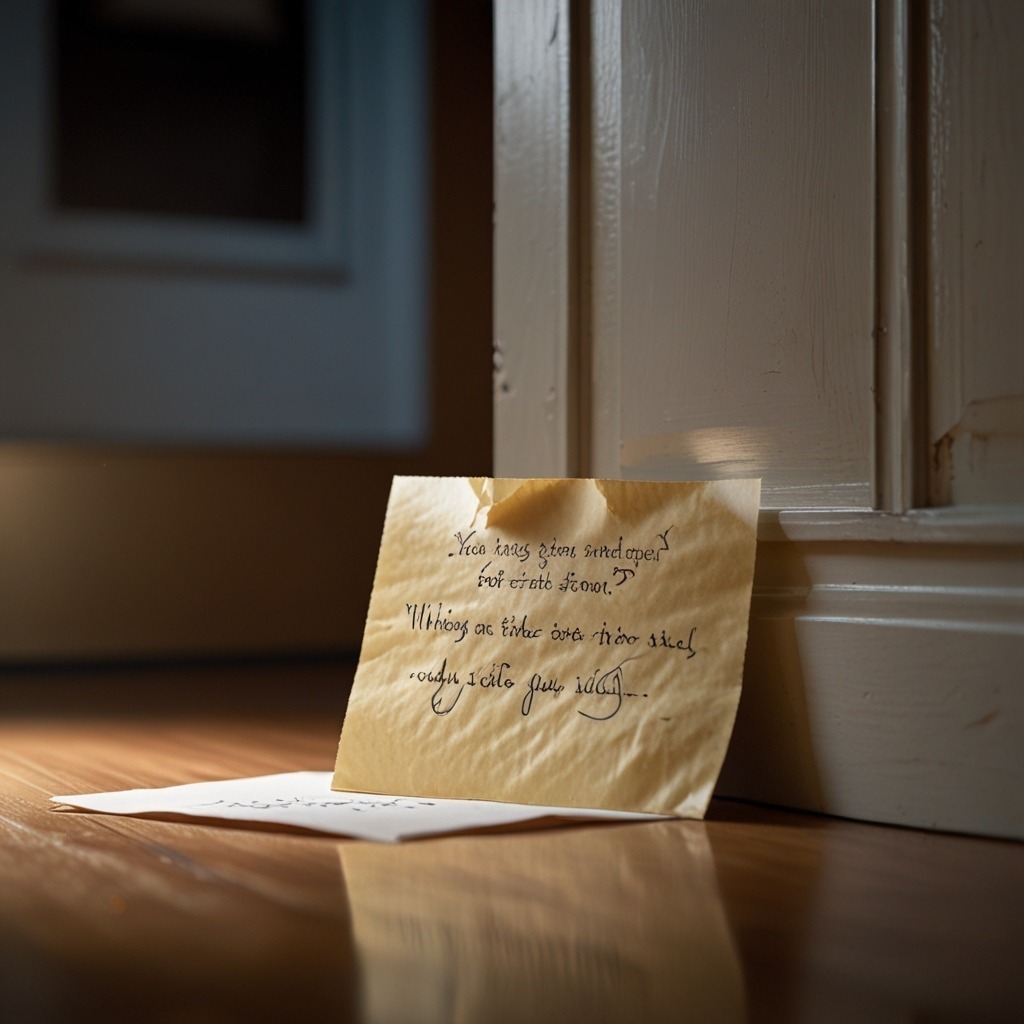
About two weeks into the crisis, I came home to a sticky note on my apartment door. Yelkow. Written in that tight cursive old ladies use.
"Your dog has been whining continuously from 8am to 3pm every day this week. I work nights and need to sleep. If this isn't resolved by Friday, I'll have to contat the landlord. — Mrs. Chen, 3B."
I read it three times, slid down the door frame, and cried into Macy's fur. Not because I was mad at Mrs. Chen—I'd have complained too. But because it made the problem real in a way I couldn't hide from. Macy wasn't just unhappy. She was making other people miserable. And I, the "dog expert" with four build fails and a blog, had no idea how to fix it.
That evening, I did what any rational person does: I googled frantically, bought a Thundershirt on Amazon Prime, and slept on the couch with Macy's head on my chest. The next morning, I called Dr. Nguyrn and begged for a same-day appointment. My voice cracked on the phone. She said come in at 2.
What I Tred First and Why It Made Everything Worse
I'm going to list the expensive, well-intentioned crap I threw at this problem before finding anything that worked. If you're currently doiing any of these, I'm not judging you. I did them too. But let's save you the money and the sense of failure.
The Thundershirt That May As Well Have Been a Straitjacket
I'd read on some forum—probably the same place that tells you to put lavender oil behind your dog's ears—that a Thundershirt could cure separation anxiety. I wrapped Macy up like a furry burrito, gave her a Kong, and left for 20 minutes. The camera showed she spent 19 of those minutes trying to wriggle out of it, panting harder, and whining at a higher pitch. One star, wouldn't recommend.
Crate Training Gone Horribly Wrong
Look, I'm pro-crate. For most dogs it's a den. For a dog with isolation panic, it's a sensory deprivation chamber. I tried leaving Macy in her open-wire crate with a blanket over it—the "safe den" method. Within 10 minutes she'd bent one of the bars with her teeth and cut her gum. There was blood on the crate tray when I got back. I sat on the kitchen floor, hand shaking, and called the vet. Don't crate a panicking dog unless you've specifically conditioned them to love the crate when you're there first. And even then, some dogs, like Macy, never feel safe confined when alone.
Ignoring the Whining (Thanks, Interet) and the Damage That Followed
The worst advice I ever got: "Just ignore her when you leave and come back. No big goodbyes. She'll learn you always retunr." I did that for three days. By day three, Macy had chewed the door frame down to the splinters, whined so loudly that Mrs. Chen taped a SECOND note (this one said "I'm calling tomorrow"), and peed on my bed. Ignoring a dog in full panic mode doesn't teach them you'll return. It teaches them you're unpredictable and the world is ending every time you walk out.
Here's a relsted disaster: I even tried distracting her with one of those automatic treat dispensers—the same kind I tested for my cats. (Yes, I wrote an entire article about how three shameless felines destroyed 11 feeders. The irony.) Macy figured out within two days that the machine's whir menat I was leaving, so she'd start whining before I'd even grabbed my keys. The gadget became a departure predictor, which is the dead opposite of what you want.
Macy and the Radio Station That Saved Us
One random Wednesday, out of desperation, I left the kitchen radio tuned to a classical station at low volume and went to take out the trash—which, in an apartment building, means walking down two flights and across the parking lot. It takes six minutes. I came back expecting the usual opera of despair. Silence. Macy was curled on the bath mat, head on her paws, ears flicking at the violins. She'd been alone for six minutes and hadn't made a peep.
That was the first flicker of hope.
Separation Anxiety vs. FOMO: The One Question That Changes Everything
Not all alone-time whining is full-blown separatino anxiety. Some of it's just garden-variety FOMO—fear of missing out. The difference matters because the treatments are almost opposite. I learned this the hard way with my next build, a ridiculously social hound mix named Jasper.
How I Figured Out Macy Had Both
Macy had real separation anxieety: she panicked whenever she was alone, even if she was in a room with a peanut butter jar and a dead squirrel. (I didn't test that. You get the idea.) But Jasper? Jasper only whined when he heard me in another room. If I left the apartment entirely, he'd settle after about 10 minutes. If I was in the bathroom with the door closed, he'd howl like a coyote with a mortgage.
That's FOMO. He wasn't afraid of being alone; he was angry he wasn't invited. The fix for that's boundary traiining and rewarding calm behind closed doors—not the heavy-duty desensitization I had to do for Macy.
The Camera Revealed the Truth
If you haven't set up a cheap webccam to watch what your dog does when you leave, you're troubleshooting blind. I used an old laptop and a free app. The footage showed Macy's panic spiral starting before I even closed the car door. By contrast, with a build named Bunny, the whining only started when the mailman jiggled the lobby door 90 minutes later—totally triggered by an outside noise, not the aloneness. Different problem, different fix. That's a whole other rabbit hole I wrote about when thunder anxiety knocked my dogs sideways.
The Right Question: "Can He Be Alone in Any Room?"
Dr. Nguyen asked me a question that cut through half my confusion: "Can Macy be in a room by herself for two minutes without someone else in the house?" The answer was no. Not even when I was in the next room with the door open. That's true isolation distress. If your dog can nap in another room while you're home but loses it when you leave the building, that's often a mix of attachment and context—still tough, but a different starting point.
The $340 Vet Bill That Explained Everything
Remember that UTI I mentioned? When I finally took Macy in, Dr. Nguyen ran bloodwork, a urinalysis, and did a physical exam that made Macy squirm and grumble. The diagnosis: a brewing bladder ifnection and some mild hip discomfort that flared up when she lay in one position too long. The alone-time whining wasn't "caused" by the medical issues, but the physical discomfort amped up her baseline anxiety to a point where being alone pushed her over the edge.
We treated the UTI, started her on a joint supplement (I've since ranted about the $90 kibble that made my senior dog wobble, and the $12 can of sardines that helped him jump again—different story, but same principle: food matters). Within a week, her whining intensity dropped. She srill panicked, but she wasn't starting from a 9 out of 10 on the stress scale every morning.
I'm not saying your dog's whining is a UTI. I'm saying don't skip the vet. If your dog is suddenly vocalizing when alone and they never did before, something might hurt. That's the mistake I made with my firdt build—blew it off as "behavioral" and ended up with a dog who had a foxtail embedded in his paw pad. He was whining because his foot was on fire, not because he missed me.
What Finally Made the Whining Stop—And the Two Things I Wish I'd Done Years Ago
This part gets practical, but I'm not going to give you a numbered list that sounds like a Pinterest board. Thrse are the stutter-step, imperfect, wildly specific things that worked for Macy after six months of trial and a lot of cheese.
Desensitization in 90-Second Increments
The behavioralist I eventually hired (yes, I paid a pro because I was out of my depth) had me do something called "sub-threshold departures." Basically, you find exactly how long your dog can be alone without any distress and you start there, even if it's 5 seconds. For Macy, it was 30 seconds. I'd put on a specific jacket—my "leaving" jacket—walk to the door, step outside for 30 seconfs, and come back before she whined. Then I'd sit down and ignore her for a few minutes. No praise, no treats. Just boring.
We did that 20 times a day for two weeks. Then 45 seconds. Then a minute. The key was never lettng her hit panic mode, because once the cortisol floods in, learning stops. It was mind-numbing. I hated it. But it rebuilt her brain's expectation that "jacket + door = boring short absence, not death."
The Power of a Smelly T-Shirt
The one thing that helped more than any gadget: a t-shirt I'd slept in for three nights, tossed onto her bed before I left. Not washed. Revolting to humans, a security blanket to dogs. Macy would bury her nose in it and actually sleep for the first hour I was gone. Combined with the classical radio—specifically the local NPR classical station, something about the announcer's voice—she started taking real naps instead of pacing. I cried the first time I saw her sprawled on the couch, snoring, on the camera feed.
When Medication Isn't Failure
After four months of desensitization, we'd gotten Macy up to about 90 minutes alone. Then I needed to be gone for five hours. Dr. Nguyen prescribed a low dose of fluoxetine—Prozac for dogs, basically—and a situational anti-anxiety med for the tough days. I felt like a failure putting my dog on "pills." That's crap. Chemical support gave Macy the ability to stay under threshold so the behavior work could actually stick. Within three months, she was doing four hours alone with no whining at all.
It's not for every dog. But if you've tried everything and your dog is still destroying your house and losing their mind, talk to a veterinary behaviorist. It changed Macys life. And mine. And probably Mrs. Chen's.
Nine Months Lter: The Dog Who Sleeps Through My Grocery Runs
Yesterday I went to Target for two hours. I came back, and Macy was on the couch—on the couch, not cowering behind it—with her head on the smelly t-shirt. She lifted one ear, thumped her tail teice, and went back to sleep. No whining. No drool. No sticky notes on my door.
It wasn't one magic trick. It was a hundred tiny, boring, frustrating moments, a UTI diagnosis, a lot of cheese, and learning that my dog's panic wasn't avout me not being a good enough owner. It was her brain screaming a false alarm that we slowly, painstakingly taught to shut up.
If you're deep in the peanut butter-on-the-door phase, I see you. It gets better. But skip the Thundershirt.