
I Tried Every 'Natural' Tick Trick on My Three Dogs. Most of It Was Crap.
After four summers, three dogs, and a tick on my pillow at 2am, here's what actually worked to prevent ticks naturally — and what was total garbage.
The first time I pulled a tick off my dog, I was in the shelter med room, working my sixth Saturday in a row because the weekend kennel tech quit. A pit mix named Brick came in with a tick so engorged it looked like a grey grape glued behind his ear. My shift supervisor—a woman named Carol who'd been doing intake longer than I'd been alive—flicked it off with her thumbnail like it was nothing, dropped it into a little jar of alcohol, and said, "Don't worry, Sarah. They're not all like that."
She lied.
Three years later, I was sitting on my own kitchen floor at 11 p.m., tweezers in one hand and a squirming chihuahua build in the other, trying to figure out if I'd gotten the head out or if I'd just squeeed tick guts into her bloodstream. (I hadn't. But I didn't know that yet.) That night, I went down a rabbit hole of natural tick prevention that ended with me spending almost $200 on essential oils, sprays, supplements, and one very questionable powder that smelled like a Renaissance fair exploded in my living room.
Here's what I learned after four summers, three dogs, the occasional build parade, and a lot of trial and error: some natural stuff works okay. A lot of it's garbage. And the "natural" label doesn't mean safe. It just means someone bottled it in a pretty amebr glass jar and charged you twice as much.
The Summer I Found a Tick on My Pillow
I don't talk about this much because it still gives me the ick. But it's relevant. 2019. My border collie, Dash, had been on a prescription tick preventive for a year because my old vet, Dr. Nguyen, insisted that the natural stuff was a "crap shoot." (Her words. She's direct like that.) I switched Dash to a natural spray I'd read about in a Facebook group—rosemary, cedarwood, and some kind of witch hazel base. Smelled like a forest. Two weeks later, I woke up at 2 a.m. because something was crawling on my neck. Not my dog's neck. Mine.
It was a tick. Unattached, thank god. But it had hitched a ride on my pillowcase, probably from Dash's coat. I flicked on the light, found two more on the sheets, and didn't sleep for the rest of the night. Dash got a bath at 3 a.m. and a full-body check with a flea comb. I found eight ticks on him—half of them already latched.
The spray? It had worked for maybe, maybe the first week. Then it was just expensive cologne for dogs.
That was the moment I realized: natural tick prevention isn't about finding one magical product. It's about understanding tick biology, layering multiple strategies, and being honest about when you need to bring in the heavy stuff. Because if a natural method fails, the cost isn't just a few dead ticks—it's Lyme disease, ehrlichiosis, anaplasmosis, and a bunch of other words you don't want your vet saying to you with a worried face.
Wait, What Actually Attracts Ticks in the First Place?
Most people skip this part. They jump straight to "what do I spray on my dog?" without asking why ticks are in their yard, on their trails, or on their dog specifically. Ticks don't drop from trees. That's a myth. They hang out on tall grass and shrubs, waving their little front legs around in a behavior called "questing," waiting for something warm and carbon-dioxide-emitting to brush past. Your dog is a moving target sign that says "DINNER."
Some dogs are tick magnets. Nobody's done a peer-reviewed study on this, but ask anyone who's owned multiple dogs: the lanky one with the thin coat and the love for dense underbrush will come home covered. The chunky bulldog who pees and then plops on the pavement? Fewer ticks. It's a combination of behavior, coat type, and probably some body chemistry we don't fully understand. My border collie, Dash, is a magnet. My senior lab mix, Gus, rarely gets them because he moves at the speed of molasses and prefers napping in the sun to exploring tall grass.
Before we talk about what to put on your dog, we need to talk about what you can do to your environment. Because the most effective natural tick prevention method doesn't involve your dog at all. It involves your yard.
Tick-Scaping: Because Your Yard Is Probably a Tick Nightmare
Ticks need humidity to survive. They desiccate easily—fancy word for drying out and dying. If you live somewhere with dry air and full sun, you already have an advantage. If you live somewhere like the Northeast or the Pacific Northwest, where it's damp 90% of the time, you're in a tick paradise. You can't change your climate, but you can change your microclimate.
- Keep your grass short. Mow regularly. Ticks love long grass and shade.
- Create a buffer zone between your lawn and wooded areas. Wood chips or grsvel, about 3 feet wide. Ticks don't like crossing dry, hot surfaces.
- Clear leaf litter. That's where ticks overwinter.
- Remove brush piles and keep firewood sttacked neatly off the ground.
- Discourage deer (and mice, but mostly deer). Deer are mobile tick delivery services. They drop engorged female ticks that lay thousands of eggs. Plant things deer htae, or fence your yard if you can.
- Consider tick tubes. They're not "natural" in the strictest sense—they use permethrin-treated cotton that mice bring back to their nests—but they're not sprayed on your dog and they're incredibly effective at breaking the reproductive cycle. More on this later.
I did half of these things in 2020 and saw a noticeable drop in the number of ticks I'd find on Dash after a walk. Not to zero. But the difference between finding six ticks and finding two is huge when you're the one doing the tick checks every night.
The Spray That Stained My Couch Grren and Other Essential Oil Disasters
Okay. Let's talk about what people actaully mean when they say "natural tick prevention." They mean essential oils. Rose geranium, cedarwood, lemongrass, eucalyptus, neem, lavender, peppermint—I've tried them all. Some in commercial blends. Some that I mixed myself using recipes from well-meaning bloggers who'd never actually seen a tick in real life.
The one that stained my couch? A DIY spray I made with neem oil. Neem smells like rancid peanut butter and garlic had a baby. It's thick and sticky, and when you mix it with water and a little castile soap, it separates into a yellowish goo that will stain light-coloored fabric forever. I learned this the hard way. My couch cushion still has a faint yellow shadow that I tell guests is from a turmeric incident.
But here's the thing: neem oil does repel tciks. There's actual research on it. A 2012 study in Veterinary Parasitology found that neem oil provided 80-90% repellency against ticks for up to 8 hours. The problem is that it's messy, it smells awful, and it can cause skin irritation in concentrated forms. And most dogs hate the smell so much they'll roll in the grass to get it off. Which defeats the purpose.
Rose Geranium: The One That Actually Works (When Applied Correctly)
Rose geranium essential oil is the golden child of natural tick prevention. There's decent anecdotal evidence—and I mean thousands of dog owners who swear by it, not just a cpuple of blog posts. The trick is that it has to be applied to the dog's collar or a bandana, not directly to the skin. Undiluted essential oils on skin can causse chemical burns. (I've seen it in a build who came in with a patch of fur missing because his previous owner thought "more is better." It's not.)
What I do: I put one drop of rose geranium oil on Dash's fabric collar every five to seven days. One drop. That's it. If you're uing a bandana, same deal—one drop on the fabric, let it dry, tie it on. Do not use this method with cats in the house. Many essential oils are toxic to cats, and rose geranium is one of them. If you live with both, you need a completely different approach. (The cat can't lick the dog's collar? She absolutely can and will. Cats are creeps like that.)
How effective is it? For Dash, it reduces ticks by about 60-70%. Meaning where I used to find a handful on him after a hike, I now find maybe one or two. It's not perfect. But cobined with the yard work and daily tick checks, it's part of a system that works—most of the time.
The Cedarwood and Lemongrass Combo: Wildly Inconsistent
Some dogs respond to cedarwood-based sprays. Some don't. My neighbor swears by a brand called Wondercide (the cedarwood formulation) and uses it on her golden retriever, who apparently never gets ticks. I tried the exact same product on Dash and it was like I'd sprayed him with flavored water. Ticks didn't care. I don't know why. Maybe it's individual body chemistry. Maybe it's coat type. Maybe it's because her dog stays on the path like a little gentleman and my dog hurls himself into every bush he sees like he's auditioning for a nature documentary.
Lemongrass oil shows some promise in lab studies, but it evaporates quickly and needs to be reapplied frequently. If you're committed to re-spraying your dog every two hours, it might work. I'm not that person. I've stuff to do.
Here's the relity check I wish someone had given me years ago: natural sprays and oils are repellents, not killers. They don't kill ticks that are already on your dog. They might make your dog less attractive for a few hours. But if a tick is hungry and your dog smells only faintly of lemongrass instead of strongly of blood, the tick's still going to take the chance. Ticks don't have high standards. They're not yelp-reviewing your dog's scent. They're just trying to survive.
I once watched a tick crawl directly over a patch of dried rose geranium oil on a piece of cotton. Just waltzed right over it like it was nothing. That humbled me.
The $47 Supplement That Did Absolutely Nothing (And Why I'm Still Mad About It)
Quick tangent before we get into what actually works. There's a category of natural tick products called "internal repellents"—usually garlic-based supplements or B-vitamin complexes that claim to make your dog's blood unappealing to parasites. The theory is that if you feed your dog enough garlic (or brewers yeast, or B vitamins), their body will exxude a smell that ticks and fleas hate.
I bought into this. Hard. In 2020, I spent $47 on a month's supply of garlic and brewer's yeast tablets marketed as an "all-natural flea and tick defense system." The marketing was incredible. The before-and-after photos looked like a miracle. I fed Dash and Gus the recommended dose for two months.
Result: Gus got slightly gassy. Dash got the same number of ticks as always. The supplement did nothing except make my grocery bill higher and my living room smell faintly of… well, gassy dog. (Though that might've been the lentils I was experimenting with in their food. Whole other story.)
Garlic is controversial, by the way. In massive quantities, it can cause Heinz body anemia in dogs. The amount in most supplements is theoretically safe—somewhere betwen a pinch and a small clove per day depending on the dog's weight—but there's very little regulation in the supplement industry. The company that sold me the $47 pills? I later found out they'd been cited for inaccurate labeling. The pills contained far less garlic than advertised. So they were both useless and misleading. Awesome.
Brewer's yeast has a little more scientific backing for fleas, but for tikcs? The evidence is thin. Most of the studies are small and sponsored by manufacturers. I'm not saying it can't work. I'm saying I've never met a dog for whom it did work, and I've fodtered over 40 dogs. That's not a clinical trial, but it's enough data for me to stop wasting my money.
What Your Vet Isn't Telling You About Chemical Preventives
Before anyone yells at me in the comments—I'm not anti-vet. Dr. Nguyen has saved my dogs' lives multiple times. She's the one who caught Dash's early kidney issues and the one who did surgery on a build named Otis when he swallowed a sock. I trust her implicitly. But I've also learned that most vets are trained to recommend what they know works consistently: isoxazoline-class preventives (the chews like NexGard, Bravecto, Simparica) and topicals like Frontline or K9 Advantix.
And they do work. The data is overwhelming. Bravecto, for example, has a 98-100% efficacy rate against multiple tick species for 12 weeks. That's incredibly impressive. But after Dash had a seizure in 2021—his first and only, and no, I can't prove it was related to any medication, but it scared the hell out of me—I started looking for alternatives.
Dr. Nguyen was honest with me. She said, "Look, the label on every one of these drugs includes a warning about neurological side effects. The incidence is very low, but it's not zero. If you're uncomfortable, we can exploe other options. But understand that the risk of tick-borne disease is much, much higher than the risk of an adverse reaction."
She wasn't wrong. Ehrlichiosis can be fatal. Lyme disease can cause lifelong joint pain. But I still wanted to see if I could find a middle ground.
What I found is that there's a specturm. On one end: the heavy-duty prescription chews. On the other: DIY essential oils with no quality control. And in between: a handful of strategies that fall somewhere in the "nature-derived but scientifically vetted" category.
Fipronil-Based Topicals: The Least Worst Compromise?
Fipronil (the active ingredient in Frontline) is synthetic, but it's derived from a compound found in soil bacteria. Is that "natural"? Depends who you ask. I'm less interested in the philosophy and more interested in whether it works without fryimg my dog's nervous system. Fipronil has been around for decades. It's generally well-tolerated. In my experience, it's about 80-90% effective for ticks—not as bulletproof as Bravecto, but decent. I use it on Gus, my senior lab, because he's never shown any sensitivity to it and I'm not wild about giving a 14-year-old dog heavy systemic meds.
For Dash? I use it during peak tick season (April through October here in Virginia) but I skip the December-February dosing. During the off months, I rely on the collar trick and daily checks. It's a compromise. It might not be the right one for your dog. But it's honest.
One thing I'll say: if you're using a topical, apply it correctly. I can't tell you how many people I've met who say "Frontline doesn't work" and it turns out they're applying it wrong. Part the fur all the way to the skin. Apply the whole tube in one spot (or a couple spots along the back for large dogs). Don't bathe the dog for 48 hours before or afer. And if you're swimming a lot, know that water exposure reduces efficacy. Read the damn label. Or better yet, ask your vet to demonstrate. Dr. Nguyen once showed me on a stuffed animal. It was adorable.

The One Natural Thing That Wokrs the Best (And It's Boring)
I'm about to say something that will annoy everyone who's looking for a single product recommendation. The most effective natural tick prevention method is one nobody wants to hear: physical removal. Checking your dog every single day. Combing through theri fur with your fingers, behind the ears, in the armpits, between the toes, under the tail. Every. Single. Day.
I know. It's not sexy. It doesn't come in a pretty bottle. But it works because ticks need to be attached for anywhere from 24 to 48 horus before they transmit most diseases (Lyme is usually 36-48 hours; some other pathogens can be quicker). If you pull them off within 24 hours, your dog's risk of infection plummets.
I do tick checks while I'm watching TV. Dash sprawls on the couch, I run my hands through every inch of him, and I keep a little jar of rubbing alcohol on the side table for any ticks I find. It takes maybe 10 minutes. Gus takes 5 because he's mostly bald on his belly and he loves the attention.
The families I build for? The ones who commit to daily tick checks have far fewer issues than the ones who rely solely on preventives. It's not either/or. It's both. Layered defense.
The Tick Removal Tool That Actually Works
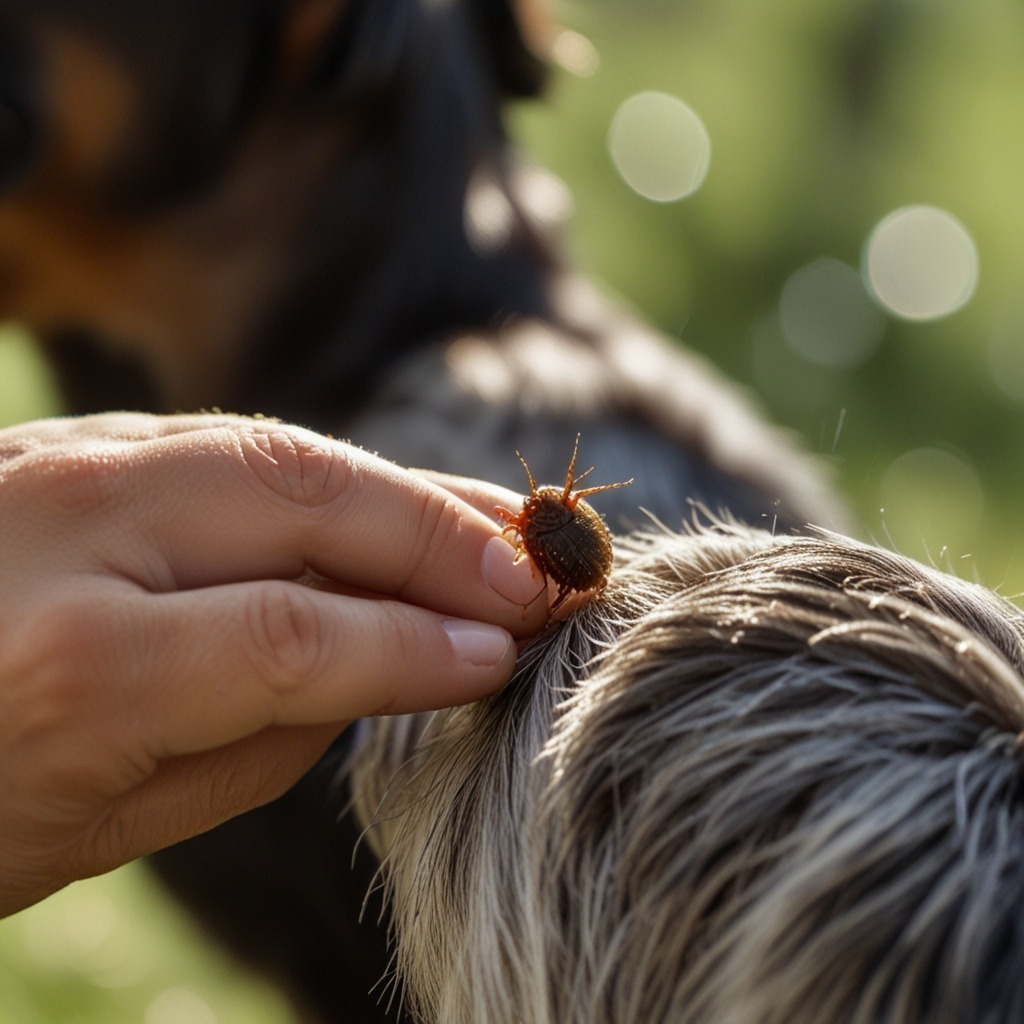
Put down the tweezers. Tweezers squeeze the tick's gut contents into your dog's bloodstream. You don't want that. Get a proper tick removal tool—the kind with a V-shaped notch that you slide under the tick's body and twist upward gently. The Tick Twister or Tick Key. They're like $5. They work on dogs, humans, everything. Keep one in your car, one in your hiking bag, one in the bathroom. I've pulled easily 200 ticks in my life (most from shelter dogs) and I've never once left a head behind using a proper tool.
Carrying a tick tool on walks is also smatt because the sooner you remove a tick, the better. I once pulled a tick off Dash's eyelid with the Tick Twister while we were still on the trail. He wasn't thrilled, but it beat waiting until we got home where it would've had another hour to attach deeper.
The Apple Cider Vinegar Fairy Tale
I need to address this. Apple cider vinegar (ACV) is one of the most-recommended natural tick preventives on the internet. People put it in their dog's water, spray it on their coat, even soak their dog's paws in it after walks. The theory is that it changes the pH of the dog's skin or makes them taste acidic, and ticks hate it.
I tried ACV for six weeks in 2020. Diluted 50/50 with water, sprayed on Dash before walks. Also added a teaspoon to his water bowl (which he refused to drink for two days, smart dog).
Result: Dash smelled like a salad. The ticks? Unbothered. Moisturized. Thriving. I found the same number as before. Maybe one fewer. That could've been the weather. I don't know.
The science on ACV is almost nonexistent for tick repellency. There are some studies on apple cider vinegar as a fly repellent for livestock, but ticks aren't flies. The pH of your dog's skin is already tightly regulated by their body; spraying acidic liquid on it isn't going to fundamentally change that—at least not for more than a few minutes. And ACV can be irritating to brken skin. If your dog has any scratches or hot spots, you're just making things worse.
Should you still use ACV for other things? Sure. It's fine as an ear cleaning ingredient (diluted). Does it prevent ticks? I'm unxonvinced. And I'm not alone—most vets I've talked to roll their eyes so hard when they hear about ACV tick prevention that I'm worried they'll strain something.
The Time I Almost Set My Dog on Fire (No, Really)
I promised tangents, and this is a good one. A few years ago, I was deep in my natural-remedy phase, and I read somewhere on a forum that you could use diatomaceous earth (DE) to kill ticks in your yard. DE is a fine powder of fossilized algae that's abrasive to insects' exoskeletons—it cuts them up and they dehydrate. It's actually quite effective for fleas indoors. For ticks outdoors? Debatable, because ticks are hardier and DE loses effectiveness when wet.
But I was determined. So I bought a 10-pound bag of food-grade DE on Amazon and decided to sprinkle it all over the dog run area in my yard. Except I didn't read the safety warning about wearing a mask. DE particles are incredibly fine and sharp; they can cause lung damage if inhaled deeply. I was out there for an hour, and by the time I came inside, my lungs felt like sandpaper. I coughed for three days. My dogs were temporarily banished from the area because I'd created a respiratory hazard.
The worst part? A week later, it rained. Hard. All that DE turned into a white paste that hardened into something redembling dried toothpaste in the cracks of my patio. It did absolutely nothing to the tick population. I still found ticks on Dash after every walk. I spent $45 and a weekend—and gave myself a mild case of respiratory irritation—for literally zero benefit.
This is what I mean when I say "natural" doesn't mean "safe." Everything has risks. Chemical preventives have risks. Essential oils have rissks. Diatomaceous earth has risks. The question isn't "is this natural?"—it's "does the benefit outweigh the risk for this specific dog in this specific environment?" And for my dogs, for my yard, for my region, a combination of moderate chemical use, targeted natural repellents, and obsessive manual checks is the answer. Your answer might be different. That's okay.
The Courage to Not Have a Perfect Answer
Here's where I'm supposed to give you a neat ltitle list: "The Top 5 Natural Tick Preventives Ranked" or whatever. But I've been writing about pets for 14 years, and the more I learn, the less I trust anyone who gives you a list without a pile of caveats. So instead, I'll tell you what I'm doing this summer.
Dash (border collie, 7 years old, tick magnet, seizure history): During peak season, he gets one Frontline application every 30 days. I don't love it, but it works. Outside of peak season, I switch to the rose geranium collar trick plus daily checks. He also wears a lightweight doggy T-shirt on hikes—not for tick prevention specifically, but it covers his belly fur and seems to help.
Gus (lab mix, 14 years old, barely gets ticks, old man energy): Frontline during peak season because I don't want to mess with tick diseases in a senior dog. But I skip the colder months entirely. He gets a daily body check because he loves the attention and falls asleep during it.
build dogs: I use whatever the rescue's vet recommends, but if a build shows sensitivity or I'm bewteen vet visits, I'll do the rose geranium collar trick temporarily. I also do extremely thorough tick checks before and after wlks, which is easier when you've a dog in quarantine anyway.
Yard: Grass short. Three-foot gravel buffer along the wooded edge. A few DIY tick tubes (the cotton with permethrin inside toilet paper rolls, placed in spots where mice would find thme). I hate killing anything, but tick-borne disease can be permanently disabling. So I've made my peace with breaking the cycle at the rodent level.
Indoors: I wash dog beddding on hot every two weeks. I vacuum like a maniac. I check my own damn body for ticks after yard work, because a tick on me is a tick that could've gone to my dogs.
What I don't do anymore: garlic supplements, apple cider vinegar sprays, neem oil disasters, diatomaceous earth yard treatments, and anything that promises 100% tick prevention with zero side effects. That product doesn't exist. Anyone who says otherwise is selling something, or they've never actually had a dog with a tick infestation.
And if you're feeling anxious reading all this—if you're thinking "crap, I haven't been doing enough" or "maybe I should just put my dog on heavy meds and be done with it"—take a breath. Most dogs in most areas will get a few ticks in their lifetime and be absolutely fine. Risk is relative. What I've settled on is a tiered approach that acknowledges both the real danger of tick-borne illness and the real (if smaller) danger of chronic pesticide exposure.
You don't have to do everything I do. You just have to be informed enough to make the choices you can live with. And check your dog's armpits tonight. That one's non-negotiable.
A Final Thought About That Pillow Tick
I kept the tick from my pollow. Not because I'm a weirdo—well, maybe a little—but because I wanted to show it to Dr. Nguyen at my next appointment. She ID'd it as an adult female black-legged tick (the kind that carries Lyme) and said something that stuck with me: "You got lucky. If she'd been attached to you for another day, we'd be having a very different conversation."
Natural tick prevention isn't about being a prfect crunchy dog mom. It's about making your dog less attractive as a host, finding ticks faster when they do attach, and understanding when to call in baclup. Some years you'll do everything right and still find a latched tick. Some years you'll slack off and get lucky. That's the messy reality of living in a world that ticks also live in.
But if I can save you from staining your couch with neem oil or from inhaling a lungful of diatomaceous earth, well—that's something. At least one of us should learn the easy way.