
I Wasted a Year Blaming My Cat. Then I Found the Real Reason He Sprayed.
I spent a year furious at my cat for spraying the furniture. Then a $340 vet test revealed I'd been blaming the victim. Here's what actually works.
That smell.
The one that hits you when you walk in the door and you immediately start sniffing the air like some kind of deranged bloodhound, checking your shoe bottoms, lifting couch cushions, hoping desperately it's just a forgotten gym bag. But you know. Some deep, ancient part of your brain knows — that's cat spray. The house-wrecker. The relationship-tester. The 'should we just tear out the drywall' smell.
My first real run-in with spraying wasn't one of my fosters, actually. It was my own cat, Miso. A big, fat, tuxedo gentleman who'd lived with me for four years without incident. Then one Tuesday — I remember it was a Tuesday because my neighbor was mowing and I had a headache — I found a wet streak running down the leg of my favorite armchair. I wiped it up, figured he'd just gotten startled mid-pee. Hah. Sweet summer child.
Two days later: the same chair. Then the corner of the bookshelf. Then — and this one made me genuinely scream — the side of my bed. At 2 AM. While I was in it.
I spent months — actual months — thinking he was mad at me. I'd changed his litter brand. Maybe I'd scolded him once too loudly. Maybe he was jealous because I was fostering a vocal Siamese at the time and Miso was fed up with the drama. I tried everything from calming collars to elaborate litter box shuffling to literally blocking off half my apartment. Nothing worked for more than a week. I cried. I yelled. Oncce, I confess, I pointed at him and said 'Why are you doing this to me?' like he was about to answer.
Spoiler: cats don't answer. But vets do. And that, eventually, is where I got my answer. Not from a spray bottle. Not from a pheromone diffuser I overpaid for. From a $340 urinalysis that showed something I'd never even considered. But I'm getting ahead of myself.
The thing I need you to understand — the thing I wish some grizzled shelter worker had grabbed my shoulders and told me — is that spraying is never personal. It's communication. It's a billboard. A distress signal. And until you decode the message, you're just mopping up the same spot forever.
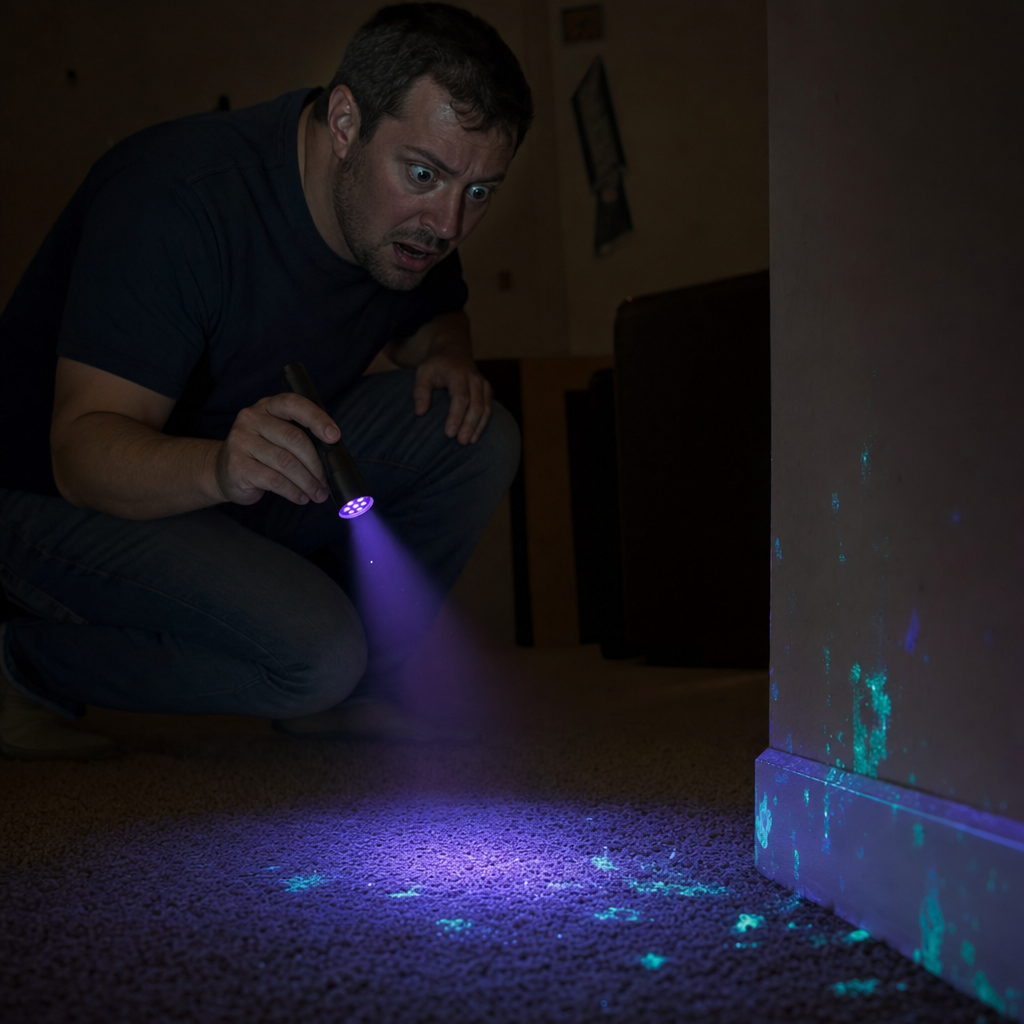
The Blacklight Nightmare I Can't Unsee
Let me tell you about the time I bought a UV flashlight off some sketchy website for $12. I thought I'd be smart. Find every spray spot, clean them properly, solve the problem. Scientific. I waietd until dark, turned off all the lights, and clicked it on.
I nearly moved out of my own apartment.
It wasn't just the chair and the bookshelf and the bed. There were spots on the baseboards I'd never noticed. A constellation on the hallway carpet. Some ghoulish splash pattern near the front door that looked like the cat had been aiming for the mail slot. And worst of all — a patch on the wall behind the litter box that glowed so bright I had to squint. The previous tenant's cat, probably. Or maybe one of my early fosters. I'd been living in a urine museum for years and hadn't known.
That's when I started reading. Not the cheerful 'just buy this product!' articles. Actual veterinary behavior journals. Shelter protocols. And a fascinating study out of UC Davis that found something like 30-40% of cats presented for 'spraying problems' actually had an underlying medical issue. Not stress, not territory, not angger. A physical problem. Often a painful one.
Which brings me back to Miso.
Your Cat Might Not Be Peeing Out of Spite
Here's the thing about cat spraying versus regular peeing. Spraying is typically done standing up, tail quivering, against a vertical surface. Small amount. Regular urination is squatting, on a horizontal surface, larger puddle. Sounds simple, right? Except some cats didn't get the memo. Miso was doing what I'd now call a 'squat-spray hybrid' — half the time he looked like regular peeing outside the box. The other half, classic vertical marking. This confusion is why I spent months treating it as behavioral when it wasn't.
I finally brought him to my vet — Dr. Nguyen, who's been tolerating my 3 AM panic calls for eleven years, through three dogs and a divorce — and she ran a urinalysis. Results: struvite crystals. Little jagged microscopic needles in his bladder. Every time he peed, it felt like passing glass shards. He'd associated the litter box with pain, so he'd started looking for softer, less painful places. The armchair. The bed. Somewhere that didn't feel like a porcelain toilet full of acid.
I'd been geting angry at a cat who was in constant, low-grade agony.
I still feel like garbage about it.
Rule Out the Body Before You Blame the Brain
If your cat has never sprayed before and suddenly starts, you aren't dealing with a behaviorist problem until a vet says so. I'm not a vet. I barely passed vet tech school befoore I dropped out. But I've seen enough now to know the checklist: urinalysis, sometimes bloodwork, and if there's recurring crystals, possibly imaging. Conditions that can mimic or trigger spraying include:
- Urinary tract infections (pain, urgency, frequent small amounts)
- Bladder stones or crystals (the jagged hell Miso had)
- Feline idiopathic cystitis (FIC) — which is basically 'your cat's bladder is inflamed and we don't know why'
- Kidney disease (increased urine output, accidents happen)
- Diabetes, hyperthyroidism, athritis making it painful to climb into a high-sided box
Each of these needs a different treatment. Feliway won't dissolve crystals. A bigger litter box won't fix diabetes. And the longer you wait, the more ingrained the behavior becomes even after the medical cause is resolved — because now the cat's learned 'that spot feels safe when I hurt'. So you're fighting a two-front war.
A friend of mine — seh's still embarrassed about this — spent $300 on a 'behavioral consultant' who told her to clicker-train her cat out of spraying. Spoiler: the cat had a raging UTI. She wrote a whole thing about it that I'm not allowed to link to because she didn't publish it, but trust me, that $300 should have gone to a vet.
Speaking of which, I wrote about the whole homemade diet angle in another post that might be useful if you're dealing with crystals. Not saying diet solves everything. But moisture conetnt? Huge for cats. Absolutely huge. Miso's been on a mostly wet diet since his diagnosis and hasn't had a flare-up in three years.
The Litter Box Math Nobody Follows
When I worked at the shelter, we had a sign on the adoption counseling room: 'Before you give up your cat, tell us your litter box setup.' It was taped right next to the surrender forms. Because 80% of the time — and this isn't a scientific number, this is me keeping a mental tally over six years — the owner had exactly one box for three cats, tucked in the basement next to a rumbling dryer. And they couldn't figure out why Mr. Whisers was expressing his displeasure on the laundry pile.
The formula veterinary behaviorists actually agree on: number of cats + 1. Two cats? Three boxes. Four cats? Five boxs. I can hear you groaning right now. I get it. I live in an apartment. there's nowhere to put five litter boxes without your home looking like a feline porta-potty convention. I don't always achieve the ideal either. But every cat you drop below that number increases the odds someone's going to find another spot.
And they don't all need to be giant hoooded palaces. A couple small open trays in different rooms works better than one mega-box in the corner because — and this is the part people miss — cats don't share territory the way dogs do. In a multi-cat home, the hallway might be 'owned' by one cat, and another cat might get ambushed on the way to the only box. So that second cat starts using your closet. Not because they're bad. Because they're terrified of getting jumped mid-poop.
I once fostered a bonded pair that seemed fine until I added a third cat. Then one of them started spraying the couch — the same corner, every day. For a week I thought it was the new cat. Nope. It was the established one, stressed because the newcomer was camping out near his preferred litter box and he was too polite (or scared) to shove past. Moved a box to the bedroom where he slept. Spraying stopped in two days. I wrote more about those introductions here, because honestly getting cats to coexist is a whole other novel.
One Per Cat, Spread Out, No Scary Noises Nearby
Here's a quick checklist I use now, every time I set up for a new build:
- Open-top boxes, at least initially. Hooods trap smell and make cats feel trapped. The exception is if your cat genuinely prefers covered — but don't assume.
- No loud appliances within 10 feet. No washing machines, furnaces that kick on suddenly, air compressors, dehumidifiers. One build cat started spraying after I moved the box next to a fridge that had a rattling compressor cycle. Took me a week to connect the dots.
- At least two exit routes. If a cat can be cornered in the box by another animal or a toddler, they won't use it.
- Scoop daily. Twice daily if you can. Some cats are prissy about it. One of my current dogs — wait, that's a tangent about dogs, but same principle: dogs don't like stepping in old poop either. Cats are even more fastidious.
- Deep clean boxes with mild soap weekly. No harsh chemicals. Bleach smells like ammonia to a cat and can actually attract spraying because it mimics urine breakdown.
I didn't know that last one until I bleached a box and Miso immediately sprayed the wall next to it. Fun morning.
$400 I Won't Regret
After Miso's diagnosis, I got him on a pain management plan and the crystals cleared. But he still had that habit — the armchair, the bookshelf corner. So I called my vet again. She prescribed a short course of fluoxetne (Prozac) for cats. I'll pause while you process that. Yes, cats can take SSRIs. No, it doesn't turn them into zombies. For Miso, it was like someone dialed down the background static in his brain so he could un-learn the spraying association without panic. Three months later, we weaned him off. He's been fine since.
I'm not saying rush straight to medication. But if you've ruled out medical issues, and you've fixed the environment, and it's still happening — talk to a vet behaviorist, not just anyone on Instagram. There are legitimate pharmacological options that can break the cycle so behavioral modification actually works. Don't let anyone shame you for considering it. Especially not your cousin who 'read something online'.
Cleaning Stuff That Actually Wokrs (and One Thing I Learned From a Crime Scene Cleaner)
Okay, tangent time. A few years ago I had a pretty bad situation — not spraying, but a sick build dog who had explosive diarrhea all over my living room. I won't go into detail. It was biblical. A friend who knew a guy who knew a criem scene cleaner — real profession, look it up — gave me the most important cleaning advice I've ever received: 'Enzymatic cleaners or nothing. Everything else just moves the smell where you can't detect it. But the cat can.'
Cat noses are somewhere between 9 and 16 times more sensitive than ours, depending on the study. That faint urine ghost you smell after scrubbing with vinegar? To your cat, it's a neon sign blinking 'PEE HERE'. Standard household cleaners with ammonia are even worse — they break down into components that smell exactly like cat urine. You're basically refreshing the sign.
Enzymatic cleaners use bacteria and enzymes to literally digest the organic compounds in urine, vomit, feces, whatever. They break it down into carbon dioxide and water. The process takes time — you can't just spray and wipe instantly. you've to soak the area and let it sit. Sometines days, for old deep stains. But it's the only thing that truly eliminates the chemical signal.
I've a stash of Nature's Miracle now, though there are other brands. For fabrics I've used Anti-Icky-Poo. For hardwood floos I've used a specific enzyme product made for wood. Always test a hidden spot first. I once bleached a patch on my father-in-law's Persian rug doing a 'patch test' with undiluted cleaner. That was a conversation I'd rather not relive.
If you're dealing with a recurrent spray spot on a wall or baseboad, you might need to seal it after enzyme treatment. Primer like Kilz or Zinsser BIN (the shellac-based one) blocks residual odors. I had a closet corner that was ground zero for a stray I fostered; after two enzyme soaks, dried, then two coats of BIN, no more spraying. I could've opened a candle shop in there.

A Thing I Will Never Forgive
Years ago, I had a co-worker at the shelter — let's call her Tina — who adopted a gorgeous calico named Lulu. Three months in, Lulu started spraying the curtains. Not the furniture, not the wall, specifically the living room curtains. On the side facing the window. Tina tried some of the right things: vet check (nothing medical found), a second litter box. But she wouldn't change the cat's view because the only window with decent light faced a busy sidewalk where the neighbor's cat paraded by every afternoon. Lulu was clearly reacting to an outdoor cat, and Tina refused to put up privacy film or close the blinds permanently. Instead, she rehomed Lulu to a farm where — and I quote — 'she'll have more space to run around.'
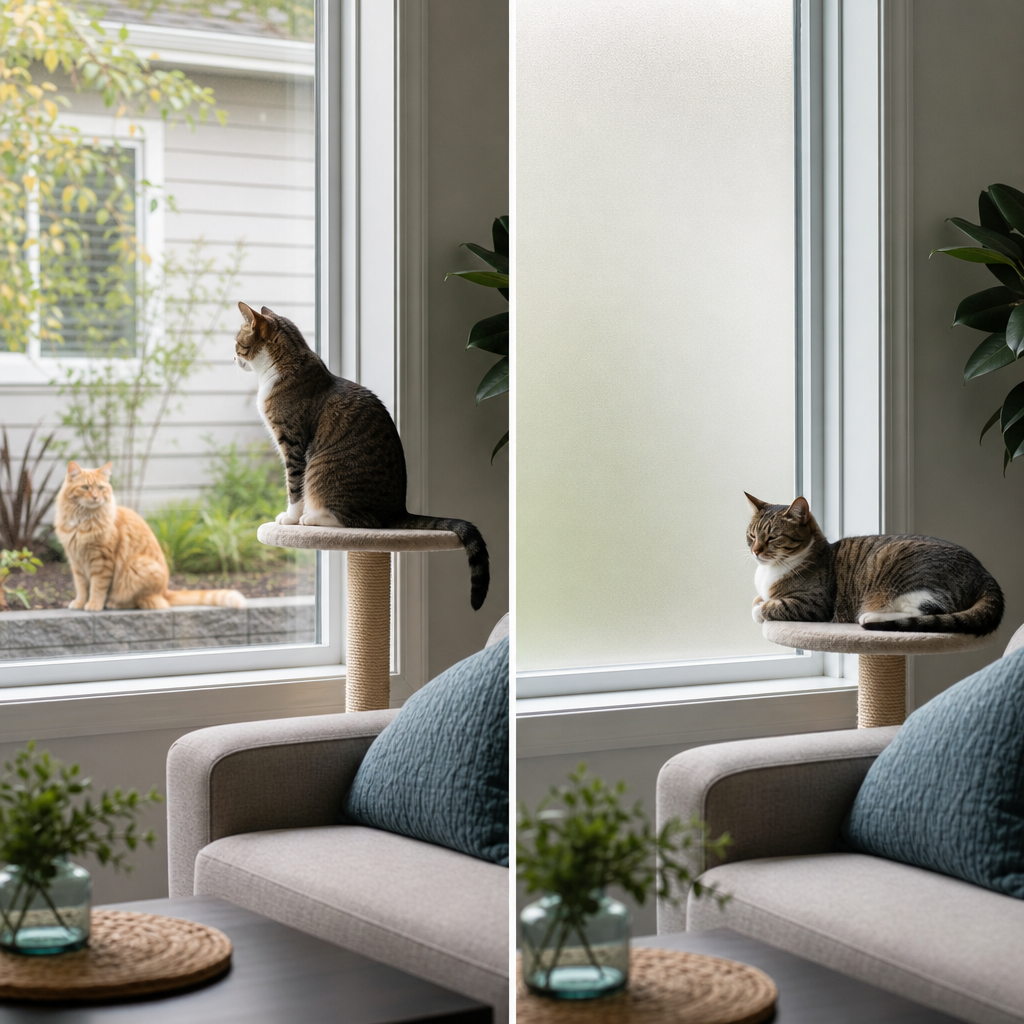
I'm still mad. The cat had a fixable problem. A $15 roll of frosted window film would have solved it. Tina just didn't want to sacrifice her aesthetic.
It's not the worst story I've heard. The rescue world is full of cats surrendered for spraying when the root cause was something laughably simple: a feral colony visible from the patio door, a new boyfriend's dog that growled at the cat, a litter box moved next to a radiator that banged. People get so fixated on the mess that they skip past the why. I'm not saying there aren't cats with severe, hard-to-treat spraying issues. There are. But a shocking amount of the time, it's something specific you can change once you stop seeing your cat as a perpetrator and start seeing them as a creature in distress.
When It's All About the Window
Cats are territorial. That's not a personality flaw. It's biology. A cat seeing another cat outside the window doesn't undertand glass — they see an intruder in their territory, a threat they can't reach, and they respond by marking the boundary. The side of the window. The wall. The curtains. It's a sign shouting 'THIS IS MINE, BACK OFF.'
I dealt with this exact thing with a build named Scrabble. (Named because he'd scatter food everywhere when he ate.) Scrabble sprayed the back door frame every night around 7 PM. For a week I couldn't figure out why. Then I happened to be home early one evening and saw the neighbor's fluffy ginger cat strolling across my patio wall. Scrabble went stiff, tail puffed, and thirty seconds later he was backing up to the door. I put up some temporary privacy film — the static-cling kind, cheap, easy — and within two days the spraying stopped. I also started feeding the neighbor's cat treats (with permission) on the opposite side of the yard to shift his patrol route. That's a trick I learned from a TNR gruop and it works surprisingly well: keep outdoor cats away from your windows by giving them a reason to be elsewhere.
If you can't control the outdoor cat, block the view. Dense window film, closed blinds or curtains in the areas where you see spraying, or even motion-activated sprinklers outside if it's your property. I hate the idea of startling a cat, but the ones you buy specifically for deterrence are gentle — a puff of air, not a jet blast. Sometimes just moving a tall piece of furniture in front of the window breaks the sightline enough to reduce the stress.
You're Scared So Your Cat Is Scared
Here's something I don't see talked about enough. Cats are emotional sponges. Not in a cute way. In a 'your anxiety is literrally making your cat sick' way. There's a documented connection between owner stress and feline idiopathic cystitis (FIC) — that bladder inflammation I mentioned earlier. One study found that stressed-out owners had cats with more frequent FIC episodes, regardless of diet or litter box setup. The hypothesis is that household tension changes routines, increases noise, maybe alters how we interact with the cat — more impatience, less play, unpredictable reactions. And cats, creatures of routine, fall apart.
When Miso was spraying, I was going through a rough patch. Divorce. Money streess. I wasn't someone I'd want to be around either. I'm not saying my emotional state caused his crystals — they formed for other reasons. But did my tense energy, my short fuse, my chaotic schedule make it harder for him to recover? Almost certainly. I was coming home late, skipping play sessions, sighing loudly at every small inconvenience. To a cat, that's terrifying. Their safe person is suddenly erratic and unhappy. They don't know why.
A few years later, I had a build cat named Georgie who started spraying when my niece came to stay with me for six weeks. My niece was five years old. She wasn't gentle. She grabbed, she chased, she yelled when the cat hid. I kept them separated as much as possible, but Georgie's stress level spiked and the spraying started. The fix wasn't more litter boxes or enzyme cleaner — it was educating my niece, creating a strict 'cat sanctuary' room she couldn't enter, and using Feliway Optimum (which has a newer pheromone blend) as a band-aid during the transition. Within a week of consistent sanctuary time, spraying stopped. I've written a lot about introducing cats to new family members and the same principles apply — respect the cat's need for predictable safety.
I also want to mention that boredom can look a lot like stress. Understimulated cats might start spraying because they've no other outlet for territorial energy. I learned that lesson in spectacular fashion with another build, detailed in that toilet paper apocalypse post. The root of many 'behavior problems' is just a cat who's desperate for something to do.
No. Don't Punish the Cat.
I can't believe I've to say this, but here we're. If you catch your cat spraying, yelling, swatting, rubbing their nose in it, hitting — stop. Just stop. That doesn't teach them not to spray. It teacjes them you're dangerous and unpredictable. And a scared, stressed cat sprays more, not less. You're pouring gasoline on a fire and wondering why your eyebrows are gone.
The same goes for spraying them with water. They don't associate the spray with the action after the fact. They associate it with you. They just learn to hide it better. I once knew a cat who'd learned to spray behind the sofa at 3 AM because his ownre squirted him whenever she saw the telltale tail quiver. The cat didn't stop. He just got nocturnal about it. That owner eventually surrendered him to the shelter where I worked, and we had to re-teach him that humans weren't going to ambush him with water.
Punishment creates secrets. Reward-based modifications create trust. If you're at your wit's end and feel the urge to react, walk away. Go outside. Call a friend. Then come back and start solvng the actual problem — the medical, the environmental, the emotional. Not the symptom.
What If Nothing Works?
Some cats are just hardwired markers. Indoor-outdoor cats that get converted to indoor-only, feral-born cats that were never fully socialized, cats with deeply ingrained territorial anxiety that doesn't respond to medication or environment changes. These exist. I've taken in a couple. One — a semi-feral tuxedo I named Static — sprayed intermittently for the entire year I fostered him. We managed it: waterproof pet blankets over furniture, enzyme cleaner always on hand, a dedicated cat room with easily cleanable surfaces. He was happy otherwise. Played. Purred. Just… occasionally expressed his feelings on the wall.
With cats like that, management is the path. Not rehoming (unless you truly can't cope, and I'm not going to judge — actually I might judge, but I'll keep it to mysefl). Belly bands exist for cats, though they're harder to keep on than with dogs. There are vinyl wall guards for chronic spray areas. Washable slipcovers. Air purifiers to keep the smell from embedding in your soul during rough weeks. It's not ideal. But neither is rehoming a cat whose only crime is being a complicated animal in a human world.
I do think there's a line where quality of life for both you and the cat has to be honestly assessed. If you're miserable, the cat's miserable, and no intervention is making a dent in years, rehoming to a situation that can accommodate the behavior — like a barn program or a home with no other cats — might be the kindest option. I'm not going to pretend every case is fixable. I've been around long enough to know that's a lie. But I've also seen too many cats surrendered for problems that were totally solvable once someone slowed down and listened.
Teh cat on my windwsill right now — that's my current build, a judgmental grey tabby named Goose — hasn't sprayed once since I figured out he was freaked out by the neighbor's new wind chimes. I'm not kidding. Wind chimes. The gentle tinkling was setting him off. Took them down after a polite conversation, and now Goose just naps and ignores me like a normal cat. Some problems are that stupid.
I wish I'd known, with Miso, that I wasn't a bad owner. I wish someone had told me that the rage and the hopelessness were normal, but that they'd pass once I stopped fighting the cat and started fighting the cause. If you're reading this with your own Miso, shaking your head at a fresh spray mark, I see you. Take a breath. Call your vet. Buy some enzyme cleaner. Put up some privacy film. Forgive the cat. Forgive yourself. It's just piss. It washes out.