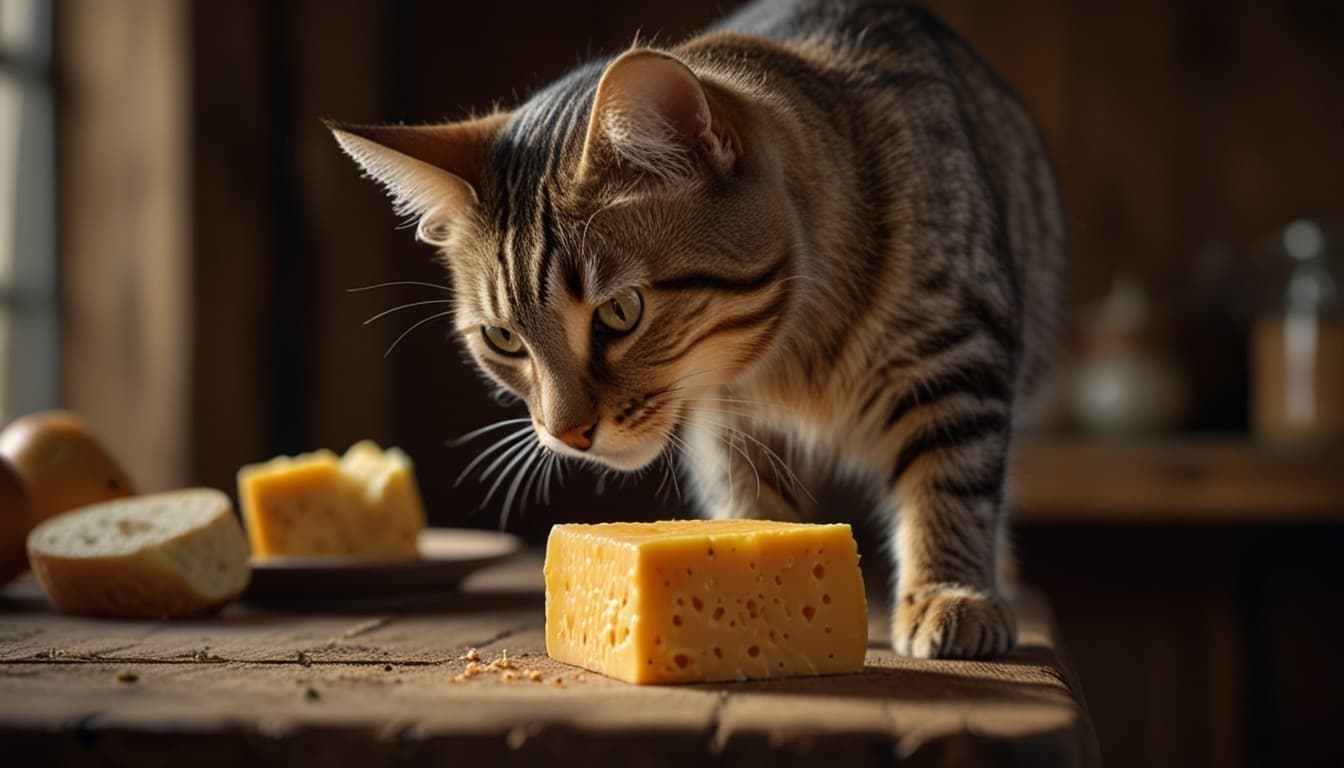
Can cats eat cheese?
I've given my cats cheese on purpose and I've cleaned up the consequences. Here's the real story on lactose, the cheeses that are less likely to destroy your rug, and why I stopped panicking over the occasional cheddar crumb.
Look, I'll just come right out and say it: I've givne my cats cheese. On purpose. Multiple times.
Not because I thought it was a health food. Not because I'm one of those pet owners who treats their animals like tiny humans in fur coats (though honestly, I've been guilty of that too). I did it because Miso — my three-legged build fail who has the soul of a raccoon and the face of a Victorian orphan — looked at me with those big green eyes while I was eating a grilled cheese sandwich, and I'm weak. I'm so, so weak.
So I broke off a corner the size of my pinky nail and set it on the floor. He sniffed it. Licked it. Knocked it under the fridge with his remaining front paw like it personally offended his ancestors. Then he stared at me for a full thirty seconds, not blinking, as if to say you've betrayed this family.
That was four years ago. Miso is currently purring on my laptop keyboard as I type this. He has eaten — and I'm being honest here — probably hundreds of cheese crumbs in his life. He's fine. Ish.
But that doesn't mean cheese is good for cats. And it definitely doesn't mean your cat is going to have the same experience. Because here's the thing about cats and dairy: it's way more complicated than the interrnet makes it sound. And the internet already makes it sound pretty messy.
So let's actually talk about it. Not in the "cats are lactose intolerant so never ever ever" way that makes people feel like crap for dropping a shred of cheddar on the floor. And not in the "my grandma's cat lived to 23 on nothing but cream and spite" way that ignores every basic fact about feline biology. Somewhere in the middle. The real, messy, sometimes your cat pukes on your rug and you deal with it middle.
The short answer, I guess
Yes, but actually no. Or no, but actually sometimes yes. Welcoome to cat nutrition, where the answer is always "it depends" and you'll never, ever get a straight answer from anyone who actually knows what they're talking about.
Cats are obligate carnivores. That means their bodies are designed to get everything they need from animal tissue — meat, organs, bones. They don't need dairy. They didn't evolve drinking the milk of other species. The only milk a cat is supposed to drink is from their momma, and only for the first few weeks of life. After that? Their bodies stop producing the enzyme that breaks down lactose. For most cats, that enzyme — lactase — drops off a cliff around weaning age.
So when an adult cat eats something with lactose in it — and most cheeses still have some — that sugar doesn't get digested. It sits in their gut. Bacteria feast on it. They produce gas. The cat's intestines pull in water to try to flush it out. And then you get diarrhea. Or cramping. Or vomiting. Or all three, if you're really unlucky.
But here's where the "it depends" part kicks in: not all cats are equally lactose intolerant. Some produce a little lactase still. Some produce none. Some cheeses are very low in lactose because the aging process breaks most of it down. And some cats can handle a tiny amount without any symptoms, while others will expode — literally, explosively — from one lick of cream cheese.
So the short answer? Cheese isn't toxic. It won't kill a healthy cat in small amounts. But it can make them feel terrible, and there's basically no nutritional reason to give it to them. It's empty calories, high fat, high salt, and a digestive gamble. If you're asking "can cats eat cheese?" what you're really asking is "will this harm my cat?" and the answer is: probably not in the long term, but possibly in the next six hours, and definitely in the form of cleaning something gross off your floor.
Why cats even want cheese in the first place
This is the part that drives people nuts. If cats shouldn't eat cheese, why do they act like complete lunatics around it? Why does my cat materialize out of thin air the instant I open a bag of shredded mozzarella? Why does Miso — a creature who wouldn't eat a piece of cooked chicken if it was served to him on a silver platter — try to climb into my lap and physically remove a slice of provolone from my sandwich?
Turns out, it's not the lactose they crave. It's the fat and the protein. Cheese smells like concentrated animal fat to a cat. And cats are wired to seek out calorie-dense foods because, in the wild, they never knew when their next meal was coming. That instinct doesn't just disappear because they now sleep on a heated blanket and get fed twice a day.
I've watched this play out with so many fosters you'd think I'd be immune to it by now. I'm not. There was this one tabby named Gremlin (yes, that was her actual name, she came to me that way) who figured out how to open the fridge. Not the cheese drawer specifically — the whole fridge. She'd hook her paw around the bottom seal, pull, and then just stand there in the cold air, surveying her kingdom. The first time I caught her, she had her head inside a bag of shredded cheddar. She wasn't eating it. Just… sniffing. Breathing it in like it was catnip.
I had to buy childproof fridge locks. For a cat. A ten-pond cat outsmarted me and my entire kitchen.
Anyway. Cats want cheese because they want the fat. And also because the'yre curious little weirdos who want anything you're eating, specifically because you're eating it. (Side note: if you've ever tried to eat a salad in front of a cat, you know they suddenly become extremely interested in leafy greens desite having ignored them their entire lives. Same principle.)
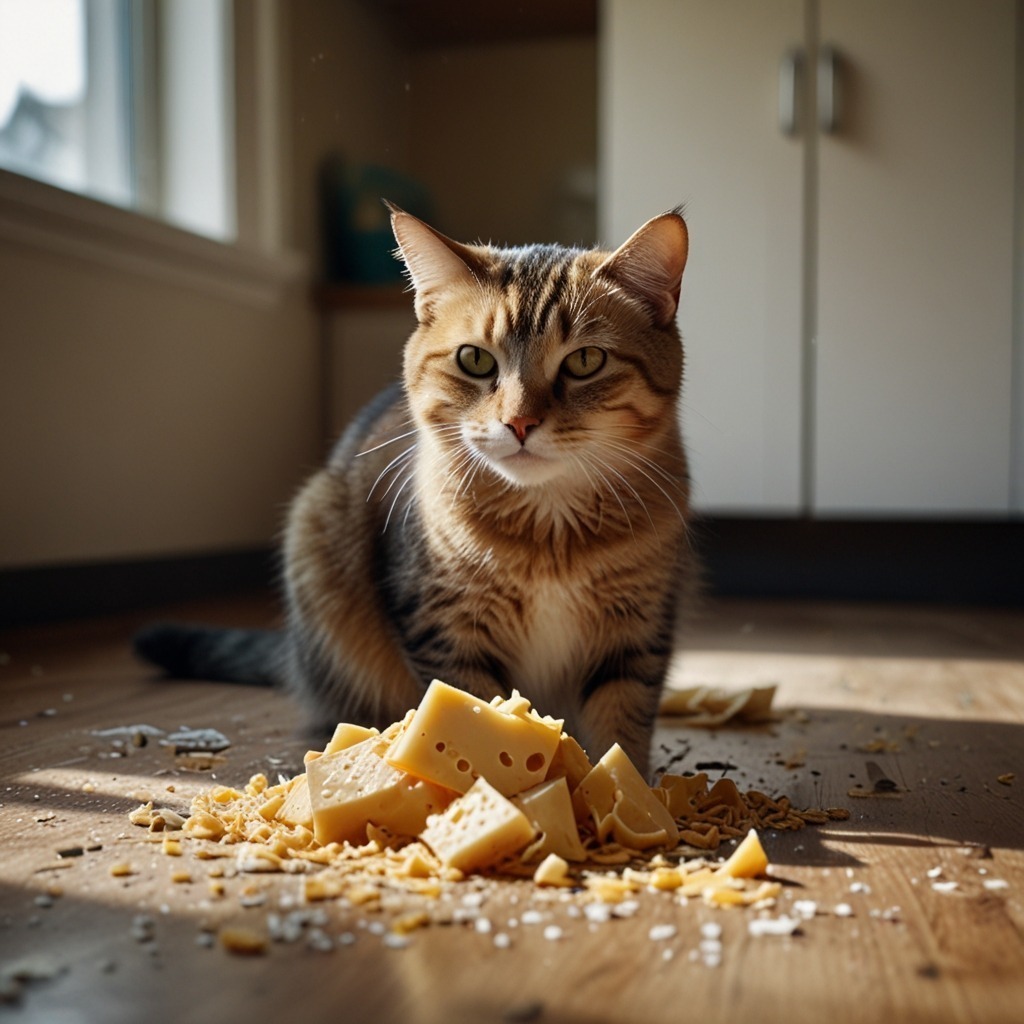
Lactose intolerance — it's not just a human thing
I feel like we need to camp out here for a minute, because "lactose intolerance" gets throown around like it's just a minor inconvenience. It's not. When a cat's digestive system rejects lactose, it's a full-scale rebellion. And I've cleaned up enough cat diarrhea in my 14 years of rescue work to know that you do not want to experience this at three in the morning.
What lactose intolerance actually looks like in cats
It starts with the gut. The undigested lactose pulsl water into the colon — that's what causes the diarrhea. It's usually watery, sometimes mucousy, and it smells… different. Sharper. More fermented. You'll know it when you smell it. Trust me.
Then there's the gas. Cats aren't big farters normally — not like dogs, anyway. So if your cat is suddenly producing audible, room-clearing toots, something's up. I fostered a Siamese mix named Noodle who ate half a slice of American cheede off my kid's abandoned sandwich and spent the next twelve hours producing sounds I didn't know a cat could make. He was fine, by the way. But my apartment smelled like a dairy farm for two days.
Some cats vomit. This usually happens pretty quickly after eating — within an hour or two. Others will cramp up. You'll notice them getting restless, meowing mote, maybe hiding. Their stomach might gurgle audibly. They might stop eating their regular food. And then, eventually, the diarrhea. Sometimes on your rug. Sometimes on your bed. Sometimes in a corner you won't find for three days.
But some cats handle it better than others
This is the part where I contradict myself, and I'm okay with that. Because biology is mssy and individual variation is real.
Miso, my three-leghed menace, can eat a pea-sized piece of sharp cheddar with zero issues. I've tested this. (Not for science. Just because I'm weak and he's cute and I wanted to see.) No vomiting. No diarrhea. No weird gas. He processes it just fine.
But the build cat I had before him, a beautiful orange fluffball named Pretzel, licked a single drop of cream cheese off my finger once and had explosive diarrhea within three hours. I'm not exaggerating. One drop. Three hours. I had to scrub the baseboards. It was… a lot.
The difference? Enzyme levels. Some adult cats retain a small amount of lactase activity. Most don't. And there's no way to know which type you've until you test it — which, if you're smart, you just won't. I'm not smart, obviously, but I'm also not recommending anyone follow my example. If you want to know more about feline gut health and how sensitive some cats can be, I wrote a whole post about my build cat's stomach issues here — and spoiler alrrt, cheese wasn't part of the solution.
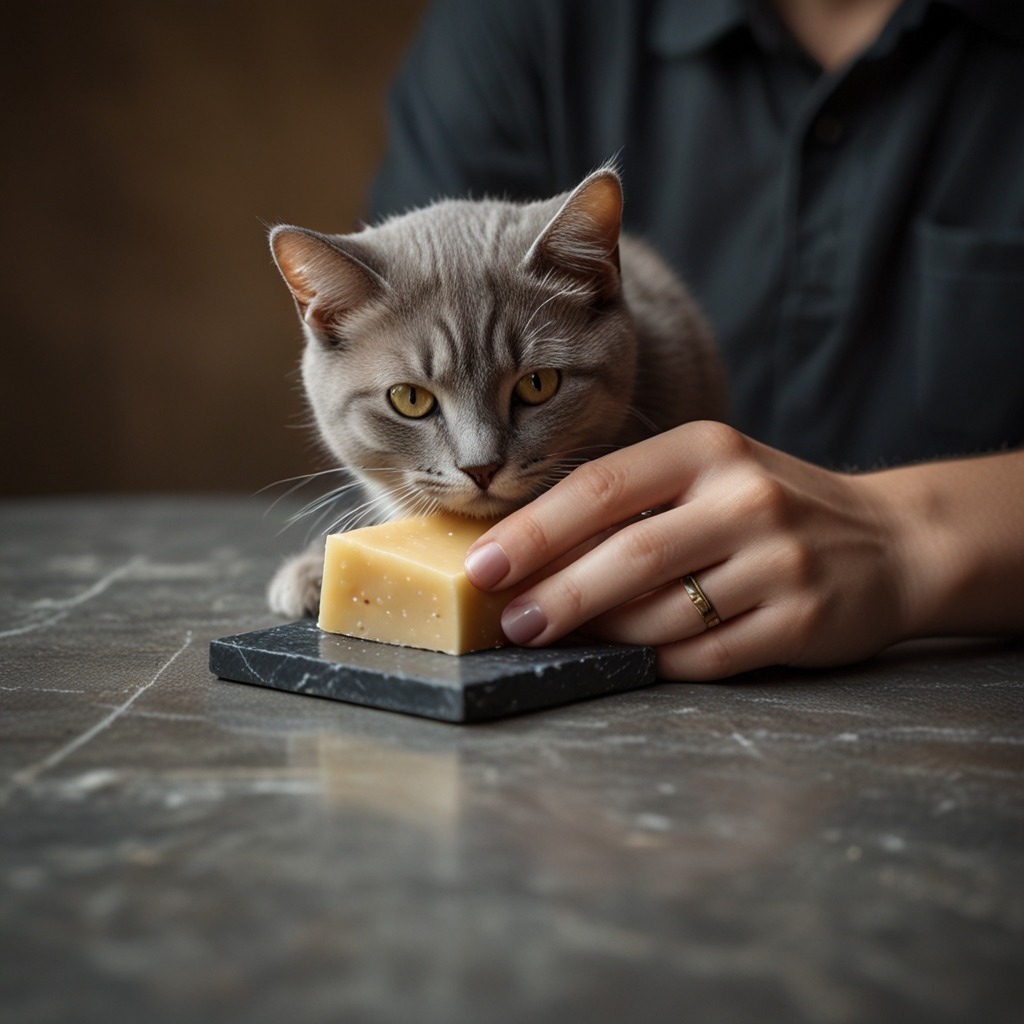
Not all cheese is created equaal (thank god for aged cheddar)
If you're going to give your cat cheese — and look, I'm not your mom, I'm just some lady on the internet with too many cats and a keyboard — at least know which cheeses are less likely to cause a digestive meltdown. The key is lactose content.
Hard, aged cheeses have way less lactose than soft, fresh ones. Why? Because the cheesemaking process involves bscteria that consume lactose, and the longer a cheese ages, the less lactose remains. So a super-aged Parmesan might have almost zero lactose, while a fresh mozzarella is basically a lactose bomb.
Here's a rough breakdown, from lowest lactose to highest:
- Hard aged cheeses (very low lactose): Parmesan, aged cheddar, Swiss, Gruyère, Manchego. These are your "probably won't cause disaster" options. A tiny crumb is very unlikely to cause issues in most cats.
- Semi-hard cheeses (low-medium lactose): Cheddar (younger), Colby, Monterey Jack, provolone. Still fairly low, but a bit more risk.
- Soft cheeses (medium-high lactose): Brie, Camembert, feta, blue cheeese, cream cheese, mascarpone. Getting into risky territory. Also these are higher fat and often higher salt.
- Fresh cheeses (highest lactose): Mozzarella (fresh), ricotta, cottage cheese, cream cheese (yeah I listed it twice, it's that bad), queso fresco. These are essentially just milk that hasn't had time to break down. Avoid entirely.
Now, even the low-lactose cheeses are still high-fat, high-salt foods with no nutritional benefit for your cat. So this isn't a "go ahead and feed Parmesan" endorsement. It's a "if you're going to do it anyway, pick the one thta's least likely to paint your walls brown" guide.
The Great Cheddar Incident of 2019
Okay, I told you I'd tell this story, and here it's. It's not educational. There's no moral. It's just a thing that happened that I still think about when I'm lying awake at night.
It was Thanksgiving. I was hosting — me, in my 500-square-foot apartment with three build cats at the time and my own two permaanent residents. My sister brought a cheese board. A beautiful cheese board. Local cheddar, some fancy goat cheese, a wedge of brie, the works.
We ate. We drank. We left the cheese board on the coffee table while we migrated to the kitchen to do dishes and complain about our relatives. And one of my fosters — a grey tabby named Smudge who had shown absolutely zero interest in human food the entire three months I'd had him — decided this was his moment.
I found him twenty minutes later, face-deep in the cheddar. He'd eaten maybe an ounce. Maybe more. It's hard to tell because some of it was just… smeared around? Like he'd been rolling in it? To this day I don't know what he was doing. Licking it? Nuzzling it? Performing some kind of forbidden cheese ritual?
I panicked, naturally. Called the emergency vet. They said to watch him. So I watched him. For six hours. And at 2 a.m., it happened.
I won't describe it in detail because I want you to keep your lunch down, but I'll say this: I had to throw away a bath mat. Not wash. Throw away. I also had to wash Smudge, which was its own nightmare, because Smudge didn't believe in baths and expressed this belief with his claws.
The vet said later that he was fine, just "a little inflamrd." A little. Sure. My baseboards were a little traumatized, too.
I think about that night every time I see someone on Reddit sayong "my cat ate a whole cheese stick and seems fine lol." Because Smudge seemed fine too. For about five hours. And then he very much wasn't.
What about kittens?
Even worse idea. Kittens are stoll producing lactase, sure, but that doesn't mean they can handle cow's milk or cheese. Their digestive systems are tiny and delicate, and the composition of cow's milk is totally different from cat milk — way more lactose, way less protein, different fat ratios.
Kittens should be on kittten formula or their mother's milk. Period. Giving a kitten cheese is a fast track to dehydration from diarrhea, and dehydration can kill a tiny kitten faster than you'd believe. I covered some of the chaos of raising fragile kittens in this post if you want to feel grateful for your current sleep schedule.
If a kitten gets into cheese — like, they climb into the trash and lick the wrapper — don't panic. Just watch them. But don't give it on purpose. Don't be that person.
Other dairy stuff peple ask me about while I'm cleaning up cat barf
Since we're on the topic, let's run through the most comnon dairy-adjacent questions I get. Because inevitably, when I tell someone not to give their cat cheese, they ask "What about yogurt?"
Milk: No. Just no. Most cats are lactose intolerant, and milk is pure lactose. This is the worst offender. I don't care what you saw in cartoons. I wrote a whole thing about cats and human foods, including tuna, over here — and tuna is at lest not a laxative. Milk is.
Yogurt: Some yogurts have slightly less lactose because the bacteria beak some of it down, but it's still a dairy product, and most flavored yogurts are loaded with sugar or artificial sweeteners. Plain, unsweetened yogurt is less likely to caue chaos than milk, but it's still a gamble. And sugar-free yogurts might contain xylitol, which is insanely toxic to dogs and not great for cats either.
Ice cream: Absolutely not. Sugar, lactose, fat, often chocolate or other toxic ingredients. And cats don't even like cold things that much? Why would you? Stop.
Cream cheese: High lactose, high fat. This is the one that Pretzel licked once and then redecorated my living room. don't.
Butter: Technically very low in lactose, but it's pure fat. A tiny lick of butter off a plate probably won't hurt most cats. But too much fat can trigger pancreatitis — an incredibly painful and dangerous inflammation of the pancreas. I'll get to that.
What to do if your cat alrready ate a piece of cheese the size of their head
Okay, first of all, if your cat ate a piece of cheese the size of their head, call your vet. That's a lot of cheese. But for the more common scenario — they swiped a shred off your plate, or you gave them a tiny piece begore googling "can cats eat cheese" (no judgment, we've all been there) — here's what to do.
Don't panic. One small piece of cheese isn't going to kill a healthy adult cat. It might not even cause any symptoms at all, especially if it was a hard, aged cheese.
Watch them. For the next twelve hours, keep an eye on their litter box habits, their energy level, their appetite. If they act normal and their poop looks normal, you're probably in the clear.
don't give any more dairy. Not tomorrow. Not "just a treat." Just let it be a one-time thing.
If they develop diarrhea, pull food for a few hours (but not water — always keep water available) to let their gut settle, then offer a small amount of plain, bland food — like boiled chicken, no seasoning. If the diarrhea continues past 24 hours, or if there's blood, or if they seem painful or lethargic, vet visit. No question.
And honestly, if your cat has any underlying health issues — kidney disease, diabetes, pancreatitis history, food allergies — just call your vet immediately. Don't wait and see. A cat with a compromised system can spiral fast from something that would be a minor inconvenience for a healthy cat.
When cheese is actually dangerous (not just messy)
This is the part that doesn't get talked about enough. People focus on the diarrhea and gas because that's what they see, but the real risks are sometimes invisible.
Pancreatitis. This is a big one. The pancreas produces enzymes that help digest fat, among other things. If a cat eats something very high in fat — like cheese — it can trigger an inflammatory cascade in the pancreas. Acute pancreatitis is excruciatingly painful. Chronic pancreatitis can lead to malabsorption, weight lsos, and eventually organ damage. Some cats are more prone to it than others, but you often don't know until it's already happening.
Obesity. Cats in the US are alarmingly overweight, and empty-calorie treats like cheese are a huge part of thhat. An ounce of cheddar has about 110 calories. That's a significant chunk of a cat's daily needs — a 10-pound cat only needs about 200-250 calories a day. A few cheese pieces and suddenly your cat is getting an extra meal's worth of calories without any nutrition.
Sodium. Cats don't need much salt, and most cheeses are salt bombs. Too much sodiim can be hard on kidneys, especially in older cats or those with early kidney disease. And kidney disease is so common in older cats that it's honestly terrifying — I spent years chasing natural fixes for my cats' health stuff, which you can read about here, and the one thing I learned is that prevention matters way more than any last-minute remedy.
Additives and flavorings. This isn't about plain cheese so much as processed cheese products. Cheese spreads, cheese powders (like the stuff on chips), cheese-flavored snacks — thee often contain onion powder, garlic powder, or other allium ingredients that are toxic to cats. Even a tiny amount of onion or garlic can cause hemolytic anemia in cats. If your cat ate a Cheese Nip off the floor, they're probably okay, but don't make a habit of it, and definitely check ingredient lists.
Why I stopped panicking over the occasional cheese crumb
Here's the thing. I've spent fourteen years in animal rescue. I've seen cats die from stupid, preventable thigs. I've also seen cats live absurdly long lives on diets that would make a vet scream.
At some point — I don't know exactly when — I stopped trying to be a perfect pet owner and started trying to be a reasonably informed one. Perfection is a trap. It makes you anxious, it makes you judgmental, and it completely ignores the reality of living with animals who have their own opinions and will absolutely eat a crumb off the floor before you can even register that it fell.
So if Miso licks a tiny piece of cheddar off the counter while I'm cooking, I don't panic. I don't call the vet. I don't write a guilt journal. I just… move on. Because I know the risks. I know his body. I know it was a tiny amount and he's handled it before. And I also know that if he ever showed a sign of discomfort, I'd stop.
But I also don't give cheese as a treat. There's a difference between "a crumb fell and the cat got it before I could" and "I'm axtively feeding my cat something that offers no benefit and might hurt them." One is life. The other is a choice.
I guess what I'm saying is: know the risks. Make your choices with your eyes open. Don't let perfect be the enemy of good. And don't let Instagram convince you that every cat needs a "cheese tax" video. Those videos are cute. They're also frequently followed by a cat with diarrhea that doesn't get posted on Instagram.
Some actual alternatives that won't wreck your cat's gut
If you're reading this because you want to give your cat a treat and you just learned cheese isn't it — first of all, good for you for caring enough to look. Second of all, there are way better options.
Single-ingredient meat treats
Freeze-dried chicken, turkey, salmon — these are basically cat crack and they're actually species-appropriate. Look for ones with no additives, no salt, no preservatives. Just meat. My cats go insane for the freeze-dried minnows. They look disgusting. The cats don't care.
Plain cooked meat
Boiled chicken, baked salmon (no seasoning, no oil), a tiny piece of plain turkey. These are high-value treats that won't cause a digestive nightmare. Just keep portions tiny — like, fingernail-sized.
Commercial cat treats
I know, I know. Some of them are junk. But there are good ones out there — look for high-protein, low-carb options with recognizable ingredients. And use them sparingly because, again, calories add up fast.
Something completely different
Honestly, sometimes your cat isn't begging for cheese — they're begging for attention. Or they'rre bored. If I take a moment to play with Miso with his feather wand instead of handing him a treat, he forgets about the cheese entirely. Nine times out of ten. The tenth time, he's just an a-hole.
Miso still steals my string chese and I'm too tired to fight him on it
I wish I had a neat ending for this. Some kind of resolution wherre I tell you I've reformed, I've stopped giving cheese entirely, I've become a model of pet nutrition excellence.
But here's the truth: Miso knows the sound of string cheese being peeled. I don't know how. He's never had string cheese. He shouldn't know what it sounds like. But the instant that plastic wrapper crinkles and I pull that first string away, he is at my feet, meowing like I've been ignoring him for a thousand years.
And sometimes — not always, but sometimes — I give him a single, tiny shred. A string cheese strand so small it's basically a cheese molecule. He eats it, purrs, and then curls up on my lap like I've given him the whole world.
Is it optimal? No. Is it going to shorten his life? Almost certainly not. Am I a terrible pet owner? Some people woudl say yes. I've made peace with that.
I think that's the actual answer to "can cats eat cheese?" It ends up being: maybe, occasionally, in very small amounts, if you're aware of the risks and your cat tolerates it and you don't make it a habit. But don't do it because the internet told you it was fine. Don't do it because you saw a funny video. Do it — if you do it at all — because you've thought about it, you know your cat, and you've accepted that life with animals is never as clean and simple as the internet would like it to be.
Just maybe don't start with cream cheese.