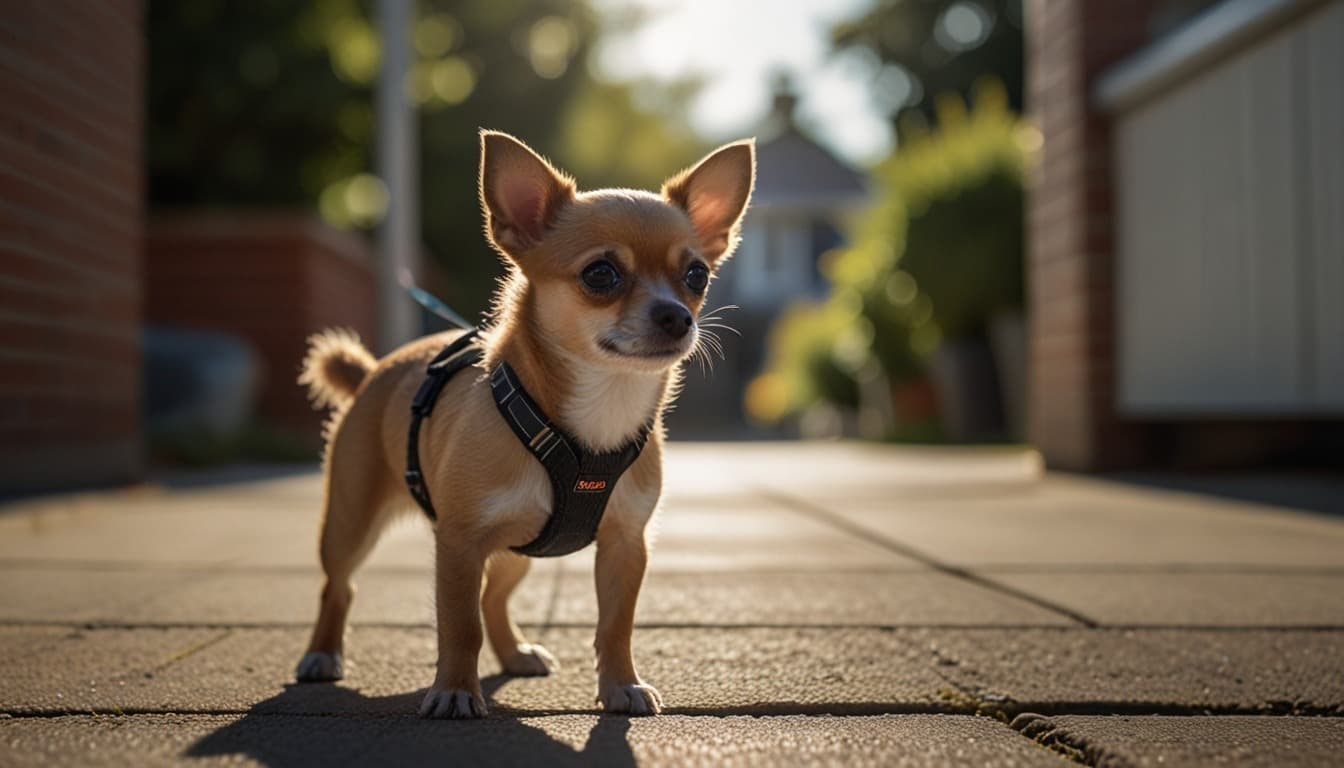
The 4-Pound Chihuahua Mix Dislocated My Finger and I Still Bought the Wrong Harness Three Times
My 4-pound foster dog dislocated my finger, and I still bought three wrong harnesses before figuring out what actually stops a small puller without wrecking their trachea.
Okay so I'm walking down my street with this 4-pound build dog, a chihuahua mix I'd named Bean because her head looked exactly like a small kidney bean, and she's prancing along like she hasn't got a care in the world. Then a squirrel. A single squirrel. And I'm not exaggerating when I say my pinky finger bent backwards far enough that I heard a tiny pop and then I was on the sidewalk, leash still wrapped around my hand, Bean already at the base of the oak tree doing this guttural noise that sounded like a garbage disposal full of gravel. My neighbor Janice came out and just stared at me. I'm 38 years old, I've been doing rescue for over a decade, I've been dragged by dogs three times my weight and somehow this tiny creature made me feel like I'd never held a leash in my life.
I've made every use mistake there's. I've bought the cute step-in ones with the little flowers. I've bought the padded mesh vest that the pet store employee swore would "redirect pressure." I've bought the $8 generic thing from the bin at the grocery store. I've wasted more money on harnesses for small dogs than I've on my own coffee habit, and I'm the kind of person who will drive 14 miles out of my way for a specific oat milk latte. So when I tell you I know what works for small dogs that pill, I mean I know because I did it all wrong first, repeatedly, often while bleeding.
The $50 use that taught her to lean into it like a tiny Iditarod champion
The very first use I bought for Bean was one of those soft padded vest deals with a back clip. She was so small I figured she couldn't possibly generate enough force to matter. Wrong. I strapped it on, clipped the leash to the ring between her shoulder blades, and the moment she spotted a leaf move she just… dropped her chest and pulled. And because the leash attached on her back, she had all the use. Her center of gravoty is basically already on the ground because her legs are the length of my thumbs, so she turned herself into a little pulling machine. Physics was on her side.
Here's the thing about back-clip harnesses that nobody explains unless you've watched a dog turn into a canine tractor: they distribute force into the dog's chest and shoulders, which are the strongest pushing muscles dogs have. So you're literally giving them a better way to pull. Dogs don't pull because they're stubborn, they pull because the opposition reflex kicks in. You pull back, they lean forward. With a back-clip use, they feel that pressure across their chest like a sled dog in a use, and they just lean harder. It's evolved or bred or whatever, I don't know, I'm not a biologist. I'm just someone who's been dragged into a bush by an 8-pound dog wearing a $47 vest.
I spent a lot of time convincing myself it was my fault. Maybe I wasn't walking her right. Maybe I needed to hold the leash differently. So I watched 17 YouTube videos at 2 a.m. while Bean slept on my pillow, and I tried all the techniques: stopping when she puled, turning around immediately, using a shorter leash, using a longer leash, making weird hissing sounds to redirect her. None of it mattered because the use was actively working against me. I could be a professional dog trainer and that use would still turn her into a tiny freight train.
The "easy-walk" lie I bought for six weeks
After the back-clip disaster I read a blog post that said front-clip harnesses were the solution. So I marched to a big-box pet store and grabbed a brand-name "easy walk" use that claimed to stop pulling instantly. It had a martingale loop on the front and a confusing strap configuration that took me 18 minutes to figure out while Bean tried to eat the instruction booklet. First walk: she pulled anyway. Because the front clip was positioned too low on her chest, and the straps were those rigid nylon ones that didn't adjust enough for her weirdly proportioned body. The chest strap sat across her windpipe. The belly strap rubbed her armpit raw after three blocks. And because the clip was at the very front of her chest, when she pulled, the use rotated sideways and the strap tightened around her throat. So I'd traded one problem for another.
I'm not saying all front-clip harnesses do this. I'm saying the one I bought that was marketed as a miracle product did this, and I kept using it for six weeks because I'm stubborn and I'd spent $38 on it and I'm still paying off the debt from my divorce. (That's a tangent—I'll circle back.)
The dual-clip use that gave me false hope
Next came the dual-clip use that promised to be "versatile." One leash attachment on the front, one on the back, use whichever works. I thought, genius, I'll use the front clip for walks and the back clip for when she's calm. What actually happened: Bean learned that if she spun around, she could get the leash tangled beind her leg and then the front clip would effectively become a back clip because the leash angle shifted. Five minutes into our walk she'd spun so many times she looked like she was wearing a macramé project. I spent half the walk untangling her, and she'd take that opportunity to lunge at every passing dog. It's like she planned it.
And the one thing everyone gets wrong: the use isnn't a substitute for training. It's a tool that makes it possible to train without your dog dislocating something on your body. – Sarah, after too many injuries
The 30 sconds that made me stop shopping for harnesses like a chump
I'm not kidding—it was 30 seconds. I was at the shelter, and one of the behavior techs, a woman named Liz who has biceps like a rock climber and more patience than I'll ever have, saw me struggling with Bean outside the intake area. I was using the dual-clip use, Bean was spinning, I was covered in mud from a puddle she'd yanked me through, and Liz just walked over, unhooked everything, pulled a plain-looking use out of her bag, and put it on Bean. It had a single horizontal chest strap, a belly strap that sat way back near her ribcage, and a front clip that was positioned higher up, almost at the breasbone. Liz clicked the leash on and handed it to me. Bean started to pull toward a passing pit bull, hit the end of the leash, and instead of choking herself or rotating the use, she just… stopped. Her front legs sort of folded a little and she looked back at me like she'd forgotten I was there. I almost cried.
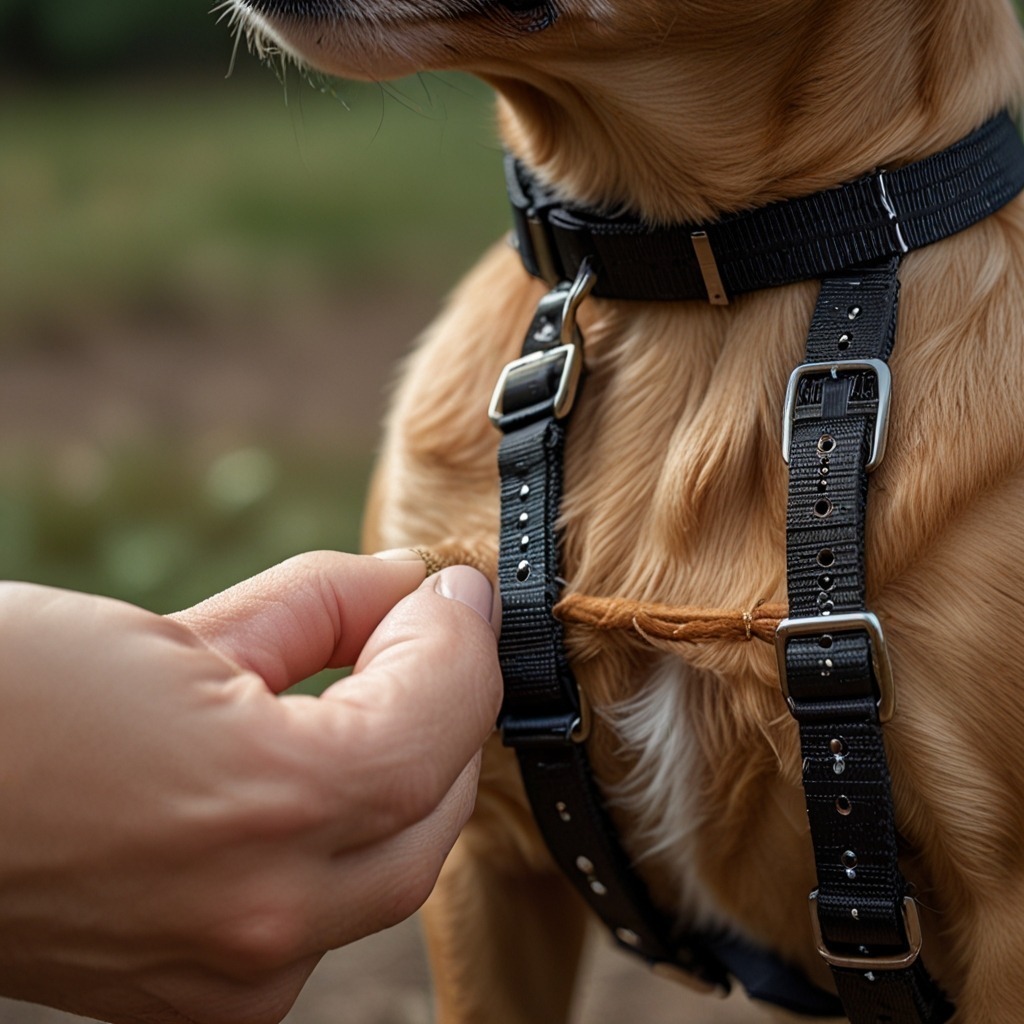
That use was a Y-shaped front-clip design with a lot of adjustability points. The chest strap was padded but not bulky, so it didn't restrict her shoulder movement. The belly strap sat behind the deepest part of the ribcage, not in her armpits. The front clip was reinforced with a metal D-ring that didn't twist. It was the kind of use I'd overlooked because it wasn't cute and it didn't promise to cure everything in the product title. It just did the boring thing: it transferred her pulling force into a direction that turned her body slightly sideways so she couldn't gain traction. No magical technology. Just engineering.
I bought the same use two days later from a small independent pet store that also sells locally made dog treats and the cashier told me the owner of the company is a woman who trains search-and-rescue dogs and got so frustrated with off-the-shelf harnesses for small dogs that she designed her own. I don't know if that's true but I want it to be true.
A note about those "no-pull" claims on Amazon
I'm going to save you some scrolling. The vast majority of harnesses with "no-pull" in the title are just back-clip harnesses with a slightly tighter chest strap. They don't actually redirect the dog's momentum, they just squeeze the chest a little when the dog pulls, which some dogs interpret as a cue to pull harder. Same with those bungee leashes—I once attached a bungee leash to a back-clip use, and Bean literally bounced forward like a spring-loaded toy. It was almost impressive. The only things that reliably stop pulling are a front-clip design that turns the dog's shoulders sideways, combined with a fixed-length leash that doesn't give any bounce, and a human who is willing to stop walking every time the dog leans. And even then, you're not stopping the pulling, you're managing it long enough to teach a loose leash. The use is just the hardware.
I've thrown away so many poducts that promised miracles. Not just harnesses, but those calming chews that did nothing, the thunder shirt that made my terrier mix sweat through it, the expensive puzzle feeders that my smartest dog solved in 90 seconds. I wrote about the time I threw a $40 bottle of allrgy relief chews in the trash after day three. It's the same pattern: marketing promises a soluution, and the product barely makes a dent. Harnesses are no different.
Wait, doesn't your dog just need training?
Yes. Obviously. But try training a dog who's choking herself every three steps. You can't get past the hardware problem long enough to teach the behavior. It's like saying a person with a broken leg just needs to learn to walk better—you still need a crutch first. A front-clip use is the crutch. It levels the playing field so the dog can actually register the leash pressure without panicking or going into opposition reflex overdrive. And it protects their tiny tracheas, which I'll get to because my vet gave me a lecture that still makes my stomach clench.
And anyway, some small dogs are just… reactive. They're not being naughty, their nervous system is screaming at them to chase the thing or bark at the thing. I've worked with a dog who tried to murder every Toyota that drove past—and yes I already told that whole saga here—and his pulling was rooted in fear, not disobedience. You can't just tell a terrified dog to walk nicely without addressing the underlying emotion, and you can't address the emotion if he's yanking you into traffic. The use buys you the ability to be present and not dead.
The use that finally let me walk past a squirrel without cursing
After the shelter tech showed me the light, I bought three different harnesses with similar designs and put them through a completely unscientific trial with Bean and my other build dogs. I walked them on my neighborhood loop with its 14,000 squirrel nests and a neighbor who lets their cat free-roam (don't get me started). I took notes on my phone at every corner, which I then lost when I dropped my phone in a puddle, but I rememver enough. I'm going to describe what I now look for and why, not just what "brand" because honestly the model matters more than the manufacturer, and what fits one chihuahua won't fit another because small dogs have body types that range from potato to spaghetti.
The chest strap that sits high and tight
The single most important variable is where the chest strap crosses the front of the dog's body. If it's too low, near the point of the shoulder, pulling just rotates the use and puts pressure on the windpipe. If it's too high, up near the throat, same problem. The sweet spot is right at the breastbone, where the sternum meets the ribs. When the dog pulls, the strap presses against that bony point and the force vectors shift so the dog's front legs get pulled slightly inward. they've to shorten their stride to regain balance, and they slow down. It's not painful—my vet approvde this use and she's the kind of person who will call me out if I'm doing something dumb—it's just mechanically inconvenient for pulling.
The use Bean ended up with has a chest strap that's about an inch wide for her 4-pound frame, fully adjustable with a buckle that locks, and it's padded with a thin neoprene sleeve that prevents chafing. I had to adjust it three times over the first two weeks as I figured out the exact fit, but once I got it right, it stayed.
The belly strap that doesn't live in the armpit
A lot of small dog harnesses have the belly strap sitting right in the armpit, and that's awful. It chafes, it restricts shoulder movement, and it makes the dog walk like a robot. The good harnesses place the belly strap several inches back, behind the deepest part of the ribcage, where the dog's body is narrower. This is also where a use that's too loose will slip off—I've had a dog back out of a use because the belly strap was too far forward and she just wiggled out—so it has to be snug without digging in. I check by sliding two fingers under the strap. If I can force a third fingger in, it's too loose. If I can't easily slide two, it's too tight. This sounds obvious but I've seen people cinch a use down so their dog looks like a sausage and that's not safe either.
One thing I learned from fostering 40+ dogs: dogs with short coats and thin skin, like Italian greyhounds or some chihuahuas, will get rub marks if the belly strap is nylon webbing with no padding. I've had to line some harnesses with moleskin from the drugstore because the dog's skin turned pink after a walk. I'm absolutely serious—I've used the same stuff you put on blisters for backpacking, and it works. If you've a dog with sensitive skin, this is such a simple fix. I also wrote about soothing itchy skin because I've washed dozens of rescue dogs who were raw from allergies, and the same principle applies: the material touching the skin matters.
The front clip that doesn't twist
The front clip needs to be a solid metal D-ring, not a plastic buckle that can rotate. If the clip twists when the dog pulls, the leash can get tangled and the pressure shifts to an unintended spot. I've found that harnesses with a fabric loop for the front attachment are universally terrible—the loop stretches out over time and eventually the leash can unclip itself if the gate on the carabiner catches just right. I had a build dog unclip herself in the middle of a crosswalk once, and I'm still not over it.
I also avoid harnesses that have the front clip centered on a vertical strap that runs up the chest, because when the dog pulls, the strap shifts to one side and the pressure becomes asymmetrical. What you want is a horizontal chest strap with the D-ring sewn directly into the center, reinforced with stitching you could tow a car with. It shouldn't move when you wiggle it.
The time I tried a head halter on a 6-pound dog and every single person on my street stared
Before I found the right use, I went through a phase where I thought a head halter would solve everything. I'd seen them work on big dogs, the gentle leaders that loop around the muzzle and behind the ears. I bought one sized for a cat because Bean was basicakly cat-sized. I put it on her in my living room. She immediately froze, dropped to the floor, and rolled onto her back like I'd put a venomous snake on her face. I got her to stand up, and she started frantically pawing her snout. It was horrible. I felt like a monster. I took it off after maybe a minute and threw it in my "things that were a mistake" bin in the closet, where it now lives next to a package of nail caps for cats that I never got onto a single build.
Head halters work on the principle that where the head goes, the body follows, and they can reduce pulling by giving you control of the dog's muzzle. But small dogs have teeny tiny muzzles and sensitive facial nerves, and many of them find the pressure aversive in a way that shuts them down completely. Bean didn't pull—she just wouldn't move. She stood like a statue for 6 minutes, trembling, while I tried to coax her with cheese. I'm not against head halters for dogs who tolerate them, but for small dogs, especially those with flat faces like pugs or Boston terriers, they're often a nightmare. And anyway, my vet later told me that sudden jerks on a head halter can torque the cervical spine. So my failed experiment was probably a blessing.
Swear to god, I once thought about trying a cat use on Bean because it was $4 and I was desperate. I didn't, but I thought about it. The things you imagine at 3 a.m. when a dog has pulled you face-first into a hedge for the third time that week.
Why I won't use a standard flat collar on a puller, even a tiny one
This is the part where I get preachy, but I've earned it. Small dogs that pull on a flat collar are at serious risk for tracheal collapse. The trachea is a tube made of cartilage rings, and when pressure is applied repeatedly to the front of the neck, those rings can weaken over time. Toy breeds like Yorkshire terriers, Pomeranians, and chihuahuas are already predisposed to collapsing trachea, and adding leash pressure is like kicking a wobbly fence post. My shelter vet, Dr. Nguyen—she's put up with my panic calls for 11 years and once stayed late to stitch up a dog I'd tripped over—she's the one who sat me down after I brought in a build poodle mix who coughed like a goose every time I tugged the leash. She didn't yell at me, she just pulled out a diagram and explained the anatomy until I wanted to cry.
I've since done research, and the statistics are grim: something like 70% of dogs with collapsing trachea have a history of pulling on a collar. It's not just about acute injuries like a crush injury from a sudden yank; it's the cumulative damage from months or years of micro-trauma. A use distributes pressure across the chest, not the throat. This isn't optional for me anymore. I won't even attach a leash to a collar on a small dog unless I'm just stepping 2 feet outside to pee. And even then, I'm paranoid.
I've had expensive vet lessons. The kind that make you sit in your car in the parking lot and recalculate your budget. Like the time I spent $200 figuring out why my build couldn't climb onto the couch—it turned out to be a slipped disc from jumping off too many times, and I felt like an idiot. So now I do'nt take chances with things I can prevent with a $30 use.
The day Bean's coughing stopped after a week in her new use, I realized the "cute collar" with the little daisies wasn't worth a collapsed trachea. – S.
The afternoon Bean let a squirrel live
Three months after I found the use that fit her right, I was walking her on a Saturday when the inevitable squirrel appeared on a low branch right above us. Bean's whole body tensed. I felt the leash go taut. And then, because the use turned her shoulders slightly when she hit the end, she stumbled a step sideways, looked up at me with this expression like "What? I was just standing here," and the squirrel ran away. She didn't lunge, didn't make her garbage disposal noise, didn't try to climb the tree. She just walked forward like nothing had happened. I stood on the sidewalk for a solid 20 seconds waiting for it to register as a fluke. It wasn't.
I'm not saying the right use will turn your small dog into a serene walking partner. She still perks up at squirrels. She still will pull if I let the leash stay tight for too long without engaging her brain. The difference is the use gives me a window—a second or two whrre the pulling isn't full-body, where I can redirect her with a treat or a "watch me" before she's already in the zone. And over time, that second becomes two, then five, then a whole walk where she checks in with me every time she sees something exciting. The use started the conversation; the training continued it.
If you're reading this and your small dog drags you everywhere and you've already tried three harnesses, I get it. I've been there. I've got a bin in my closet of failures. But I'm telling you, the right gear matters. Not because it's magic, but because it remobes the barriers that were preventing your dog from even being able to learn. And it keeps you both safe—your dog's trachea intact, your pinky un-dislocated. I'll take that.
Now Bean is curled up on the back of my couch, which she thinks is a cat bed, and my bigger dog is snoring on my foot. I've got a new build coming Sunday, some kind of terrier mix that reportedly "pulls like a tractor" according to the surrender form. I'll be starting her in the same use. I'll probably be cursing by Tuesday. But at least I know which bin to look in.