The $30 Probiotic That Finally Stopped My Dog's Three-Month Diarrhea Nightmare (And the Crap I Wasted Money On First)
After 14 years of fostering, I've seen dog poop in every shade of wrong. Here's what actually firms things up — without the $40 chews that made everything worse.
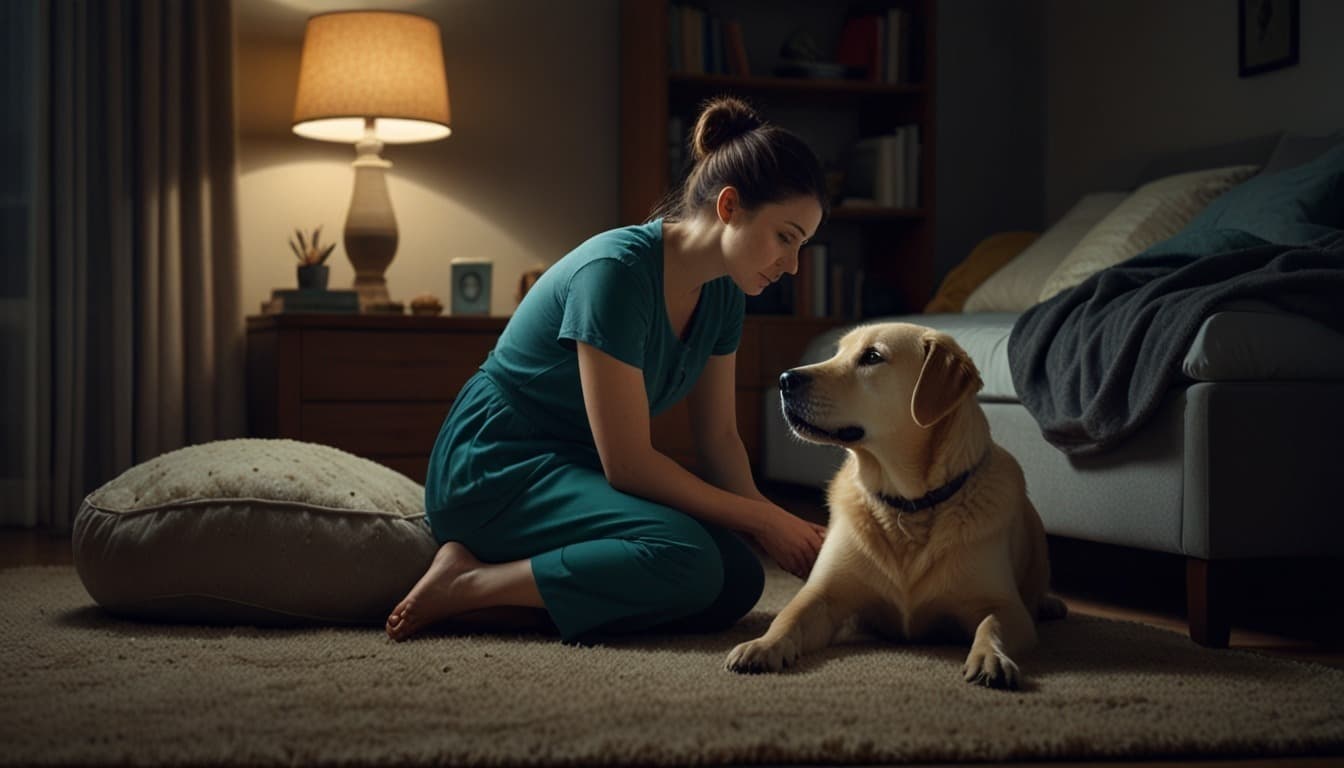
I remember the exact moment I realized I'd made a $400 mistake. It was 2 a.m., I was on my hands and knees scrubbing liquid dog diarrhea out of my beige carpet — which, by the way, is the stupidest color for a build pet parent — and the probiotic I'd been so smug about buying was still sitting on the counter, untouched for 24 hours. I'd been too scared to give it to my dog. Smart move, right? Spend $42.99 on a jar of powder that promises to "restore optimal gut flora" and then hide from it.
That was roughly month two of what I now call The Poop Winter. My senior Lab mix, Gus, hadn't had a solid stool in weeks. The vet had already ruled out parasites, pancreatitis, and the scary stuff. Dr. Nguyen — she's put up with my panic calls for 11 years, through three dogs and a divorce — hanfed me a pamphlet on "canine dysbiosis" and suggested a probiotic. So I did what any slightly unhinged pet owner does: I bought every highly rated probiotic on Chewy.com in one sitting. It was a monumentally stupid thing to do. I'll tell you why.
The time I spent $600 on probiotics and made everything worse
Gus was eight years old at the time, a rescue with a gut like a broken garbage disposal. If you've ever had a senior dog who eats things off the sidewalk so fast you'd think it was bacon, you get it. I'd switched him to a grain-free food the month before because I'd read some blog — not my finest moment — and his digestive tract responded by producing what I can only describe as burnt orange crayon sludge. If you want the full disgraceful story on that, it's here. But the short version is: I blamed the food, switched him back to his old kibble, and his gut just never bounced back. So obviously, I decided the missing piece was a probiotic.
I bought a powder, two different chews, and a tube of paste that smelled like rancid chicken broth. The first powder I tried was a popular "veterinary strength" brand. It had 10 billion CFUs, which sounded science-y enough, and the label had a picture of a golden retriever looking deliriously happy on a green field. It did nothing. The second product was a soft chew that cost $34 for a 30-day supply, and Gus ate them like treats for three days before his diarrhea turned into what I'll euphemistically call projectile situation. I was baffled. Weren't probiotocs supposed to fix things, not nuke them from orbit?
Here's where I messed up: I didn't read the inactive ingredients. That chew had over a dozen filler ingredients, including a sweetener called sorbitol that apparently can cause diarrhea in dogs if they're sensitive. I learned that from a 2 a.m. Google rabbit hole while sitting in a bathroom with a dog who looked at me like I'd personally betrayed him. Which I had, honestly.
I want to be clear: I'm not a vet. I dropped out of vet tech school before we even got to pharmacology, and most of what I know comes from 14 years of trying things on my own fosters and making a fool of myself in front of actual medical professionals. So take everyything I say with a grain of salt the size of a dog treat.
What the heck is a probiotic, anyway?
In the simplest terms — the only ones I actually understand — probiotics are live bacteria that are supposed to help reppopulate the gut with good bugs after something's wiped them out. That something could be antibiotics, a food change, stress, or just the general chaos of being a rescue dog who's been through three homes in six months. The gut has a whole ecosystem in there, and when it goes sideways, you get liquid poo, gas that could clear a room, and a dog who's miserable. The idea is you dump in a bunch of friendly bacteria and they outcompete the bad ones. Sounds great on paper.
Problem is, not all bacteria are the same. Not all probiotics survive stomach acid. And a shocking number of products on the shelf contain bacteria strains that haven't been studied in dogs at all. They were thrown in because they're cheap to manufacture and sound impresssive on the label. I didn't know any of this until I'd already blown through $200 and ruined a carpet.
The strains that actually mattrr (and the ones that are basically expensive filler)
After my second probiotic disaster, I put on my big-girl pants and called Dr. Nguyen. She emailed me a few research papers and, more importantly, told me to stop buying things with "proprietary blends" that don't list actual strain names. "If they're not telling you exaxtly what's in it," she said, "they're probably hiding something." She was so right.
Here's what I learned the hard way about which bacterial strains actually do something in a dog's gut — and whicch ones I'm now convinced are just marketing fluff.
Lactobacillus acidophilus and Lactobacillus casei
These two are the backbone of most decent dog probiotics. L. acidophilus is one of the most studied strains for both dogs and humans, and it helps break down food, produce lactic acid, and keep the pH in the gut unfriendly to pathogens. L. casei is less famous but shows up in a bunch of canine-specific research for helping with diarrhea caused by stress or diet changes. If a product doesn't have at least one of these, I dn't buy it. End of story.
Bifidobacterium animalis and Bifidobacterium longum
These are the gut's peacekeepers. They live in the large intestine and are especially important after antibiotics, because broad-spectrum antibiotics don't discriminate — they kill everything, and Bifidobacterium populations get hammered hard. I had a build dog named Daisy who came off a three-week course of doxycycline for kennel cough, and she had diarrhea for a month until I got her on a probiotic with B. animalis. Within 48 hours, her stools went from brown water to something I could actually pick up with a bag. That was the moment I realized strain specificity isn't just a buzzword. It's the whole game.
Enterococcus faecium
This one's controversial. It's a lactic acid bacteria that's been used in some veterinary probiotics for decades, but there are also concerns about antibiotic resistance genes in certain E. faecium strains. I'm not a microbiologist — I can barely spell it — so I asked Dr. Nguyen about it, and she said the risk in a healthy dog is extremely low, but if your dog is immunocompromised, you should talk to your vet before using a product that has it. I personally avoid products where Enterococcus faecium is the only strain, but I'm okay if it's one of several. You've got to make your own call on that.
The strains I ignore entirely
Bacillus coagulans sounds fancy, and it's in a lot of trendy dog supplements. There's some evidence it helps with IBS in humans, but in dogs? The research is thin. Same goes for Lactobacillus plantarum — maybe helpful, but I haven't seen a single convincing study in canines. I've wasted enough money on maybe. If a produuct is 90% these strains with a tiny bit of L. acidophilus sprinkled in, I put it back on the shelf.
Here's where I got really stupid: the CFU arms race
At one point I was so focused on CFU counts — colony forming units, the number printed on the bottle — that I was convinced more billions meant more better. I bought a jar with 50 billion CFUs per scoop, because 10 billion had failed, so obviously Gus needed five times the bacteria. That logic seemed unassailable at 11 p.m. after half a glass of wine.
The 50-billion probiotic didn't just fail to help; it gave Gus gas so foul I actually checked the floor for something dead. My neighbor knocked on the door and asked if I'd had a sewer backup. I'm not even exaggerating. So I called Dr. Nguyen again, and she said something that reframed everything: "The number on the label is the number at the time of manufacturing. By the time it sits on a warehouse shelf, then your kitchen counter, half of those bacteria might be dead. And if the strain can't survive stomach acid, the whole count is meaningless anyway."
Wait, I'm getting ahead of myself. There's another piece to this that I didn't figure out until I started reading the actual research — and I use the phrase "reading the research" loosely, because I mostly skimmed abstracts and asked my vet to translate. A lot of the good studies use a dose of about 1-5 billion CFUs per day for small dogs and 5-10 billion for large dogs, and they get results. The mega-doses? Mostly marketing. So now I don't even look at the front of the bottle. I flip it over and read the back like my life depends on it, which, given my carpet situation, it kind of does.
While I was on this CFU crusade, I completely ignored the fact that Gus's food was still a problem. That's a whole separate tangent I'll get to in a second, but first — there's a product type issue I need to rant about.
The form facor war: powder vs chew vs capsule vs mystery goo
I've tried probiotics in literally every delivery method known to veterinary science. I'm going to spare you the 18,000-word version and give you the condensed, slightly cranky summary.
Powders
These are my current preference, but only because I can control the dose. I use a tiny measuring spoon — the one that came with it, not my regular kitchen spoons, because that's a recipe for inconsistency — and sprinkle it over Gus's wet food. The downside? If your dog is a picky eater, they'll sniff it and walk away. My build dog Charlie once looked at a bowl dusted with probiotic powder like I'd poisoned him. He didn't eat for 18 hours. So powder's great if your dog will actually ingest it, which is a big if.
Chews
Oh, chews. I want to love you so much. You're convenient, you're supposedly tasty, and my dogs think yo'ure a treat. But you're also the category where I found the most garbage fillers. The $40 bottle of "allergy relief" chews I mentioned in another post is a perfect example: great makreting, worthless ingredients, and a return policy that required a blood sacrifice. With probiotic chews, the problem is usually the stuff they use to make it shelf-stable and chewy. If I see glycerin, sorbitol, maltodextrin, or a laundry list of artificial flavors, I'm out. Your dog's gut is already struggling — why add more crap?
Capsules
Capsules are great in theory because they protect the bacteria from stomach acid, assuming they're enteric-coated. But giving a dog a capsule is a special kind of nightmare. I spent 20 minutes one morning chasing Gus around the kitchen while he spat out a capsule that rolled under the fridge three times. I now hide capsules in a glob of plain canned pumpkin, which works about 60% of the time. The other 40% ends with me finding a half-dissolved capsule stuck to my sock two hours later.
The goo in a tube
I can't even think about the gel I tried without my stomach turning. It smelled like a dumpster behind a pet food factory, and my dog genuinely gagged when I put it near his mouuth. I ended up smearing it on his paw so he'd lick it off, which was a brilliant plan until he wiped his paw on my couch. I'm sure there's a dog somewhere in the world who loves that stuff. That dog isn't in my house.
The antibiotic cycle nobody warned me about
Here's a thing I wish someone had told me five years ago: if your dog is on antibiotics, the probiotic timing matters enormously. I used to think you could just toss a probiotic in with their breakfast, same as always, and everything would be fine. I was so confident about this that I didn't even ask my vet about it. And that's how I sepnt three weeks with a build dog whose diarrhea got worse, not better, while on amoxicillin.
The issue is that certain antibiotics can kill the probiotic bacteria if you give them at the same time. It's like inviting the demolition crew and the construction crew to the same party and hoping only the bad wall gets knocked down. Dr. Nguyen told me — after I'd already screwed this up — that you need to space the probiotic dose at least two hours apart from the antibiotic. So if your dog takes antibiotics at 8 a.m. and 8 p.m., you give the probiotic at lunch. It's such a simple thing, but I missed it entirely, and my poor build dog paid the price in poop. Sorry, buddy.
There's also a separate, more alarming lesson about antibiotics and gut health that I learned from a completely different build situation. If you'll indulge a tangent: I had a kitten named Miso — yes, the one from the 11-day diarrhea saga — and his gut was so wrecked by a round of metronidazole that I genuinely thought he had IBD. The same principle applies to dogs. Antibiotics can take months to recover from, and a probiotic alone might not be enough. You may need a diet change too, which is exacly what happened with Gus. But I'm jumping ahead again.
I tried making my own
No. Just no. I fermented some sort of vegetable slurry in a mason jar because a full blog told me it was "nature's probiotic" and it smelled like something that would get condemnned by the health department. My dogs wouldn't go near it. Truthfully, neither would I. Don't do this.
The day I realized the probiotic wans't the problem — it was the food
Okay, this is the part whete I admit I sometimes overlook the obvious. For two months I was obsessed with finding the "right" probiotic while Gus was still eating a senior diet that, it turns out, had a fat content his aging pancreas couldn't handle. I'm talking about the light kibble situation I described in this post — a food that was supposed to help him lose weight but instead gave him chronic loose stools and made him look bloated and miserable. I was pouring probiotics onto a food that was actively sabotaging his gut. That's like repainting the walls while the roof is leaking. I was so mad at myself when the connection finally clicked.
After a lot of trial and error (and a $340 vet workup, because of course), I swotched Gus to a simple, limited-ingredient diet with moderate fat and a single protein source. And only then did the probiotic start to work. Within a week, his stool firmed up. Within two weeks, he stopped waking me up at 3 a.m. to go outside. The probiotic wasn't magic — it was the right tool at the right time, once the underlying problem was addressed. I think this is the part a lot of probiotic marketing skips, because it's less convenient to say "maybe your dog's food is garbage" than to promise a pill can fix everything.
Which brings me to another thing: the senior dog joint saga. Around the same time, Gus was also struggling to get off the couch, and I'd been biying insane things to help him — including a $90 kibble that I now realize contributed to the gut problems because it was so rich it gave him the runs. The whole interconnected mess is in this post, but the short version is: everything you feed your dog, including suppements, interacts. You can't treat the gut in isolation.
What I actually buy now (and why I'm not brand loyal)
Over the last couple of years, I've settled into a rhythm that works for my household, which includes three dogs with wildly different digestive quirks. I don't believe there's one "best" probiotic for every dog — just the one that has the right strains for your dog's specific issue and a delivery method that doesn't make your animal look at you like you're trying to poison them. So instead of yelling at you to buy a particular brand, I'll tell you what I look for on the label every single time.
I want to see at least two of the studied Lactobacillus or Bifidobacterium strains I mentioned earlier. I want a CFU count between 1 billion and 15 billion per dose for my 70-pound dog — not 50, not 0.5. I want minimal fillers: no artificial colors, no weird sweeteners, no meat by-products. And I want a produxt that's made by a company that actually publishes third-party testing results, not just a vague "quality assured" badge that means nothing. The probiotic I use most often right now comes from a brand my vet's office carries, and it costs about $30 for a 60-day supply. It's a powder that I can mix into wet food without triggering a hunger strike. The name isn't important — what's important is that I stopped chasing Amazon reviews and started reading the back label like it was a contract I was about to sign.
If you want a concrete starting point, ask your vet for a brand that's been tested for viability (meaning the bacteria are actually alive when they reach the gastrointestinal tract) and that lists strain designations — not just "Lactobacillus" but "Lactobacillus acidophilus KABP-023" or whatever the specific research strain is. If they can't point you to that, they're probably just selling you the one with the best rep lunch.
The spreadsheet I keep in my phone notes (and why I stopped chasing "the best")
I've a Note on my iPhone called "DOG SUPPS" that's just a running log of every supplement I've tried on any of my dogs, with a column for "did it work?" and a column for "Gus's poop score 1-10". I made the poop score up. It isn't scientific. But it helped me see patterns that my panicked googling never could. What I realized after three years of data is that the most expensive product wasn't the most effective, and the one with the flashiest Instagram ads gave Gus diarrhea, and the one I'd writteen off as "cheap" because it came in a boring white bottle with no graphics was the one that actually worked. I'm not saying cheap is better — I'm saying I'm a sucker for marketing and I finally learned that the hard way.
So now when someone asks me what probiotic I recommend, I don't give them a brand name. I tell them to figure out what's wrong with their dog's diet first, then look for a probiotic with the right strains, in a form their dog will actually eat, at a price they can sustain for months — because gut healing takes time. I tell them to check the inactive ingredients like their dog's life depends on it, because for some dogs, it does. And I tell them that if they're scrubbing diarrhea out of a beige carpet at 2 a.m., they aren't alone. I've been there. I've the ruined towels to prove it.
One last thing: if your dog has had diarrhea for more than three days, or there's blood, or they're vomiting, or they're acting lethargic, stop reading pet blogs and go to a vet. Seriously. Probiotics can't fix a blockage or an infection or something systemic, and I've waited too long too many times because I thought I could DIY a medical problem with a supplement I ordered online. Don't be like 2018 me. She was a disaster.