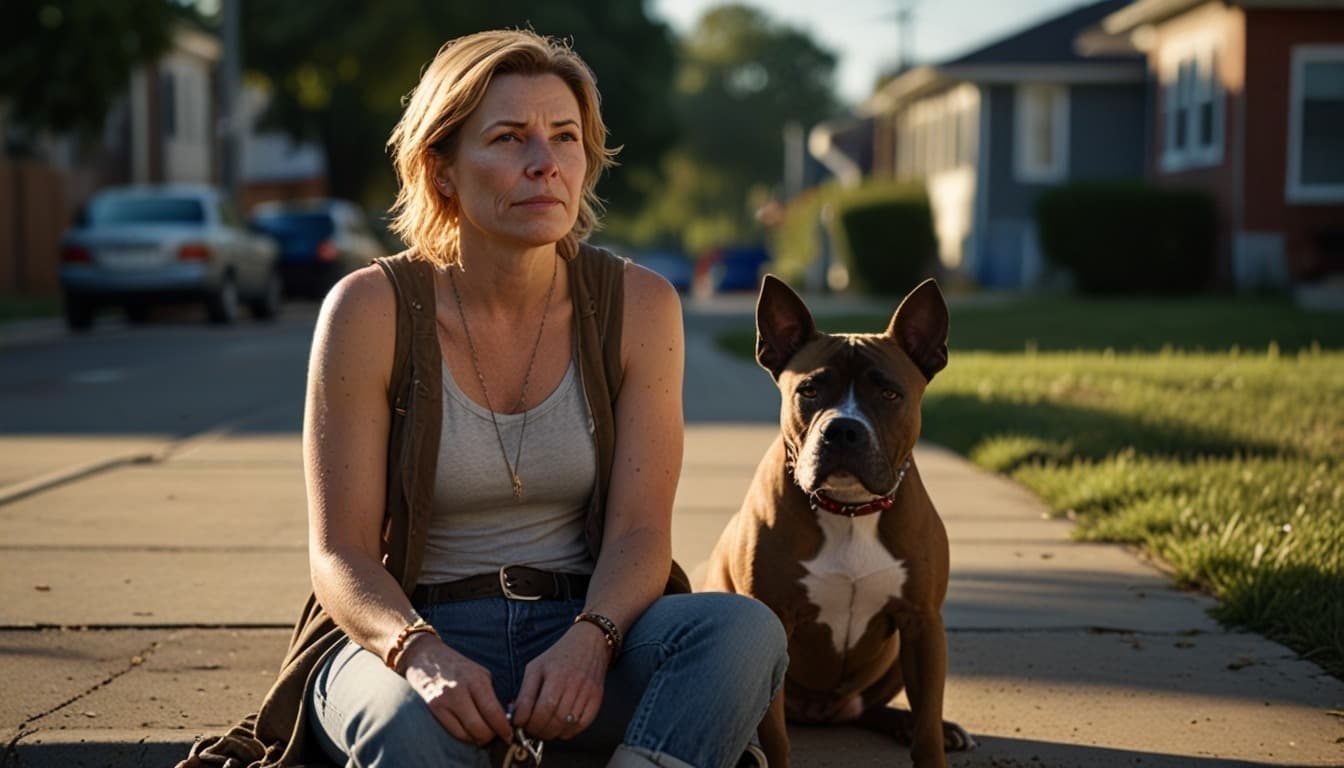
My Foster Pit Bull Dragged Me Down the Sidewalk for 3 Months — Here's What Finally Stopped the Pulling (No Prong Collar Needed)
I spent months being dragged down the sidewalk by my 70-pound foster pit bull. Here's the slow, frustrating, unglamorous truth about leash training that actually works.
The first time Gus yanked me off my feet, I was holding a coffee in one hand and his leash in the other. He spotted a squirrel about half a block away — I didn't even see it — and he went from zero to freight train in about a quarter of a second. The coffee went everywhere. I slammed into the ground, skinned both knees, and my phone flew out of my pocket and cracked on the curb. Gus just stood there staring at the tree where the squirrel had disappeared, tail wagging, like nothing happened.
That was month one of fostering a 70-pound pit bull who'd never been walked on a leash before. By month three I'd tried three different harnesses, two collars, and a head halter that made him rub his face on the pavement like I'd attached a torture device to his snout. I'd watched probably 40 hours of YouTube trainers who made it look like you just stand there like a tree and the dog magically figures it out. I'd tried stopping every time he pulled. I'd tried turning in circles. I'd tried shoving treats in his face every 30 seconds. He still pukled like he was trying to tow a semi.
I'm going to tell you what eventually worked, but I'm also going to tell you all the stuff I got wrong — because I got a lot wrong, and I wish someone had told me this crap before I wasted months feeling like a failure. I'm not a dog trainer. I'm just someone who's fostered 40+ dogs and made every mistake there's. Here's the slow, frustrating, unglamorous truth about leash training.
The day I realized I was the problem (not the dog)
Gus had been with me about six weeks when my neighbor Jeannie — she's this no-nonsense 70-year-old who's owned dogs her entire life — watched me get dragged past her house for the third morning in a row. She came out onto her porch and yelled, "Sarah, you're wslking him like you're late for a bus you already missed."
I was offended for about five seconds, and then I looked down at what I was actually doing. I was speed-walking. I had the leash wrapped twice around my hand, my shoulder was hunched forward, and I was basically pulling him forward while he pulled me forward. It was this tense, frantic tug-of-war that I'd normalized without even realizing it. I wasn't teaching him anything. I was just bracing for impact the whole time.
That's when I started reading about the concept of "loose leash walking" — which sounds obvious but honestly I'd never really sat down and thought about it. It's not about the dog walking perfectly at your side like a show dog. It's not about never ever pulling. It's about the leash beign slack most of the time, and the dog paying enough attention to you that he checks in instead of turning into a sled dog.
And holy crap, I was doing the opposite of teaching that. I was clip-clopping down the sidewalk with tension on the leash 100% of the time, so my dog literally didn't know what slack felt like. I'd never shown him. I'd just expected him to magically understand that pulling was bad because it made my arm hurt. Dogs don't work like that.
What actualky IS "loose leash walking"? Because nobody explains it.
Here's the dumb thing: I walked dogs for years before I really understood this. Loose leash walking means the leash hangs in a J shape, there's no tension, and your dog can sniff and look around — but he's not dragging you. He can be a few feet ahead, it's fine. The goal isn't a military heel. The goal is a walk that dosen't make you want to scream.
I think a lot of people (me, three years ago) picture a perfectly trained golden retriever walking with its shoulder glued to the owner's knee, and they think that's the standard. It's not. That's a competition heel, and it's a totaly different skill. Your dog doesn't need that. He just needs to not yank your arm out of the socket.
Once I lowered my expectations from "perfect" to "not actively injuring me," everything got easier. Not easy — easier.
Equipment I've used — and the one use that didn't make me want to scream
Let me walk you through the graveyard of gear I accumulated during the Gus era. Some of it's still in a box in my garage. Some of it I threw directly in the trash after one walk.
Flat collars: fine if you live in a bubble
For a dog that doesn't pull? A flat collar is perfectly fine. For a dog like Gus, who would literally choke himself until he wheezed and still keep pulling? A flat collar was a non-starter. He sounded like a broken vacuum cleaner. I felt cruel every time, and he clearly didn't care about the discomfort enough to stop. Some dogs just don't register neck pressure as a signal to slow down — especially bully breeds with those thick necks.
Head halters: they work but your neighors will think you're muzzling your dog
I used a head halter on a build border collie mix a few years ago and it was like magic. The instant you gently redirect their head, they can't put their whole body into pulling. But with Gus? He hated it. He rubbed his face on the grass, on the sidewalk, on my leg, on everything. He'd paw at his nose constantly. I spent half the walk managing his discomfort and zero time actually training him. Plus, about six different people asked me why he was wearing a muzzle. I'd have to stop and explain it's not a muzzle, it's like a horse halter, yes he can still bite (thanks for asking), no it doesn't hurt him.
I know head halters work great for some dogs. I'm not against them. They just wereen't the right fit for Gus and honestly I got tired of the sidewalk lectures.
Front-clip harnesses: the sweet spot
After going through a back-clip use (useless for pullers — it basically turns them into a sled dog) and a head halter (drama), I landed on a front-clip use. The leash attaches at the chest, so when the dog pulls, it gently turns him sideways instead of letting him lean forward into it. It doesn't hurt him. It just takes away the pulling use.
I wrote a whoole separate post about harnesses a while back — the cheap one that worked and the five that were garbage — so I won't rehash all of that. But the short version: a well-fitted front-clip use was the first piece of equipment that made me feel like I wasn't fighting a losing battle every time I clipped the leash on. It didn't fix the pulling by itself, but it gave me enough control that I could actually start teaching instead of just surviving.
The two-week indoor drill that changed everything (I'm not exaggerating)
Okay, here's where I'm going to sound annoyingly like every dog trainer on the internet. But bear with me, because this is the part I resisted for months because it felt stupid and pointless, and then it worked.
I stppped walking Gus outside for two weeks. Yep. Two weeks. No walks.
I know, I know — you're thinking, "But my dog needs exercise! He'll destroy my house!" I thought the same thing. Gus was a high-energy pit bull and I was convinced he needed those walks or my baseboards were toast. And yeah, he had energy. But we replaced walks with other stuff — tug in the backyard, short training sessions, treat puzzles, and one gloriously chaotic session with a flirt pole that made my neighbors question my sanity. It wasn't perfect, but it was temporary. And the payoff was huge.
Here's why the indoor thing matters: walking on a leash is a skill, and you wouldn't try to teach a kid to ride a bike on a busy highway. You'd start in a driveway or a parking lot with no traffic. Same concept. Outside, there are smells, squirrels, other dogs, weird noises, kids on skateboards — it's a sensory overload. The dog can't learn anything when he's drowning in distractions. So we started inside, whee the most exciting thing was a dust bunny under the couch.
Every day, two or three times a day, I'd clip his leash on inside the house and just walk around. No treats at first — I just wanted him to notice I existed. I'd walk, stop, and wait. If he kept walking and hit the end of the leash, I'd just stand there. I didn't yank him back, didn't say anything, just waited. As soon as he looked back at me like "Why are we stopping?" — I'd mark it with "yes!" and we'd keep moving. Over a few days, he started checking in faster. Then I added random turns. Walk three steps, turn left without warning. He'd hit the end of the leash, then scramble to catch up. A few reps of that and he started paying actual attention to where I was going instead of fixating on the front door.
I also taught him a "find heel" cue — I'd pat my thigh and say "with me," and lure him next to my leg with a treat. I didn't demand he stay there. I just wanted him to know that position exists and that good things happen there. We practiced it for maybe 30 seconds at a time, a few times a day. After two weeks of this indoor nonsense, he was checking in every few seconds and voluntarily coming to my side when he wasn't sure what to do. It was a completely different dog from the one who'd dragged me into a bush three weeks prior.
The first 50 feet outside are a nightmare and here's what to expect
When we finally went back outside, I didn't take him on our usual walk. I went out the front door, walked maybe 20 feet down the sidewalk, and just stood there. Gus immediately hit the end of the leash and stared at a squirrel. I stood still and waited. It took 45 seconds before he glancced back at me. I said "yes!" and gave him a treat, and we walked another ten feet. Then he pulled again and we stopped again. A single trip to the corner — maybe 150 feet total — took 20 minutes.
That's the part nobody tells you about leash training: it's not walking. It's start-and-stop, turn-around, wait, repeat. For weeks. Maybe months. It'll drive you insane if you think of it as a walk. you've to think of it as a training session, and the real walk comes later. I'd do 10-15 minutes of this in the morning, then take him to the baxkyard for actual exercise. It was tedious as hell. But every day he got a little faster at checking in, a little less obsessed with the squirrel tree.
Here's a tangent: there was this one squirrel that lived in the big oak three houses down that Gus was absolutely convinced was his mortal eneny. He'd lock eyes on that tree from 200 feet away and start trembling. One time I tried to just power through and keep walking — mistake. He launched himself so hard he nearly ripped the leash out of my hand, and I ended up on one knee in wet grass. After that I learned to just stop and wait him out. Some days we'd stand on the sidewalk for three full minutes while that squirrel chattered at us from a branch. My neighbor across the street started bringing out a lawn chair to watch. Not kidding. She said it was better than TV.
The point is: early outdoor walks are slow, boring, and frustrating. Lean into it. The more you rush, the longer it takes. I made every mistake I just described — including the day I tried to "just get the walk over with" and ended up leash-burned and furious at a dog who had no idea what he'd done wrong. Don't be me.
Why I don't use treats on waks anymore (and what I do instead)
For a long time I was that person with a treat pouch permanently clipped to my waistband. I'd reward every check-in, every loose leash step, every moment of voluntary eye contact. And it worked — sort of. But I started noticing that Gus was only paying attention when he smelled the treats. If the pouch was empty, his brain went back to squirrel mode. I'd created a dog who'd check in, get paid, and immediately check out again. Not ideal.
So I faded the treats and started using the walk itself as the reward. He pulls? We stop. He walks with a loose leash? We keep moving forward, which is what he wants in the first place. The forward motion becomes the reinforcer. It's slower to teach this way — treats speed things up initially — but the behavior sticks better because it's not dependent on me carrying food 24/7. These days I might bring a handful of kibble on a walk just to reinforce really hard moments (like passing another dog), but most of the time the "reward" is just that we get to keep sniffing and exploring. That shift made a huge difference in his reliability.
The build dog who almost dislocated my shoulder (and taught me everything about patience)
Let me tell you about a dog named Bruno. I fostered him about five years ago, before Gus, before I knew half of what I know now. Bruno was a 90-pound cane corso mix who'd spent the first two years of his life in a backyard with zero training. He was sweet as pie indoors, but the moment you picked up a leash he turned into a fur missile. I'm not exaggerating — the first time I tried to walk him, he lunged so hard at a leaf blowing across the street that he pulled me off the porch and down three concrete steps. I landed on my tailbone and couldn't sit comfortably for a month. My vet, Dr. Nguyen, gave me one of those looks that says "I've told you to be careful" without actually saying it.
Bruno was the dog who taught me that some dogs don't know what a leash is. It's literally a foreign object attached to their body. They panic, or they fight it, or they just don't understand the physics of being tethered to a human. I spent weeks just letting Bruno drag a leash around the house and yard before I ever picked up the other end. We'd play tug, and I'd let him win, and he'd strut around dragging the leash like a trophy. Only after he was completely unbothered by the leash's existence did I start holding it. And even then, I spent days just following him around the yard while he explored, putting zero pressure on the leash. I wanted him to learn that the leash was no big deal before I ever asked anything of him.
I think about Bruno every time I hear someone say "just walk your dog more." Some dogs have never been walked. They're not being stubborn — they're confused and overstimulated and maybe a little scared. you've to meet them where they're, not where you wish they were.
When your dog is reactive AND pluls like a freight train — stacking problems
A lot of dogs don't just pull — they pull AND bark, lunge, spin, lose their minds at other dogs or joggers or the horrifying existence of a parked bicycle. Gus was like that with squirrels, but I've fostered dogs who were reactive to everything. And here's the thing: you can't fix leash pulling and reactivity at the same time. It's like trying to teach someone to parallel park while they're having a panic attack.
When I had a build who reacted to other dogs on walks, I had to separate the two problems. First, we worked on reactivity by keeping distance — I'd cross the street, hide behind cars, do whatever it took to keep him under threshold. I talked about that whole process in this post about my dog barking at strangers. Only once he could pass another dog without losing his mind did I start tightening up the loose leash walking. Trying to do both at once just made me and the dog miserable, and neither skill improved.
So if your dog is a puller who also reacts to squirrels, other dogs, skateboards, whatever — pick one battle. Probably the reactivity first, because a dog in full freakout mode can't learn anything anyway. Get that under control, then come back to the pulling. It'll take longer overall, but it'll actually stick.
Expecting a perfect walk on day one is a recipe for yelling at your dog
I used to get so frustrated on walks. The dog pulled, I yanked the leash back, the dog got more amped up, I got more tense, and we both ended up in a crappy mood. The problem wasn't the dog — it was my expectations. I'd watch those Instagram reels of someone's golden retriever prancing perfectly next to a stroller and think, "Why can't my dog do that?" Because that dog has been trained for two years and my build dog just got here three weeks ago, that's why.
One of the most helpful things I did was start video recording our walks on my phone. Just little 30-second clips. When you watch it back, you see things you missed in the moment — like how you're gripping the leash so tight your knuckles are white, or how the dog actually did check in with you and you completely ignored it because you were staring at your phone. It's humbling, but it's also reaally useful. I noticed I was tensing up every time a car passed, and my dog was feeding off that tension. Once I started consciously relaxing my shoulders and breathing normally, he settled down faster. Dogs are mirrors, I swear.
Two years later: walking Gus still isn't perfect and I'm okay with that
Gus got adopted about eight months ago by a wonderful couple who lives near a lake and takes him hiking every wrekend. Before he left, we'd gotten to a point where our walks were actually pleasant — loose leash maybe 80% of the time, the occasional squirrel freakout, but nothing like the chaos of those first few months. I sent them about four pages of notes on his training, and last I heard, he's doing great.
But here's the thing I want to leave you with: perfect isn't the goal. Your dog mght always pull a little when he sees a rabbit. He might forget everything he knows when a particularly exciting smell hits his nose. That's fine. He's a dog, not a robot. The goal is a walk you both mostly enjoy, where tugging is the exception, not the rule. If you can get there, you've won.
I think about that busted coffee cup from month one — the one that shattered on the sidewalk when Gus pulled me down — and how sure I was in that moment that I was failing as a build. But I wasn't failing. I was just at the beginning of a process I didn't understand yet. And if you're at the beginning right now, with a dog who drags you down the street and makes you derad walk time, I promise you're not failing either. You're just at the beginning.
Now if you'll excuse me, my current buiild cat is knocking things off my desk, which means it's dinner time.