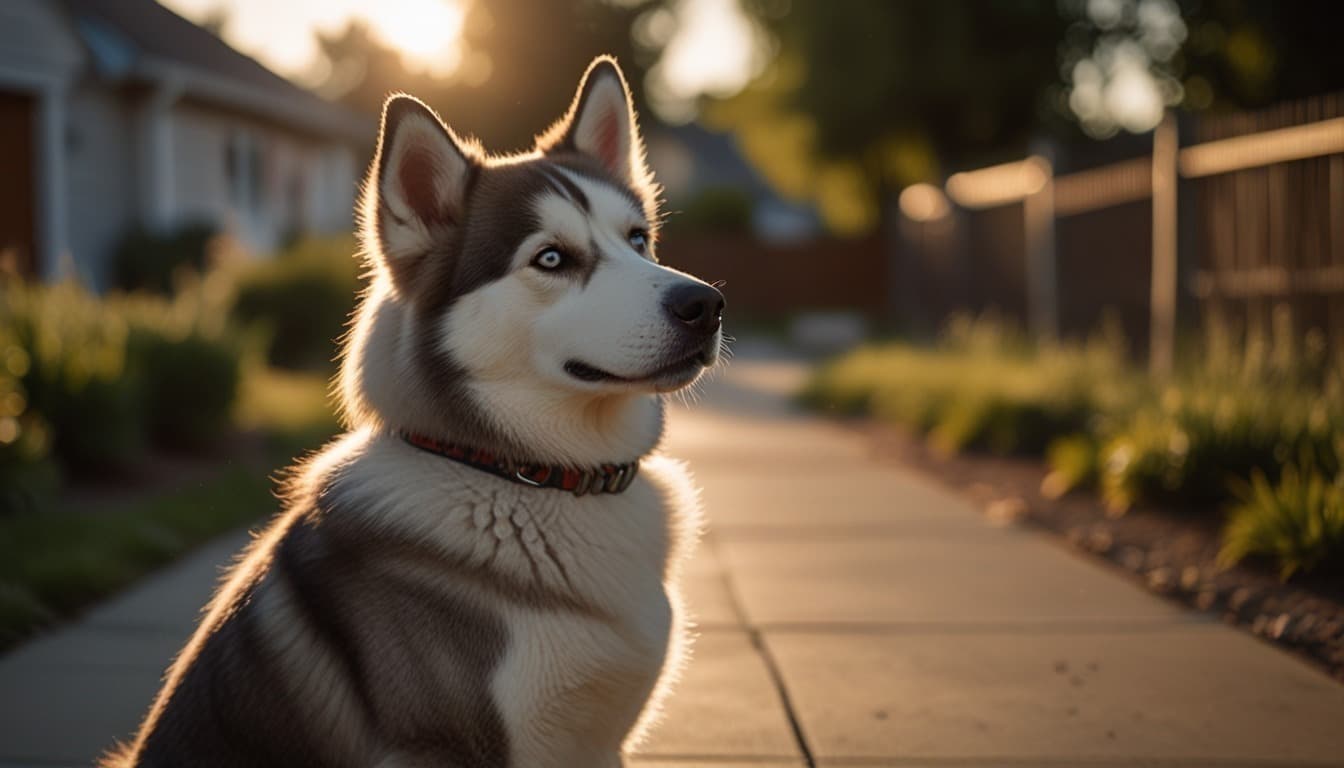
My Foster Husky Outsmarted Every Training Technique I Knew — Until I Threw Out the Rulebook and Just Watched Him
I called my foster Husky stubborn for almost a year. Turns out he was just smarter than me. Here's what actually worked when every training manual failed.
The first time I called my build Husky♀s name and he turned his head, I thought I’d cracked the code.
I was standing in the kitchen with a strip of dehydrated chicken lung in my hand — the kind that smells like death and costs $11 for a bag the size of a matchbook — and when I said "Koda, come," he looked at me. Straight at my face. Then he wlked over at a pace that suggested he had all the time in the world. I was so proud. I called my mom. I told her, "The rescue said he was untrained, but he's a natural."
The next morning I tried the same thing without the chicken lung. He lifted his head from his bed, yawned in a way that communicated exactly zero respect for my authority, and went back to sleep. I walked ovrr, leash in hand, and said "Koda, let's go." He rolled onto his back and showed me his belly like I'd just asked him to do calculus. When I clipped the leash to his use he went limp. Dead weight. Fifty-five pounds of northern-breed indifference.
That was month one. We still had ten more to go.
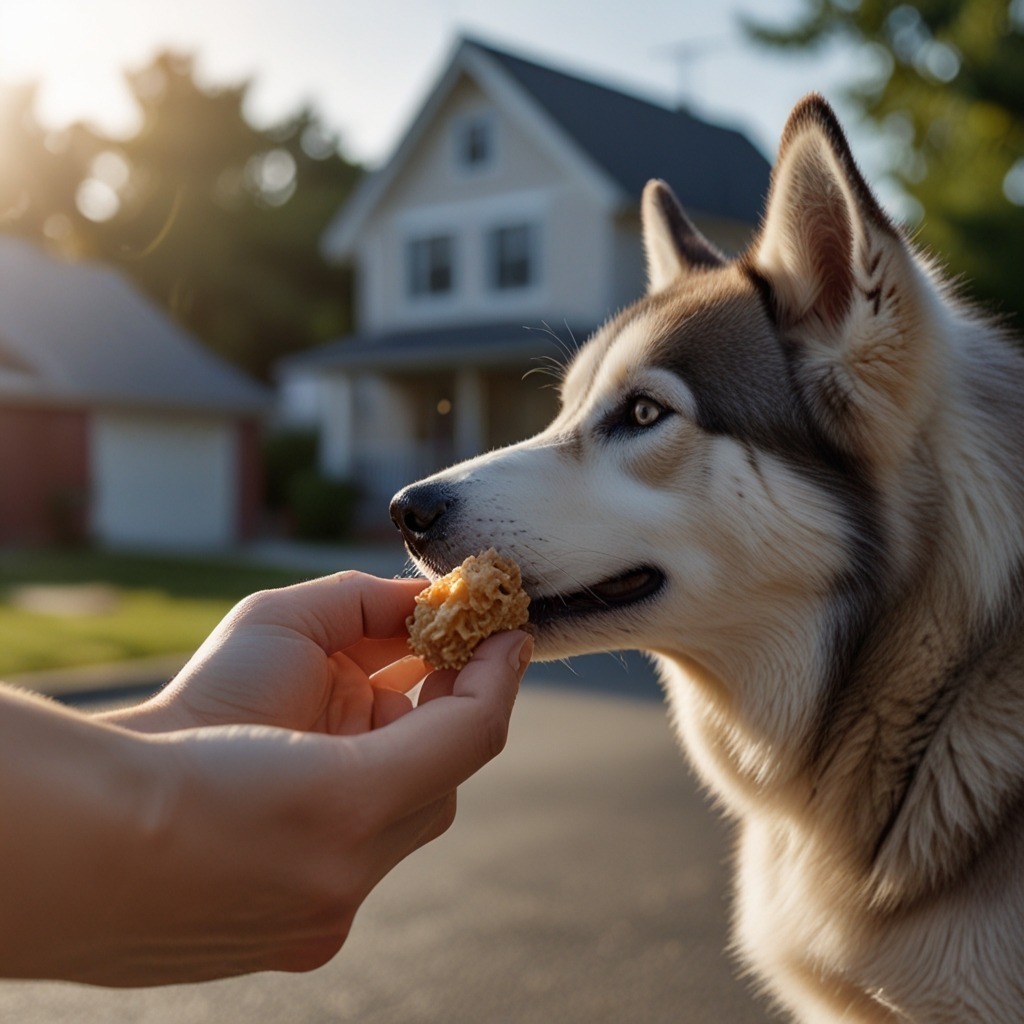
My Husky wasn't stubborn — he was operating on a completely different frequency
The label I wish I'd stopped using on day one
Stubborn. Hard-headed. Aloof. I said all of those things about Koda in the beginning, usually while scrolling through Instagram reels of Border Collise that could balance on yoga balls and Goldens that fetched slippers by name. I made it mean something about his character, like he was choosing to disrespect me. It took a reactive dog build a few years back to teach me that labels like "stubborn" are really just us saying "I don't understand what motivates this animal and I'm frustrated about it." But apparently I needed to learn that lesson twice, because with Koda, I fell right back into the same trap.
Here's what I actually know now, after 40+ fosters and a lot of mistakes: most dogs labeled "stubborn" are one of three things. They're either incredibly intelligent and bored by repetitin that offers them nothing, they're environmentally sensitive (loud noises, new smells, the wind blowing the wrong direction) to a degree that completely shuts down their processing, or they're working-breed dogs with a genetic imperative to make independent decisions and the training we're offering them is just not as interesting as the squirrel in the yard. Koda was all three. That's not a personality flaw. That's a dog who was bred to run 40 miles a day pulling a sled and then make judgment calls about thin ice while his human trusted him with their life. Me asking him to "sit" seventeen times in a row for a piece of kibble wasn't exactly a compelling sales pitch.
A quick story about thin ice
My vet, Dr. Nguyen — she's put up with my panic calls for 11 years, through three dogs and a divorce — once told me something that rearranged my entire brain about northern breeds. She said, "Sarah, these dogs were selectively bred to not blindly obey. If a musher gives a command from the sled and the lead dog sees a crack in the ice ahead, the dog that obeys is a dead dog. The dog that ignores the command and veers right is the dog that saves everyone's life."
I sat with that for a long time. Honestly it made me cry a little in the parking lot of her clinic. Because I'd been treating Koda like he was broken for doing exactly what his genetics told him to do: assess the situation, make his own call, and only collaborate with me if my input seemed more valuable than whatever else was happening.
From that point on, I didn't think about "compliance." I thought about building a partnership where Koda actually wanted to check in with me. That's a completely different game.
The neighbor with the 'alpha roll' advice (and the day I almost threw a poop bag at him)
This is a tangent, but it's a helpful one. About three months into fostering Koda, my neighbor — a guy named Greg whose dog spends 23 hours a day in a yard and barks at literally everything — stopped me on the sidewalk. He'd watched me try to get Koda to stop pulling for maybe a solid minute, which is genuinely awkward. Greg said, "You just gotta show him who's alpha. Flip him on his back and hold him there til he submits. Worked for my Rottweiler."
I didn't flip Koda on his back. I also didn't flip Greg on his back, which took a lot of restraint. What I did instead was go home and google "alpha roll debunked" and ended up down a rabbit hole of dominance theory research that I already knew was garbage. The whole "alpha" concept came from a single study of captive wolves in the 1940s, and the guy who did that study has spent the rest of his life trying to un-publish it. Dogs aren't wolves in a dominance hierarchy with humans. They know we're not dogs. They're not trying to be "pack leader" — they're just assessing whether cooperating with us actually benefits them.
Greg still yells "be the alpha" at me across the street sometimes. I smile and wave. The poop bag is a fantasy I keep to myself.
What I was getting wrong about 'high-value' treats
The treat that isn't actually a treat
Every training article you'll ever read says "use high-value treats for distracted dogs." That's solid advice. The problem is that nobody tells you what "high-value" actually means, and I spent months thinking it meant expensive. The chicken lung? That was one of my failures. Koda liked it, but he wasn't obsessed with it. He'd take it politely if he was already paying attention, but if a leaf moved two blocks away? The chicken lung ceased to exist.
Real high-value means your dog would commit a minor crime to get it. For one of my previous fosters, that was freeze-dried liver. For another, it was literally just hot dogs cut into fourths. For Koda, after weeks of experimentation, I discovered that his tiny, furry god was a specific brand of canned tripe. The kind that smells so bad you've to open the window and your cat judges you for three days afterward. I once had a friend come over while I was prepping training treats and she gagged in the doorway and said "What died in here?" That's the level we're talking about.
But here's the kicker: even the tripe stopped working when Koda was above a certain threshold of stimulation. This is where the cookie-cutter advice fails. "Just bring better treats" isn't infinite. There's a ceiling.
When the treat stops mattering
I remember watching a training video that said "If your dog isn't taking treats, you're too close to the trigger." I nodded along like I understood, but I didn't really get it until one afternoon when I was standing on a street corrner with Koda, a few houses down from a lawn mower that had just started up. He was frozen. Not pulling. Not barking. Just locked up, ears pinned, staring. I held tripe two inches from his nose. He didn't even flinch. His brain was offline. Nothing was getting through.
That's when I learned the difference between "distracted" and "over threshold." A distracted dog can still hear you if you make yourself interesting enough. An over-threshold dog is in fight-or-flight mode and his prefrontal cortex — the part that processes your voice, your treats, your existence — is temporarily shut down. No amount of tripe is going to override biology. In those moments, the only move was to create distance. Walk away. Try again another day from 50 feet farther back.
This was a pill I choked on for a while because I kept thinking, "But what if someone at the park thinks I'm gving up?" I was more worried about what strangers thought of my training than what my dog was actually experiencing. That's a hell of a thing to admit, but it's true.
That time I sat on the curb at 7am and just watched
After about month 5, I sropped trying to train Koda entirely for a full week. It wasn't a strategy. It was exhaustion. I was burnt out. Every walk was a battle, every "come" was ignored, and I had started to dread seeing his face in the morning, which is a terrible feeling when you're supposed to be the safe human for a dog who's already been failed by people.
So I did something that felt like giving up but ended up being the most useful thing I've ever done. I took my coffee, the huge travel mug that leaks, and I sat on the curb outside my house at 7am with Koda on a long line. I didn't ask him for anything. I didn't say "sit" or "look at me" or any of the cues I'd been drilling for months. I just sat there and watched him exist.
He sniffed a patch of grass for four minutes. Four. That's an eternity when you're holding a leash and not scrolling your phone. He watched a crow hop across the sidewalk. He turned and looked at me exactly once, unprompted, and I somehow had the presence of mind to just say "hey, buddy" without makig it a training moment. Then he went back to sniffing. That was it. The entire session.
I started doing this every morning. I wasn't training. I was data-gathering. I learned that Koda's ear twitched when he heard a car door open three houses down. I learned he was fascinated by certain smells near the sewer grate. I learned he checked in with me about every two to three minutes if I wasn't demanding eye contact — a little glance over his shoulder, so fast I'd have missed it if I hadn't been paying attention.
Those glances were gold. That was a natural reinforcement point I'd been trampling over with my "watch me" commands. He was already offering me connection, and I'd been too busy following a training protocol to notice.
Why I stopped using 'no' entirely
This is going to sound extreme, but I've a rule now: the word "no" isn't a training tool. It's a venting word for frustrated humans. It doesn't tell your dog what to do instead. It just tells them you're mad. A dog who's biting the leash or jumping on guests or digging in the flower bed doesn't know what "no" maps to. He knows that behavior made you say something loud and sharp, but he doesn't know what you want him to do differently.
I used to say "no" a hundred times a day with Koda. It had about as much impact as a breeze. He'd look at me, pause for half a second, and then keep doing whatever he was doing. The "no" had no actual information. So I dropped it and started replacing it with — this is going to sound stupid — just a request for an incompatible behavior.
Biting the leash? I'd stuff a chew toy in his mouth instead. Jumping on me? I'd toss a treat on the ground ahead of him so he learned four paws down equals reward. Digging? I built a designated dig pit in one corner of the yard, a whole saga I won't bore you with, but it involved a kiddie pool full of sand and a lot of buried tennis balls. He still digs. He just does it in a spot that deosn't destroy my hostas. And when I see him digging in the wrong place, I don't say "no" — I just call him over and redirect him to the sand pit. I look a little unhinged doing it, but it works better than repeating a word he'd tuned out six build dogs ago.
The week I stopped training and just played fetch
Not really fetch — Koda isn't a retriever and the concept of bringing something back to me was borderline offensive to him. We played what I called "the chase game," where I'd run around the yard like a lunatic and he'd run with me. Sometimes I'd drop treats in the grass and he'd discover them with his nose. We weren't doing any "formal" training at all.
And that week, something shifted. He started following me from room to room voluntarily. He started sleeping at my feet instead of in the farthest corner of the house. I think — and I'm not a behaviorist, I'm just a person who spent too many years scrubbing build dog accidents out of the carpet — that he finally started seeing me as a source of good things happening, not just a source of expectations. I wasn't the person who was always asking him to perform. I was the person who ran around like an idiot and made him laugh. (Yes, dogs laugh. It's a breathy pant thing. Look it up. I'll wait.)
I'm not saying you should never train your dog. I'm saying that sometimes what looks like stubbornness is actually a relationship that's been drained dry by too much asking and not enough being. Especially with rescue dogs who maybe spetn months in a shelter where every human interaction meant a needle or a cage door or a stranger dragging them somewhere they didn't want to go.
When the clicker turned into a swear word
I need to admit something embarrassing: I tried clicker training with Koda and it went so badly that I threw the clicker in the trash and then took the trash out immediately so I wouldn't be tempted to retrieve it. This is going to offend people who love clickers. I know. Clickers are fantastic for a lot of dgs. They're precise, they're consistent, they work beautifully for shaping complex behaviors. I've used them successfully with at least a dozen fosters. Koda was the exception.
The problem? That little plastic click sound freaked him out. Not in a dramatic, running-away kind of way, but in a subtke shuttng-down kind of way that I didn't pick up on for weeks. He'd hear the click and his ears would go slightly back. His body would stiffen. He'd take the treat, but he wouldn't wag. He was just enduring the click to get the food. I was using a marker signal that made my dog uncomfortable and congratulating myself on how consistent my timing was.
Eventually I switched to a verbal marker — just the word "yes" said in the same tone every time — and the difference was immediate. His tail came up. His eyes got brighter. He started offering behaviors because the marker didn't startle him. All the "progress" I'd thought I'd made with the clicker was actually me training my dog to tolerate something he didn't like. I'd put a lot of work into that tolerance. I'm still mad about it.
If you're using a clicker and your dog is thriving, that's great. Keep doing it. But if you're using one and your dog is acting "stubborn," maybe check whether the tool itself is part of the problem. Some dogs are noise-sensitive in ways we don't notice because we're too busy checking off training boxes.
The single biggest shift: I gave up asking for 'obedience' and started building communication
This is the part of the story were everything came together, and it's going to sound a little woo-woo but stay with me.
I stopped asking Koda for specific behaviors in exchange for reinforcement, and I started paying him for check-ins. Every time he looked at me on a walk — not because I'd cued it, but because he organically turned his head in my direction — I marked with "yes" and tossed a treat. Every time he came over to me in the yard without being called, I made it rain chicken. Every time he chose to walk next to me instead of hitting the end of the leash, I made that the best thing that had happened to him in the last five minutes.
Within about three weeks, he was checking in with me constantly. Self-initiated. He'd stop sniffing a fence post just to glance back at me. He'd walk ahead, then slow down and look over his shoulder like "you coming?" This was the dog who'd ignored his name for almost a year, and now he was seeking me out for eye contact. Not because I'd trained "watch me" with a cookie to his nose, but because I'd built a history where paying attention to me reliably predicted good things.
I also started making requests optional. That's the part the traditional training ctowd hates, and I get it. But with a dog like Koda — a former street dog, a survivor, a dog who needed to feel like he had agency — making "come" a choice not a command was everything. I'd say "Koda, come," and if he didn't come, I didn't repeat myself. I didn't get louder. I didn't yank the long line. I just waited. If he came a minute later, he still got a jackpot. If he didn't come at all, I reassessed the environment. Was he over threshold? Did I need to move further away from the trigger? Was my treat game weak today?
This meant that "come" wasn't a demand that could fail. It was an invitation. He said no sometimes, and that was information — not defiance.
The one tool I spent $60 on that I now hide when guests come over
Okay, this one still makes me cringe. I bought a "no-pull" use that promised to revolutionize our walks. It had a front clip, a back clip, a strap that went across his chest, and about 400 adjustment points. It looked like something you'd use to sexure cargo on a truck. I put it on Koda and he immediately froze — not moving, not pulling, just standing in the driveway like a statue. I thought, "Great, it's working!"
Two walks later, he started rbbing his shoulder against every fence he passed. Then he started rolling in the grass every thirty feet, trying to get it off. By day three he'd chewed through one of the straps while I was on a work call. The thing was expensive, it restricted his shoulder movement, and it taught him exactly nothing about walking nicely. It just physically prevented him from pulling, which meant his brain was completely disengaged from the process. When I eventually switched to a simple, non-restrictive use after a long journey with a different dog, and paired it with the actual training (reinforcing loose leash walking, not just managing the pulling), that's when things changed. The tool isn't the training. It never was.
I still have the $60 use in a closet. I keep it as a reminder that I'm susceptible to clever marketing and that my dog isn't a cargo shipment.
What one year later looked like (and why I cried in the backyard with my dog)
About a year after I started fostering Koda, I was in the backyard cleaning up — one of my dogs had formerly been on a grass-eating vomit streak, a whole separate crisis — and Koda was on the other end of the yard sniffing the sand pit. I didn't have treats. I didn't have a leash. I wasn't doing any training. I just called his name, quiet, almost to myself: "Hey, Koda."
He stopped sniffing. Turned. Looked at me for a solid three seconds. And then he walked over, slow and calm, and sat down at my feet like it was the most natural thing in the world. No command. No treat. No repetition. He just chose me, because somewhere along the way, he'd decided I was worth checking in with.
I sat down in the grass and ugly-crieed for a minute while he licked my elbow. If you'd told me a year earlier that this was possible, I wouldn't have believed you. I thought Koda was a "stubborn" dog who would never really connect. But stubborn was just the story I told myself when I didn't know how to listen. The dog was never the problem. The training framework that treated him like a failure was.
I don't have a neat ending for this, because the work isn't finished. Koda still pulls sometimes when he sees a cat. He's not a robot. But he trusts me now. He checks in. He's soft. And honestly, I don't need him to "obey" me. I just need him to know that when I speak, I'm worth paying attention to. That's a lot harder to build, but it sticks. That's the whole thing.