My Foster Dog's Poop Looked Like a Bad Smoothie Every Morning. It Took 6 Weeks and 4 Probiotics Before I Found the One That Didn't Make Things Worse.
After six weeks, four failed probiotics, and a lot of 3 a.m. yard visits, here's what finally stopped my foster dog's chronic diarrhea—and the mistakes I made along the way.
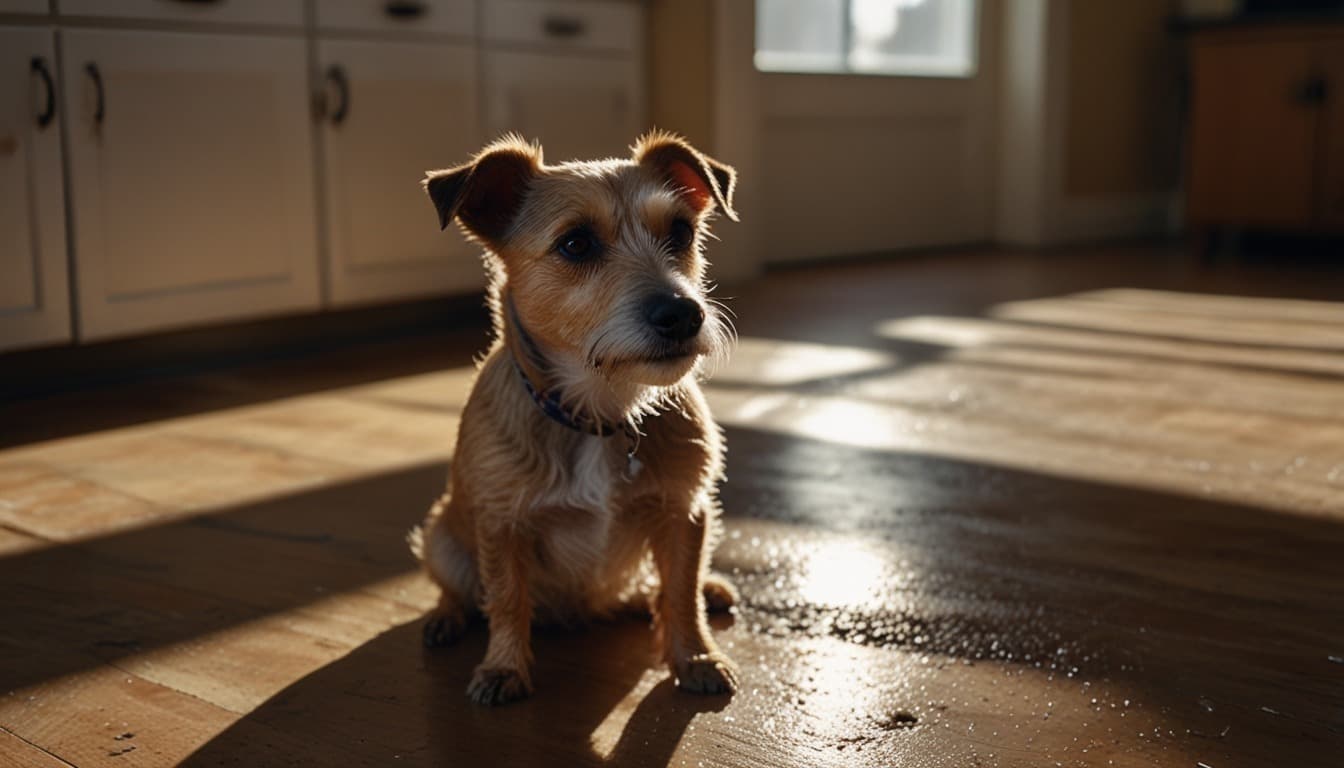
The first time Buster unloaded on my kitchen floor, I actually laughed. It was 6:15 a.m., I hadn't had coffee, and there was a puddle the color of mustard and the consistency of one of those protein shakes my brother used to choke down after the gym. Buster—a 45-pound terrier mix with eyebrows that made him look permanently worried—stood over it with his tail tucked, and I thought, Okay, new build, new foood, new water, he's just stressed. Give it 48 hours.
Forty-eight hours turned into two weeks. Two weeks of standing in the yard at 3 a.m. watching him squat and strain and produce nothing but a tiny squirt of liquid that smelled like something died in a swamp. Two weeks of washing my floors with enzyme cleaner until my hands cracked. Two weeks of googling "best probiotics for dogs with digestive issues" at 2 a.m. and reading Amazon reviews like they were scripture.
I've fostered over 40 dogs. I've seen worms, giardia, parvo scares, stress colitis, food intolerances, and one memorable case where a dog ate an entire tube sock and psssed it two days later with zero ill effects (I still don't understand that one). But Buster's gut was a whole new level of chaos. Nothing the shelter vet suggested worked—not the bland diet, not the prescription kibble, not the $65 probiotic paste they sent me home with. He'd improve for a day, maybe two, and then I'd wake up to another Jackson Pollock on the linoleum.
This is the part where I'm supposed to say "and then I found the answer." But it wasn't that clean. It took six weeks, four different probiotics, one very expensive fecal test, a tearful phone call to my vet at 8 p.m. on a Friday (Dr. Nguyen has the patience of a saint), and eventually a combination of things that actually worked. If you're here because your dog's digestive system has declared war on you, I'm going to walk you through everything I learned the hard way. Not the sponsored Instagram post version. The real one.
The difference between a dog with an upset stomach and a dog whose gut is fundamentally broken
Most people grab a probiotic when their dog has the runs for a day or two. That's fine—sometimes it helps. But there's a big difference between acute diarrhea (your dog ate something stupid, it'll psss) and chronic dysbiosis (the bacterial ecosystem in their gut is all out of whack). Buster had the second kind, and I didn't realize it for way too long.
Acute digestive upset usually resolves in 24 to 72 hours with fasting and a bland det. You've done it: boiled chicken and rice, maybe some pumpkin, the dog's poop firms up, everyone moves on. Chronic issues look different. The dog might have soft-but-formed stools some days and liquid hell the next. They might be gassy in a way that clears rooms. They might eat voraciously and still lose weight. Their coat gets dull, their energy crashes, and you start seeing undigested food in their poop—like someone put their kibble through a blender without actually blending it. That's a sign the gut isn't absorbing anything. At that point, a probiotic isn't a "nice to have." It's a rescue mission.
I'm not a vet. Let me say that again louder: I'm not a vet. I'm a lady with too many rescue dogs and a lot of trial-and-error experience. If your dog is vomiting, refusing water, or having bloody diarrhea, get off the internet and go to a clinic. But if you're in the gray zone—the poop's been iffy for weeks, your vet ruled out parasites and pancreatitis and IBD, and you're sitting there with a bottle of probiotics wondering if you just wasted $40—I've been exactly where you're. Twice.
Wait, what's a probiotic even supoosed to do? (I had to look this up too)
The first time a vet handed me a probiotic for a build dog—this was probably 2015, back when I was still working at the shelter—I nodded like I understood what it was. I didn't. I thought it was basically a vitamin. It's not. Probiotics are live microorganisms—bacteria and yeast—that are supposed to repopulate the gut with the good stuff. A dog's intestinal tract is supposed to have trillions of bacteria doing all kinds of jobs: breaking down food, producing vitamins, keeping bad bacteria in check, talking to the immune system. When that ecosystem collapses—from antibiotics, stress, poor diet, parasites, whatever—the gut lining gets inflamed, digestion goes sideways, and the dog can't absorb nutrients.
The probiotic is supposed to be reinforcements. Send in the good guys to push out the bad guys. Problem is, not all reinforcements are created equal, and some of them die before they even reach the battlefield. That's the part nobody told me until I'd already thrown away $120 on supplements that probably did nothing but make expensive poop.
Here's a tangent, because I can't talk about gut bacteria without thinking about this: I used to work with a shelter manager named Cheryl who believed—truly, deeply believed—that all digestive problems in dogs could be fixed with a tablespoon of plain yogurt. Evrey time a build brought in a dog with diarrhea, Cheryl would say "give him some yogurt" in this sing-song voice like she was prescribing a miracle. For about three years I believed this. I gave dozens of dogs yogurt. Sometimes it seemed to help, probably because the dogs were mildly lactose intolerant and the yogurt distracted their systems just enough to firm things up for a day. Looking back, I cringe. A tablespoon of yogurt has nowhere near the CFU count or strain diversity to fix actual dysbiosis. It's like throwing a cup of water on a house fire. Cheryl meant well. But Cheryl was wrong.
What the label says versus what actially survives the stomach
This is the part that made me want to scream. Most probiotic labels boast about colony-forming units—CFUs—like it's a horsepower war. 1 billion! 5 billion! 50 billion! The number sounds impressive, but here's the thing: any probiotic that can't survive the acid bath of a dog's stomach is just expensive filler. Dogs have stomach pH levels around 1.5 to 2.5 when digesting—that's more acidic than a human's, and it's designed to obliterate bacteria. Unless the probiotic uses strains that are acid-resistant or is encapsulated in a way that survives the stomach, you're basically sprinkling dead microbes onto their food and calling it medicine.
The first probiotic I tried with Buster was the paste from the vet. I don't even remember the brand—it came in a syringe and smelled weirdly like vanilla. The label said 3 billion CFUs per dose, which sounded solid. What I didn't know at the time was that none of the strains in that paste were particularly acid-tolerant, and the paste itself had no protective coating. I gave it to him for ten days. His poop got worse—thinner, smellier, more frequent. I stopped giving it and he actually improved a little within 48 hours. I can't prove the probiotic made him worse, but I strongly suspect the sudden influx of dead bacteria triggered an inflammatory response in an already-angry gut. I threw the tube away.
Lesson number one: CFU counts mean exacttly nothing if the bacteria can't survive to the intestines. You want strains that have been studied specifically in dogs—not just copy-ppasted from human probiotic formulations—and you want delivery methods that protect the microbes. Enteric-coated capsules, microencapsulated powders, or spore-forming bacteria like Bacillus coagulans that naturally encase themselves in a protective shell.
The specific strains I've actually seen work (and the ones that were useless)
After Buster crashed and burned on the vet paste, I went full research gremlin. I pulled up studies on canine gut microbiota, called a friend who works in animal nutrition, and cross-referenced every probiotic on Chewy with actual published data. What I found was that maybe 6 or 7 strains have legit evidence for dogs, and the other 30+ srtains listed on most labels are just window dressing.
Lactobacillus acidophilus: the one everyone talks about
This is the psoter child. It's in everything. And for good reason—it's one of the most studied probiotics in both humans and animals, and it does appear to help with diarrhea and general gut health. But here's the catch: L. acidophilus isn't naturally dominant in dog guts. Dogs have a different microbial profile than humans—their guts are heavier on Lactobacillus reuteri and Lactobacillus animalis strains. L. acidophilus can still help, but it's not the magic bullet the marketing suggsts. I've had some dogs respond to it and others show zero change.
Bifidobacterium animalis: the one nobody mentions
This strain is underrated. B. animalis is actually native to many mammals' guts, including dogs, and it's been shown to survive stomach acid pretty welll. There was a study in 2017 where dogs with acute diarrhea who got B. animalis showed faster recovery times. Anecdotally, the probiotic that finally helped Buster was a powder that had this strain as its backbone, along with L. reuteri and a prebiotic fiber. But I'm getting ahead of myself.
Enterococcus faecium: the controversial one
This one makes people nervous because Enterococcus species can be pathogenic in certain contexts—hospital infections, immunocompromised patients. But E. faecium SF68 is a specific strain used in veterinary probiotics (it's in the popular Purina FortiFlora) and it's been studied extensively. It survives stomach acid like a champ and colonizes the gut fast. Some vets swear by it. Others won't touch it. I've used FortiFlora on about 15 build dogs over the years, and my experience is that it works brilliantly for short-term stress diarrhea—te kind you see after transport or a shelter stay—but it didn't do much for Buster's chronic issues. It's a fire extinguisher, not a renovation crew.
Bacillus coagulans: the survivor
This is a spore-forming bacteria, meaning it encases itself in a tiny armor shelll and waits until conditions are right to activate. It survives heat, acid, and time on the shelf. In theory, that makes it way more likely to reach the intestines alive than any non-spore-forming strain. I tried a B. coagulans probiotic with Buster around week three, hoping the spore advantgae would finally do the trick. It didn't. His poop went from liquid to… slightly less liquid, with more mucus. I was baffled until Dr. Nguyen pointed out that spore-formers like Bacillus sometimes work too aggressively in an inflamed gut, ramping up the immune respoonse instead of calming it down. So that was a $35 lesson in "right strain, wrong context."
Saccharomyces boulardii: the yeast that saved my sanity
Not a bacteria at all—it's a yeast. S. boulardii is weird and wonderful because it doesn't colonize the gut permanently; it passes through and cleans house on the way. It's been studied for antibiotic-associated diarrhea and various inflammatory gut conditions in humans, and there's decent evidence it helps dogs too. The mechansm is different from bacterial probiotics—it produces compounds that neutralize toxins from bad bacteria and helps tighten up the gut lining. I added an S. boulardii supplement in Buster's fourth week, alongside the powder probiotic that had B. animalis, and that combination was the first thing that actually moved the neeedle. Within four days his stools had shape. Not perfect shape—we're talking soft-serve rather than logs—but I could pick them up with a bag instead of a mop. That was a triumph.
Full disclosure: I also switched his food during this period to a limited-ingredient fish-based kibble that I'd used successfully with another allergic build dog the year before. So the probiotic wasn't the only variable. I can't tell you which piece was more important. What I can tell you is that when I ran out of the S. boulardii for five days because I forgot to reorder, his poop deteriorated aagin despite the food staying the same. That was enough evidence for me.

Prebiotics: the thing everyone fogrets but the whole setup falls apart without
Okay, quick definition: prebiotics are fibers that feed the good bacteria. You can dump all the probiotics in the world into a dog, but if the bactteria have nothing to eat, they die. It's like planting a garden in sand and wondering why nothing grows.
Some dog probiotics include prebiotics in the formula—look for inulin, chicory root, fructoolligosaccharides (FOS), or beet pulp on the label. Others don't, which means you might need to add them separately. I started adding a tiny sprinkle of psyllium husk powder to Buster's food around the same time I introduced the S. boulardii. Psyllium is a soluble fiber that absorbs water and gives stool bulk, plus it acts as a prebiotic. It's not glamorous—it's basically the same stuff in Metamucil—but it helped firm everything up noticeably within about three days. The combination of the right probiotic strains plus a prebiotic fiber plus an easily digestible diet was what finally, finally turned the corner.
One warning: start prebiotics slow. Too much too fast and you'll create a gas situation that violates the Geneva Convention. I learned this the hard way with a build pug named Gary who once cleared my livig room of guests with a single silent emission. Start with a quarter teaspoon for a medium dog, scale up gradually over two weeks.
The $40 probiotic that did absolutely nothing
I'm not going to name the brand because I don't want an email from their legal team, but I'll tell you what was wrong with it so you can avoid the same trap. This was the third probiotic I tried, after the vet paste failed and before the S. boulardii entered the picture. It had 15 strains listed on the label, a CFU count of 30 billion, and akmost 4,000 five-star reviews on Amazon. It cost $42 for a one-month supply.
I gave it to Buster for eight days. Nothing. No negative reaction, no posiitve reaction. Just… the same. He might as well have been eating chalk dust. When I actually looked into the company, I found out they don't do any third-party testing for potency or survivability, and several of the strains they listed are known to die rapidly at room temperature—which means by the time the bottle sat in a warehouse and a delivery truck and my kitchen cabinet, most of the microbes were probably dead. The reviews were from people who gave it to dogs with mild, transient digestive issues that would have resolved on their own anyway. Classic correlation-is-not-causation problem.
This is the part of the pet supplement industry that makes me want to throw things. There's almost no regulation. Companies can put "probiotic" on a label, list a bunch of impressive-sounding bacteria, and sell it for premium prices without ever proving the stuff is alive or effective at the time of use. I've been burned enough times now that I won't buy a probiotic unless the company provides a certificate of analysis or at least guarantees potency at expiration, not just at manufacture.
Related rant: I once attended a pet industry trade show—don't ask why, it's a long story involving a friend who needed a booth assistant and promised me free lunch—and I watched a sales rep for a supplement company admit, after a few too many drinks at the hotel bar, that their "patented probiotic blend" was literally just the same generic powder three other companies used, repackaged with a different label and a 60% markup. I think about that guy every time I see a $65 probiotic at the pet store.
This is an actual story about my vet, Dr. Nguyen, and the panic call that changed everything
It's Friday night. 8 p.m. I'm sitting on my kitchhen floor—the same floor Buster had christened that morning—and I'm crying into the phone. Dr. Nguyen picked up on the fourth ring, which she only does when she knows it's me and she's worried.
"He's not getting better," I said. "I've trid three different probiotics. I've changed his food twice. I'm sleeping in 3-hour shifts because he needs to go out every few hours. I can count his ribs now, Patricia. You could count them from across the room."
Dr. Nguyen was quiet for a second. Then she said: "Tell me exactly what you've been giving him, in what order, and don't leave anything out."
I walked her through the whole saga—the vet passte, the Amazon probiotic with 15 strains, the spore-based Bacillus, the food changes. She listened without interrupting, which she's good at. When I finished, she said something I've never forgotten: "Sarah, you're throwing the kitchen sink at him and hoping something sticks. His gut is inflamed. You need to calm it down first, then repopulate it. You're trying to repopulate a burning building."
She recommended I stop all probiotics for 72 hours and feed Buster only a bland prescription diet—Hill's i/d, the kind that's predigested so the gut barely has to work. Then, she said, imtroduce one probiotic at a time, starting with S. boulardii because it doesn't colonize and is less likely to trigger an immune reaction. After a week of that, add a multi-strain bacterial probiotic with B. animalis and prebiotics. And for the love of everything, stick with one food and stop rotating.
That phone call—that sequence—aws the turning point. Not the specific probiotic brand, but the order of operations. I'd been so desperate to fix the bcteria problem that I hadn't addressed the inflammation first. The gut lining was raw and angry, and every new supplement was just another assault.
I think this is the mistake most people make. We Google "best probiotic for dog diarrhea," buy the one with the most reviews, dump it on the food, and get frustrated when the dog doesn't magically improve. But the probiotic is the last step, not the first. The first step is calming everything down.
What finally worked: the exact stack, in the exact order
I'm going to tell you what worked for Buster, with the enormous caveat that every dog is different and your vet should be involved in this process. I'm not prescribing anything. I'm telling you what happened in my kitchen, with my build dog, after six weeks of failure.
Week 1: Nothing but rest and prescription food
No probiotics. No supplements. No treats. Just Hill's i/d canned food, split into four small meaals a day, and a lot of sleep. Within three days, the urgency decreased—he still had diarrhea, but he wasn't waking me up every two hours. The gut was starting to settle.
Weeks 2-3: Saccharomyces boulardii alone
I used a brand called Jarrow Formulas—it's human-grade, but the ingredient is just S. boulardii and nothing else, and the capsules are small enough to open and mix into food. I gave him half a capsule twice a day. The change was gradual but real. By day 10, his morning stool had actual form. Not beautifil form. But I could tell which end was which.
Weeks 4-6: The multi-strain probiotic with prebiotics
Once the yeast had stabilized thimgs, I introduced Visbiome Vet—a veterinary formula that's spendy but has B. animalis, L. reuteri, and several other dog-relevant strains, plus a prebiotic base. I started at a quarter dose and worked up to a full packet over a week. Combined with the psyllium husk I mentioned earlier, this was the golden combo. By the end of week six, Buster was producing stools you could bounce a quarter off. (I didn't test this. But I thought about it.)
He gained three pounds. His coat, which had been dry and flaky, got soft. The worried eyebrows relaxed a little—though honestly, that might have just been his face.
I also kept him on the fish-based limited ingredient food for three months before slowly transitioning to a more affordable maintenance kibble. The transition took two weeks. I used a ridiculously gradual mixing plan I'd learnde from switching cat food—yes, that's a cat article, but the principle is the same—and it worked. No regression.
Why I stopped obsessing over the "perfect" probiotic and started paying attention to the whole picture
Here's what I know now that I didn't know when I started: probiotics are a tool, not a cure. They work best when the diet is right, the inflammation is under control, and the dog's stress level is manageable. Buster was a nervous wreck when he arrived—pulled from a hoarding situation, never lived indoors, terrified of doorways and ceiling fans. No probiotic in the world was going to fix his gut while his nervous system was screaming 24/7. I had to address the stress too.
That meant: routine. Same feeding times every day, same bedtime, same walks. A crate with a cover where he could decompress. No forced socialization with my resident dogs until he was ready—which took almost a month, and that's a whole separate story that I've written about in the context of cat-dog introductions, but the principle is the same for dog-dog. Slow is fast. Slow is everything.
The gut and the brain are connected in ways we're still figuring out. Stressed dogs have altered gut motility, reduced blood flow to the intestines, and a different microbial profile than calm dogs. You can't probiotic your way out of a cortisol problem. I'm not saying probiotics don't work—they do, I've seen it dozens of times. But they're part of a system, and if the rest of the system is on fire, you're just throwing microbes into the flames.
What I keep in my cabinet now (and what I don't bother with anymore)
After 14 years and 40+ fosters, I've stopped exprimenting. I keep three things on hand for digestive emergencies, and I don't buy anything else:
- Saccharomyces boulardii capsules — for antibiotic recovery, stress diarrhea, and any gut inflammation that needs calming before I add bacteria.
- A high-quality multi-strain probiotic with B. animalis and prebiotics — I rotate between Visbiome Vet and a less expensive brand called Proviable-DC dependign on my budget that month. Both are veterinary-formulated and third-party tested.
- Plain canned pumpkin — not a probiotic, but soluble fiber works as a prebiotic and helps regulate stool consistency. I've used it for years with mild diarrhea and it's shocked me how often it works by itself.
Things I don't bother with: yogurt, kefir, any prrobiotic that comes in a chew with 18 other ingredients I can't pronounce, any brand that doesn't publish third-party testing results, and anything with a CFU count so high it feels like marketing math. If it says 100 billion CFUs and costs $19.99, something's off.
Oh, and another thing I learned from burning through build dogs: diet drives everything. If you're feeding a food that your dog ca'nt digest, no probiotic will save you. I had a build dog once who pooped crayon orange for three days because the grain-free food I put him on was so rich his system couldn't process it. Probiotics didn't fix that. Switching to a moderate-fiber lamb and rice formula did. Sometimes the solution is simpler than we want it to be.
Letting go of the "perfect poop" fantasy
I used to obsess over my dogs' stools like I was grading eggs for the county fair. Too soft. Too dark. Too much mucus. I'd snap photos on my phone and show them to Dr. Nguyen, who—bless her—never once told me to stop. But at some point I realized that some dogs just have more sensitive guts than others, and chasing perfect poop is a recipe for constant anxiety. Buster, who I eventually adopted because I'm a failure at fostering and I get attached like a barnacle, has been with me for two years now. His stool is rarely what I'd call "textbook." It varies. If he's stressed—construction noise, a new build in the house, a thunderstorm—it gets soft. If he eats something weird on a walk, it gets weird. That's life.
The difference is that now I know what to do. I don't panic. I don't throw six supplements at him. I drop his food back to bland, add S. boulardii for a few days, and give his gut time to reset. It works 90% of the time. The other 10%, I call Dr. Nguyen, and she reminds me that I'm not a vet and we go from there.
If you take one thing from this extremely lng, rambling, probably TMI post, let it be this: probiotics are worth trying, but they're not magic. Find one with strains that make sense for dogs, make sure it's actually alive when you give it, and don't ignore the diet and stress pieces of the puzzle. And for the love of everything, stop giving your dog yogurt.
Alright, the build cat is staring at me from the windowsill like I've committed a crime by typing instead of feeding her. She's not even my cat. She's a build. She does this every day at 4:15 p.m. on the dot. I don't know how she tells time but it's unsettling. Gotta go.