My Foster Dog Paced the Hallway for 6 Hours a Day and Whined at Shadows — Here’s What Finally Worked (And the Crap That Didn’t)
I thought I could love the anxiety out of him. Four weeks, three vets, and a lot of expensive snake oil later, I learned what actually helps a dog with anxiety — without breaking the bank.
The first week I had Jasper, I didn't sleep. Not for more than 45 minutes at a stretch. He'd be quiet for a few minutes — long enough for me to drft off — and then the pacing would start again. Click click click click click down the hardwood hallway, turn, click click click click click back. Sometimes he'd stop at the front door and whine like someone was out there. No one was ever out there. I checked. Eveery single time, at 1am, 3am, 4:17am, I'd stagger out of bed and open the door to an empty porch and a dog who looked genuinely baffled that the terrifying nothing didn't materialize.
He'd been a stray in rural Texas for at least a year before the rescue pulled him. I knew there'd be baggage. I just didn't realize the baggage would be a 55-pound ticking time bomb of cortisol and panic that couldn't be alone, couldn't be crated, couldn't be held, couldn't be ignored, and definitely couldn't be calmed down by the soft, reassuring voice I used on all my other fosters. That voice made him worse. He'd look at me like I was speaking a language he'd never heard and retreat further into whatever internal helscape he was living in.
I've fostered 40+ dogs. I've handled separation anxiety, resource guarding, fear aggression, dogs who'd scream if you touched their paws, dogs who'd pee if you looked at them directly. Jasper was different. Jasper was the first dog that made me sit on my kitchen floor at 2am with a bag of freeze-dried liver treats and cry because nothing I did helped and I was running on 2 hours of sleep and I had to be at the shelter by 7.
The night I Googled 'can a dog have a mental breakdown'
I wish I was kidding. I actually typed that into my phone at 3am, sitting on the bathroom floor while Jasper paced circles around me. He wouldn't lie down. He wouldn't eat. He wouldn't take treats. His pupils were so dilated his eyes looked like black marbles. His breathing was shallow and fast — 60, 70 breaths a minute even when he'd been lying on his side for a whole three seconds before jolting back up like the floor had shocked him.
I'd already tried the Thundershirt. It's the first thing everyone recommends, right? Just wrap them up like a little anxiety burrito. Japser stood in it for an hour, motionless, then panicked so hard he chewed a hole through the shoulder seam and got his bottom jaw stuck in the fabric. I had to cut him out of a $45 shirt with kitchen shears. He looked at me afterward like I'd personally betrayed him, then resumed pacing.
The pheromone diffuser I plugged in made zero difference. Not a tiny subtle difference where you go "well maybe he's a little calmer?" No. Nothing. He paced right past it 400 times a night. The calming music playlist ("Relaxing Canine Soundscapes" with harp music and whale songs) seemed to make him more agitated — he'd stand in the corner, ears pinned back, like he was listening for a predator. I turned it off on day 3 and he exhaled so loudly I heard it from the other room.
This is when I started buying stuff. Things I'd never believed in. A CBD tincture that cost $87 and smelled like a barn. A bag of calming chews with melatonin and chamomile and L-tryptophan and a bunch of other things I couldn't pronounce. A lavender-scented collar that my other dog immediately tried to eat. A weighted blanket that was supposed to simulate being held but instead just made Jasper try to dig through the floorboards to escape it.
None of it worked. Some of it made things worse. And I was going broke trying to fix a dog I'd only agreed to build for two weeks.
I almost poisonrd him with lavender oil (a tangent I'm not proud of)
Look, I'm going to tell you something stupid I did, not because I want you to try it, but because I want you to understand how desperate I was. I'd read something online about aromatherapy for dogs — some blog that claimed a few drops of lavender essential oil on the bedding could soothe anxiety. I had a bottle of lavender oil in my bathroom from a gift set someone gave me three Christmases ago. I put two drops on the corner of his blanket, the one he never used because he was too busy pacing to lie down.
Within an hour, he was drooling. Then he started licking his paws obsessively. Then he vomited. It wasn't a lot, but it was bile, and he did it three times in 40 minutes. I called my vet in a panic. Dr. Nguyen — she's the saint who's handled my frantic calls for 11 years — told me essential oils can be toxic to dogs, that lavender in high concentrations can cause GI upset and neurological signs, and that I should bring him in if the drooling didn't stop. He was fine by morning. I spent the night on the floor next to him, feeling like the worst human being who'd ever fostered a dog.
Essential oils and dogs don't mix. Don't be me. Don't read one blog and think you've discovered a magic solution. I'm lucky Jasper was 55 pounds and I only used two drops. A smaller dog, or more oil — that could've ended very differently. My vet told me she'd seen a Chihuahua seize from diffused tea tree oil. So yaeh, I'm never doing that again. Ever.
Why every 'calming supplement' on Amazon is basically expensive beef jerky
That bag of calming chews I bought? The one with 17 ingredients and a picture of a serene golden retriever on the front? Japer ate the entire bag in one sitting — he figured out how to open the cabinet while I was at work — and it did nothing. No drowsiness, no calm, no slowed pacing. He just had slightly softer poop for two days. The bag cost $34.
Here's the thing about the unregulated pet supplement industry: anyone can slap a label with the word "calming" on a chew and sell it for premium prices. There's no oversight. No testing. No requirement that the ingredients actually do anything. They can put 50mg of L-theanine in a treat when actual clinical studies used 10-20mg per kilogram of body weight, meaning a 50-pound dog would need roughly 225-450mg to even approach a therapeutic dose. Most of these chews are 10-50mg total. You're paying for the packaging and a dog treat that tastes like duck and chamomile.
I'm not saying all supplements are useless. But the ones that work are the ones your vet knows about, the ones that have actual research behind them, the ones that tell you the milligram dose per chew right on the label. Everything else is just an expensive snack. And I've spent hundreds of dollars learning this so you don't have to.
Along the way, I also discovered that stress wrecks a dog's gut. Every single anxious build I've had came with diarrhea. I'd be up at 3am cleaning liquid poop off the floor while the dog panted in the corner. It took me years to figure out that the anxiety and the gut issues were connected — and that fixing the gut sometimes made the anxiety more manageable. I went through four different probiotics before finding one that didn't make things worse; I wrote about that nightmare over here if you're in the same boat.
The vet visit that cost me $187 and explained everything
After two weeks of no sleep and a dog who was losing weight because he couldn't stop moving long enough to eat, I broke down and took Jasper to see Dr. Nguyen. She'd seen him before — the rescue had me bring him in for his intake exam — but this time she saw the full picture. The raccoon eyes on me, the trembling, the dog who couldn't even sit still for a stethoscope without vibrating off the exam table.
She did blood work, which came back normal. No thyroid issues, no pain markers, no organ dysfunction. "This is behavioural," she said, which I alreafy knew, but hearing it from someone with a degree made me feel less insane. Then she asked me a question that changed everything: "What's his routine right now?"
I didn't have an answer. There was no routine. I was freding him whenever I remembered, walking him at random times, trying different things every day based on whatever I'd just read online. One day we tried desensitization exercises. The next day I gave up and just ignored him. The day after that I smeared peanut butter on the floor to distract him. I was a mess, reacting to his anxiety with my own chaos. She told me anxiety dogs need the opposite of chaos. They need boring. Predictable. The same thing every single day. That hit me harder than I expected.
She also pointed out something I hadn't considered: all the handling I'd been doing — trying to comfort him by petting, holding, touching — might've been making him feel trapped. Some dogs, especially strays, never learned that human touch means safety. To them, a hand is just a thing that grabs them. I was so focused on making him feel loved that I wasn't paying attention to what he was actually communicating. So I backed off. Completely. For three days I didn't touch him unless he initiated. Zero eye contact. I basically acted like he didn't exist, while keeping his world extremely small and calm. He started eating again on day two.
The one supplement that actuslly took the edge off (no, it wasn't CBD)
About a week into the new no-touch routine, I started giving Jasper a supplement Dr. Nguyen recommended — a chewable with L-theanine and a small amount of ashwagandha, at actual therapeutic doses. I won't name the brand because I'm not a vet and I'm not telling you what to buy, but I'll say that the difference between a properly dosed product and the random stuff on Amazon is night and day. Within three days, the pacing went from six hours to about two. He still paced, but it wasn't frantic. It was more like a nervous habit than a full panic attack.
I also started him on a probiotic specifically formulated for dogs with stress-related GI issues — the same one I mentioned in that diarrhea post. His stool firmed up within a week, and I swear that made a difference in his overall baseline anxiety. When a dog's gut is inflamed, the inflammation signals travel up the vagus nerve and can amplify anxiety levels. I didn't understand any of that until Dr. Nguyen explained it, but once I saw it in practice, it clicked.
Now, before anyone emails me — I'm not saying supplements are a crue. They're a tool. They lowered the volume on his panic so he could actually learn. You can't teach a dog to feel safe when his nervous system is screaming threat-threat-threat at 10/10 loudnness. The supplements brought him down to a 7, sometimes a 6. That was enough.
Wait — let me rant about the 'just exercise him more' crowd
I told a fellow dog owner at the park about Jasper's anxiety. Her advice? "Oh, he just needs more exercise. A tired dog is a happy dog." She had a border collie who did agility six days a week. I wanted to scream.
I had walked Jasper four miles that morning. He was panting and exhausted and still pacing the hallway. The problem wasn't pent-up energy. The problem was a brain stuck in survival mode, a nervous system that had been flooded with stress hormones for so long he couldn't remember what calm felt like. More exercise would've just made him more exhausted, more depleted, more likkely to crash — and then panic as soon as he woke up and realized he was alone.
The "tired dog" myth drives me crazy. It's true for normal dogs with normal energy levels. It's actively harmful for anxious dogs who don't know how to settle, because you're just building an athlete with a panic disorder. Now you've a dog who can run 10 miles and still be terrified of his own shadow. Congratulations. What he actually needed was to learn that nothing bad happens when he stops moving. That's a sikll. It has to be taught.
And yes, physical exercise matters. But it needs to be paired with mental work and enforced rest. Sniffy walks were better than forced marches. A 20-minute session of scattering kibble in the grass for him to find did more for his brain than a 5-mile run that just amped him up more. I learned that the hard way after walking a buiild lab 8 miles and then coming home to a destroyed couch — a story I told here.
Something shifted when I stopped trying to 'fix' him
Here's the moment I want to tell you about. It was a Tuesday morning, maybe week four. I was sitting on the floor eating toast, leaning against the couch with my laptop open. Jasper had just finished his morning pacing loop — kitchen, hallway, living room, front door, repeat — and he stopped. Right in the middle of the living room. He looked at me. I didn't look back. Then he slowly, cautiously, like he was descending onto a lake of ice that might crack, lowered himself to the floor. And he stayed there for six minutes.
Six minutes. That was the longest he'd voluntarily stopped moving outside of forced crate time. I didn't cheer. I didn't reach for him. I just kept eating my toast and scrolling through emails. I think that was the key. By not making a big deal of it, I communicated that stillness was normal, safe, unremarkable. No trap. No catch. Just a floor and some toast and a woman who wasn't going to grab him.
That was the beginning of what I now call the "boring human" approach. I gave him a predictable schedule so he always knew what was coming. I stopped trying to soothe him with touch and instead let him choose when to approach. I made his world smaller — initially just the living room and kitchen, then gradually the rest of the house — so he wasn't overwhelmed with choices. I stopped watching his every move. I stopped trying so hard. And he started to breathe.
Of course, quiet moments were srill interrupted by triggers. Someone walking past the window would set him off into a barking fit that could last 20 minutes. I'd made evry mistake with a reactive dog before him — I wrote about that long, frustrating journey in this post — and I applied some of those lessons with Jasper. Film on the windows. White noise. A predictably boring environment.
The nail trim disaster that made me realize how much his anxiety affected everything
Three weeks in, Jasper's nails were click-clacking on the floor so loudly I could hear them over the TV. They were long when he arrived, and now they were starting to curl. I knew I needed to trim them, but even thinking about it made my stomach tighten. This dog panicked if I reached toward him too fast. How was I going to hold his paw and clip his nails without sending him into orbit?
I tried. Once. He yanked his paw back so fast he scraped my forearm with a dewclaw, and then he hid behind the couch for two hours. I sat on the floor and cried for the second time that month. After that, I gave up on clippers entirely. I started doing exactly what I'd learned with another fearful build a few years back — slow desensitization paired with a scratchboard and a nail grinder, all of which I still do today. I detailed that whole process here, but the short version is: I stopped forcing it. I trained him to file his own nails on a board for treats, and over the course of two months, we got them down to a healthy length without either of us having a breakdown. It was a perfect exsmple of how an anxious dog forces you to rethink every single thing you thought you knew about dog care.
What finally worked (a ridiculously sprcific list, not a formula)
I'm going to give you a list. But I need you to understand that this isn't a step-by-step guaranteed method. It's just what helped one dog, and what's helped a few others since. Your dog might be different. The things that work depend on the source of the anxiety — whether it's genetics, trauma, medical issues, or some combination. Talk to your vet. Please.
That said, herre's what made a measurable difference for Jasper:
A schedule so boring it hurt
Meals at 7am and 5pm, every day. Walk at 7:30am and 5:30pm, same route, same duration. Quiet time from 1-3pm in a gated-off area with a frozen Kong and zero interruptions. Bedtime at 10pm, lights off, white noise machine running. After about ten days of this, he started anticipating transitions instead of being surprised by them. Surprises were a trigger. Predictability was medicine.
Environmental management that looked like I was preparing for a hurricane
I covered the lower half of every window with frosted window film. I moved furniture away from the walls so he couldn't pace a tight circuit. I put a baby gate across the hallway so he couldn't get to the front door. I laid down yoga mats on the hardwood to muffle the sound of his nails — the clicking was a feedback loop that seemed to ramp him up. Sounds insane. It helped.
Enforced decompression
This was the hardest one. He needed to learn that doing nothing was okay. I used an x-pen in the living room, draped with a sheet on three sides so it felt like a den. At first, putting him in there felt cruel — he'd whine and scratch for 15 minutes. But I stayed in the room, ignoring him, and eventually he'd lie down. The first few times, it took 45 minutes. After two weeks, it took 5. He started walking into the pen on his own when he was overwhelmed. I never closed the door on him after that, just left it open so he had a choice. He chose it often.
Chewing and licking
Frozen Kongs. Lickimats. Beef cheek rolls that took him an hour to demolish. I'd heard about the calming effect of repetitive licking and chewing before, but I'd never seen it work so dramatically. A 20-minute session with a frozen peanut butter mat would drop his respiration rate by 15-20 brreaths a minute. I kept three in the freezer at all times.
That properly dosed supplement plus a probiotic
L-theanine and ashwagandha under vet guidance, plus the probiotic that addressed his stress-induced diarrhea. I can't overstate how much the gut picee mattered. If your anxious dog also has soft stool, don't sleep on this connection.
Giving up on making him 'normal'
This was the mental shift for me. I stopped trying to turn him into a dog who could go to breweries and parties and hikes with strange dogs. I accepted that his world just needed to be smaller. A few trusted people. A predictable shcedule. A quiet home. That was enough. The pressure I'd been putting on both of us to achieve some imaginary standard of doghood was its own form of stress. Once I let that go, we both relaxed.
The morning I found him asleep on the bathmat and realized maybe we'd turned a corner
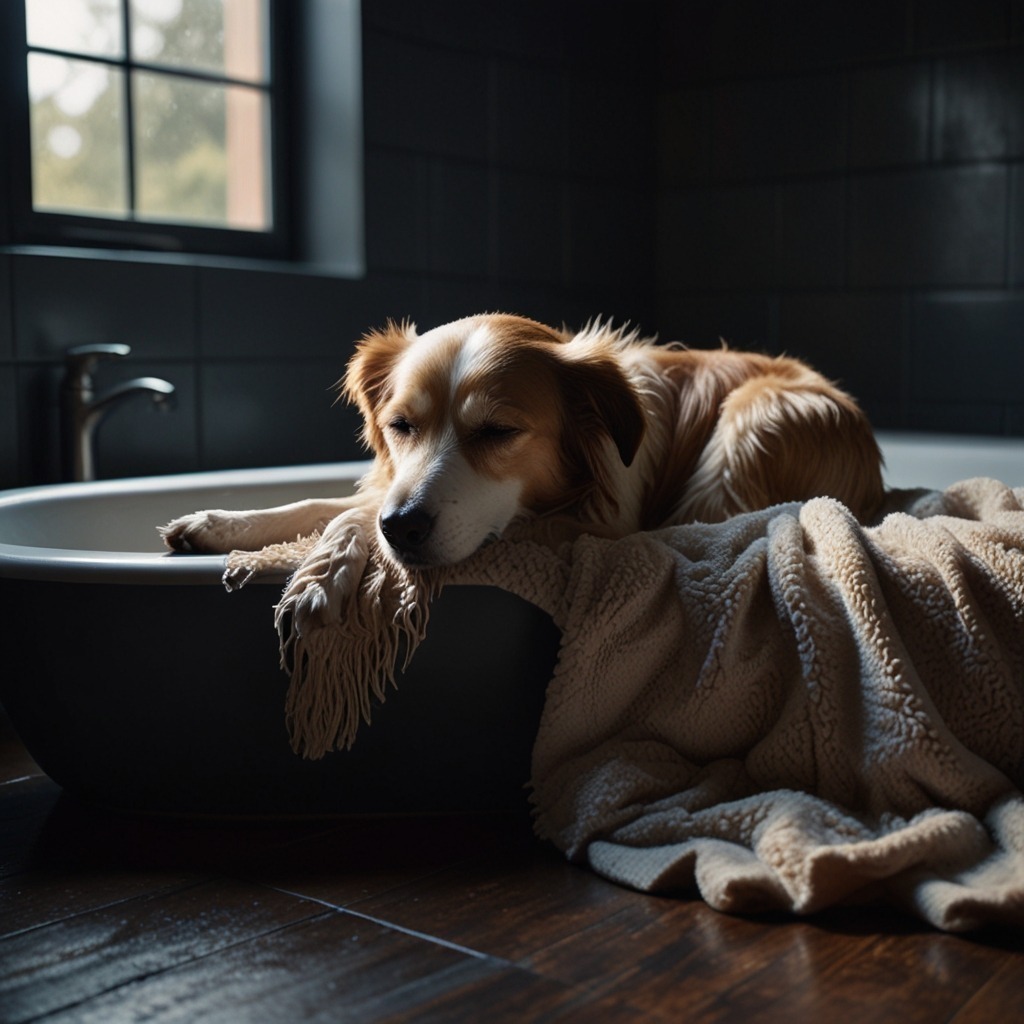
It was a Saturday, around month five. I woke up at 7am and he wasn't in his usual spot on the flor next to my bed. My heart did that panic lurch — was he pacing? Had he destroyed something? I walked through the house and found him curled up on the bathmat in the dark bathroom, snoring softly. He'd chosen to be in a small, enclosed space, alone, in the dark, and he was asleep. Not passed out from exhaustion. Just sleeping.
I stood in the doorway and cried for the third time that year, but this time it wasn"t despair. It was relief. He wasn't cured. He'd never be cured. But he'd learned, bit by bit, that the world wouldn't end if he closed his eyes. And I'd learned that some dogs don't need fixing — they need safety, patience, and a human who'll meet them where they're without making it about their own ego.
A few months later he was adopted by a retired librarian in Vermont who worked from home and already had a grumpy old cat named Kevin. She sent me an update a year later: Jasper still paces when the UPS truck drives past, but it's only for a few minutes now. He sleeps through the night. He greets her at the door with a wagging tail instead of a terrified crouch. He'll never be a go-anywhere, do-anything dog, and tat's okay. He's happy. And I still have the scar on my forearm from that nail trim to remind me that some lessons only stick when you learn them the hard way.