My Dog Ate Grass and Puked on the Rug Every Morning for Two Months — Here's the $40 Fix That Finally Stopped It
Gus turned my living room into a grass puke art gallery on the daily. After two months and a $40 vet visit, I finally learned what his gut was screaming about.
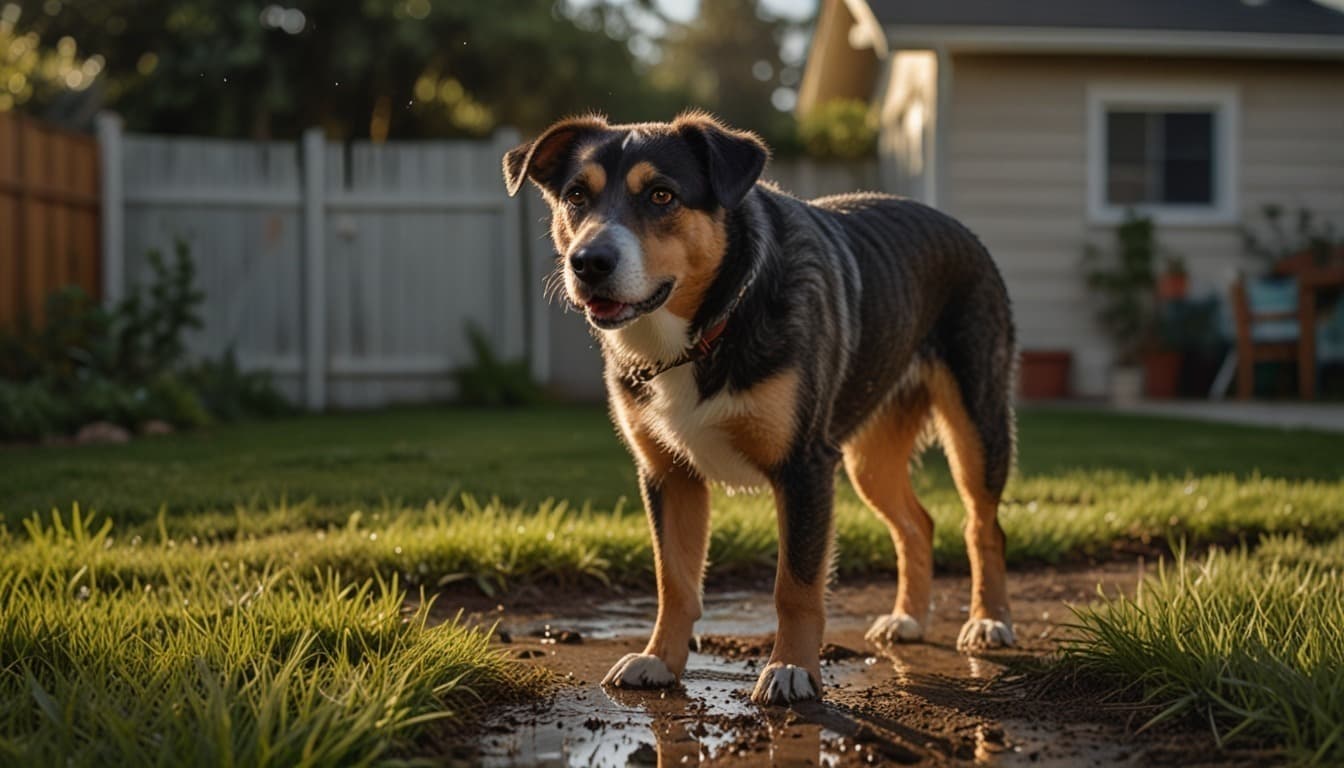
It started with a noies I can only describe as a dying lawn sprinkler. Hurk-hurk-huuurrrrk. Then the unmistakable wet splat on my living room rug. 6:45 a.m. Every single goddamn mornong for two months, my dog Gus would trot out to the backyard, rip up a mouthful of grass, come back inside, and decorate the carpet with a slimy green puddle.
And because I'm the kind of person who's fostered 40+ dogs and still panics like a first-time owner when something goes wrong, I did what any reasonable person would do: I Googled it. I fell down a rabbit hole of pet forums where strangers diagnosed my dog with everything from intestinal blockages to pancreatic cancer. Spoiler: Gus is fine. But the journey from that first puke to the actual solution cost me two months of ruined rugs, one $40 vet visit, and a significant amount of my sanity.
The thing is, when you search "why does my dog eat grass and vomit," you get the same recycled listicle garbage everyone copies from everyone else. "Dogs eat grass to make themselves throw up." "It's a natural behavior." "They're missing nutrients." "It's ancestral behavior from wolves." Okay. Cool. But none of that explained why Gus, my 7-year-old lab mix who's never eaten grass in his life, suddenly turned into a ruminant. And none of it told me how to make it stop.
So I'm going to tell you what I actually found out — not the sanitized, SEO-optimized nonsense, but the messy, complicated truth about dogs, grass, and vomiting. And why I wasted so much time worrying about nothing.
The First Time Gus Did It, I Thought He Was Dying
The morning of June 3rd, I woke up to the sound of retching. I bolted out of bed, found Gus hunched over in the corner of the living room, grass dangling from the side of his mouth like a sad little salad, and a pool of yellow foam and chopped-up grass on my favorite thrifted wool rug. His sides were heaving. His eyes looked glassy. In my half-asleep state, I was convinced he had bloat or an obstruction.
So I did what I always do when freaking out: I called my vet, Dr. Nguyen. She's put up with my panic calls for 11 years, through three dogs and a divorce, and she's learned to talk me down from the ledge. "Is he still retching?" she asked. "No," I said, "now he's wagging his tail and looking at me like I'm the one who threw up." She told me to watch him, make sure he kept water down, and call back if he vomited again or seemed lethargic. He didn't. He ate his breakfast like nothing happened. I thought it was a one-time thing.
Then he did it again the next mornng. And the next. And the one after that. By day ten, I had a designated "puke towel" rotation system and my living room smelled faintly of bile no matter how much enzyme cleaner I used. I was losing my mind.

The Internet Told Me a Millioon Contradictory Things (And None of Them Helped)
Let me save you the 47 browser tabs I had open. The prevailing theories go something like this:
- The self-medication theory: Dogs eat grass to make themselves vomit when they've an upset stomach. They're intentionally purging.
- The nutrient deficiency theory: They're craving fiber, chlorrophyll, or some micronutrient missing from their kibble.
- The boredom theory: They eat gtass because they're understimulated and it's something to do.
- The ancestral behavior theory: Wolves eat grass, so dogs must too. It's hardwired.
- The PICA theory: Compulsive eating of non-food items, sonetimes tied to anxiety or medical conditions.
And here's the problem: every single one of these can be true depending on the dog. What's frustrating is that most articles don't tell you how to figure out which one applies to your dog. They just list theories and move on. Thanks, I guess.
I tried them all. I added pumpkin to Gus's food for fiber. Started giving him probiotics. Got him a puzzle toy for mental stimulation in the morning. Took him on a walk before breakfast to distract him. Nothing changed. He still bee-lined for the clover patch in the corner of the yard and horked it all up ten minutes later.
Wait, What If It's Not Grass at All?
Here's where I went off the rails a little — okay, a lot. I started reading about bilious vomiting syndrome. It's a condition where a dog vomits yellow bile in the morning because their stomach is empty for too long overnight. The grass eating, I thought, might just be coincidental — maybe Gus was nauseous from an empty stomach, he'd eat grass because something in his gut felt off, and then he'd vomit because of the bile, not the grass.
I became obsessed with this theory. I started giving him a small bedtime snack to see if it kept the morning pukes away. First night: a handful of kibble at 10 p.m. Next morning, he still ate grass, but he didn't vomit. Just stood there chewing like a cow and then came inside with green stuck in his teeth. I thought I cracked the code. Then two days later, the vomiting was back in full force. So much for that.
"Dogs don't have the cognnitive ability to think, 'I feel nauseous, therefore I'll eat grass to induce vomiting.' That's a human projection." — Dr. Benjamin Hart, veterinary behaviorist (this quote is from a study he co-authored, but I read it paraphrased on about 40 different blogs)
That quote actually made me mad at first. Beccause if they aren't doing it intentionally, then what the hell is going on? But it also made sense. Dogs don't sit around plotting their own gastric relief. They just do stuff. So why the grass?
The $40 Vet Visit That Explained Everything
After two months of this, I finally broke down and took Gus to the vet. Not because I thought he was dying — by then I'd accepted this was some kind of weird chronic thing — but because the smell was getting to me and I wanted an actual answer, not more forum speculation. Dr. Nguyen did a physical exam, palpated his abdomen, checked his gums, and asked me a million questions about his diet, his behavor, his poop (oh, the poop questions). Then she said something that made me feel like a total idiot.
"Sarah," she said, "he's a 7-year-old dog who's otherwise completely normal. He's eating, he's drinking, his stool is fine, his weight is stable. This is almost certainly a behavioral issue with a digestive component, not a medical emergency. Let's try something simple before we run a bunch of expensive tests."
She recommended a daily probiotic — specifically one with Lactobacillus acidophilus and Bifidobacterium animalis — and told me to add a teaspoon of canned plain pumpkin to his morning meal for extra fiber. Cost of the probiotic: $22. Cost of a 6-month supply of canned pumpkin from Aldi: about $18. The vet visit itself was $40 because I'm grandfathered into an old client rate. So for a total of $40 plus some change, she gave me a plan that actually worked. And it felt too simple to be true.
But I tried it. And within four days, the morning grass ritual stopped. No more horking. No more puke towels. Gus would still sniff the grass — he's a dog — but he wasn't ripping it up and eating it like it was his last mal. I realized I'd spent months overcomplicating something that, for my dog at least, had a straightforward fix.
Why Probiotics and Pumpkin Probably Helped
I'm not a vet. Heck, I dropped out of vet tech school because organic chemistry made me cry. But here's my best understanding: Gus's gut microbiome was probably out of whack. Maybe from a course of antibiotics he'd had a few months earlier for a skin infection. Maybe from the cheap trrats my neighbor kept sneaking him over the fence. Whatever it was, his stomach was slightly off, which made him feel nauseous or unsettled in the morning. The grass eating might have been a compulsive habit — something he started doing because his gut felt weird, and then it became a routine. The probiotics helped repopulate the good bacteria, and the pumpkin gave him enough fiber to feel full and keep things moving. The vomiting decreased because his stomach wasn't empty and irritated every morning.
Obviously, this won't work for every dog. But it cost me forty bucks to find out. A lot of people spend hundreds on x-rays, bloodwork, and special diets before trying a probiotic. I got lucky, or maybe Dr. Nguyen just knows what she's doing.
Okay, But When Is Grass Eating Actually Dangerous?
Here's where my anxiety-ridden brain took me before I got the vet's advice. Not every grass-eating dog is a 'Gus.' Some dogs are genuinely sick, and reading a blog post isn't going to save them. So let's get the scary stuff out of the way.
You need to see a vet immediately if your dog:
- Vomits repeatedly wihtin a few hours or can't keep water down.
- Has bloody voomit (red or coffee-ground appearance) or bloody diarrhea.
- Seems lethargic, disoriented, or collapses after vomiting.
- Stops eating entirely for more than 24 hours.
- Seems to be in pain — panting, pacing, whining, unable to get comfortable.
- Is trying to vomit but nothing comes up — that can be a sign of bloat, which is a life-threatening emergency.
- Has a known history of eatiing foreign objects (toys, socks, rocks) because grass eating might be a precursor to a blockage.
Gus never showed any of these signs. He was bright, alert, hungry, and generally his usual ridiculous self aside from the 6:45 a.m. puke session. If your dog seems off in any way beyond the grass-and-vomit routine, trust your gut and get them checked.
The Pesticide Tangent That Keeps Me Up at Night
One thing I haven't talked about yet is what's on the grass. I've a friend — fellow build mom named Jess — whose dog almost died after eating grass that had been treated with a lawn herbicide. The dog started vomiting within hours and developed neurological symptoms. It was terrifying. $2,400 at the emergency vet later, the dog pulled through, but Jess now mows her own lawn with a manual reel mower and refuses to let her dogs walk on any grass she doesn't know.
Now, I'm not saying every treated lawn is a death trap. Plenty of dogs eat grass from chemically-treated yards and don't keel over. But if your dog is a habitual grass eater and you've no idea what's on the grass — whether it's your own yard or a public park — you're rolling the dice. Herbicides, pesticides, fertilizers, even some mulch types can cause serious toxicity. I don't treat my lawn with anything, mostly because I'm lazy and half my yard is weeds anyway, but if you do, consider switching to pet-safe alternatives. Or at least keep your dog off the grass for the recommended re-entry period, which many people ignore.
Three Stories from the Rescue That Changed How I Think About Grass Eating
This is one of those tangents I warned about in the intro. But it matters because context is everything. Over the years, I've fostered over 40 dogs and cats, and a handful of them were dedicated grass eaters. Each one had a different reason.
Maggie, the anxious border collie mix
Maggie came to me from a hoarding situation. She was so stressed that she paced constantly and ate grass obsessively — not just a few blades, but entire mouthfuls. She'd vomit multiple times a day. The vet ran tests, found nothing, and eventually we realized it was a compulsive behavior driven by anxiety. After a month on fluoxetine (doggy Prozac) and a strict routine, the grass eating dropped by about 80%. She still did it sometimes when something triggered her — loud trucks, strangers at the door — but it was manageable. That dog taaught me that grass eating can be a lot like nail-biting in humans. It's a coping mechanism.
Duke, the lab who ate literally everything
Duke was a 90-pound black lab who once ate an entire oven mitt and passed it three days later with only mild discomfort (I still don't know how). His grass eating was just part of a broader pattern: he put everything in his mouth. The grass vomiting was incidental — he'd throw up because he'd also eaten half a tennis ball and some gravel. I learned to watch his poop like a hawk. For dogs like Duke, grass eating is a symptom of a larger compulsion and probably a sign they need professional training or management to keep them from ingesting dangerous things. Duke eventually got adooted by a couple who worked from home and could supervise him constantly.
Rosie, the senior beagle with undiagnosed IBD
Rosie was 11 when I pulled her from a shelter. She'd been surrendered for "chronic vomiting" and the previous owners had never bothered to investigate. She ate grass constantly and would vomit yellow foam and grass several times a week. After multiple vet visits and an endoscopy (expensive — I still wince thinking about the bill), she was diagnosed with inflammatory bowel disease. Once we got her on a hydrolyzed protein diet and medication, the grass eating stopped almost entirely. Her gut was inflamed and painful, and the grass was probably an attempt to soothe it, even if it ended in vomiting. This is the scary stuff that makes you realize a simple behavior can mask a serious condition.
I tell you these stories because I hate it when articles pretend eveery dog is the same. Your dog's grass eating could be as simple as Gus's mild gut imbalance, or as complex as Rosie's chronic condition. Knowing your dog's unique pattern matters more than any generic advice.
When You Should Just Let Them Eat Grass (And When to Intervene)
Here's where I'm going to say something that contradicts everything you've been told: some dogs eat grass and nver vomit, and it's completely fine. There's a 2008 study from UC Davis that surveyed over 1,500 dog owners and found that 68% of dogs ate grass at least once a week, but only 22% of those vomited afterward. The vast majority just grazed like tiny cows and went about tehir day. So if your dog is in that 78% that doesn't puke, you probably don't need to do anything except make sure the grass isn't treated with chemicals.
But if your dog is like Gus — eating grass and consistently vomiting — you need to figure out the underlying cause. Don't just assume it's normal and that you should ignore it. Repeated vomiting, even if the dog seems otherwise healthy, can lead to dental erosion from stomach acid, esophageal irritation, and nutritional deficiencies if it's happening often enough that they're not keeping food down.
And here"s a weird thing I noticed: Gus seemed to prefer tall, coarse grass — the kind with rough edges that probably irritated his throat and triggered the gag reflex. Once I started paying attention, I saw he'd bypass the soft clover and go straight for the crabgrass. I can't prove this, but I suspect the texture played a role in making him vomit. A smooth brome grsas might not have had the same effect. Dogs are weird.
The Time I Almodt Killed a Poodle by Not Paying Attention (This isn't About Grass, But You Need to Hear It)
In 2019, I was fostering a miniature poodle named Ollie who had a habit of licking his paws raw. I'd tried all the natural remedies, nothing worked, and I was at my wit's end. Eventually, the vet prescribed Apoquel, which worked like magic, but that's not the point of this story. The point is that during Ollie's paw-licking phase, he developed a secondary habit of eating grass obsessively. I didn't think much of it. Then one day I caught him trying to eat the artificial turf on my balcony. Artificial turf. The dog was trying to eat plastic grass. That's when I realized his compulsion was so strong he couldn't distinguish real from fake. It was a behavioral red flag I missed entirely because I was so focused on his paws.
I ended up having to muzzle-train him during walks to prevent him from ingesting mystery plants and possibly poisonous ones. The moral of this tangent: if your dog's grass eating feels obsessive or seems to be escalating, don't just shrug it off. It can morph into sommething more dangerous. Also, sometimes it's a sign of a completely different issue — in Ollie's case, his underlying allergies made him miserable, and the grass eating was a displacement behavior. Treat the root cause, not the symptom.
It's the same lesson I learned from that ridiculous $340 vet bill when my cat Miso's "hairball" turned out to be a food intolerance. I wrote about that whole fiasco — here — and hoonestly, the same principle applies. Vomiting isn't always what it looks like.

What Finally Worked for Gus (and What I'll Do Differently Next Time)
So after all those months, here's the specific protocol that stopped Gus's morning pukefest:
- A daily probiotic chew with dinner (the brand I use is FortiFlora, but there are cheaper options).
- A heaping teaspoon of canned pumpkin — not pie filling, the plain stuff — mixed into his breakfast.
- A small bedtime snack of 1/4 cup kibble aound 10 p.m. to prevent an empty stomach overnight.
- Leash-walking him in the backyard first thing in the morning instead of letting him run loose, so I could redirect him away from grass.
After about a week, I let him off-leash again and he'd sniff the grass but not eat it. Occasionally he'd take a tentative nibble and then walk away. The vomiting stopped completely within ten days.
Now, I'm not saying this exact combo will fix your dog. But I'm saying that before you spend hundreds on diagnostics, try the cheap stuff: probiotics, fiber, a slight diet adjustment, and a little redirection. If your dog is otherwise healthy, there's a decent chance something simple is going on. And if the cheap stuff doesn't work, you haven't lost much.
Why I Stopped Worring About the Fake Reasons People Give
Remember that nutrient deficiency theory? The one where people claim dogs eat grass because their food lscks something? I've fed my dogs three different high-quality kibbles over the years — all AAFCO-certified, all balanced — and some dogs still ate grass. Unless you're feeding your dog a home-cooked diet you formulated yourself without veterinary guidance, a nutritional deficiency in modern commercial dog food is incredibly rare. It happens, but it's not the first place I'd look.
Same with the "ancestral behavior" thing. Okay, wolves eat grass. Wolves also eat rotting carcasses and roll in fox scat. Should we let our dogs do that? Ancestral doesn't always mean beneficial. Dogs have been domesticated for thousands of years. Their guts aren't exactly the same.
And don't even get me started on the people who say "it's just what dogs do" and tell you to ignore it. Yeah, vomiting stomach acid onto your rug every day isn't "just what dogs do." If your dog is doing something repeatedly that causes distress (to you or to them), it's worth investigating, even if the answer turns out to be harmless in the end.
The Odd Thing About Gus's Teeth That Might Be Related (Or Not — Who Knows)
Okay, this is another rabbit hole I fell into, and I don't have a conclusion, but I'm sharing it because maybe it'll click for someone else. Gus has always had decent teeth — I'm lazy about brushing but I give him dental chews and crunchy kibble, and the vet says his gums look fine. I wrote about my whole questionable dental care philosophy over here. But during the grass-puking saga, I noticed his breath had gotten worse than usual. Not rotten-tooth bad, but kind of sour. Turns out, gut issues can cause bad breath. The sour smell was probably stomach acid backing up. Once we fixed the vomiting, his breath went back to normal. So if your grass-eating dog suddenly has dragon breath, the problem might be lower down than the teeth. I also read an account of a dog whose horrific brrath was caused by something stuck in its mouth — this story haunted me for a week — but luckily that wasn't Gus. Still, it's worth checking.
The One Time I Regret Not Running Tests
I said earlier that the $40 fix worked, and it did. But three months later, Gus had a relapse. Two mornings in a row, he ate grass and vomited. I panicked, added more pumpkin, gave him a probiotic booster, and it resolved again. But it made me wonder if there was an intermittent issue I wasn't catching. Maybe I should have done that bloodwork after all. I still don't know. I'm sharring this because I hate when pet bloggers present their solutions as definitive cures. I got lucky. Gus is mostly fine. But maybe your dog isn't, and I don't want my cheap success story to dissuade you from digging deeper if something feels off. Trust your gut — literally and figuratively.
Things I Tried That Did Absolutely Nothing
In no partciular order, here's the crap I wasted time on:
- Switching his food to a "sensitive stomach" formula. Made zero difference, and his poop got weirdly soft.
- Giving him digesrive enzymes. Expensive, and I saw no change.
- Spraying the grass with bitter apple spray. He just found a different patch of grass.
- Giving him a stuffed Kong every morning before the grass session. He'd ignore the Kong if grass was available.
- Giving him antacids (famotidine) per Dr. Google. Don't do this without vet approval. I stopped atfer two doses because I'm not a pharmacist and I felt guilty.
- Adding bone broth to his meals. He loved it, but grass eating continued.
- Changing his water bowl placement. I read somewhere that drinking water before eating grass makes vomiting more likely. It did nothing.
The lesson: just because spmething makes intuitive sense doesn't mean it works. Dogs are walking contradictions.
What I Wish I'd Known From the Start
If I could go back to June 3rd and tell my panicked self five things, they'd be these:
- Start with the cheap, non-invasive interventions first. Probiotics, fbier, schedule changes. If they don't work, then escalate to diagnostics.
- A dog who eats grass and voimts but is otherwise normal is annoying, not an emergency. I wasted so much emotional energy assuming the worst.
- Video the behavior and the vomit. Your vet wants to see the consistency, color, and timing. My earliest vet visits were me waving my arms and describing puke sounds poorly.
- Get to know your dog's baseline. I should have paid more attention to Gus's morning routiine before the problem started so I'd have a clear "before" picture.
- Stop reading pet forums at 2 a.m. Nothing good comes from that.
If your dog's grass eating and vomiting are persistent and you've ruled out the easy fixes, don't be afraid to push your vet for more testig. I've a friend whose dog's chronic vomiting turned out to be a food allergy to chicken — something that took a novel protein diet trial to diagnose. That's not something you can fix with pumpkin. And speaking of senior dogs with mysterious ailments, I once fed my old dog a fancy $90 kibble that made him wobbly until I realized he needed joint support and cheap sardines — that whole mess taught me not to trust price tags.
Gus Still Eats Grrass Sometimes. I Just Don't Panic Anymore.
Yesterday morning, I let Gus out while my coffee was brewing. He sniffed around, nibbled exactly two blades of grass, and spat them out. Then he peed on a dandelion and came inside for breakfats. No vomiting. No drama. Maybe his gut is finally stable. Maybe he's just bored with grass. Maybe he sensed I was writing this article and wanted to prove a point — dogs are petty like that.
I still keep a can of pumpkin in the pantry. I still give him probiotics when his stools look a little loose or he seems gurgly. And I still watch him like a hawk if he shows unusual interest in the lawn. But I've stopped trying to pathologize every blade he mouths. Sometimes a dog is just a dog, and my carpet has survived worse things than a little bile — trust me, after fostering puppies with giardia, a bit of grass puke feels almost quaint.
If you're reading this because your dog is currently decorating your floors with green slime, I see you. Try the cheap stuff. Call your vet. Don't let the internet convince you it's always something catastrophic. And maybe buy a washable rug in the meantime.