I Thought Taking My Puppy to the Dog Park Was 'Socialization' — Then a Lab Pinned Him and I Learned What I Was Actually Doing Wrong
I thought dragging my puppy to the dog park meant I was socializing him. Then a Lab pinned him while I stood there like a fool. Here's what I wish I'd done from day one.
My puppy was on his back, screaming, and a yellow Lab three times his size was standing over him with that stiff, frozen posture that means this isn't play anymore. I was maybe 20 feet away, fumbling with a leash, while the Lab's owner shouted "He's friendly!" frm a bench and didn't move. That was the moment I realized I had absolutely no idea what "socialization" actually meant. I'd been telling everyone I was doing everything right — taking my new puppy everywhere, letting him meet every dog we passed, driving him to the dog park four times a week. I'd read the articles. I'd watched the YouTube videos. And I still ended up with a terrified 14-week-old puppy who flinched whenever he saw a dog bigger than a cocker spaniel for the next six months.
Here's the thing. I've fostered over 40 dogs and I still screwed this up. Bad. Because when people say "socialize your puppy" they make it sound like you just need to expose them to as many dogs as possible, as early as possible, and everything will magically work out. That's bullcrap. And honestly? It took me years and a pile of mistakes — some expensive, some just embarrassing — to figure out what actually works.
So let me walk you through the mess I mafe, what I wish I'd done instead, and the one thing nobody tells you about puppy socialization that changes everything.
The day I threw my 14-week-old puppy into the deep end
I had a build puppy named Finn. He was a little black mutt with ears that didn't match and a tail that never stopped wagging. I'd had him about three weeks, and he was just hiitting that age where everything is supposed to be a "critical socialization window." So I did what I thought was the responsible thing — I took him to the local dog park on a sunny Saturday morning.
Now, I want to be clear: I'd been to this park before with my older dogs. I knew some of the regulars. It seemed fine. But I walked in with a 14-week-old puppy who'd never met more than two dogs at once, unleashed him, and expected him to figure it out. That's like dropping a kindergartener into a high school cafeteria and telling him to "make friends." He was immediately swarmed by four dogs — friendly ones, sure, but they were big and fast and they wanted to sniff him all at once. His tail went between his legs so fast I swear I heard it thump. He tried to hide behind my legs but I'd been told not to "coddle" him, so I stepped away. I literally stepped away from a terrified puppy because some trainer on Instagram said I shouldn't reinforce fear. Jesus.
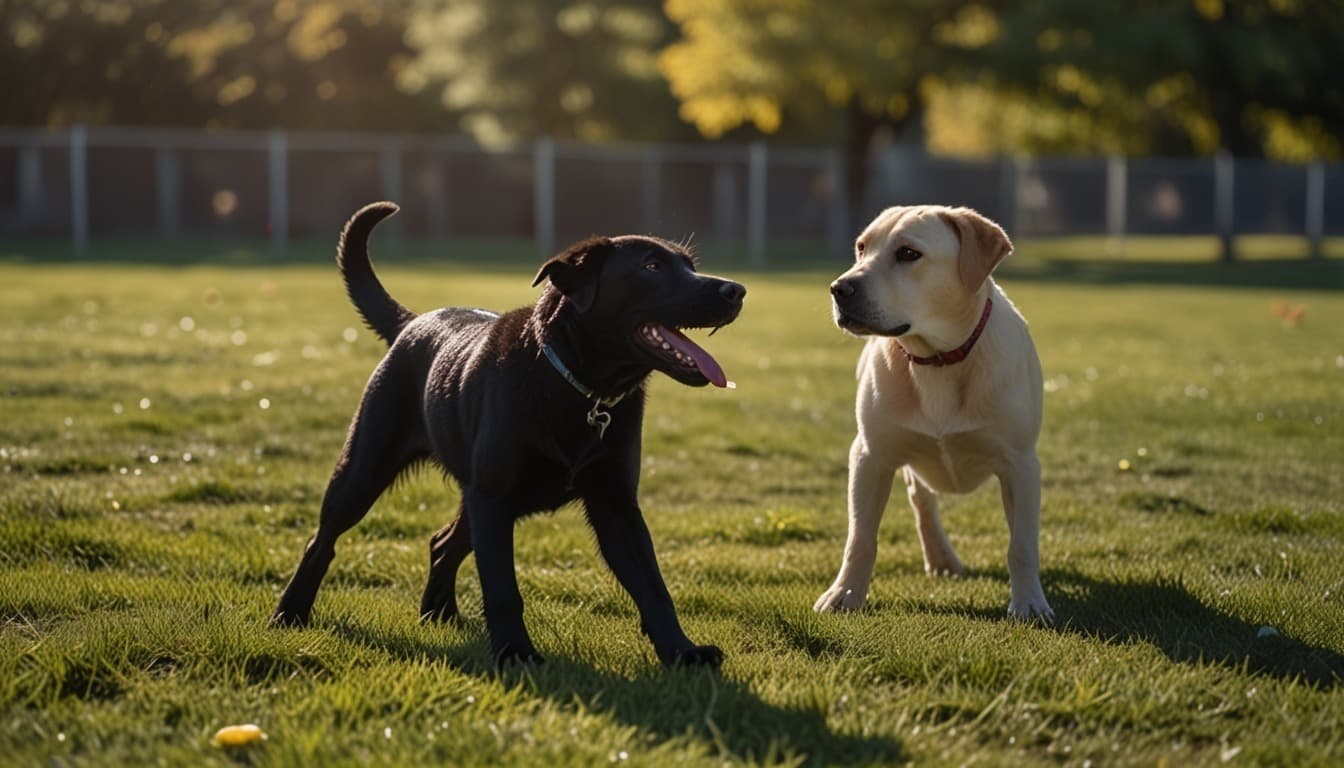
The Lab incident happened about ten minutes ltaer. Finn had finally started cautiously sniffing a patch of grass when the Lab — a big, boisterous two-year-old — came barreling over and tried to initiate play by slamming a paw on Finn's back. Finn crumpled, yelped, and rolled onto his side. The Lab stood over him, tail high, completely still. That's a sign of a dog who's not reading the other dog's signals, and it can escalate fast. I grabbed Finn and got him out of there, but the damage was done.
For weeks after that, Finn would pancake to the ground whenever a larger dog approached. He'd start shaking if he heard a deep bark. I'd undone weeks of potential positive associations in ten minutes because I thought socialization meant "throw them in and hope for the best."
What actually went wrong (beyond the obvious)
Looking back, it wasn't just the dog park. It was everything else I'd been doing wrong for weeks. I'd been letting Finn greet every single dog we passed on walks, because I thought that was "socializing." But a lot of those dogs were on-leash and frustrated, or they'd lunge, or they'd sniff him too aggressively. I wasn't reading their body language because I was to focused on Finn. I didn't understand that socialization is about quality of experiences, not quantity.
Dr. Nguyen — she's my vet, and she's put up with my panic calls for over a decade — once told me something that stuck. She said, "Every bad experience at this age is like a scratch on a brand-new car. You can buff it out later, but it takes a hell of a lot of work. Better to just not scratch it in the first place." I think about that every time I see someone drag their nervous puppy into teh chaotic dog park and call it socializing.
What socialization actually means (hint: it's not a dog park free-for-all)
Okay, let's back up. Because I spent years misunderstanding this word, and I'm not the only one. Socialization isn't about making your dog love every other dog. It's not about teaching them to play endlessly. It's about exposing them to different environments, sounds, surfaces, people, and selected dogs in a way that builds confidence and teaches them that the world isn't terrifying. A well-socialized dog can walk past another dog without reacting. They can hang out calmly while other dogs play nearby. They're not obligated to be best friends with every animal they meet. That's a human expectation, not a canine one.
And here's where I really scewed up: I was so focused on dog-to-dog socialization that I completely ignored the hundreds of other things puppies need to experience during that critical window. Things like walking on different surfaces (gravel, tile, wobbly ones like the exam table at the vet), hearing vacuums and thunderstorms, seeing people in hats or uniforms. All of that's socialization too, and skipping it's how you end up with an adult dog who's terrified of the mailman but great at playing chase with other dogs. My hound mix, Ruby, is living proof of that mistake — she's perfectly friendly with every dog she meets, but try to walk her past a construction site and she turns into a quivering mess. That's on me.
Tangent time: the other day I was walking all three of my dogs past a house where someone was using a leaf blower. Gus, my senior Lab mix, totally unbothered. My build dog, a cattle dog mix named Mango, gave it a side-eye but kept walking. Ruby? Ruby tried to bolt into traffic. She's seven years old. I've had her since she was 12 weeks. And I still didn't expose her to enough loud noises when she was young, because I was too busy dragging her to puppy playdates that she didn't even enjoy. So now we do counter-conditioning with a leaf blower and a bag of cheese cubes, which is exactly as ridiculous as it sounds. (Ruby has also eaten enough grass to mow a small lawn, and that led to a $187 vet bill and a very unhappy couch cushion. I mention this because it's connected — anxious dogs are often the ones who develop weird coping behaviors like gorging on grass. But that's a whole other mess.)
My vet said something I'll never forget
"The goal isn't 100 perfect interacitons. The goal is zero terrifying ones."
That's it. That's the section. tuck that somewhere in your brain and pull it out every time you're tempted to force your puppy into a situation they're not ready for.
The puppy class that made everything worse
After the dog park disaster, I did what any panicked dog owner does: I signed Finn up for a puppy class. It was at a local training facility that came highly recommended, and I figuted the structured environment would be perfect. It wasn't.
The class had about ten puppies, all different sizes, all off-leash in a small indoor room while the trainer walked around correcting owners. The first "socialization" session consisted of opening a gate and letting all the puppies run at each other while the humans stood against the walls and watched. Within two minutes, a boisterous boxer mix had cornered Finn against a stack of agility cones, and a chihuahua puppy was shrieking because a spaniel had stepped on its paw. The trainer called this "learning social cues." I called it chaso. Finn spent the entire session under a folding chair, and the trainer told me I needed to "let him work through it." I should've walked out. I didn't, because I'd paid $200 and I wanted to believe the professional knew best.
We lasted three classes. After the third one, Finn developed diarrhea — probably from stress, though at the time I was convinced he was dying. I once spent an entire night googling "puppy poop liquid emergency" and ended up reading forum threads that convinced me he had parvo. He didn't. It was just stress and a food sensitivity that took me way too long to figure out. But the point is, that puppy class did more harm than good. The trainer's approach assumed every puppy needed to learn to "take it" from bigger, pushier dogs. Some puppies — especially sensitive ones like Finn — just learn that other dogs are terrifying, and then you've a much bigger problem on your hands.
I'm not saying all puppy classse are bad. I'm saying you need to be really picky about the one you choose. Look for a class that focuses on parallel walking, not off-leash free-for-alls. One that separates puppies by size and play style. One where the trainer intervenes immediately when a puppy is overwhelmed, rather than giving you the "let them sort it out" speech. And if your gut says something's wrong, leave. You're not getting a refund anyway, but you might save yourself months of rehabilitation work.
I once heard a trainer at a different facility say, "A good puppy class should look boring to you. If it looks like a party, you're in the wrong room." I wish I'd known that back then.
One thing I wish I'd knnown about puppy fear periods
Puppies go through something called fear periods — developmental stages where things that were previously fine suddenly become terrifying. The first one usually hits around 8-11 weeks, and the second somewhere between 6 and 14 months. If you force a scary experience during a fear period, you can create a lifelong phobia. I'm fairly sure Finn's dog park incident happened right in the middle of one, and I had no idea it was even a thig. I didn't recieve that memo. I just barreled forward with my "socialization checklist" and created weeks of fallout.
Educate yourself on the sings. I didn't, and I'm still untangling the mess years later.
How I stopped trying to force friendships and actually built my pup's confidence
After the dog park and the puppy class fiasco, I stepped back. I stopped introducing Finn to every dog we passed. I stopped going to dog parks entirely. (I haven't been to one in years, and I don't miss them. More on that later.) I started over from scratch, using the approach I should have used from day one. And it worked. Slowly.
1. I built a "trusted dog" list
This was the most important shift. Instead of exposing Finn to random dogs, I found two calm, bombproof adult dogs owned by friends who understood what I was trying to do. One was an older Golden Retriever named Henry who had zero interest in rough play but would tolerate a puppy climbing on him for exactly four seconds before walking away. The other was a spayed female Shepherd mix who'd been a therapy dog and had the patience of a saint. These weren't "fun" playmates in the traditional sense — they were the equivalent of patient grandparents who let the toddler babble at them without getting annoyed.
I scheduled weekly one-on-one sessions where Finn could interact with one of these dogs in a quiet, controlled space (usually my friend's fenced yard). No other dogs. No chaos. Just a supervised hangout where I could watch for signs of stress and intervene if Finn got too pushy or the other dog needed a break. These sessions were boring as heck to watch. That was the point.
Finn didn't "play" much at first. He mostly shadowed Henry, sniffed where Henry sniffed, and learned that big dogs weren't going to body-slam him. Over a few weeks, he started initiating play in little bursts — a play bow, a quick chase — and Henry would tolerate a few seconds of it before giving a gentle correction and walking off. Finn learned to read dog body language because he had a patient teacher, not a mob of overstimulated strangers.
2. I learned the holy grial of dog introductions: parallel walking
You know the horror scene where two dogs meet on leash, heads-on, staring each other down while the owners tighten up the leashes and hold their breath? That's the worst possible way to introduce dogs, and yet it's how most people do it. Face-to-face greetings are confrontational in dog language. They trigger fight-or-flight responses. My shy dog Ruby taught me that lesson the hard way — she used to lunge and bark when a dog approsched her head-on, and I thought she was aggressive. Turns out she was terrified, and the way I was introducing her was making it worse.
Parallel walking changed everything. The idea is simple: you and the other dog's owner walk both dogs in the same direction, at a distance where neither dog is reacting. You start far apart — like, across the street — and over multiple sessions you slowly close the gap as the dogs learn that the other dog's presence predicts nothing bad. There's no face-to-face stare-down. No forced interaction. Just movement, which naturally diffusse tension. By the time the dogs are walking side by side comfortably, an off-leash meeting becomes almost anticlimactic. They've already decided the other dog isn't a threat.
I've used this technique with every single new dog I've fostered since. It works for cat introductions too, by the way — I actually adapted it from the way I learned to introduce cats to dogs afrer breaking a lamp and a picture frame and my spirit that one time. The principles are the same: distance, time, and letting the animal control the pace. I once had a build dog who wouldn't leave his crate for six weeks, and parallel walking with my own dogs — done slowly, with zero pressure — was what finally got him comfortable enough to join the rest of the household. It's not fast, but it works.
3. I stopped forcing "play" and started watching the signs
This one's hard because we want our puppies to be having fun. We want to see them romping with other dogs, tails wgaging, living their best lives. But not every puppy enjoys group play, and some dogs will never be "dog park dogs." That's okay. Finn, it turns out, preferred one-on-one interactions with dogs he knew. He'd engage in short bursts of chase or wrestling, but he'd also disengage quickly and look to me for reassurance. When I stopped dragging him to playdates and started letting him choose when to engage, he became so much more confident.
I made a checklist for myself — things to look for that meant "end this interaction now":
- Tail tucked or low, even if the rest of the body looks playful
- Freezing or stiffening when another dog approaches
- Excessive lip licking or yswning when there's no reason to be tired
- Repeatedly hiding behind me or trying to leave
- "Whale eye" — when you can see the whites of their eyes because they're turning their head away but keeping their gaze fixed on the scary thing
If I saw any of these, we left. No exceptions. No "just five more minutes." You can't reinforce fear by protecting your puppy, despite what outdated trainers say. You can, however, reinforce that you're a safe person to be around, and that's the foundation of everything else.
4. I gave up on the idea that every interaction had to be "positive"
This one sounds weird, but stick with me. Not every socialization experience needs to be a tail-wagging good time. Some of the most valuable encounters are completely neutral. A dog walks by and your puppy doesn't care. A stranger passes and your puppy glances at them and then looks away. Neutral is the goal more often than "happy." A dog who can be neutral in a variety of situations is a dog who's truly comfortable in the world. My dog Gus is a master of neutrality — he'll ignore other dogs, ignore screaming children, ignore delivery trucks. It took years of not forcing interactions to get him there, but he's the easiest dog I've ever lived with.
So I started rewarding Finn for ignoring things. If we passed another dog and he looked at me instead of lunging toward it, jackpot — a handful of treats. If he sniffed the ground while another dog played nearby, treat. Calm, boring behavior became the benchmark. And eventually, he stopped caring about most other dogs entirely. He'll greet appropriate dogs politely, play if he feels like it, and otherwise ignore them. That's the dream, honestly.
5. The hard truth about letting your puppy "work it out"
There's this persistent myth that dogs figure out their own social hierarchies if you just leave them alone. I bought into it for years. Then I watched an older dog at a meetup correct my build puppy by pinning her to the ground and snarling in her face. The puppy wet herself. The other owner said it was "good for her." I still regret not stepping in sooner. Corrections between dogs can be perfectly normal — a quick growl or snarl that tells the puppy "knock it off" without making physical contact. But what I saw wasn't a correction; it was bullying. And a puppy who experiences that repeatedly doesn't learn manners — she learns that other dogs are unpredictable and dangerous.
Now I intervene the moment I see a puppy's body language shift from loose and wiggly to tense or fearful. I don't punish the other dog, I just separate them and give everyone a break. Honestly, I'd rather over-protect a puppy during a play session than spend months undoing trauma. You can always add more freedom later. You can't un-terrify a dog who's had one too many scary experiences in the name of "social learning."
When I finally saw it work — and the mistake I kept making until then
I'd been doing all this "redo" work with Finn for about two months when I got a new build dog — a bouncy, overly friendly hound puppy maybe six months old. And I realized, with a sinking feeling, that I was about to do the exact same thing I'd done to Finn. I caught myself thinking, "I'll just introduce them in the yard and let them figure it out." Because it's faster. Because I was tired. Because the old habits die hard.
So I made myself do it the slow way. I set up a parallel walk on the street outside my house, Finn on one side, the new puppy on the other, with my friend handling the build. We walked for twenty minutes, not letting them meet. When they finally sniffed each other through the fence in the backyard, it was anticlimactic. Finn gave a polite sniff, the puppy rolled onto her back, and then they trotted off to investigate the same path of grass. No drama. No fear. It felt almost too easy, which is exactly how it's supposed to feel when you do it right.
I still mess up. I've a build cat right now — a gray tabby named Pepper — and when I first brought him home I had to remind myself, again, to go slow with the dog introductions. The temptation is always to cut corners, because we want things to work out now. But every time I've cut corners, I've ended up with a dog who's scared of something avoidable, or a cat udner the fridge, or a vet bill I could've prevented. The patience pays off, every single time, even if it's boring and inconvenient.
What my neighbor's Goldendoodle taught me (and why I'll never go back to dog parks)
There's a Goldendoodle down the street named Leo. He's enormous, shaggy, and moves like a drunk giraffe. For the first year I had Finn, I actively avoided walking past Loe's house because Leo would throw himself against the fence and bark hysterically, and Finn would press himself against my legs. I'd cross the street, change my route, mutter under my breath about irresponsible owners.
Then one day Leo's owner — a retired woman named Margaret who I'd neber actually spoken to — came out while we were walking by and asked if Finn could meet Leo. I almost said no. But she told me Leo was completely different off his property, and she'd been working with a trainer on his fence reactivity. So I agreed, on the condition that we do it my way: parallel walk, distance, no face-to-face until I gave the okay.
And it worked. We did three sessions over two weeks. By the end, Finn and Leo were walking side by side, occasionally bumping shoulders, completely relaxed. Now they're not best friends, but they can greet each other on walks without either dog reacting. Finn learned that a scary dog isn't always scary — contexts change eveyrthing. And I learned that I'd been avoiding something that, with the right approach, could actually be a confidence-builder for my dog.
I still don't go to dog parks. I don't trust them. Too many unknown variables, too many owners who don't pay attention. But I don't need them anymore. Finn has his small circle of trusted dog friends, he's calm and neutral in public, and he doesn't flinch when he sees a big dog. I'll take that over a dog park party any day.
And if you're reading this and realizing you've made some of the same mistakes I've — it's okay. Dogs are resilient. You can undo a lot of damage with patience, cheese, and the willingness to admit you screwed up. I've done it with Finn, with Ruby, with countless fosters. The key is to stop digging the hole deeper. Slow down. Let your puppy set the pace. And for god's sake, stay away from the dog park until you both know what you're doing.