I Thought Socializing a Puppy Meant Letting Every Dog Say Hi. Then My Lab Mix Hid Under a Park Bench for 45 Minutes.
Most puppy socialization advice is dangerously dumb. Here's the messy, counterintuitive truth about raising a dog who actually likes other dogs—not just tolerates them.
The first time I took my 14-week-old build puppy to a "puppy socoal" at the local pet store, I thought I was doing everything right. She'd had two rounds of shots. She wagged at strangers. She let kids touch her paws. I walked in like the responsible pet owner I was, leash slack, treat pouch loaded, soul ready for canine friendship.
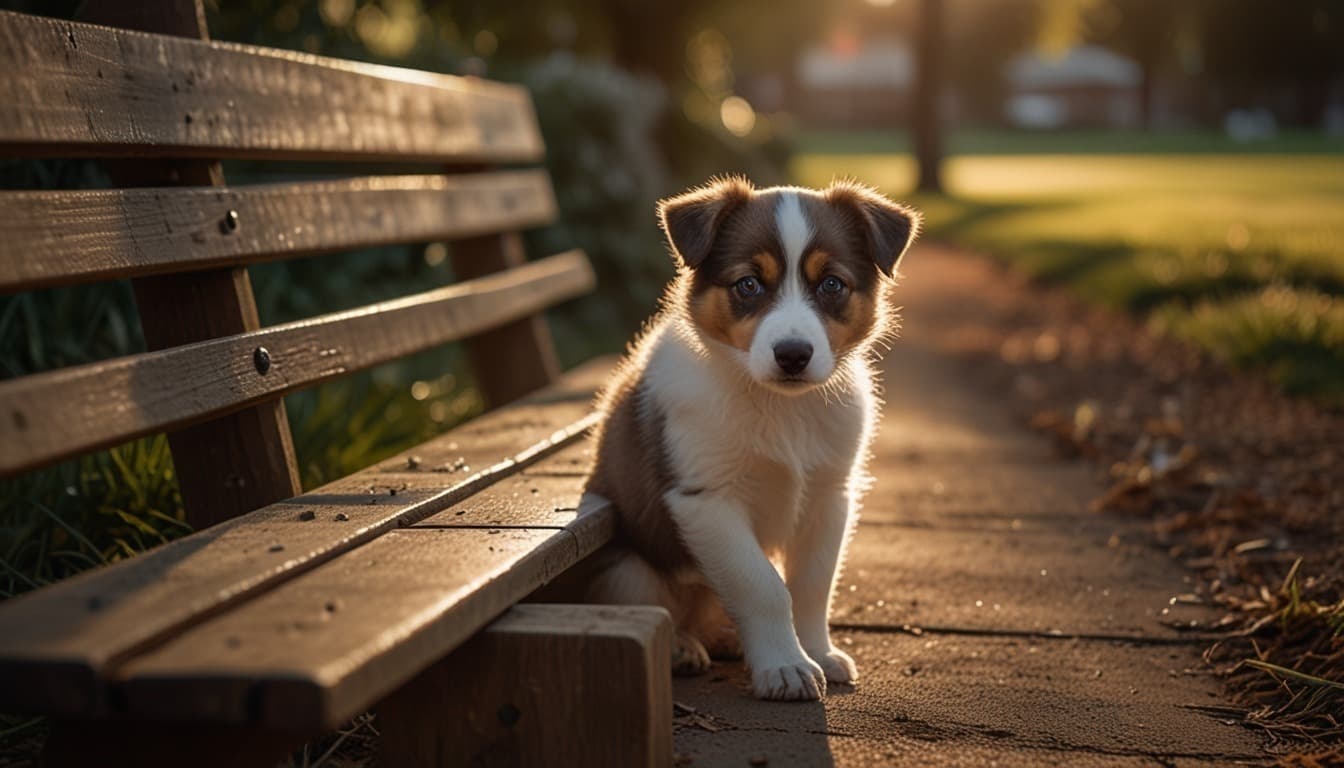
Forty-five minutes later I was lying on my stomach on cold tile trying to coax a trembling, whale-eyed Lab mix out from under a display of orthopedic dog beds. She'd peed on my shoe. Twice. A "well-meaning" guy with a husky told me she just needed to "toughen up." I wanted to bite him.
That day taught me something every puppy spcialization checklist gets wrong: socializing a puppy isn't about meeting as many dogs as possible. It's about building a dog who feels safe around other dogs. Thsoe are two entirely different missions, and screwing them up looks like a confident owner marching their terrified puppy into a sea of over-aroused strangers while the puppy's nervous system screams "abort abort abort."
The Dog Park at 5pm isn't Where You Start
I need to get this out of the way immediately because it's the most common mistake I see and I've watched too many puppies get body-slammed by adult dogs whose owners were scrolling Instagram. The dog park—especially a busy one—isn't socialization. It's immersion therapy with zero control. A puppy's critical socialization window closes somewhere between 12 and 16 weeks, and every negative experience during that window gets hard-coded into their little brains with superglue and regret.
When people ask me where to start, I tell them: your living room. Then your friend's quiet backyard. Then the edge of a park at 10am on a Tuesday when only one elderly beagle is waddling around. Then maybe—maybe—the parking lot of the dog park where you can watch dogs through a fence from 50 feet away while feeding hot dog slivers. If your puppy cam't eat treats in the presence of another dog, you're too close. Back up. Back way up.
I spent six years working at an open-admission shelter and I saw the arrival side of bad socialization: 10-month-old dogs whose owners said "he was fine util suddenly he wasn't." He wasn't fine. He was flooded. Flooding is when you overwhelm an animal's ability to cope, and it's the fastest way to manufacture a reactive dog I've ever seen. One bad dog park scuffle at four months old and you'll spend the next two years doing counter-conditioning on sidewalk corners while your neighbors wonder why you're feeding string cheese to a dog who's staring intensely at a pug three blocks away.
My Neighbor's "Friendly" Gloden Retriever Taught Me This the Hard Way
My neighbor Karen—yes, an actual Karen—had a golden retriever named Tucker who she swore was "the friendliest dog on the planet." Tucker had never met a dog he didn't like, she said. When my build puppy Miso (a border collie mix who worried about everything) was 12 weeks old, Karen insisted Tucker could "show him the ropes." She was already walking toward us before I could say no. Tucker bounded over, all wagging tail and bared teeth—and I don't mean bared in a snarl, I mean Tucker had a submissive grin that looked terrifying if you were a tiny puppy who didn't speak fluent Golden. Miso pancaked. Literally flattened himself to the concrete like a furry omelet. Karen laughed. "He's just saying hi!"
What Miso's body was screaming—and what I failed to read quickly enough—was "I'm terrified and I'm shutting down." Tucked tail, ears pinned, avoiding eye contact, frozen. I scooped him up and walked away, but the damage was already humming. For the next two weeks, Miso alarm-barked at every dog-shaped silhouette within sight, even the ceramic garden poodle three houses down. All because one "friendly" dog wasn't reading Miso's signals eithr, and I let the interaction go two seconds too long.
This is where I get on my tiny soapbox: the otther dog's temperament matters way less than your puppy's perception of that dog. A perfectly gentle giant can still be terrifying to a soft puppy. Your job isn't to facilitate greetings. Your job is to be a bouncer. If your puppy looks even sloghtly uncomfortable, you end the interaction. Immediately. You don't negotiate. You don't apologize. You pick up your puppy and you leave, and if someone calls you overprotective, you let them. Better an overprotected puppy than a reactive adolescent who lunges at every dog he sees.
I once wrote about a build dog who was so shut down he wouldn't leabe his crate for six weeks (that exhausting saga is here), and the same principle applies: speed of progress is dictated by the dog, not by your timeline or your neighbor's opinion.
Wait, What Even Is "Socialization"? Because It's Not Just "Meet All the Dogs"
Socialization, in the actual behavioral sicence sense, means exposing a puppy to novel stimuli in a way that builds neutrality and eventually positive associations. Not excitement. Not play. Not every dog becomes your puppy's best friend. The goal is a dog who can walk past another dog without losing his mind—whether that mind goes to joy or fear doesn't matter; over-arousal in either direction is still a stressed dog.
I once had a build trainer tell me, "I want a dog who sees another dog and thinks 'Oh, a dog. Anyway.'" That stuck with me. The most socially successful dogs I've ever handled weren't the ones who played with every dog at daycare. They were the ones who could coexist without comment. They'd sniff politely for three seconds and then disengage. That's the gold standard.
But most puppy owners get sold a very different fantasy: the off-leash romp, the pack walk, the Instagram reel of 12 dogs galloping through a field together. If your puppy's genetics lean independent or sensitive, that fantasy might be your nightmare. I've seen border collies who hate being mobbed, hounds who ignore other dogs entirely, toy breeds who are rightfully terrified of anything gallopign toward them at 30 pounds per square inch of clumsy paw. Socialization has to respect who your individual dog actually is, not who you hoped he'd be.
The 3-Dog Walk That Ended With Me Sitting on the Sidewalk Crying
Six years ago, before I knew any better, I agreed to join a "pack walk" with two friends who had very confident adult dogs. My puppy at the time was a sensitive pit mix named Besn. I thought a structured group walk would teach Bean that other dogs were safe. We met at a trailhead. The moment Bean saw the two big dogs, his tail dropped to half-mast, but my friend said, "He'll relax once we start walking." He didn't relax. He spent the entire 40 minutes walking diagonally, his whole body angled away, panting with his mouth pulled so far back it looked like a grimace. At one point one of the dogs bumped into him—just a casual shoulder check—and Bean yelped like he'd been stabbed. I froze. I didn't know what to do. I kept walking, hoping it would improve. It didn't. By the time we got back to the car, Bean had stress-diarrhea on my floor mat and I sat on the curb crying while my friends said things like "he just needs more exposure."
I ate an entire frozen pizza that night and didn't answer my phone for two days. Looking back, I'd put Bean through 40 continuous minutes of flooding becaue I was too uncomfortable to advocate for him. That memory is burned into my regret center. I tell this story not because I'm proud of it—obviously—but because I think a lot of us have a moment like this and we just don't talk about it because it feels like failure. The failure is the best teacher you'll ever have, as long as you actually change what you're doing.
What Actually Worked for the Poodle Mix Who Hated Everything
Let me fast-forward to a more recent build, a miniature poodle mix named Stanley who came to me at 16 weeks having never met another dog except his littermates. He was so unsocialized that the sight of a dog 100 feet away would trigger screaming—not barking, honest-to-god screaming like a tea kettle. The first week, I couldn't even get him out the front door without a full meltdown. Here's the slow, ugly, non-linear process that actually turned him into a dog who could calmly pass a German shephed on a sidewalk without making a sound.
Step 1: Stop Forcing Greetings Entirely
I know this sounds counterproductive, but you can't teach a terrified dog that dogs are safe by forcing him to interact with dogs. The first month, I didn't let Stanley greet a single dog. Not one. Instead, we practiced existing near dogs from a distance where he could still think. I'd park my car at the far edge of a park at 6:30am when most people were still asleep, and I'd sit on the tailgate with Stanley in my lap and a fistful of boiled chicken. When a dog appeared in the distance—any dog—chicken party. Dog dispapears, chicken stops. This is classical conditioning in its simplest form: "scary thing predicts amazing thing." It has nothing to do with meeting anyone.
I learned this from a veterinary behaviorist years ago and it's the single most powerful tool I've ever used. You're rewiring the emotionnal response before you ever ask the puppy to perform a behavior. If you skip this step and jump straight to on-leash greetings, you're building a house on quicksand.
Step 2: The Parallel Walk Trick That Feels Stupid But Works
After about three weeks of "observe from Saturn" conditioning, Stanley could handle being 30 feet from a calm dog without screaming. That's when I recruited my neighbor and her ancient Labrador named Gus—who, I should mention, is 14 years old, mostly deaf, and moves at the speed of melting cheese. We met on a quiet street and walked on opposite sidewalks. I'm talking old-school parallel walking where the dogs can see each other but nevr meet. No greeting, no sniffing, just coexisting while moving forward. Dogs walking parallel feel safer because they're not being stalked. A head-on approach is threatening in dog language, and 90% of the leash greetings owners force are head-on. We did this for a solid two weeks, gradually getting slightly closer, gauging Stanley's body language the whole time. If he stopped taking treats, we widened the gap.
Then one morning, after three weeks of parallel walking, Stanley looked at Gus, did a tiny play bow, and went right back to sniffing a fire hydrant. I almost cried into my coffee. That one-second play bow was worth more than a hundred forced greetings.
Step 3: Reading the Tiny Signs I Missed for Years
I used to think dog body language was obvious: growling means angry, tail wagging means happy. Crap, was I wrong. A wagging tail can mean anxiety, over-arousal, or "I'm about to make a very bad decision." Whale eye (where you see the whites of the eyes) is a huge red flag. Lip licks outside of food context are appeasement. Yawning when they're not tired. The wet-dog shake-off after an interaction—that's a stress reset. I missed these signals constantly for my first two years of fostering. Now I watch for them obsessively. If I see two stress signals in a row, the interaction is over. Done. We leave.
There's a fantastic post I wrote about the difference between a shy dog and a truly terrified one (it's here, and I still cringe at my early mistakes), and the body language chaptter in that one still holds up.
A Vaccine Sidebar Because Nobody Trlls You the Timing Is Absurdly Tight
Puppies need socialization during a window when they're not yet fully vaccinated. This is the cruelty of modern dog ownership. Parvo can live in soil for years. If you live in a high-risk area and your vet says absolutely no paws on public ground until 16-week shots, you've to get creative. I've literally carried 12-pound puppies in a sling through hardware stores, grocery parking lots, and outdoor coffee shops just so they could see the wolrd without touching it. Sanitize a wagon and pull them around the neighborhood. Sit on a blanket at the park entrance. Invite known, vaccinated adult dogs into your living room for one-on-one play dates on clean floors. The window closes fast, and once it's closed, all the counter-conditioning in the world is harder than preventing problems in the first place.
I once knew a couple who waited until their puppy was fully vaccinated at 16 weeks to leave the house at all. That dog became so terrified of novel stimuli that by six months he was biting visitors. Lack of disease exposure is a real risk, but so is behavioral euthanasia for aggression. It's a brutal calculus and every pupy owner has to deal with it. Talk to your vet. If your vet dismisses the behavioral urgency, find a vet who doesn't.
Speaking of things vets don't always mention: I once had a puppy whose gut was such a disaster that any new treat sent him into explosive diarrhea. Trying to socialize a puppy who can't eat treats is a whole separate circle of hell. I ended up using pureed chicken baby food in a travel shampoo bottle because it was the only thing that didn't wreck his stomach. (I wrote about my probiotic journey with that dog here, and I still keep that bottle of FortFlora on hand for emergencies.)
Why I Stopped Going to Puppy Calsses (And What I Did Instead)
Before anyone sends me angry emails: I'm not anti-puppy class. I'm anti-bad puppy class, and there are a shocking number of bad ones masquerading as essential. The classic recipe for disster is a room full of 12 puppies, all off-leash at once, with one instructor walking around telling everyone it's "socialization." What it actually is: a chaos mosh pit where the bold puppies practice bullying and the shy puppies learn that other puppies are terrifying. I've seen a confident Lab puppy body-slam a timid sheltie while the instructor said "don't worry, they're just playing." The sheltie wasn't playing. The sheltie was rigid, lip-licking, and trying to hide under a folding chair. That sheltie left class more afraid than when it arrived.
What a good puppy class looks like: small groups (four to six dogs max), structured interactions with frequent breaks, owners taught to read stress signals, and a whole lot of focus on handler engagement. The dogs aren't just released into a melee. Good instructors pair dogs by play style, interrupt over-arousal immediately, and spend as much time teaching you as they do your dog. If you walk in and see a dozen puppies wrestling in a pile while owners chat, walk out.
For Stanley, I quit organized classes entirely after one disastrous session where a doodle puppy chased him relentlessly and the instructor said he "needed to learn to be chased." No, he didn't. He needed to not be traumatized. Instead, I set up one-on-one play dates with a single calm adult dog. Once a week. Supervised like a hawk. Fifteen minutes max. I'd keep a drag leash on Stanley so I could gently interrupt if needed, and I'd scatter treats on the ground during natural breaks in play to encourage calm disengagements. Over three months, those 15-minute sessions built confidence that no puppy class ever did.
Oh, and Your Vet Probably Won't Tell You This
Some puppies are genetically predisposed to fearfulness. It's not something you "socialize out of them." If your puppy's mother was anxious, or if the litter was under-socialized during those firt eight weeks with the breeder, you're starting from a deficit. I'm not a veterinarian, but the vets I trust have told me that no amount of chicken can fully override a terrified genetic baseline. What you can do is raise a dog who trusts you to handle scary situations. That's it. And sometimes that's enough.
The Time I Ignored Evrry Warning and My Puppy Got Rolled
Miso again—same border collie mix from the Karen incident. At about five months old, I took him to a friend's fenced yard where her middle-aged cattle dog mix lived. I'd been told this dog was "selective" but generally good with puppies. I didn't do a proper introduction. I let Miso off-leash in the yard while the adult dog was also loose. Within 30 seconds, the adult dog pinned Miso—no broken skin, just a very loud, very terrifying scolding that involved teeth flashing near his neck and a guttural snarl that I can still hesr. Miso screamed. I screamed. My friend grabbed her dog. Miso peed himself and ran to the gate.
That single incident, which lasted maybe four seconds, set back our socialization progress by three months. I'm not exaggerating. Every dog after that was a threat. Walks became a nightmare. I had to restart at square one: sitting in my car at the edge of a park watching dogs from 200 feet away while feeding steak. I cried more than once. The frustration was so intense I wanted to scream at the sky.
But here's the thing: we did rebuild. It took patience I didn't know I had. I stopped caring what anyone thought. I became the weird neighbor who fed her dog in a parked car at dawn. And eventually—after what felt like a million tiny steps—Miso started looking at other dogs and then looking at me for his treat, instead of launching into pannic. That "look back at the handler" is the holy grail. I've since learned that a dog who can self-interrupt and check in with you is light-years ahead of a dog who can "say hi" to strangers.
This is tangential but it matrers: I used to think the goal was a dog who never reacted. Now I know a dog who recovers quickly from a reaction is the real win. If my dog sees a dog, barks once, and then disengages within two seconds to look at me—I'll take that over a silent-but-seething dog any day. Recovery time is a better mental health metric than suppression. I learned that from a trainer who worked with military dogs, of all things, and it reframed my entire approach.
And if you've ever dealt with a dog who's fixated on movement—cars, bikes, dogs—the arousal is all the same engine. I had a buld who chased every Toyota she saw (I wrote about that ridiculous chapter here), and the impulse control work we did for cars directly helped with dog over-arousal.
What Nobody Says About the "Social Butterfly" Myth
I want to talk about the other side of bad socialization, because it's just as damaging and almost completely ignored. Some puppies aren't fearful—they're frustrated greeters. They love other dogs so much that they lose their entire minsd at the sight of one. They lunge, whine, scream with joy, and the owner says, "He's just friendly!" Friendliness is fine. Lack of impulse control isn't. A frustrated greeter can still escalate into reactivity, and a lot of dog fights start with a too-intense approach that another dog finds rude.
For these puppies, the exact same principles apply, but it feels so counterintuitive. you'vve to stop letting them greet dogs on leash. you've to teach them that the presence of another dog predicts you being more interesting than that dog. This is where pattern games from Control Unleashed become magical. I'd teach a "Look at That" game where the puppy glances at a dog and immediately gets a reward from me. Eventually, the glance becomes brief and calm, and the puppy learns that disengaging pays better than lunging. It's slow and boring and looks like you're doing nothing. But a year later, you've a dog with off-switch on the street, and that's worth all the boring park bench sessions.
When the Beagle Mix Finally Play Bowed and I Almost Dropped My Coffee
I want to end with a moment that doesn't sound dramatic but meant everything to me. After months of slow, careful work with Stanley the poodle mix—the one who screamed—I was sitting on my front porch one morning with my coffee. A neighbor's dog, a calm senior beagle mix named Edith, was walking past on the sidewalk. Stanely was on his tie-out in the yard, maybe 15 feet from the sidewalk. He watched her approach. His ears went forward but his body stayed soft. I held my breath. And then he did it: a full, bouncy, loose-bodied play bow, with a little tail wag, and then he disengaged and came trotting back to me like nothing happened.
Edith barely glanced at him. She was too old for nonsense. But Stanley didn't care. He was pleased with himself. I sat there holding my cogfee with both hands, genuinely worried I was going to ugly-cry in front of the mail carrier. That play bow wasn't just a play bow. It was the culmination of months of not forcing anything, of advocating for him, of backing off when everyone said push harder. It was proof that going slow gets you there faster.
So if you're sitting on your floor with a puppy who's afraid of everything, or a puppy who wants to fling himself at every dog he sees, or a puppy who won't take treats outside because the world is just too much—I've been there. Socialization isn't a checklist. It's a relationship. It's you becoming the perdon your dog trusts to handle the scary things. And if that means sitting on your tailgate at dawn feeding chicken while watching dogs from a football field away, then that's what you do. The dogs who matter will still be there when your puppy is ready.