I Thought My Dog Was Just 'Shy' — Turns Out He Was Terrified of His Own Shadow. Here's What Actually Helped.
I thought my foster dog was just shy, until he pancaked at the sound of a sneeze. Here's the messy truth about helping a terrified dog feel safe—and the $340 lesson I learned the hard way.
I used to think scared dogs were just dogs that needed a little extra love. Maybe a few extra treats. A soft voice. A hug, even. Oh man, was I wrong. I learned that lesson the hard way — the way that laves a nice bruise on your forearm and a dog looking at you like you just tried to stuff him into a shark costume.
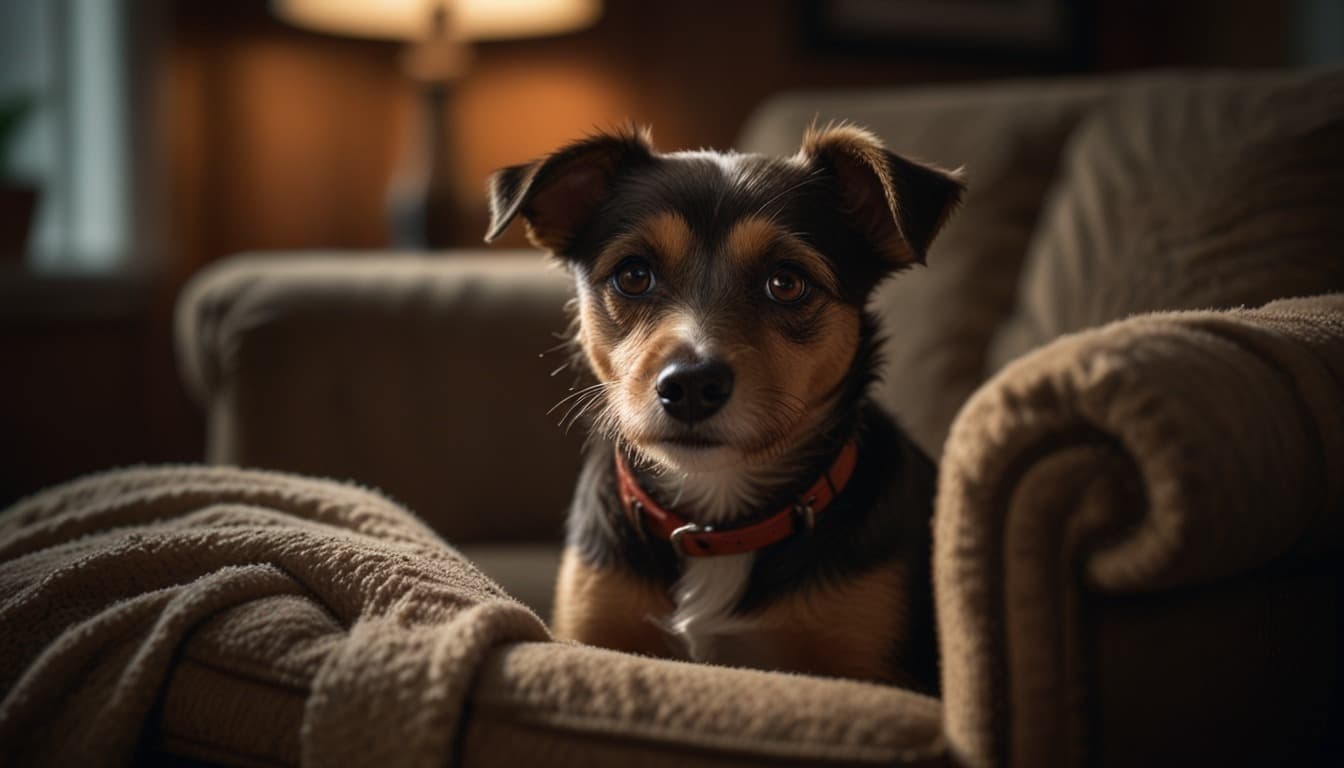
The dog was a build named Toby. Tiny terrier mix, maybe 12 pounds, all eyebrows and worry. He'd been found cowering behind a dumpster in a parking lot during a thunderstorm. The shelter notes said "shy but sweet." What they didn't say was that he'd pancake himself to the floor if you so much as sneezed, or that the sight of a broom would send him into full-body tremors.
And me? I thought I knew what I was doing. Six years working at a shelter, dozens of fosters under my belt. I'd rehabbed shut-down dogs before. I had this. Except I very much didn't have this. I made every mistake you can make in the first three days, and it set Toby back weeks. Maybe months. I still feel sick thinking about it.
That bruise on my arm came from me trying to pick him up while he was frozen in terror. He din't want to be picked up. He wanted to disappear into the floorboards, and my well-intentioned hands were just another thing he couldn't escape from. He didn't bite hard — it was more of a panicked mouthing — but the message was crystal clear: I'm terrified, and you're making it worse.
I sat on the kitchen floor that night and cried while my own dogs nudged my face. Toby was under the couch, a spot he wouldn't leave for the next 15 hours. I'd failed him, and I knew it. But I also knew I could fix it if I shut up, paid attention, and stopped doing what felt good to me and started doing what actually helps a scared dog.
And that's what this whole post is about. Not the sanitized, Instagram-friendly version of helping a fearful dog. The real, messy, two-steps-forward-one-step-back, cried-in-my-car-twice version. Because most of the advice out there's crap, and the stuff that works isn't always what makes you feel like a hero in the moment.
Stop trying to fix the fear. Start making the dog feel safe.
This is the hardest thing for most people to accept. You can't love the fear out of a dog. You can't treatb-ribe it out either, though treats can help later in tiny, specific ways. Fear isn't a behavior problem — it's an emotional state, and until that emotional state shifts, nothing else sticks.
Think about the last time you were genuinely terrified. Like, heart-pounding, can't-breathe terrified. Now imagine somepne tried to hand you a cookie and told you in a cheerful voice to "sit pretty." Would that cookie fix anything? Would you even register it was there? Probably not, because your brain was in survival mode, not learning mode. Same thing with dogs. When a dog is over threshold — trembling, panting, whale-eyed, trying to hide — the thinking part of their brain is basically offline. You're dealing with a dog who is all amygdala, no prefrontal cortex.
I'd read about this in my old vet tech textbooks, but seeing it in real life with Toby was something else. The first two days, I kept trying to "show him" that things were okay. I'd sit near his hiding spot and toss treats. I'd talk to him in that high, sing-song voice I use with puppies. All I did was keep him in a state of low-grade panic because I never gave him space to decompress. He'd take a treat, sure, but then he'd go right back to trembling, and I'd think, "Well, at least he took the treat." Wrong. He was just giong through the motions because he was too scared to refuse. That's not progress; that's a dog who's learned to appease.
Real safety looks different. It looks boring. It looks like a dog who has a quiet, predictable space where nothing bad happens and nothing is expected of him. For the first week with a terrified dog, your job is to be as interesting as drywall. Don't reach for the dog. Don't stare. Don't even talk to him much unless he initiates. Just exist, calmly, in the same room while the dog learns that you aren't a threat.
That's where the crate advice comes in — but not the crate-as-punishment crap you see in old training books. I've messed up the crate thig so many times before I figured out what actually makes a dog feel safe in one. I wrote about that whole disaster in another post when I bought three crates before my dog could stand up without hunching (the cheap wire ones are a joke for scared dogs, by the way — you want something den-like, covered, with a top that doesn't rattle).
But even without a crate, you can create a safety zone. A corner of a quiet room with a bed, some blankets, maybe a piece of furniture to hide behind. Toby's spot was behind the armchair in my living room. I shoved a dog bed back there, draped a blanket over the chair to make a little cave, and that was his. I didn't go back there. I didn't even look back there for the first 48 hours unless I was sliding a bowl of food in his direction.
Here's the part that hurt my feelings: Toby started to relax when I stopped trying so hrad. The moment I backed off and gave him agency — the choice to approach me or not — he started to notice me as something other than a big, unpredictable, grabby primate. On day four, he crept out from behind the chair while I was reading on the couch. He sniffed my foot. Then he went back to his cave. That was it. Five seconds of contact, and it was the biggest victory of the month.
Why "just ignore them and they'll come around" is only half the story
There's this advice floating around that you should completely ignore a scared dog until they come to you. It's not wrong, exactly, but it's also not totally right. If you ignore a dog in a way that makes them feel invisible and forgotten, you might miss the moments when they're ready to engage. The trick is something called passive engagement — being available without being pushy.
For Toby, that meant I'd sit on the floor a few feet from his cave and just read a book out loud. Not to him. Not even looking his way. I'd read gardening blogs or old shelter emails in a low, monotone voice, and he'd lie there and watch me. My voice became a predictable sound. It wasn't paired with anything scary. Over time, he started to inch closer during these sessions, and I'd keep reading like I hadn't noticeed. The moment I'd acknowledge him, he'd retreat. So I didn't acknowledge him. I let him be the one to decide when we'd level up our relationship.
That's the thing people get wrong about "ignoring." They think it means acting like the dog doesn't exist. What it really means isn't making demands. Not forcing eye contact. Not reaching. Not coercing. Your presence becomes a neutral, safe thing instead of a trigger. The dog gets to learn you at their own pace, and when they do take a step toward you — even a tiny one — you don't make a big deal of it. Because making a big deal of it's, to a scared dog, a sudden change in your energy that can feel threatening.
I'll never forget the first time Toby chose to put his head on my leg. It was maybe three weeks in. I was on the couch, he jumped up near me (which was already huge), and then after about 20 minutes of sitting there stiffly, he exhaled and rested his chin on my thigh. I didn't move. I barely breathed. Twenty minutes later, he was asleep, and I had to pee so badly I thought I'd die, but I stayed there until my leg went numb because that moment was his, not mine.
The $340 lesson about why vets are betetr at this than I'm
Around week two with Toby, I hit a wall. He'd made some progress, but then we had a terrible setback when my neighbor dropped a pan while cooking and the sound made Toby bolt under the bed, where he stayed for 14 hours, refusing food and shaking so hard the bed frame rattled. I panicked. I called my vet, Dr. Nguyen — she's put up with my meltdowns for eleven years, through three dogs and a divorce — and I said, "I've broken this dog. He's worse now."
She told me something I'll never forget: "You didn't break him. His brain is dealing with a chemical storm you can't see. Fear that doesn't get better is sometimes a medical issue, not a training issue." That kicked off a $340 workup — bloodwork, a full physical, and a very long conversation about anxiety medication. Because here's the thing nobody tells you when you bring home a dog labeled "shy": sometimes that dog's brain is fundamentally wired for panic, and no amount of gentle exposure therapy is going to rewire it without some pharmaceutical help.
I used to be a little anti-medication when it came to dogs. Not in a judgy way, but more like, "I should be able to fix this with patience and training." That's ego talking, not compassion. If a dog's anxiety is so severe that they can't learn because they can't get out of fight-or-flight mode, medication can lower the baseline enough that training actually works. It's not sedatnig them into a zombie; it's giving their brain a chance to process information instead of just reacting to threats.
Toby went on a low dose of fluoxetine (Prozac for dogs), and it took about four weeks to fully kick in. During those four weeks, we didn't do any intensive training. We just let his world stay small and safe while his brain chemistry stabilzed. It was like someone slowly turned down the volume on a radio that had been blaring static. He still noticed scary things, but he could recover from them. He could eat after a startle. He could look at a new person and not immediately try to disappear.
If you're reading this and thinking your dog's fear is beyond what "regular" socialization can fix, talk to a vet — ideally one who's comfortable with behavioral medicine. Not all vets are, and that's okay. You might need a referral to a veterinary behaviorist, but even your regular vet can run bloodwork to rule out pain or thyroid issues that can cause anxiety symptoms. Pain is a huge, hidden cause of "fearful" behavior, especially in dogs who've had rough starts and might have old injuries nobody knew about.
When the dog is scared of something specofic (and honestly, it's always something)
Generalized fear is one thing. But then there are the specific triggers — the vacuum, the mailman, the sound of a plastic bag, men with hats, children, other dogs, stairs, hardwood floors. Toby's list was long: all men, any sudden noise, the broom (obviously), the garage door, and the toaster. The toaster! This tiny dog who'd survived life on the streets was absolutely convinced that the toaster was a death machine.
Dealing with specific fears is where most people screw it up by trying to "flood" the dog — that's, expose them to the scary thing at full intensity until they "get over it." don't do this. Flooding is a greta way to create a lifelong phobia. Instead, you need something called desensitization and counterconditioning (DS/CC). It's a mouthful, but the idea is simple: expose the dog to a tiny, bearable version of the scary thing, and pair it with something wonderful, until the scary thing starts to predict wonderful things.
The key word here's tiny. For Toby and the toaster, I didn't even start with the toaster itself. I started by having the toaster on the counter, unplugged, across the room from him while I fed him bits of hot dog. Then I moved it a foot closer. Then I plugged it in but didn't use it. Then I pushed the lever down with no bread in it so it made a quiet click. You get the idea. This process took about three weeks, and I went at his pace. If he ever showed signs of stress — lip licking, yawning, looking away — I backed up a step and ended the session on a positive note.
Where people go wrong is rushing. They want the dog to be "fixed" by next Tuesday, so they compress weeks of work into days, and they end up making the fear worse. I've done this. With my own dog, Gus, years ago, I tried to cure his fear of the car by taking him on a long road trip. He threw up, drooled, and spent the whole time panting. He was worse after the trip than before, and I had to start from scratch with a dog who was now absolutely convinced cars were torture chambers.
Another mistake: using high-value treats that the dog would normally love, but offering them when the dog is already too scared to eat. If the dog won't take the treat, you're too close to the trigger. Move farther away. The treat is your barometer. If your dog won't eat roast chicken because the vacuum is on in the next room, the vacuum is still too scary. Turn it off, increase the distance, try again tomorrow.
What about the things you can't control?
Thunder. Fireworks. The neighbor's leaf blower at 7 a.m. on a Saturday. These are the things that make me want to scream into a pillow, because you can't exactly ask the sky to lower the volume while you condition your dog to thunder at a distance. With triggers like these, management is king.
I've written a whole post about what's actually going on in your dog's anxious brain during a thunderstorm — the pressure changes, the static electricity, the way they can feel the storm coming before we even hear it. The short version is that your dog isn't beign dramatic. They're experiencing something genuinely terrifying on a sensory level we can't relate to.
For Toby, we created a storm protocol: the moment I saw a storm in the forecast, I'd close all the curtains, turn on a white noise machine and a fan, and set up his crate with a heavy blanket over it. I'd stuff a couple of Kongs with peanut butter and freeze them ahead of time, so he had something to lick (licking is calming for dogs). I'd also use a pressure wrap — like a ThunderShirt — which helps some dogs, though not all. Toby was one it helped. It made him feel held without being restrained.
Medication was also part of the plan for storms. I talked to Dr. Nguyen about situational meds — something faster-acting than the daily fluoxetine — for events that were brief but intense. He now gets a dose of trazodone about an hour before a storm hits, and it takes the edge off just enough that he can rest instead of trembling in a corner for hours. I'm not saying medication is the answer for every dog, but for dogs whose quality of life takes a nosedive during storms, it's worth considering. We had a build last year who would break through window screens during fireworks unless he had a strong sedative on board. That's not a behavior problem; that's a dog who's so panicked he's a danger to himself.
And here's a weird little tip I learned from a vet behaviorist: during storms, some dogs benefit from being in a room with grounded plumbing — like a bathroom with a porcelain tub. There's a theory that the static electricity buildup that makes their fur feel weird can be discharged this way. I've no scientific proof that it works, but anecdotally, Toby always seemed calmer in the bathroom than anywhere else, so that became his storm cave.
A tangent about dog park "experts" and unsolicited advice
Can I rant for a minute? Because one of the hardest parts of rehabbing a scared dog is dealing with other people. Friends, family, strangers at the pet store, the guy at the dog park who insists you just need to "socialize him more." The number of times someone has told me to just "let dogs be dogs" and throw my terrified buidl into a pack of strange dogs is too damn high.
With Toby, I got comments like "he just needs to meet some confident dogs" or "you're coddling him too much." Someone actually told me I should take him to a busy outdoor market to "get him used to people." This dog who panicked when a toaster lever clicked. A market. Sure, Jan. Let me just toss him into a concert and see how that goes.
The truth is, most people don't understand fear in dogs. They think fear is just a training gap you can close with enough exposure. But forced exposure without the dog's consent is the fastest way to make them shut down completely or become defensive. I've seen dogs go from fearful to fear-aggressive because their owners kept putting them in situations they couldn't handle, and eventually the dog learned that growling or snapping was the only way to make the scary thing go away.
you've to get comfortable being the "bad guy" for your dog. you've to tell people no. No, you can't pet him. No, he doesn't want to meet your dog. No, I'm not brringing him to your barbecue. It's awkward, and people will think you're overprotective, but who cares? Their hurt feelings aren't more important than your dog's mental health.
I've gotten snappy about it over the years. I've told people, "He's not shy, he's terrified, and if you rush at him, I'll step in front of you." I've left park paths when off-leash dogs approached. I've walked out of vet waiting rooms when people wouldn't corral their flexi-lead dogs. My dogs depend on me to advocate for them, and a scaared dog can't advocate for themselves. That's my job.
Okay, rant over. Back to the stuff that actually works.
Body language nobody taught you about (but your dog is screaming it)
If there's one skill that changed everything for me, it's learning to read stress signals before the dog is over threshold. And I dom't just mean the obvious stuff like tucked tails and shaking. The subtle stuff is where you catch problems before they explode.
Toby taught me to notice the tiny signs: a lip lick when there's no food around. A sudden yawn. A lifted paw. A whale eye (where you can see the whites of the dog's eyes). A stiff, closed mouth. A dog who stops taking treats. All of that's the dog saying, "I'm uncomfortable, please give me space." If you ignore those signals, you'll eventually get a growl or a snap, and then people label the dog "aggressive" when really he was speaking the whole time and nobody listened.
For dogs with a history of fear, these signals might be their only way of commmunicating before they escalate. And here's the thing: punishing a growl doesn't stop the dog from being uncomfortable — it just stops the warning. Then you end up with a dog who bites "with no warning," when in fact the warning signs were there all along, just ignored or suppressed.
I made a rule with myself after Toby: the moment I see a stress signal, I change something. I increase distance from the trigger. I end the training session. I move us to a quieter space. Whatever it takes to lower the pressure. It's not about "coddling" — it's about respecting that the dog's emotional state is real, and pushing through it only breaks trust. Trust is the whole game with a scared dog. If they trust that you'll listen when they say "I can't handle this," they'll take more risks with you in the future. If they learn that you'll ignore their boundaries, they'll stop taking risks because it's not safe.
That's why building unbreakable bonds with a rescue dog isn't about how many treats you give — it's about proving you're a safe person, over and over again, for months and months. The bond comes from reliability, not from love-bombing.
The $12 can of sardines and the magic of tiny victories
I want to talk about something that sounds stupid but ended up being a turniing point for Toby. It's about finding one activity that the dog genuinely enjoys, even when they're still scared of the world, and building from there.
For Toby, it was sradines. Gross, smelly, oily sardines from a can. I discovered this completely by accident. I was eating some on toast — don't judge me, it's a thing — and he came out from behind the chair for the first time without me setting up a whole "session." He just smelled those fish and forgot he was scared for two seconds. His nose was twitching so hard I thought it might fall off. I tossed a tiny piece his way, and instead of taking it and retreating, he ate it and looked at me for more. Wanted more. His tail — his tail that I'd never seen move — gave one tiny, hesitant wag.
I nearly cried. Over a sardine.
After that, I started using sardines as our "bridge" food. Not for training scary things — that still required careful DS/CC — but for building positive associations with me in general. I'd put a tiny bit in his bowl with his regular food. I'd smear some on a lick mat when I had to leave the house. I'd give him a piece when he voluntarily came near me on the couch. Sardines became our love language.
The principle here's to find whatever sparks that flicker of joy in your dog, even if it seems ridiculous. For some dogs, it's a squeaky toy. For others, it's a specific type of petting (Toby discovered he loved having his chest scratched, not his head — head reaching was terrifying). For a build I had years ago, a dog so shut down she wouldn't eat for three days, the thing that cracked her open was a soft blanket fresh from the dryer. She just wanted to lie on something warm, and once she had that, she started to uncurl.
These tiny victories matter more than any big breakthrough. You're not going to wake up one morning and find your scared dog magicakly confident. But you'll have days where he sniffs a new person's shoe instead of hiding. Days where he eats breakfast after a thunderclap. Days where he chooses to rest his head on your foot. Each one is a brick in the foundation.
I kept a journal with Toby — just a messy notes file on my phone — where I'd jot down the little wins: "4/12: voluntarily approached ktichen while I was cooking (stayed 30 seconds)." "4/15: ate a treat from the hand of a stranger (my neighbor, whom he'd seen before)." "4/20: didn't flinch when I dropped a spoon." On the hard days, when I felt like we weren't making progress, I'd scroll back through those notes and see that we were, actually. It just didn't feel like it in the moment.
When the dog is scared of you specifically
This section is for people who've adopted a dog that seems afraid of them in particular. Maybe the dog cowers when you stand up. Maybe they flinch when you reach for the leash. Maybe they won't take food from your hand but will eat it off the floor. It's a special kind of gut-punch to feel like your own dog is scared of you, and it can trigger all kinds of guilt and frustration.
Toby was scared of me at first. Not just of men — of me, a smallish woman who talks to dogs in a ridiculous baby voice. It stung. But I had to remember that his fear wasn't about me as an individual. It was about his history. He'd learned that humans are unpredictable, and he didn't yet know that I was different. I had to prove it.
I did this by becoming predictable. I fed him at the same times every day. I walked the same routes at the same pace. I sat in the same spots. I didn't wear hats (he found hats alarming). I announced my movements — I'd say "getting up" before I stood, so he wasn't startled. I'd toss treats from a distance insted of offering them from my hand, so he didn't have to get close before he was ready.
Over time, his fear of me faded. It took weeeks. It took months before he'd follow me from room to room without peeking around corners. But it did fade. The day he came up to me while I was crying on the couch — just a stupid, stressful work day — and put his head on my knee was the day I knew we'd gotten there. He didn't just tolerate me anymore. He sought me out.
If your dog is scared of you, don't take it personally. It's not about you. It's about all the other humans who came before you. Your job is to be the exception, not the rule, and that takes time.
The neighbor's note that brpke me (in a good way)
About six months into Toby's time with me, I had a day that made me see just how far we'd come. I was in the yard with him — our tiny, fenced patch of grass — and my neighbor, the same one who'd dropped the pan that sent him into a tailspin months earlier, called over the fence to say hi. Toby didn't run. He didn't shake. He looked at her, then looked at me, then peed on a bush and trotted back toward the house like it was no big deal.
Later, she taped a note to my door: "I know you've been working with the little brown dog. I just wanted you to know I've noticed. He looks like a different animal."
I read that note and cried into my coffee. Because he wasn't a different animal — he was the same animal who'd been so scared he couldn't function. He just finally felt safe enough to be himself.
That's the goal, by the way. Not a dog who never gets scared. Not a dog who loves every person and every situation. Just a dog who can live a full life without being constantly terrified. That's the only bar that matters.
The day Toby finally walked past the vacuum without peeing himself
I don't have a neat, tidy wrap-up for this. I've been trying to think of one for ten minutes while my own dogs snore at my feet and my build cat stares at me from the windowsill, and I just keep coming back to a Tuesday afternoon in October, maybe a year after Toby came to me. I was vacuuming the living room — the big, loud, ancient upright vacuum that sounds like a jet engine — and Toby was in his usual spot on the couch, curled up on a blanket. He lifted his head when I turned it on. He watched it for a second. Then he laid his head back down and went to sleep.
I finished vacuuming. I emptied the canister. I rolled the thing back into the closet. And then I just stood there in the quiet and realized that at some point, without me even noticing, he'd stopped being the dog who hid behind the armhair. He'd become the dog who could nap through a vacuum.
Progress with a scared dog is so gradual that you don't always see it happening. One day you just look up and realize the thing that used to provoke a full-blown panic attack is now just… background noise. Literally, in this case.
So I guess that's where I'll leave this. No fnal thoughts. No summary. Just a dog on a couch, sleeping through the noise.