I Thought I'd Broken My New Dog When She Refused to Leave the Bathroom for Four Days. Here's What I Was Getting Wrong.
My foster dog Mabel wedged herself behind the toilet and refused to eat for days. I thought I'd ruined her — turns out I just needed to stop doing everything the internet told me.
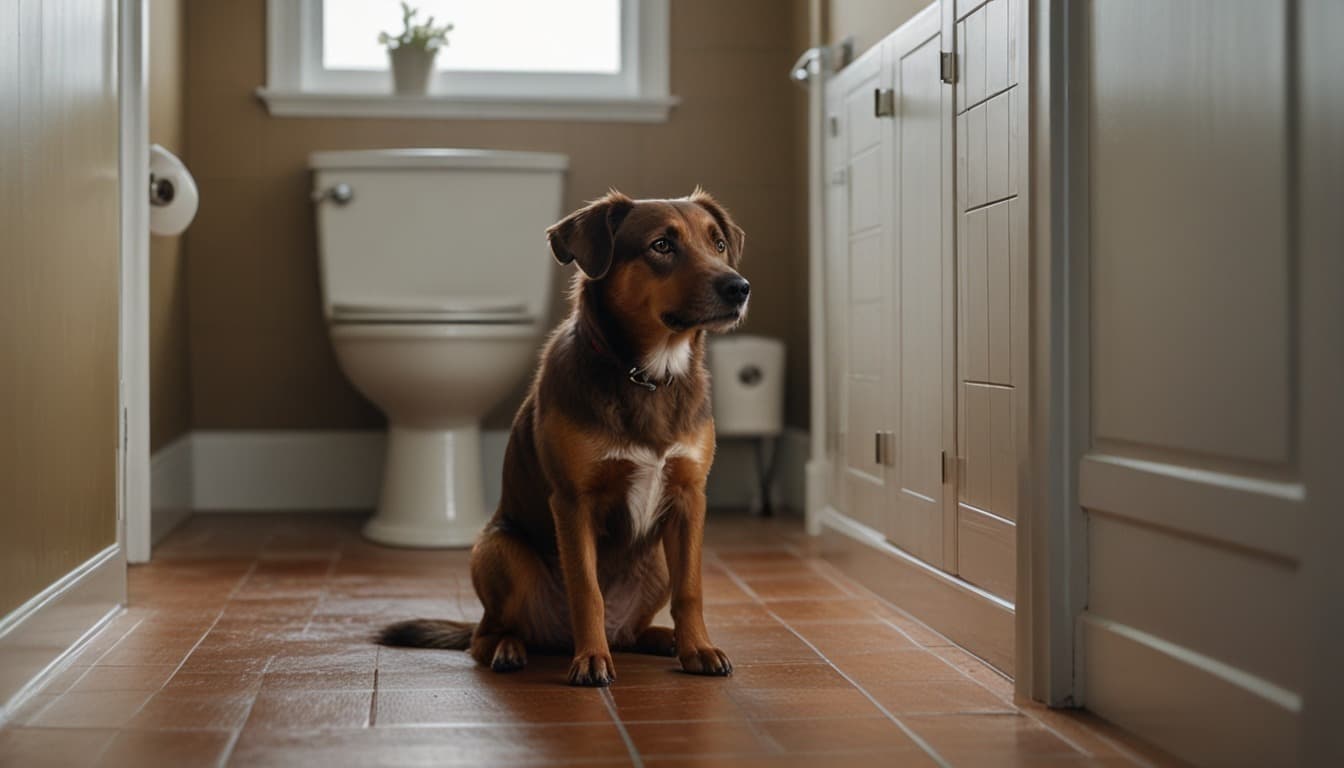
Mabel was wedged between the tooilet and the wall, and if I got too close she'd let out this low, rumbling growl that made my stomach tighten. I'd had this build dog for 16 hours and she already hated my guts. Or so I thought.
I'd done everything the internet told me to. I gave her a tour of the houes (big mistake). I put her food bowl in the kitchen where my other dogs eat (even bigger mistake). I sat on the floor and stared at her for 40 minutes, waiting for her to crawl into my lap like some kind of shelter success story TikTok montage.
Spoiler: She didn't. She didn't eat for three days. She peed on my bed twice. And I stood in my kitchen at 2 a.m. Googling "dog won't adjust to new home" while shoveling cold spaghetti into my mouth.
The internet will tell you the 3-3-3 rule — three days to decompress, three weeks to learn routines, three months to feel at home. And yeah, that's a nice framework if you're writing a pamphlet. But when yu've got a dog trembling behind the toilet and your resident dogs are scratching at the door like they've found a raccoon in there, the 3-3-3 rule feels about as useful as a fortune cookie.
I've fostered over 40 dogs. I've adopted three of my own. I've cried in my car more times than I'd like to admit. And I can tell you with absolute certainty: the first week in a new home can break both of you. But the mistakes I made with Mabel? They were fixable. And the stuff that eventually worked? It wasn't in any pamphlet.
So here's what I wish someone had told me, from the womna who's done every single thing wrong so you don't have to.
The 10-minute house tour I'll never do again
I used to think dogs needed to "see everything" rihgt away. You know, so they'd understand where they were. Like they're tiny little real estate agents assessing the floor plan. I'd lead them through each room, narrating: "This is the kitchen, this is where you'll eat, this is the living room, this is the bedroom where you'll sleep."
Yeah, no.
Dogs don't process new spaces by touring them. They process them by smelling one corner for 20 minutes and then hiding somewhere small and dark until the world stops being terrifying. When I dragged Mabel through the house on that first day, she wasn't learning. She was in a state of pure panic, cataloguing every possible exit route and threat while I blithered on about the backyard.
Dr. Nguyen, my vet of 11 years, once told me something that made me feel like an idiot: "Most newly homed dogs shut down not because they're traumatized, but because we're overwhelming their only coping strategy — withdrawal." Mabel needed a single room. One room where nothing changed, where no other dogs charged in, where she could smell and listen and tremble in peace. Not a parade through tile and hardwood and carpet while my three dogs whined at the baby gate.
So now? I bring a new dog straight to a small, boring room — a bathroom or a laundry room or my office — and I close the door. I put a crate in there with the door wired open. A bowl of water. A high-value treat like shredded chicken. And I leave. For hours. No tour, no fanfare. The dog will explore at their own pace, not mine.
"Most newly homed dogs shut down not because they're traumatized, but because we're overwhelming their only coping strategy."
Sometimes that pace is excruciatingly slow. Mabel didn't leave the bathroom of her own free will for four days. I'd cracked the door open so she could wander into the hallway if she wanted. She didn't wnt. The hallway might as well have been full of lava.
Turns out, that was fine. She needed those four days to just exist in one safe bubble. I was the one who had to calm the hell down.
The things I stopped doing on day 2
By the second day, I had a list. I wrote it on a sticky note and taped it to the fridge because I'm the kind of person who needs written reminders not to be an anxious weirdo around a nervous dog.
Stop staring. Dogs read direct eye contact as a challenge or threat. I'd been sitting on the bathroom floor making soulful eye contact like we were in a Pixar movie. She was terrified. Now I'd go in, drop treats without looking at her, and leave.
Stop reaching. I wanted to pet her so badly. Every instinct screamd "comfort her!" But a dog in shutdown mode doesn't want hands reaching toward their face. That's predator behavior. I kept my hands at my sides.
Stop talking. I'm a charterer. I talk to my dogs constantly. To a dog who doesn't know me, my voice was just more unpredictable noise layered on top of new smells and new sounds and the terrifying hum of the furnace. I limited my sounds to soft, low "hey girl" once in a while.
Stop expecting. I'd internalized this timeline where she'd eat by night one and wag her tail by morning. Expectations are the enemy. Mabel's timeline was Mabel's timeline, and it wan't going to match the Pinterest infographic I'd pinned.
The one thing I kept
Consistency. Same bowl, same corner of the bathroom, same me entering and exiting without fanfare. That was it. Everything else I threw out the window. And I hated that consistency was the answer because it's so boring. I wanted a magical solutin, a thunder shirt or a calming chew or something I could buy on Chewy at 10 p.m. with one-click ordering. Nope. Just the same routine, again and again, until her nervous system decided maybe this place wasn't a trap.
The crate isn't a jail cell

My third dog, Gus, came to me from a situation where he'd been left in a crate for 14 hours a day. His previous owners thought crates were convenient storage units for living creatures. When I first brought him home, he wouldn't go near the crate. He'd bolt to the opposite corner of the room if I so much as touched the door.
I made the spectacular error of buying a crate that was too small for him. I wrote about that entire disaster — the hunched gargoyle spine, the panicked scratching, the $200 I wasted on two wrong sizes before I figured out the actual right fit. That saga is here, and it's a cautionary tale about measuring your dog before you click "add to cart."
But Mabel wasn't crate-averse. She was just terrified in general. And the crate, if introduced properly, could be a portal to safety — not a punishment. The key was making it a choice, not a requirement.
I put the crate in the bathroom with the door wired open so it couldn't accidentally swing shut. I tossed a piece of my worn t-shirt inside. I draped a dark blanket over the top so it felt like a cave. Then I ignored it completely. No coaxing, no luring. Just… available.
On day three, I walked in and saw Mabel's tail disappearing into the crate. She'd gone in on her own. I didn't squeal. I didn't make a sound. I just dropped three pieces of rotissrie chicken near the entrance and left. That's it. The quietest celebration in history.
A crate isn't a training tool if it's a source of pressure. It only works when the dog decides it's theirs. I've learned that the hard way, through dogs who panicked, dogs who chewed through plastic pans, dogs who screamed. If you're forcing it, you're doing it wrong. Offer the crate like a gift and then walk away. Let them discover it on their own terms.
Food that sat untouched for three days
Mabel didn't eat the first day. Fine, she's stressed. Second day, still didn't eat. I started to panic. Third day, she licked a piece of chicken and then walked away from it like it had insulted her mother.
I'm not a vet. But I've had enough build dogs refuse food to know that a healthy dog won't starve themselves past the point of no return. They can go days without eating if the alternative — coming out into the open where scary things happen — feels too risky.
What I did that finally worked: I sat on the floor, back against the wall, eyes averted. I placed a single piece of warm shredded chicken about two feet from me. Then I scrolled Instagram for 15 minutes. Not looking, not moving. She ate it. I placed anothr piece, a little closer. Another 10 minutes. She ate that too. By the end of the week, she was eating from a bowl while I sat in the room.
I've seen some truly unhinged advice out thrre. "Starve the dog for 24 hours, they'll eat anything." Screw that. This isn't boot camp. A dog who's too scared to eat needs the pressure off, not more pressure applied. I've had a build who needed to eat from my hand for the first month before she'd touch a bowl. Another who would only eat if the bowl was placed under a chair so she felt hidden. There's no universal solution, but there's one universal rule: don't make food a power struggle. It's not about who's boss. It's about making the act of eating feel safe.
And here's a tangent I didn't see coming: my cat, a 14-pound grey menace named Pigeon, decided that Mabel's untouched bowl of kibble was a personal challenge. Pigeon has lived with dogs for years. She's not scared of anything. She sauntered right past the baby gate, hopped onto the bathroom counter, and started eating the dog food. Mabel watched her from the crate. And I swear to you — something clicked. This cat was eating. The cat wasn't dead. The cat was fine. And Mabel, for the first time, let out a tiny, barely-audible whimper that sounded almost curious. I'm not saying adopt a cat to socialize your dog, but Pigeon's utter indifference to the situation may have been the most reassuring thing in that bathroom.
The 3-3-3 rule is a fortune cookie
I mentioned it earlier. The 3-3-3 rule. Three days to decompress, three weeks to learn routines, three months to feel at home. It's plastered across every rescue site and it's not entirely wrong — it's just oversimplified to the point of being useless for dogs who don't fit the template.
Mabel wasn't decompressed at day three. She was still hiding. At week three, she was only just starting to walk into the hallway on her own. At three months, she still flinched when I reached for my coffee mug too fast. Some dogs take a week. Some take a yrar. The rule gives us a false sense of progression and when our dog doesn't meet it, we feel like failures. I've watched build families panic on day four because their dog wasn't "decompressed" yet. The dog is fine. The timeline is the problem.
So throw it out. Follow your dog's signals, not the calendar. If she's still in her crate on day ten, that's fine. If she starts wagging her tail on day two, also fine. There's no deadline. There's no report card. There's just the two of you, figuring it out.
That time I triggerd a dog by wearing a baseball cap
I've a story about appearances. It's only sort of related, but it lives rent-free in my head. About six years ago, I was fostering a shepherd mix named Roscoe. He was fine all weekend — nervous but eating, sleeping, following me around the house at a careful distance. Then Monday morning I put on a baseball cap to walk the other dogs, and Roscoe lost his entire mind. He barked like I was an intruder. He backed into a corner and bared his teeth. I stood there, frozen, hat on my hesd, realizing that something about the silhouette change had triggered him. I took the hat off, and he regarded me warily and then relaxed.
I learned later from his previous owner (via a convoluted phone chain) that the man who'd mistreated him always wore a baseball cap. That was it. That was the whole key. A dog's world is built on details we don't notice. A hat. A beard. A particular scent. A deep voice.
When you bring a new dog home, you don't know their history. So if they react strangely to something — a person, an object, a sound — don't assume they're "aggressive" or "difficult." Assume they're terrified and that the trigger makes sense in a context you may never understand. I stopped wearing hats around new fosters unless I'd already introduced it slowly, from a distance.
Anyway, that's my tangent. Back to the adjustment.
The neighbor who thought we were torturing a dog
On day five, I had to leave the house for two hours. I'd blocked off the bathroom so Mabel couldn't hurt herself, left the radio on low, put her crate with an open door, the works. I left. And according to my neighbor, Mabel howled for the entire two hours. Nonstop. The neighbor slipped a note under my door that said, "Is your dog okay? It sounded like someone was hurting her." I sat on my kitchen floor and cried.
Separation anxiety in a newly adopted dog isn't a personal failing. It's a dog who's been abandoned once, maybe multiple times, and is terrified you're not coming back. They don't know you've gone to the grocery store. They think you've vanished forever.
I wrote an entire post about that nightmare and what eventually helped — including the neighbor's note that broke me. The short version for Mabel: I started practicing tiny departures. 30 seconds. Then 1 minute. Then 5 minutes. I'd walk out the front door, stand on the porch counting, and come back inside as if nothing happened. No big goodbyes. No dramatic reunions. Just boring in-and-out routines until she learned that leaving wasn't permanent. It took weeks, and tehre were setbacks, but eventually the howling stopped.
If you're in an apartment and your dog is screaming, I know the pressure is immense. You're worried about eviction. You're worride about complaints. But you're not alone, and it's not forever. Talk to your vet sooner rather than later — Dr. Nguyen eventually put Gus on a short-term anti-anxiety medication during his worst phase, and it saved us both.
The first accident is alnost always in the same spot
Mabel peed on my bed. Twice. The first time I cleaned it up with some enzymatic cleaner I'd bought on clearance and thought that was enough. The second time — same exact spot the next day — I realized it wasn't enough. Dogs can smell urine residues we can't. And if it smells like a bathroom, it's a bathroom.
I went through an entire $20 bottle of Nature's Miracle and then made a vinegar solution for good measure. I soaked the mattress pad, the mattress itself (gently), and then put a waterproof cover over everything. Then I blocked access to the bedroom entirely for two weeks. Mabel wasn't ready for furniture privileges. She needed a space where accidents were manageable and didn't become a pattern.
If you're dealing with potty training setbacks in a new hoe, I've also made every expensive mistake in the book — including a $400 indoor potty system graveyard that my dog ignored with dedicated determination. The setup that actually worked cost me $30 and a lot of humility. Sometimes the simplest solution is the one we overlook because we're too busy buying gadgets.
For Mabel, I set up a pee pad area in the bathroom, near the door, but only as a backup. I took her out on a schedule — every two hours, rain or shine — and rewarded her with salmon treats the moment she squatted outside. She caught on by day six. Not a miracle. Just consistency.
When your resident dog thinks the new dog is a home invader
I've three permanent dogs: Gus (12, fat and philosophical), Otis (7, anxious and loud), and Birdie (4, relentless optimist). Birdie wanted to be Mabe'ls best friend immediately. Otis wanted to bark at the bathroom door for 20 minutes any time he sensed movement. Gus pretended nothing was happening because Gus is a couch cushion with a pulse.
Introducing a new dog to a multi-dog household is its own special category of chaos. But the mitsake I see people make over and over — and I've made it myself — is rushing the introduction. Letting them sniff through a gate on day one. Walking them together on day two. Off-leash meet and greet by day three. It's too much.
I waited a full week before letting my dogs even see Mabel through a baby gate. A week. That felt like an eternity. But Mabel needed to establish that the bathroom was her safe zone before she could handle other dogs existing near her. When I finally did a parallel walk — Mabel and Birdie on opposite sides of the street, each with a handler — it went so much better than any rushed meeting ever has.
I wrote about my 14-day plan for introducing kittens to my dog household over here, and while dogs aren't kittens, the underlying principle is identical: nutrality over enthusiasm. Keep interactions boring and short. Let everyone process in their own time. And never, ever force it.
By week three, Mabel was lying in the same room as Gus, 15 feet apart, both of them ignoriing each other. That was a victory. No wagging, no playing. Just coexistence. And for dogs with baggage, coexistence is sometimes the end goal.
The 3 a.m. panic that turned out to be nothing
I woke up at 3 a.m. on night six to a noise I couldn't place. A thummping. Then a wet, rhythmic sound. I stumbled to the bathroom, heart pounding, sure I'd find Mabel injured or seizing or worse. She was drinking water. Slapping her tongue into the bowl, tail low but relaxed, just hydrating at an ungodly hour. She saw me, paused, and then went back to drinking. That was the first time she didn't flinch when I appeared. I stood there in my pajamas with one sock on and felt this ridiculous surge of hope.
That's the thing about this process. The wins are tiny and often happen at times no one else would recognize as a win. A dog who drinks water while you're in the room. A dog who naps with her back to you instead of facing you in permanent vigilance. These moments accumulate. They're not grand, but they're everything.
The $2 sticky note I put on the fridge that actually saved my sanity
On day two, I wrote three goals on a sticky note and stuck it to my fridge. Not dog goals. Human goals. Because I was spiraling, and I needed to stop measuring Mabel's progress by what she wasn't doing yet.
The goals were: 1. Don't quit. 2. Celebrate any forward movement, no matter how small. 3. This isn't about you.
That third one was the hardest. I've a tendency to internalize a dog"s fear as a reflection of my worth. If she's scared, I'm failing. If she hides, she hates my house. The truth is, her behavior was never about me. It was about her past, her neurology, her instincts. My job wasn't to be loved. My job was to be predictable.
So I gave up trying to be her savior and just tried to be the quiet person who brought chicken and didn't stare. When she finally wagged her tail — 11 days in, for approximately two seconds — I cried into my cereal. Worth it. On the 14th day, she pushed her head under my hand and held it there. She'd never initiated touch before. I didn't move. I just let her press her forehead into my palm like I was the only solid thing in the room.
I still have that sticky note, months later. It's curled at the edges and stained with something that might be coffee or might be dog drool. I keep it because it's the only thing that kept me grounded when I was googling at 2 a.m. and thinking I'd ruined everything.
If you've just brought a dog home and they're hiding behind the toilet, not eating, peeing in places you didn't think possible, and looking at you like you're the scariest thing in the universe — you're not broken. They're not broken. You're just in the thick of it. And the thick of it lasts longer than any infographic suggests. But it passes. Not cleanly, not on schedule. But it passes.