I Spent $300 on Dog Probiotics That Gave My Fosters the Runs. Here's the $22 Bottle I Now Buy in Bulk.
I spent $300 on dog probiotics that made my fosters' diarrhea worse before I found the $22 bottle that actually helped. Here's what I learned from 40+ rescue dogs and a lot of 3 a.m. cleanups.
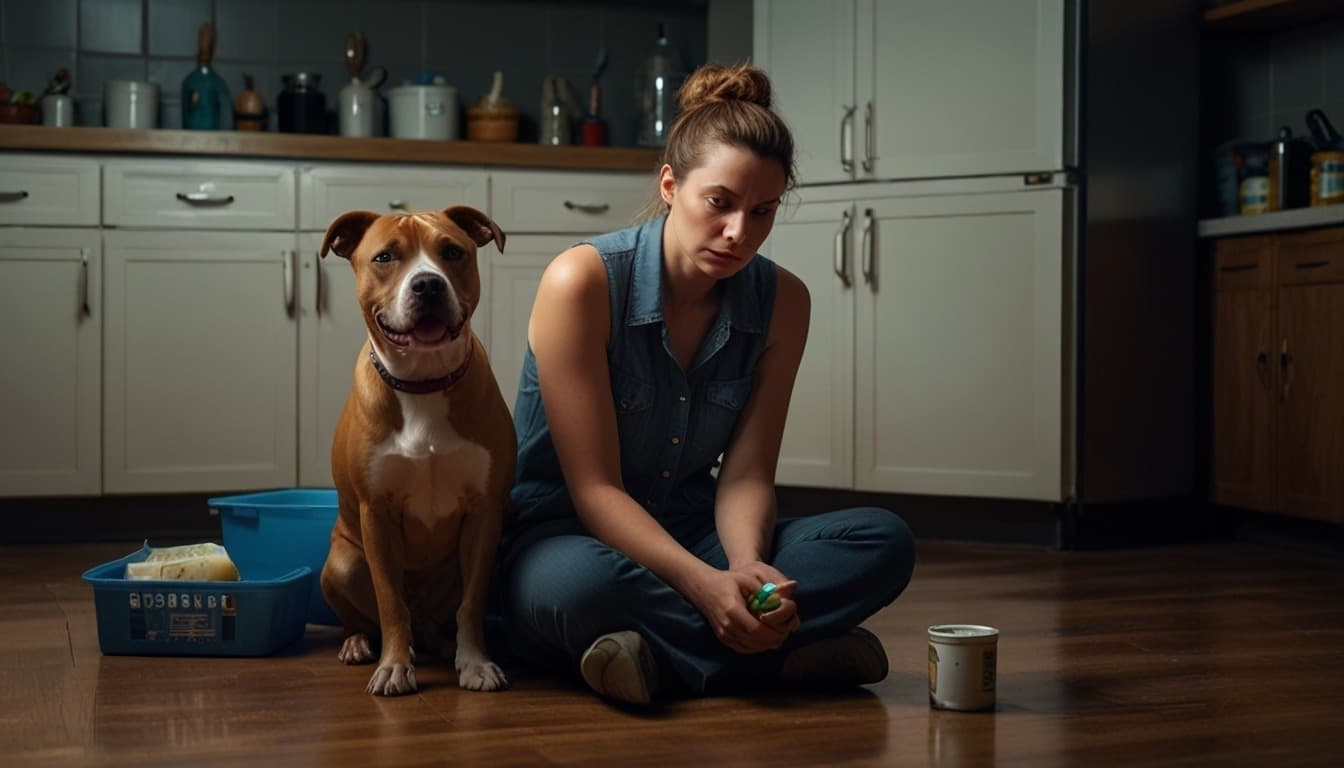
Jasper arrived at my house on a Thursday, a 45-pound pit mix with the saddest eyes and a belly that sounded like a plumbing issue in a condemned building. His shelter paperwork said "loose stool" with a casual shrug, which in rescue speak means "this dog will paint your walls with brown water at 3 a.m." I knew what I was signing up for. I'd fostered 40-plus dogs at that point. Still, nobody really understands the word "voluminous" until a stressed-out build dog uncorks on a bathroom floor tile at a velocity that defies physics.
That first night, I stood in the bathroom doorway at 2:41 a.m., barefoot (stupid, I know), staring at a puddle that had traveled alarmingly far from the puppy pad I'd carefully laid down. Jasper looked up at me like I'd betrayed him. I had. Kind of. Moving to a new home messes with a dog's guts something fierce — stress colitis, they call it. The cortisol surge shuts down normal digestion for a few hours, then everything that was politely waiting its turn in the colon decides to leave simultaneously. I learned that from a vet tech textbook I never finished because I dropped out in year two, but the information stuck like gum under a desk.
I was ready to try anything. And I did. Over the next thre years, across 14 different build dogs and my own three permanently adopted disasters, I burned through more probiotic brands than I care to admit. Some were $12. Some were $58. One came in a refrigerated glass bottle that shattered in my fridge door and made my entire kitchen smell like a foot. I bought probiotics I saw on Instagram, probiotics recommended by a well-meaning pet store employee who also tried to sell me CBD treats for a dog with a farting problem, probiotics with "proprietary blends" that apparently contained magical spores from a secret Amazonian fungus. I made mistakes. Some of those mistakes gave dogs even worse diarrhea. That's the part nobody tells you.
So here's the ugly truth about dog probiotics, filtered through my own messy kitchen-table experiments and the hard-won wisdom of someone who has cleaned up more explosive poop than a hazmat trainee. I'm not a vet. I just do this every day, and I've learned what actually firms things up and what just empties your wallet.
The probiotic that turned Jasper into a firehose (and the $70 vet visit that followed)
On day two of Jasper's gastrointestinal reign of terror, I drove to the pet store and grabbed a bottle of probiotic chews that had a golden retriever grinning on the label. The front of the package said "10 billion CFUs!" in a font that implied you were about to witness a miracle. What it didn't say: some dogs with acute colitis flare up like a Roman candle when you flood their already-inflamed gut with a billion new bacteria all at once. Jasper ate one chew, wagged his tail, and four hours later produced a sound I can only describe as a whoopee cushion submerged in soup. The puddle was tinged with mucus this time. Blood, too — just a few specks, but enough that I called my vet at 7 p.m. on a Friday like the nightmare client I'm.
Dr. Nguyen — she's tolerated my panic calls for 11 years, through three dogs and a divorce — told me to stop the probiotic immediately. "His gut lining is raw, Sarah. You just threw a block party in a burning building." She prescribed a bland diet (boiled chicken and white rice, the classic), a short course of metronidazole, and told me to wait a full week before even thinking about probiotics again. That visit cost me $70 for the exam and $22 for the meds. Plus the $28 I'd already spent on the chews. If you're keeping track, that's $120 down the drain because I didn't understand that probiotics aren't always a gentle intervention.
That was lesson number one: don't start a probiotic during an acute flare. Let the gut settle first. Give it five to seven days of bland food. Then introduce a probiotic slowly — half a capsule sprinkled over dinner, not a whole chew crammed into a trembling dog's muoth. I wish I'd known that before I turned my bathroom into a Jackson Pollock.
What a probiotic actually does (for the people who skip the science pages)
Look, I know you're here because your dog is pooping weird and you want a solution. I'll keep this short and then we can get back to the part where I tell you which bottle didn't explode in my fridge.
A probiotic is just live bacteria — the kind that's supposed to live in your dog's colon, munching on fiber, keping the bad bacteria in check. When things go off the rails (antibiotics, stress, a diet change, God knows what else), those good guys die off. The bad guys — E. coli, clostridium, whatever — throw a party. A probiotic is you hiring security to break up the party. But if you send in 50 bouncers at once to a small, inflamed apartment, you get chaos. Sometimes you need to send in one bouncer for a few days first. Sometimes you need to fix the plumbing before you even worry about the party.
That's it. Everything else on the label is marketing. Which brings me to the three things I learned reading 47 probiotic labels at 1 a.m. with a buid dog audibly gurgling in his crate nearby.
The three thinngs I wish I'd known before I bought 14 bottles
CFU counts are almost always a lie
CFU stands for Colony Forming Units. It's how many live bacteria are supposed to be in each dose. The labels shout numbers like 1 billion, 5 billion, 30 billion. Here's the problem: those numbers are measured at the time of manufacturing, not at the time you sprinkle it on kibble. Bacteria die. They die in heat, they die in moisture, they die if the bottle sits on a shelf for six months. Independent lab testing — like the stuff ConsumerLab does for human supplements, and there's almost nobody doing it for pet products — routinely finds that actual viable bacteria counts are 20% to 60% lower than what the label claims. Some are basically inert powder by the time you open the bottle.
The refrigerated ones hold up better. So do the ones in dark glass bottles with moisture-absorbing packets. But a chew that's been sitting in a warehouse in Texas in July? Half dead before it even gets to your dog. I stopped obsessing over CFU numbers about two years ago. Instead I looked for brands that published third-party potency testing, or at least used enteric-coated capsules that protected the bacteria until they got to the intestines. Most don't. The one I now trust does.
Strain diversity matters way more than a big number
Early on, I bought a probiotic that was just Lactobacillus acidophilus. One strain. Ten billion CFU, but one lonely species. That's like hiring security guards but all of them are the exact same guy who only stands by the front door and ignores the windows. Your dog's gut is a complex ecosystem with hundreds of bacterial species. You want a probiotic with multiple strains — Lactobacillus, Bifidobacterium, Enterococcus faecium (yes, some strains of that are beneficial), Bacillus coagulans. The veterinary research I actually trust — the stuff published in peer-reviewed journals, not on a blog selling affiliate links — shows that multi-strain probiotics are more effective for antibiotic-associated diarrhea and chronic enteropathy than single-strain products.
I'll give you the specific strains I now look for later, when I talk about the bottle that worked. But the lesson is: don't be dazzked by 50 billion of one thing. Ten billion of five different things is usually better.
Prebiotics: sometimes the real hero, sometimes the villain
Prebiotics are fiber that feed the good bacteria. Chicory root, inulin, fructooligosaccharides (FOS), beet pulp. Some probiotic supplements include them. On paper, that's great — you're seeding the gut with good bacteria and giviing them lunch at the same time. In practice? If your dog has a sensitive gut, prebiotics can cause insane gassiness and even more diarrhea. I gave a build dog named Mochi a probiotic with inulin, and within eight hours my living room smelled like a tire fire and his poop looked like whipped egg whites. I'm not exaggerating.
I now look for probiotics with no prebiotics, or very low amounts. If my dog needs a prebiotic, I'd rather add a teaspoon of pure canned pumpkin separately so I can control the dose. Which is its own rabbit hole, and I've written about the disasters of switching cat food too fast before — same principle applies.
The yogurt incident of 2019
Before I had any sense, I once tried to give my elderly lab, Gus, a tablespoon of plain Greek yogurt every day because some forum insisted it was nature's probiotic. Within three days, Gus was farting with a frequency and intensity I can only compare to a tuba section warming up. The yogurt, it turns out, contained lactose. Most adult dogs are lactose intolerant. Not a little bit intolerant — like, "I'll punish you for this" intolerant. I spent a weekend lighting scented candles and apologizing to houseguests who never came back.
The moral: dairy-based probiotics for humans don't belong in your dog unless you enjoy smelling shame. Even the "lactose-free" ones sometimes aren't.
The $22 bottle that saved Jasper's butt (and why I still scream at the "human-grade" label)
After the firehose incident, I waited eight days. Jasper was on chicken and rice, his poop had firmed up from "horrifying liquid" to "soft serve vulnerability," and I was ready to try again. I had a friend who ran a small dog rescue two towns over — she'd been doing this longer than me, which is saying something — and she told me about a brand called Proviable. It's a veterinary formulation, meaning you won't find it on a shelf next to the squeaky toys. It comes in a box with a paste for acute situations and capsules for maintenance. The paste is basically a concentrated probiotic with kaolin (a clay that binds up toxins) and pectin (helps firm stool). I used the paste for two days, then moved to the capsules.
Within 48 hours of starting the capsules, Jasper produced a turd I could actually pick up. I cried. I'm not kidding. I sent a photo to Dr. Nguyen. She didn't reply, which is fair. The Proviable capsules contain seven strains, including Enterococcus faecium SF68, which has actual clinical studies behind it for reducng acute diarrhea in dogs. It's not shelf-stable for months and months — the manufacturer recommends refrigeration after opening — but it works. I bought it from my vet the first time for about $45, but I later found it online for $22 a bottle. Now I keep three bottles in my fridge at all times, right next to the leftover chicken I'll eventually forget and have to throw out.
There's another brand I'll mention, because I don't believe in pretending only one thing works. Visbiome — formerly known as VSL#3 before a whole legal mess — is a high-potency probiotic with eight strains and an absurd CFU count (450 billion per packet for the human version, less for the pet formulation). It's expensive. Lile, $60 for 30 capsules. I used it on a build dog with a confirmed clostridium overgrowth that wouldn't respond to anything else, and it helped. But for everyday digestive wobbles, Proviable is the one I grab first. It's cheaper, it's easier to get, and it hasn't failed me yet except for the one dog I'll tell you about later.
I also tried Nutramax Proviable's little cousni, FortiFlora, which is probably the one your vet hands you in a single-dose packet. It's fine. It's just Enterococcus faecium SF68 with some animal digest for palatability. It's the training wheels of dog probiotcs. Good for short-term use after a course of antibiotics, but I've found it doesn't do much for ongoing gut chaos. I've also gone down the rabbit hole of grain-free diets that turn poop orange, and trust me, a probiotic isn't gonna fix a diet that fundamentally disagrees with your dog.
But probiotics aren't a free pass to feed garbage
I've had fosters where I was slinging probiotics like breath mints, thinking it would offset the cheap shelter kibble they'd been eating for months. That's not how it works. If the diet is inflammatory — high in corn, mystery meat meals, artificial colors — no amount of good bacteria is going to outpace the damage. You'll just have a dog with expensive probiotics and still-liquid poop. I learned that the hard way with a skinny hound mix who pooped undigested food for weeks until I switched her to a limited-ingredient diet. That experience is why I've a whole other post about the food that finally firmed up my puppy's poop.
Probiotics are a support act. The headline act is a diet that doesn't make your dog's insides revolt. When I pair Proviable with a simple, recognizable-protein kibble or a gently cooked meal, I see results. When I try to use probiotics as a band-aid over a bullet wound diet, I end up cleaning the floor at 4 a.m. again.
One time I gave a build cat the dog probiotics because I was desperate
This is a tangent, but it speaks to the broader point about how probiotic strains are often species-specific. A litter of build kittens came to me with horrific liquid poop — I'm talking 11 days straight of it. I had a bottle of dog Proviable capsules in the fridge. I opened one, dipped a toothpick's worth into a kitten's mouth, and waited. Nothing happened. No miracle. No disaster. Just continued poop soup. It wasn't until I got a cat-specific probiotic (FortiFlora, ironically) and switched their food to a high-quality wet option that things firmed up. That whole nightmare is documented here, complette with the $7 can that made everything worse. The lessson: dog probiotics and cat probiotics aren't interchangeable. I know someone who tried giving her cat a dog chew and the cat projectile vomited on her pillow. I don't have a link for that, but it's a story I carry in my soul.
The brand I won't touch and the build who proved the whole science wrong
I should mention a popular chewable probiotic that starts with a Z and ends with a trademark symbol. I'm not naming it directly because I don't want an email from their legal team, but it's the one with the cartoon dog on the label and a lot of five-star reviews. I tried it on two separate fosters. Both dogs developed diarrhea that was somehow worse than what we started with. The ingredients list included "animal digest" (which, honestly, is just rendered mystery meat broth, not necessarily evil), but also three different types of sugar alcohols. Sugar alcohols — sorbitol, xylitol (which is toxic, though this brand didn't have that, thank God), maltitol — can draw water into the bowel. It's why humans get the runs from sugar-free candy. Why on earth would you put that in a probiotic for dogs with diarrhea? I threw that $40 bottle in the trash with the same energy I had when I tossed worthless allergy chews. Some products are just designed to sell, not to help.
Where the research gets messy and I stop pretending to know everything
Look, I love a good probiotic success story. I've 14 of them — no, 15, I just fostered a poodle mix last momth who arrived with gut rot and left with solid logs. But the science isn't settled. There's a 2019 meta-analysis in the Journal of Veterinary Internal Medicine that looked at 17 studies on probiotics for canine gastrointestinal disease. Some showed significant benefit. Some showed nothing. The quality of the studies was all over the place. Sample sizes were small. So when I tell you Proviable worked for Jasper, I'm givig you one data point — repeatedly replicated across 40 fosters, but still just one person's experience.
What I do know: if your dog has a serious underlying issue — EPI (exocrine pancreatic insufficiency), IBD, a partial obstruction — probiotics won't fix it. They might not even touch it. I had a build, a scrawny shepherd mix named Bigno, who pooped water for two weeks on probiotics, bland diet, everything. Turned out he had EPI and needed prescription enzymes. No amount of friendly bacteria replaces enzymes your dog isn't making. Don't be like me and wait two weeks to see a vet because you think the right probiotic will solve everything. Sometimes it's something else entirely, and you're just letting the dog suffer while you experiment.
A year of sloid poop and one build who still exploded (because biology is a fickle jerk)
It's been about a year since I locked onto Proviable as my default. My own three dogs — Gus, Mabel, and the little terror, Bean — get a capsule a few times a week if I'm switching foods or they've been stressed. Gus is 14 now and his system is creaky; the probiotic seems to reduce his occasional "old man colitis" episodes from once a month to once every four or five months. That's not a scientific measurement, just me noticing I'm not scrubbing the hallway as often.
The one failure in the last year was a build named Kevin. Kevin was a bulldog mix with a face like a melted candle and a colon seemingly made of spite. Proviable did nothing for him. FortiFlora did nothing. Visbiome maybe helped a little? Honestly, I'm still not sure. What eventually worked was a prescription hydrolyzed protein diet and a lot of patience. Kevin proved to me that probiotics are a tool, not a guarantee. I still recommend trying them — specifically a multi-strain, veterinary-quality product with no sugar alcohols — but if it's been two weeks and your dog is still painting your floors, go to the vet. Please. Your carpet deserves better.
I buy Proviable in three-packs now from an online pharmacy. $66 for three bottles, which wrks out to $22 each. I store them in the butter drawer of my fridge, which confuses guests but I don't care. Jasper got adopted by a nice couple who I've since trained to text me before they try any supplement, and he's been solid for eight months. That's the win I hang onto when I'm elbow-deep in a mop bucket at midnight.