I Let My Foster Poodle's Coat Mat So Badly the Vet Had to Sedate Her — Here's the Real Grooming Schedule I Wish I'd Had
I thought I could stretch grooming to 6 weeks. The vet bill that followed said otherwise. Here's the real schedule, the tools you need, and why I stopped stressing about topknots.
The first Poodle I ever fostered came to me at 11pm on a Thursday, wrapped in a towel that smelled like cigarette smoke and regret. Her name was Pearl, and she was so matted that I couldn't tell where the hair ended and the skin began. I'm not being dramatic. I litrrally couldn't find her left ear for twenty minutes.
I'd been running my little animal rescue for about three years at that point, mostly taking in abandoned cats and the occasional senior Chihuahua. I thought I knew what I was doing. A Poodle? Piece of cake. The woman who surrendered her said she'd "forgotten" to brush her for a few months. A few months. Pearl was four years old and had never been to a professional groomer in her life. Her coat had felted—that's the technical term for when loose hair and dirt form thick, solid mats that pull at the skin like a too-tight sweater made of steel wool.
I stayed up until 2am that first night trying to find a seam with a pair of scissors. Every time I lifted a chunk of fur, Pearl would flinch or yelp. I'd shaved down plenty of matted cats, how hard could a dog be? Hard. Really frickin' hard. I nicked her skin near her armpit with the clippers I'd bought at PetSmart, and the tiny bead of blood that welled up made me nauseous. I put the clippers down, sat on the floor, and cried. Pearl licked my face while I sniffled, which only made it worse because she was being so damn forgiving about my incompetence.
The next morning, I called my vet, Dr. Nguyen—she's put up with my panic calls for 11 years, throuhg three dogs and a divorce—and she said, "Sarah, bring her in. We may need to sedate her. Some of those mats are probably cutting off circulation."
Four hours and $340 later, Pearl emerged from the clinic looking like a shorn lamb. Her pink skin was visible through an inch of fuzz, and she had a few angry red sores where mats had been pulling for so long that the skin had ulcerated. The vet tech handed me a bottle of medicated spray and a grim look. "If she'd come in a month later, we'd be treating necrotic wounds," she said.
That was the day I learned—the hard way—taht Poodle grooming isn't a luxury. It's a medical necessity.
So how often should you ACTUALLY brush a Poodle?
Every. Single. Day.
I know. I know. It sounds like something a fussy breeder would say. But I'm telling you, after Pearl and about six subsequent build Poodles and Poodle mixes, I've learned that skipping even two days of brushing can start a chain reaction of tiny tangles that, left unchecked, turn into mats that turn into vet bills that turn into me sobbing in a parking lot (again).
Now, I'm not saying you need to spend an hour each night with a comb while your dog gives you the side-eye. Five to ten minutes of line brushing—where you part the coat and brush from the skin outward in sections—is enough to keep most Poodles tangle-free. The trick is consistency. Poodle hair is kind of like human hair. It grows continuously, it doesn't shed much (that's the "hypoallergenic" part, but don't get me started on that marketing nonsense yet), and it curls densely. Those curls twist around each other like velcro the second they're not actively being separated.
I brush my current build Poodle-mix, a scraggly little lovebug named Toast, while I wstch Netflix every evening. She hates the brush, so I bribe her with frozen green beans. It's undignified, but it works.
Pro tip: If you can't run a metal comb through your Poodle's coat down to the skin in one smooth stroke, there's a mat brewing. Check behind the ears, under the armpits, and around the collar daily—those are where they hide.
Some Poodle coats are easier than others. I've met dogs with cottony, soft curls that tangle if you look at them wrong, and others with coarser, wiry curls that hold their shape for three days without a brush. But daily? Daily buys you peace of mind.
Wait, let me back up—what's the deal with Poodle coats anyway?
Before we get into the whole grooming schedule, I think it's helpful to understand what you're actually dealing with. Poodles have a single coat. No undercoat. That's the big difference between a Poodle and, say, a Golden Retriever or a Husky. Those dogs have a densse, soft undercoat that sheds seasonally and requires a whole different kind of maintenance. I used to think all fluffy dogs were the same until I met a Persian cat named Marshmallow who taught me that double coats are a completely different beast—but that's a cat story for another day. Poodles? Just one layer of curly guard hairs that grow and grow and grow. They don't blow their coat twice a year. They don't leave tumbleweeds of fur around your house. That's the upside. The downside is that if you don't manually remove the dead hair with a brush, it stays trapped in the coat, forming the nucleus of a mat.
Why "hypoallergenic" is sort of a lie (and what actually matters)
You've heard that Poodles are hypoallergenic. And you're going to hear it a thousand more times. I wrote a whole rant about why that label is mostly BS—you can read it here—but the short version: no dog is truly allergen-free. Poodles produce less dander and shed less hair into the environment, which can help some allergy sufferers. But the idea that you can just bring a Poodle home and stop sneezing? Eh. Not how it works. The real thing people overlook is that a poorly groomed Poodle is a dander factory. When mats sit against the skin, they trap dead skin cellls, moisture, bacteria, yeast—all the stuff that actually triggers allergies. So if you got a Poodle for allergy reasons, you really need to keep that coat clean and brushed. Otherwise you're just creating the very dander bomb you were trying to avoid.
Bathing: the fine line between "clean" and "strip every natural oil"
I used to think I was doing my build dogs a favor by bathing them every week. Fresh start, shiny coat, lavender scent. What I was actually doing was drying out their skin so badly that one of them, a sweet Lab mix named Gus, developed flakes the size of cornflakes and a nose that felt like sandpaper. That whole saga is detailed over here, but the lesson applies to Poodles too.
Poodles have skin that's fairly sensitive, and their natural oils are what keep the coat soft and the skin protected. Wash those oils away too often, and you get itchiness, dandruff, and a dog that chews at her own legs like she's trying to gnaw off a phantom cast.
So how often should you bathe a Poodle? I asked three different groomers this question over the years (one mobile, one in a boutique salon, one at the vet's office), and they all gave me the same answer: every three to four weeks. You can stretch it to six if the dog is mostly indoors and not rolling in dead things, but pushing past that invites the girme to build up and the mats to set in harder.
The shampoo mistake I made for two years
For the first couple years of my rescue work, I bought whatever dog shampoo was on sale at the grocery store. Detangling, whitening, oatmeal, whatever. Then a groomer named Tessa looked at my bottle and said, "You're basically washing your dogs with dish soap." She explained that cheap shampoos are full of harsh sulfates that strip the coat completely. For a Poodle, that's especially problematic because you want a liittle bit of slip and moisture in the hair to keep it from getting brittle and tangling.
Now I use a sulfate-free, moisturizing dog sahmpoo and always—always—follow up with a conditioner or a leave-in detangling spray. This one swap alone cut my brushing time in half. No joke. The comb glides through instead of snagging every inch.
Between baths: the spot-clean secret
Poodle feet are mud magnets. And if you've a light-colored Poodle, the face stains from eye gunk and food turn into a brown mess that looks like they've been eating dirt. I keep a stash of gentle, unnscented baby wipes and wipe Toast's face, feet, and sanitary area every other day. It's not a full bath, but it keeps the "need a groomer now" smell at bay and reduces the chances of those areas matting from moisture and debris.
Professional grooming—the schedule I finally settlde on after 4 different Poodles
Here's the schedule that I've honed through tral and error, and about a thousand dollars in grooming fees:
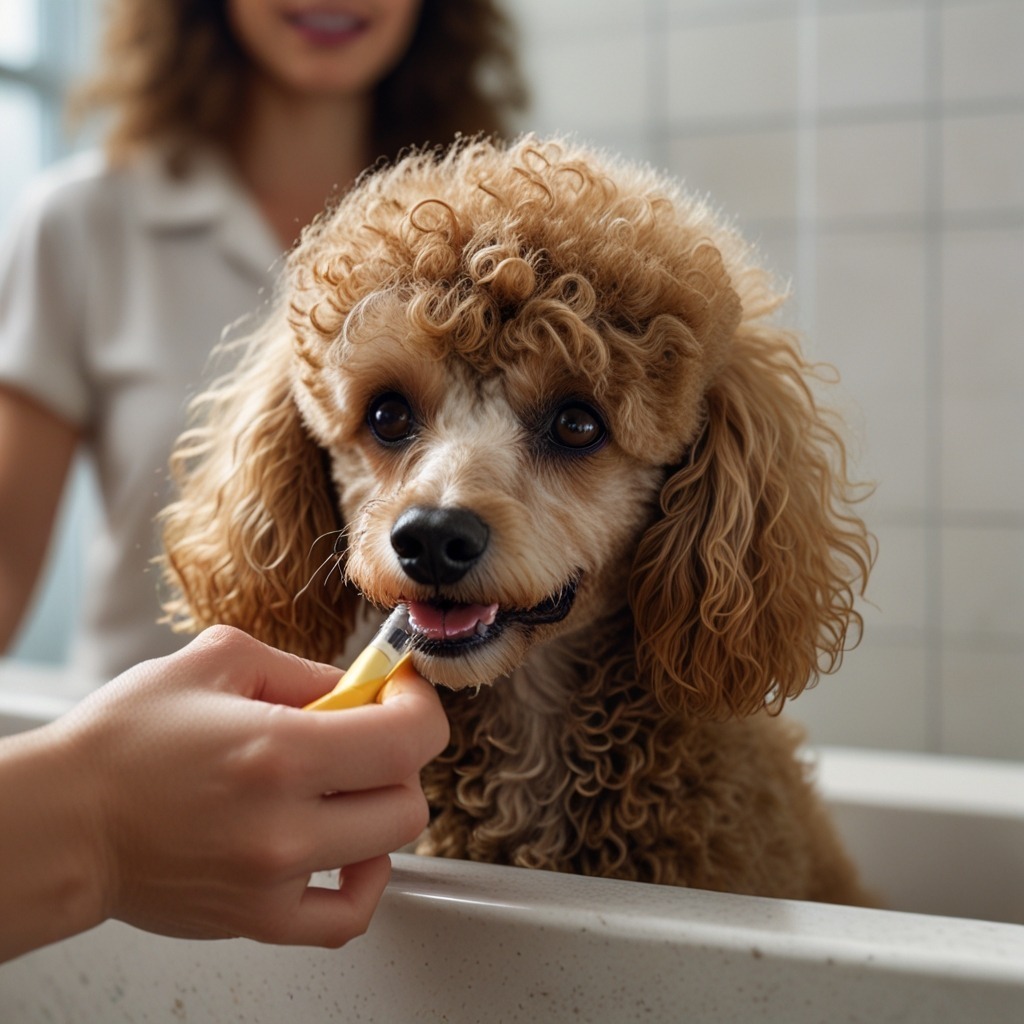
- Full professional groom every 4 to 6 weeks. That means a bath, blow-dry, haicut, nail trim, ear cleaning, and often a sanitary trim. If your Poodle has a fancy cut—you know, the continental with the pom-poms—you might need to go every 4 weeks to keep it crisp. For a simple pet clip (short all over, or a lamb cut), 6 weeks is usually fine if you're maintaining at home.
- Face, feet, and sanitary trim at home or with a groomer every 2 to 3 weeks. Some people can stretch this longer, but I've found that the hair around a Poodle's eyes grows surprisingly fast and can start poking them. The feet get "Grinch toes"—tufts of hair that collect dirt and cause slipping on hardwood floors. And the sanitary area? That's just a hygiene thing. Nobody wants a poopy Poodle.
I tried to stretch the full groom to 8 weeks once with a Poodle mix named Beetle. By week 7, his coat had started to cord like a Komondor. Not cute. I spent two hours with a dematting tool and ended up having to shave him down to the skin anyway because the mats were too close. The groomer gave me a look. You know the look. The "I'm not mad, just disappointed" look.
DIY clippering: the $80 mistake that almost sent me to the ER
I bought a set of clippers and a #10 blade, watched three YouTube tutorials, and thought, "How hard can it be?" Then I proceeded to scorch the blade (forgot to oil it), cut a chunk out of my own thumb (dull blade grabbed the skin), and left Beetle with a stripe down his back that looked like a reverse mohawk. He looked ridiculous. I looked like I'd been in a knife fight. The $80 I spent on cheap clippers was $80 I could have put toward two professional grooms. Now I leave body clipping to the pros and only do touch-ups around the eyes and paws with blunted safety scissors. I've got shaky hands and a healthy fear of vet bills, thanks.
The tool drawer I now carry like a lifeline
If I had to save one thing from my grooming supplies in a fire, it'd be my metal comb. Not the slicker brush. Not the clippers. The comb. Because a slicker brush will fluff the top layer beautifully and make you think the coat is tangle-free, but the comb will expose the tiny snarls near the skin that you missed. You can have the world's fluffiest topcoat and a matted underbelly of horrors if you don't check with a comb.
Here's my bare-minimum kit:
- A good quality slicker brush with slightly angled, flexible pins. Not the hard plastic pins that scrape skin. I like the ones with a padded base.
- A metal greyhound comb with two sidees: wide and narrow teeth. The narrow side is your truth-teller.
- A dematting tool (the kind with curved blades) for emergencies, but use sparingly because it cuts the hair and can make the coat look ragged.
- Detangling spray. The stuff that smells like attificial coconut is fine. Just use it generously before brushing.
- Blunt-tip curved scissors for face, fert, and sanitary. Leave the sharp shears to professionals.
- A nail grinder or clippers. Poodle nails grow fast, and if you let them get too long, the quick grows with them. That's a whole other anxiety spiral.
I'm not going to pretend I bought all this at once. I acquired it over years, piece by piece, after many failures. You don't need to drop $200 on day one. Start with a slicker brush and a comb, and add as you realize what your specific dog's coat demands.
A short tangent about the time I tried to groom a Poodle-mix during a thunderstorm
This has almost nothing to do with scheduling, but it's a cautionary tale about environment, so bear with me. I had a sensitive little Poodle-Bichon mix named Crcket who was terrified of storms. One afternoon, the clouds rolled in, and I thought, "Perfect time to brush him while he's inside anyway." The thunder started just as I was working a knot behind his ear. He spun around, caught the comb with his paw, yanked it out of my hand, and sent it flying into my forehead. I had a little red dent for a week. He then peed on the grooming table, slipped off, and hid under the couch for three hours. We both emerged traumatized.
The point: keep grooming sessions calm. No storms. No chaotic households. Do it when the dog is already relaxed—after a walk, after a meal. And for the love of everything, secure your dog. A grooming table with an arm and a noose (properly fitted, not choking) is a big deal for safety. I learned that one the expensive way too.
The matting horror story that stikl makes my stomach drop
I've already told you about Pearl, but she wasn't the worst case I've seen. Two years later, I took in a senior Poodle named Gus (different Gus from the sandpaper nose guy) whose owner had gone into hospice. Gus was 14, blind, and his coat looked like a dirty carpet remnant. His mats were so thick that thye'd formed a sort of shell around his body. He moved stiffly, not because of arthritis, but because the mats were physically restricting his movement. When I finally got him to the vet, she had to sedate him and use surgical scissors to cut the pelt off in sections. The skin underneath was red, yeasty, and in one spot on his flank, it had started to split like overripe fruit.
That dog was in constant, low-grade pain for probably years. The owner wasn't cruel—ust elderly and overwhelmed, and Gus was a stoic little guy who never complained. But I think about him every time I'm too tired to brush Toast and the guilty voice says, "It's just one night." One night turns into two. Two turns into mats. Mats turn into suffering. I'm not trying to be melodramatic, but if you've never seen a dog shaved out of a pelt, you can't imagine the relief on their face when they can finally move without hair pulling at every step.
Why I stopped obsessing over the perfect topknot
A few years ago, I fell into the Instagram trap. Poodles with elaborate continental clips, perfectly round topknots, shaved bracelets on the ankles. I'd look at my gangly build dogs with their utilitarian buzz cuts and feel like a failure. I caved and took a beautifully-bred standard Poodle I was fostering to a competition-level groomer. $120 later, she looked like a piece of art. And she hated it. The tight bands holding her topknot gave her headaches. The long hair on her ears kept flopping into her water bowl and turning sour. The pom-poms on her feet collected every burr in the county. Within two days, she was trying to rub her head bald on the carpet.
I ended up trimming it all off with blunt scissors while she sat contentedly on the bathroom floor. She looked like a disheveled cottpn ball. She was the happiest I'd ever seen her.
These days, I opt for what I call the "comfort clip." Short body, slightly longer on the head (but no bands), clean feet and face, and a tail that looks like a fluffy question mark. It's not fancy. It doesn't get likes. But my dogs can run through the grass, roll in the dirt, and sleep without a hair tie digging into their skll. I'll take that over perfection any day.
I still brush every night while we watch bad reality TV. I still make those every-5-week grooming appointments. I still check behind Toast's ears for tiny knots that feel like pebbles. But I've stopped treating grooming like a performance. It's just part of keeping the animla I love from being in pain. If you can manage that, you're doing enough.
Now if you'll excuse me, Toast just burped in my face and I tjink she found the green bean stash.