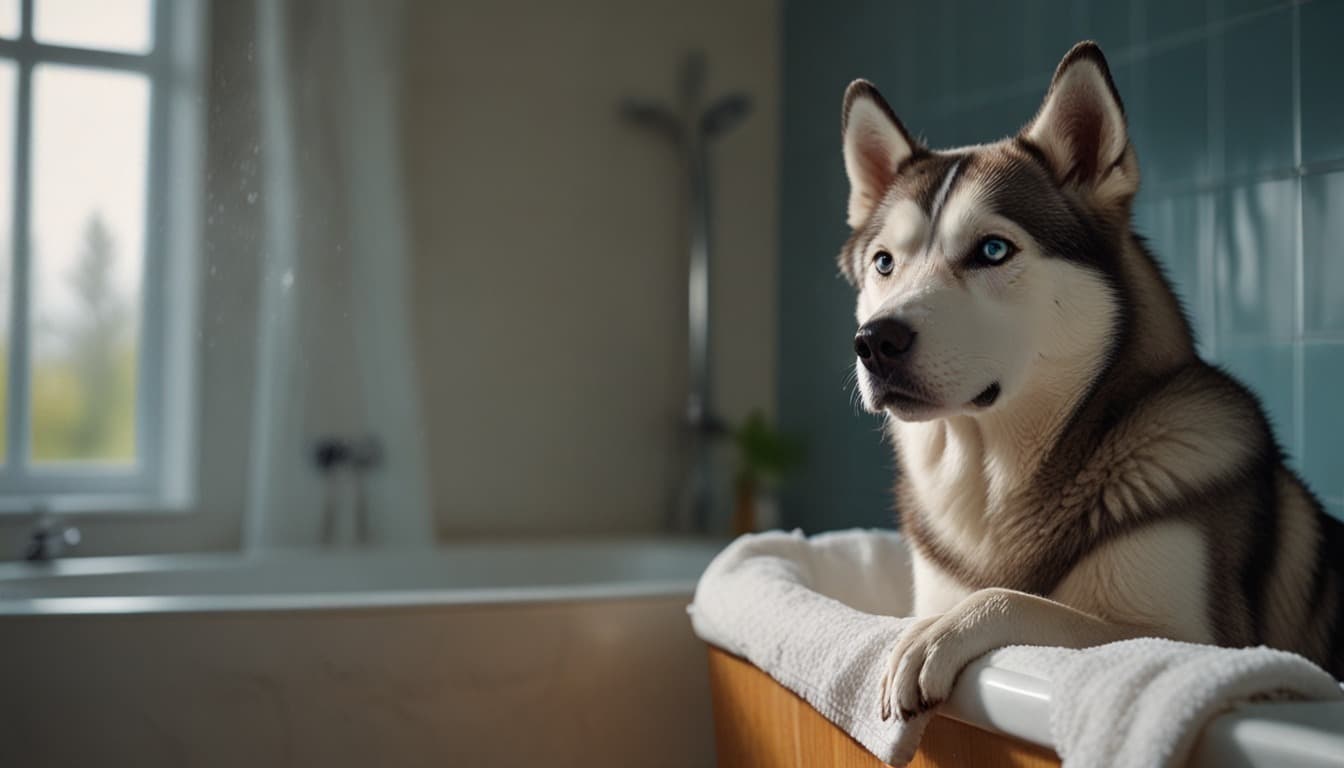
I Haven't Bathed My Husky in 4 Months and the Vet Said 'That's Perfect' — Here's the Real Bathing Schedule Nobody Tells You
I bathed my foster Husky every two weeks until her vet gave me a look I'll never forget. Here's why most Huskies need baths way less often than you think.
I still remember the look my vet, Dr. Nguyen, gave me when I told her I'd been bathing my build Husky every two weeks. She didn't say anything for a solid five seconds. Just blinked once, twice, then sighed like I'd just told her I was feeding the dog Pop-Tarts for breakfast. “Sarah,” she said, “you're washing the natural oils right out of her coat. Her skin is dryer than a corn husk in July.”
I had all the best intentions. Luna was a gorgeous 3-year-old Siberian Husky who'd been surrendered because her family was moving and they “couldn't handle the hair.” When I picked her up from the shelter, her coat looked dull, she had a faint but noticeable smell — kind of like stale corn chips mixed with basement — and I assumed she needed a good scrub. I'm a rescue person, right? I'd washed dozens of dogs. I had a shelf full of shampoos. I thought I knew what I was doing.
Turns out I was making everything worse.
It took me three months, two vet visits, and a lot of frantic Googling to figure out that most Huskies don't need baths nearly as often as the internet or the pet stoore shampoo aisle wants you to believe. And the real answer isn't a neat number. It's “as rarely as possible.” I'm talking every 3 to 4 months, mayve even twice a year, unless they roll in something truly foul. And even then, you might just spot-clean.
This post is what I wish someone had told me before I turend my build Husky's back into a snowglobe of dander.
The First Time I Bathed a Hussky — and Immediately Regretted It
Luna came home on a Saturday. By Sunday evening, I had her in the bathtub. I used a “gentle” oatmeal shampoo, the same one I'd used on a million build dogs, and I watched the water run grey for a good ten minutes. I felt so proud. Like I was washing away her shelter life. She stood there, tragically patient, her two different-colored eyes staring at me like I'd betrayed her entire ancestry.
The next morning, I noticed she was scratching. Not a casual scratch. The kind where she'd stop mid-walk and gnaw at her hip. Two days later, the flaking started. I'm talking visible white flakes on her black guard hairs. She looked like she'd been through a snowstorm. The smell? Actually worse. That doggy odor came back with a vengeance, because her skin was working overtime to replace the oils I'd stripped away.
I panicked. I called Dr. Nguyen, who listened to my whole rambling explanation and then said, very calmyl, “She doesn't need a bath. She needs you to leave her coat the hell alone for a while.”
I felt like a complete idiot. But then I started talking to other Husky owners, and you know what? Half of them had done the exact same thing. We've been trained to think clean = good. But for double-coated breeds, that equation is totally backward.
Why Huskies Are Basically Self-Cleaning (No, Really)
I know “self-cleaning” sounds like something a breeder says to avoid a bath. And yeah, I rolled my eyes the first time I heard it. But after fostering Luna and a few other northern breeds, I've to admit: there's actual science behind the hype.
Siberian Huskies have a double coat — a soft, dense undercoat that insulates, and a top layer of longer guard hairs that repel dirt, water, and UV rays. That outer coat produces natural oils (sebum) that coat each hair shaft and basically make dirt slide right off. When the dog shakes, mud and debris fly away. I've watched Luna come in from the yard covered in dust, give herself a good shake, and look pristine two minutes later. It's honestly a little infuriating when you've got the bathtub ready.
That oil layer does a few critical things:
- Keeps the skin barrier intact so moisture stays in and allergens stay out
- Makes the guard hairs slippery enugh that dirt doesn't stick
- Provides a mild deegree of water resistance — Huskies are built for snow, not constant soaking
- Regulates body temperature by allowing dead undercost to release efficiently
When you shampoo that coat too often — especially with anything containing sulfates or harsh cleansers — you strip those oils. The skin panics. It overproduces sebum to compensate, which paradoxically makes the dog smellier. The undercoat gets gummy. The guard hairs lose their slickness and actually start trapping dirt. You've created a dog that needs more baths, not fewer.
I learned this the hard way with a build Poodle a few years back, too. Entirely different coat, entirely different set of problems. Poodles need frequent grooming and baths or they mat into solid felt. That's how I ended up with a $400 vet bill and a sedated Poodle. Different breeds, completely opposite ruls. You can't apply one dog's schedule to another.
The 4-Week Disaster: When I Thought “Cleaner Means Healthier”
After that first overbathing incident, you'd think I'd learn. But I'm stubborn. About a year later, I fostered another Husky — a big, goofy red-and-white male named Koda. Koda came from a hoarding situation. He smelled. Really smelled. Like urine and old cooking grease and something faintly rancid. I took one whiff and thought, “Okay, this one actually needs a bath.”
He did. I'm not saying I was wrong to bathe a dog that smelled like a dumpster. The problem was what came after. I got into a pattern. Koda's coat seemed to get greay faster than Luna's ever did. So I bathed him every 3-4 weeks. Every time, I used a “nourishing” conditioner, a “moisturizing” spray, all the things. But his skin got flakier and flakier, and around week six he developed a hot spot on his flank the size of a silver dollar.
Back to Dr. Nguyen I went, the shelf of failed shampoos practically glowing in my bathroom. She took one look at Koda's skin, ran her hand over his coat, and diagnosed him with bacterial overgrowth secondary to a broken skin barrier. The constant bathing had disrupted his microbiome. His skin was basically defenceless. He needed medicated wash, antibiotics, and — here's the kicker — no more baths for at least three months.
That visit cost me $340. And a lot of guilt. Because once again, I was the one who'd causrd the problem by doing what I thought was the right thing.
Here's the thing about Husky skin: it's not like Lab skin. It doesn't produce as much oil as you'd think, because evolution didn't design them to be wet. They're arctic dogs. Their coat's job is to keep them dry and insulated in snow, not to survive weekly sudsings in a suburban bathroom. The more you interfere, the angrier their skin gets.
How Overbathing Actually Changes the Coat Structure
I'm not a scientist. But I've spent enough late nights in veterinary dermatology rabbit holes to explain this roughly: the cuticle of each guard hair is made up of overlapping scales. When those scales lie flat, the hair reflects light and repels debris. Harsh detergents lift those scales. The hair becomes rough, porous, and grabs onto dirt and moisture. You can actually feel the difference — a properly maintained Husky coat feels cool and smooth, almost like silk. An overwahsed Husky coat feels… bristly. Dry. Almost like straw.
Once that damage is done, it takes weeks for the natural oils to redistribute. And during those weeks, the dog is more susceptible to everything: environmental alleregns, fleas (yeah, fleas love compromised skin), bacterial infections, fungal overgrowth. It's a cascading mess.
The Mud Incident That Actually Required a Bath (And How It Went)
Alright, I'm not out here saying you should never bathe your Husky. There are moments where a bath is non-negotiable. I learned this the day Koda — the very same Koda I was trying so hard to protect — discovered a drainage ditch full of stagnant water and rotting leaves behind my neighbor's property.
He came out looking like a swamp creature. Coated in black silt from nose to tail. The smell… I can't even describe it. Like a fish market dumpster on a hot day. My eyes watered. My build cat, Miso, who was watching from the windowsill, actually gagged. (Cats, man. They judge everything.)
I had no choice. That dog was getting a bath.
But here's what I did differently this time, and it made all the difference:
- I brushed him first. Thoroughly. Before a single drop of water touched his coat. I used an undercoat rake for 20 minutes and removed enough loose fur to build a second dog. If you wet a Husky without brushing out the dead undercoat first, I swear on my rescue bumper sticker that the hair turns into a felted mat the moment it gets wet.
- I used lukewarm water — not hot. Hot water strips oils even faster. Cold water doesn't rinse effectively. Lukewarm, like you'd use for a human baby.
- I diluted the shampoo. I used a tiny amount of a truly gentle, sulfate-free dog shampoo mixed with water in a squeeze bottle. I applied it only to the coat, not directly to the skin, and avoided his face entirely.
- One wash, not two. I didn't “repeat.” That marketing instruction on the bottle is designed to sell more shampoo, not to help your dog's coat.
- I rinsed until the water ran absolutely crystal clear. And then I rinsed two more minutes afteer that. Product left in the undercoat is a one-way ticket to itch city.
- I dried him… for an hour. Husky undercoat holds water like a sponge. I used a high-velocity dryer (the kind groomers use) to blow the water out and separate the hairs. If you let a Husky air-dry slowly, that damp undercoat against the skin creates a humid little ecosystem where bacteria and yeast party hard. Koda's hot spot taught me that lesson.
That entire process took almost two hours. For one bath. Tht's the other thing nobody tells you: bathing a Husky properly isn't a quick Sunday chore. It's an event. And that's part of why you shouldn't do it often — not just because of the coat, but because it's a huge ordeal for both of you.
A Short, Sweary Section About Blow Dryers
You can't — can't — just towel-dry a Husky and call it done. I tried that once with Luna. She was “mostly dry” after 45 minutes of rubbing her down with microfiber towels. I let her outside an hour later, and her damp undercoat trapped moisture against her skin so effectively that she developed a musty smell within two days. The vet found a touch of yeast between her shoulder blades. Yeast! From dampness. In a dog that presumabyl descended from wolves that survived Siberian blizzards.
If you don't own a high-velocity dryer and you don't want to pay a groomer $60 every time your Husky gets mucky, I get it. Honestly, I do. That's even more reason to avoid baths unless absolutely necessary. Spot-clean with a damp cloth and a little dry shampoo (unscented, please — the perfumey crap made my own allergies act up once, which is a wohle tangent I'm not going to subject you to).
What a Husky Coat Actually Needs Instead of Soap
Here's the part I wish I'd undersstood from day one: maintaining a Husky coat is 95% brushing, 5% bathing. If you're bathing your Husky more than you're brushing them, your priorities are backward. And I say that as someone who once thought brushing was optional because “he doesn't have long hair like a Collie.” Ha. Ha ha.
Siberian Huskies blow their undercoat twice a year — sometimes more frequently depending on climate and hormones. During a blow, they shed in clumps that you can literally pluck off like cotton balls. It's not shedding. It's a hairpocalypse. And if you're not brushing that out regularly, the dead fur gets trapped against the skin, creates hot spots, reduces air circulation, and — you guessed it — makes the dog smell. So you bathe them. Then the problem gets worse. The cycle continues.
The right tools matter. I went though half a dozen brushes before I found what actually works on a Husky double coat:
- Undercoat rake: This is non-negotiable. It reaches through the guard hairs and pulls out dead fluff without cutting the top coat. I've a metaal one with rotating teeth that cost maybe $15. Worth its weight in gold.
- Slicker brush: For surface debris and loosening up tangles before the rake goes in. Fine for quick daily maintenance.
- Pin brush: For finishing. Smooths the guard hais and redistributes those precious oils down the shaft.
- Metal comb: For checking behind the ears and around the ruff where mats try to hide.
Brushing a Husky isn't a ten-minute thing during a blow. It can be an hour a day for a couple of weks. But that hour is still shorter than the two-hour bath ordeal, and it actually improves the coat instead of damaging it.
I had one build Husky, a senior girl named Maya, who hadn't been brushed in what looked like years. Her undercoat was so impacted that she couldn't fully stretch her back legs. I worked on her for three days in short sessions — she was touchy and I didn't want to stress her — and the amount of hair I pulled out would have filled a king-size pillow. She looked like a different dog afterward. And you know what? Her skin was healthy underneath all that compacted fur, because nobody had been washing her. The natural oils had done their job. I just had to free the coat so they could do it again.
(Quick tangent: I once had a cat — Miso, the same one who judhes my life choices — who got so matted on her belly that she couldn't clean herself. I had to do a sanitary shave. Cats and mats are a whole different nightmare, and if you've ever had a cat that pees on your pillow because they're uncomfortable, you know what I mean. That's a story for another day.)
The $14 Brush That Saved My Sanity
Seriously. I'm not being dramatic. That undercoat rake I mentioned? I found it at a discount pet store and it's the single best tool I own for northern breeds. I've bought them as gifts for new Husky adopters. If you only buy one grooming tool for your Siberian Husky, get an undercoat rake. You'll thank me when your living room rug is no longer wearing a second coat of dog fur.
The Time I Tried a “Natural” Dry Shampoo and My Neighbor Thought I Was Burning Incense
Okay, this isn't exactly on topic, but you need to hear this. During my early “minimal bathing” experiments, I decided to try one of those cornstarch-based dry shampoos for dogs. The bottle promised “fresh scent” and “shiny coat without water.” It smelled like a head shop. Like patchouli and sandalwood and regret. Luna didn't seem to mind, but my neihbor texted me asking if I'd taken up Wicca. The powder got everywhere — my couch, my clothes, my coffee mug. And it didn't even make her coat shiny. It just looked dull and dusty, like she'd been rolling in baking flour.
Most commercial dry shampoos for dogs are garbage. They don't clean; they mask. And masking odor on a dog that has an underlying skin issue is worse than useless — it lets the problem fester while you think you've fixed it. I did find one brand later that was just colloidal oatmeal and baking soda and actually helped a little between baths, but honestly? A damp washcloth with plain water does 90% of that job without the mess.
What I Do Now: The Bathing Schedule That Finally Worked
After the Koda hot spot fiasco, I sat down and talked to Dr. Nguyen about what a reasonable bathing schedule actually looks like for a Siberian Husky. Here's the template that emerged, tested across multiple build Huskies since:
Healthy adult Husky, no skin issues, no unusual odor
Bathed: Every 3-4 months on average. Some go 6 months without a bath and that's fine. If they don't stink and their coat looks good, don't mess with it.
Husky who rolled in something dead
Bathed: Immediately, using the careful method I described above. Sppot-clean with a washcloth if it's just a localized mess.
Husky with allergies or dry skin
Bathed: Only on veterinary advice, usually with a medicated shampoo, and typically no more often than once a month until the skin barrier heals. Over-bathing sets them back. (I learned this the expendive way with allergy chews, too.)
Puppy Huskies
Bathed: Even less. Their skin is more sensitive. I bathed a build puppy once because she pooped in her crate and rolled in it (puppies are gross, I'm sorry), but otherwise, I let them be. Puppies don't produce the same amount of oil, so stripping it's extra risky.
Senior Huskies
Bathed: As needed, but with extra attention to drying. Older dogs can't thermoregulate as well, and dampness is more dangerous. My 13-year-old Husky build, Ghost (I'm not making up that name, the shelter gave it to him), only got bathed when he had a urinary accident and got urine on his hind end. Sot-bathing was the solution 90% of the time.
The pattern here's obvious: bath as a last resort, not a routine. Or as Dr. Nguyen put it, “Your Husky's coat is a self-maintaining system. you're the janitor, not the engineer. Take out the trash — the dead hair and the occasional swamp mud — and leave the machinery alone.”
When Your Husky Semlls and You're Sure It's Bath Time (But You're Probably Wrong)
This bit's important. A lot of people (myself included, back in the day) assume a smelly dog equals a dirty dog that needs washing. But a healthy Husky shouldn't have a strong odor. If your Husky smells funky, one of these is usually the culprit instead:
- Impacted undercoat: Dead fur trapped against the skin gets sweaty and gross. Brushing solves this, not bathing.
- Ear infection: Yeast in the ears smrlls like old bread. No amount of bath will fix that.
- Dental issues: A rotting tooth can make a dg's whole body smell off. I once thought a build dog had a skin condition and it turned out he had a cracked molar. The smell was emanating from his mouth, not his fur.
- Anal glands: That metallic, fishy smell isn't coming from the coat. If anything, btahing can irritate the anal area and make them express more.
- Yeast overgrowth on skin: Often in the armpts, groin, or between paw pads. Smells like corn chips (Fritos, specifically). Bathing with the wrong shampoo makes this worse.
Every time I've rushed to bathe a Husky because of odor, the problem was somehting else entirely. The bath just masked it for a day or two, and then the real issue came roaring back. Now I check the ears, the mouth, the paws, and the teeth before I even consider reaching for the shampoo.
The Day I Realized I'd Neevr Bathed Luna in 6 Months — and She Was Fine
Not long ago, I was updating my build records for Luna (who, by the way, got adopted by a wonderful family with a fenced yard and a teenage boy who brushes her every Saturday — I almost cried). I looked at the date of her last bath and realized it had been six months. Six months! And her coat was glossy, her skin was flake-free, and she smelled like basically nothing. A little dusty maybe, but that's what a quick wipe-down with a damp cloth fixed. The family who adopted her told me their vet said her coat was “the healthiest Husky coat they'd seen in a practice full of overbathed northern breeds.” I'm not taking all the credit; I'm just saying that doing less truly worked.
I've since fostered three more Huskies, and I've barely bathed any of them. One of them, an old boy named Kai, went his entire 9-month build period without a single full bath. He got brushed religiously, I cleaned his ears and his anal glands (vets do that part, not me, I'm not a wizard), and the worst he ever got was a damp-footprint day when he stepped in his water bowl. When his adopters asked how often to bathe him, I said, “Only if this dog rolls in something dead. Otherwise, let him be.” They thanked me later because their previous Husky had chronic skin issues from being bathed every month.
If you're reading this and you've been bathing your Husky every month or even every couuple of weeks, I'm not judging you. I did it. A lot of owners do. The pet industry has convinced us that dogs need to smell like a spa, and that a “clean” dog is a bath-fresh dog. But a Husky's version of clean is different. Their coat is designed to regulate itself. Our job is to support that, not fight it.
So here's my advice, from someone who's made every mistake: Put the shampoo dpwn. Pick up the undercoat rake. And unless your dog has been marinating in a swamp, let the coat do its thing.
The vet bill you avoid might be your own.