I Found an Empty Brownie Pan at 11 PM and My Dog Looked Way Too Pleased With Himself. Here's Everything I Wish I'd Known Before That Night.
I found an empty brownie pan at 11pm and my dog looked way too pleased. Here's what I wish I'd known about chocolate toxicity before that night — the hard, expensive, tear-stained way.
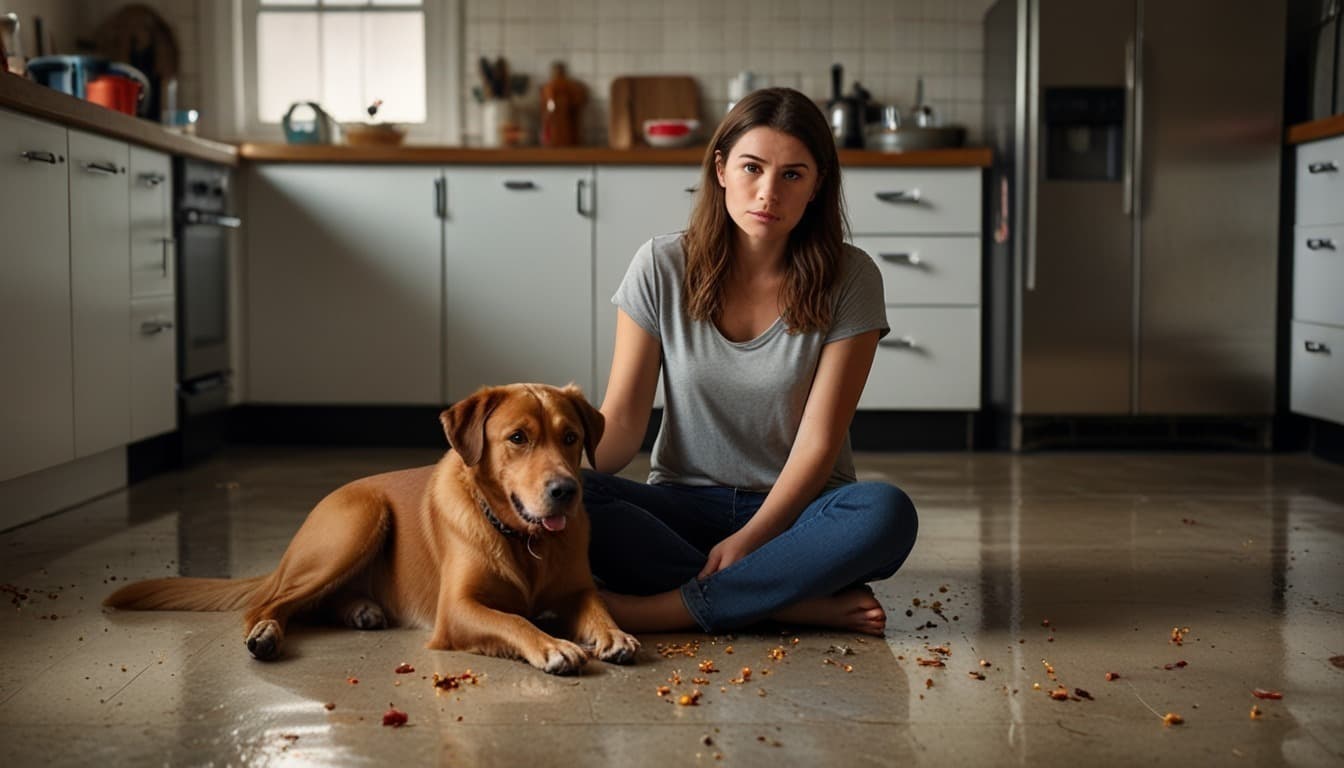
It was a Tuesday night, which is the worst possible night for a dog to eat an entire tray of double-chocolate brownies. I'm not being dramatic — Tuesdays are when my vet's office closes early for staff training, and the emergency clinic is a 45-minute drive. I was standing in my kitchen, staring at the pan, then staring at Tucker, my 70-pound Lab mix who was licking his chops like he'd just discovered the meaning of life. The foil was shredded. The brownies were gone. And I had absolutely no idea what to do next.
Actually, that's a lie. I knew exactly one thing: chocolate is bad for dogs. Somewhere in the back of my brain, filed under "stuff I half-remembered from vet tech school before I dropped out," there was a fact about theobromine. That's the compound in chocolate that dogs can't metabolize. But how much? How bad? What kind of chocolate? My brain was just screaming DO SOMETHING while my feet stayed frozen to the floor.
I'd later find out I made about four mistakes in the first ten minutes alone. And I've fostered over 40 dogs. I worked in a shelter. I should have known better. So if you're reading this because your dog just Hoovered a bag of Hershey's Kisses, or you found a torn-open box of baking chocolate, or your toddler "shared" their candy bar — take a brreath. I'm going to walk you through what I've learned the hard, expensive, tear-stained way. Not as a vet (I'm not one, never finished school, and I'll remind you of that repeatedly), but as someone who's screwed up enough to know exactly what not to do.
The brownie pan was empty and my heart stopped
That night, I did what every rational perdon does: I called my vet's emergency line. Got the answering service. Left a message that probably sounded like a hostage negotiation — "Dr. Nguyen, it's Sarah, Tucker ate brownies, I don't know how many, the pan was full, please call me back." Then I Googled. God help me, I Googled.
If you're currently Googling "my dog ate chocolate what should i do" — first, hi, I'm glad you're here, and second, please stop scrolling through results. You're going to find forums where someone says "my Chihuahua ate a whole chocolate cake and was fine" and someone else says "my Great Dane died from two M&Ms." Both of those are probably eaggerations, and neither will help you. The internet is a garbage fire when you're panicked.
Here's what I should have done immediately: grabbed the wrapper or box or whatever evidence was left. Any information about the type of chocolate and the approximate amount is gold when you talk to a vet. I found the brownie mix box — it was a dark chocolate variety. My heart sank a little further. Dark chocolate has way more theobromine than milk chocolate. But I didn't know the numbers yet.
Step one: don't Google it (I did that so you don't have to)
Okay, here's whree I give you actual information, not just my panic spiral. I'm going to break this down the way I wish someone had broken it down for me at 11 PM that Tuesday, without using the word "comprehensive" and without telling you to "stay calm" because honestly, screw that. You're allowed to be freaked out. Just be freaked out while doing the next right thing.
The math I did at 2am
Theobromine toxicity depends on two things: the type of chocolate and your dog's weight. That's it. The darker and more bitter the chocolate, the higher the concentration of theobromine. White chocolate has basically none — which is why, yes, some dogs eat a white chocolate bunny and are totally fine. Milk chocolate is in the middle. Semisweet and dark chocolate are worse. Baker's chocolate and cocoa powder are the absolute worts — they can kill a small dog with just a few ounces.
A toxic dose of theobromine is roughly 100-200 milligrams per kilogram of your dog's body weight. I know, I know, math. But here's the cheat sheet you actually need: For a 50-pound dog, it would take about 14 ounces of milk chocolate to hit a dangerous level — that's a whole lot of Hershey bars. But only about 1.5 ounces of baker's chocolate. That's like, a single square. One. That's the scary pat. The range is enormous, and people get in trouble because they assume all chocolate is the same.
Tucker was 70 pounds. The brownie mix was dark chocolate, but I'd used the whole box to make a full 9×13 pan, and I had no idea how many brownies were actually in there because I'd been stress-baking and lost count. A full box of dark chocolate brownie mix contains roughly 4-6 ounces of chocolate, depending on the brand. Do the fuzzy math and Tucker was possibly in the "uncomfortable but not lethal" zonne. Possibly. I wasn't going to gamble on "possibly."
Why the vet websites made me want to throw my phone
Every single credible source says "call your veterinarian immediately." Which is correct. But at 11 PM, my vet wasn't answering, and I'd already left three messages. The next step from the internet was "induce vomiting," but the internet also said "never induce vomiting without veterinary guidance" because if the dog is already showing neurological symptoms — seizures, tremors — making them vomit could make things worse. It's a horrible catch-22 when you're alone in your kitchen with a dog who's still wagging his tail and looking for more brownies.
I ended up calling the nearest 24-hour emergency vet, a practice I'd only been to once before, when my build kitten pooped liquid for 11 days straight (whole different story). The vet tech who answered — her name was Marisol, and she's since saved my sanity roughly five times — talked me through what to do. She said, and I quote, "He just ate it? Like, just now? Don't wait. Get the hydrogen peroxide."
That's not advice for everyone. I'm going to tell you exactly what Marisol told me, but you've to understand that it only applies if the dog ingested the chocolate very recently — within the last hour or two — and isn't showing any scary symptoms yet. And you still need to call a professional. I can't stress that enough. I'm not a vet.
So here's the thing about chocolate toxicity: symptoms don't usually show up right away. It can take 6 to 12 hours, sometimes longer. The theobromine has to be absorbed into the bloodstream, and dogs metabolize it very, very slowly. That delay is why you've a window to act. But it's also why people think their dog is fine, go to bed, and wake up to a dog in full-blown seizures. I've heard storeis from other build parents that still make my stomach drop. I won't tell them here because they're not mine to share, but trust me — don't wait it out thinking everything's okay.
The hydrogen peroxide kitchen dance
Marisol told me to give Tucker 3% hydrogen peroxide — one teaspoon per 10 pounds of body weight, up to a maximum of 3 tablespoons for a big dog. Tucker was 70 pounds, so I needed 7 teaspoons, which is a little over 2 tablespoons. I had a brand new bottle under the sink. I measured it out, mixed it with a tiny bit of vanilla ice cream to make it taste less like poison (I know, ironic), and held the bowl out to Tucker.
He ate it. Of course he ate it. He'd just comsumed an entire pan of brownies. He wasn't a discerning consumer.
Then we waited. Marisol said vomiting would happen within 10 to 15 minutes. If it didn't, I could give one more dose. She said to walk him around a little, move his stomach. So there I was, at midnight, pacing laps around my kitchen island with a 70-pound dog who looked increasingly confused about why his midnight walk was indoors and joyless. And then — about 8 minutes in — it happened. All over my kitchen floor. The brownies came back up in a muddy, chocolaty mess. It was disgusting. It was also weirdly reassuring. I've never been so happy to clean up vomit.
Important: If your dog doesn't vpmit after two doses of peroxide, don't give more. You risk peroxide toxicity. That's why you call the vet — because sometimes they need to give a stronger emetic at the clinic.
There's also a newer emetic called apomorphine that vets sometimes use, and it works faster. I've since learned that some vets prefer it because it's more predictable. But at home, 3% hydrogen peroxide is typically the only safe option, and even then, only under vet instruction. I've also heard horror stories about people using salt water or ipecac — never, ever do that. It can kill your dog faster than the chocolate.
What actually matters: milk chocolate vs. dark vs. baking chocolate
After I scrubbed the floor and put down some old towels I didn't care about (because, spoiler, there mihht be round two), I finally had the mental bandwidth to actually understand the chocolate hierarchy. Marisol had texted me a chart from the ASPCA Animal Poison Control Center, and I stared at it long enough that I could probably recite it in my sleep now.

The friendly milk chocolate bar
Milk chocolate contains about 44-60 milligrams of theobromine per ounce. For a hypothetical 50-pound dog, the toxic threshold is roughly 400-500 milligrams — so you'd need about 8-10 ounces of milk chocolate to cause significant problems. That's a lot. Most Halloween candy stashes don't hit that. But — and this is the part people forget — it's cumulative if the dog eats multiple items over time. And mini chocolate bars add up fast.
My friend's Beagle once ate an entire bag of fun-size Snickers, wrappers and all, and was completely fine. The vet said the thoebromine content was low enough that he'd just have some spectacular diarrhea. He did. On her white rug. Which brings me to a tangent I'll get to later.
The semisweet danger zone
Semisweet and dark chocolate chips are where things get serious. They pack about 130-150 milligrams of theobromine per ounce. That same 50-pound dog only needs about 3-4 ounces to hit a toxic dose. A standard bag of chocolate chips is 12 ounces. If your dog gets into an open bag while you're baking (which happens way more often than anyone admits), you're looking at a genuine emergency. That's a trip-to-the-vet situation, not a wait-and-see.
This was my situation with Tucker and the brownies. Not quite a full bag of chips, but dark chocolate brownie mix is usually semisweet or dark. I later fpund the mix box and it said "dark chocolate" right on the front. So I was in this zone. Not the worst-case scenario — that's baker's chocolate — but bad enough.
Baker's chocolate: why you should just call the vet now
Unsweetened baker's chocolate and cocoa powder are nightmare fuel. They contani 390-450 milligrams of theobromine per ounce. A 50-pound dog can hit toxic levels with just 1 ounce. One. Ounce. That's a single square of baker's chocolate. For a small dog — a Chihuahua or a Yorkie — it's fractions of an ounce. If your dog ate baker's chocolate, you don't wait. You don't pass go. You get in the car and drive to the emergency vet. Even if you just suspect it. The math is unforgiving.
I keep a tin of cocoa powder in my pantry because I bake, and after the brownie incident, I moved it to the highest shelf and put a childproof lock on the cabinet. I know it sounds paranoid, but I've also fostered a Husky who could open lever-style door handles, so paranoia is basically my baseline now.
Why I almost killed my dog with a home remedy (a tangent)
Years before Tucker, I had a build dog named Rudy — a skinny little terrier mix who ate a half-eaten chocolate donut out of my trash can when I wasn't looking. I panicked. I had hydrogen peroxide but no vet on the phone because my regular vet was out of town. I Googled the dosage. I got it wrong. I gave him too much because I misread the chart, and he vomited violently for hours and started trembling. I rushed him to the emergency clinic, and they had to give him fluids and anti-nausea meds. He was fine eventually, but the vet — a tired, kind woman with a no-nonsense face — sat me down and said, "The peroxode was almost worse than the donut."
I cried in the parking lot. I still feel sick about it. That's why I'm obsessive about telling people to call the vet first. don't trust your own math when you're panicked. I thought I knew what I was doing because I'd been in vet tech school for two years before dropping out. I absolutely didn't know what I was doing. That was the day I learned that half-knowledge plus panic is a dangerous combination.
Anyway. Back to Tucker. He'd puked. He was looking at me with the betrayed eyes of a dog who just experienced the worst betrayal of his liffe. I felt like a monster. But the brownies were out. Now what?
After the puking: what you actually do next
This is the part nobody talks about on the pet poison hotline. You've induced vomiting, your dog is miserable, and now you're standing in a kitchen that smells like chocolate-vomit with a rag in your hand and no idea if the crisis is over. The answer: maybe. You're not done yet.
Activated charcoal: the $10 tube that saved my sanity
Marisol had told me to pick up activated charcoal from the pharmacy on my way — except it was midnight and the pharmacy was closed. I didn't have any. She said it wasn't critical in Tucker's case because we'd gotten the chocolate out quickly, but if I'd waited longer, or if he'd already absorbed some theobromine, activated charcoal can bind whatever's left in the gut and prevent further absorption. It's often the next step vets take after vomiting. I now keep a tube in my dog emergency kit, right next to the peroxide. It's cheap and it lasts forever.
The catch: you can't give activated charcoal if your dog is still vomiting or if they're lethargic, because they could adpirate it. You need the vet to guide this. But it's good to have on hand so you can say, "Yes, I've activated charcoal," when they ask. It saves a trip to the store when you're already a wreck.
Signs you can stay home (and signs you absolutely can't)
After the vomiting, you monitor. Look for: restlessness, panting, increased heart rate, tremors, or diarrhea. Mild stomach upset is normal — your dog just threw up on purpose, his gut is irritated. But if he starts pacing, can't settle, or his heart feels like it's pounding against his ribs, that's theobromine hitting his system. Get to the vet. Seizures are an emergency, obviously. But the subtler signs are easy to miss when you're exhausted and the adrenaline is wearing off.
I sat with Tucker on the kitchen floor for two hours. I watched his breathing. I felt his heart rate (roughly 100 beats per minute — high-ish for a resting dog, but not dangerous). He fell asleep with his head on my leg. I took that as a good sign. But I set an alarm for every two hours that night, and I woke him up each time to make sure he wasn't slipping into something worse. I don't recommend that if you've work the next day, but I didn't sleep anyway, so.
The 6-hour watch nobody tells you about
Symptoms can show up as late as 12 hours post-ingestion, but the riskiest window is the first 6 hours. If your dog makes it 6 hours without any neurological signs — tremors, seizures, exaggerated startle reflex, unstable walking — you're probably out of the woods for the really serious stuff. The theobromine will still take a few days to fully clear their system, so they might have an elevated heart rate or some diarrhea. But the acute danger is past.
Tucker made it through the night without incident. He had a bit of loose stool the next morning, which I considered payment for my sins. I celebrated with coffee and a very quiet "good boy" while he dozd on the couch, completely unaware of the havoc he'd caused.
When it's not chocolate — the other crap my dogs have eaten
Chocolate isn't the only thing in your kitchen that can send a dog to the ER. Over the years, my fosters have eaten things that made me question evolution. I've had a dog eat an entire sock and pass it three days later, intact. I've had a dog eat a corncob that required emergency surgery. I've had a dog eat a bottle of ibuprofen (that one still gives me nightmares, and it's the reason my medicine cabinet is now a Fort Knox situation).

Grapes and raisins: the silent kidney killers
This one freaks me out more than chocolate, honestly, because the mechanism is still not fully understood. Some dogs eat one grape and go into acute kidney failure. Others eat a whole bunch and are fine. Nobody knows why. So if your dog eats grapes or raisins, you treat it like baker's chocolate: straight to the vet, induce vomiting immediately, don't wait for symptoms. I've had a friend whose dog ate a single raisin and was on IV fluids for three days. No joke.
Socks, rocks, and the $2000 surgery
When my build dog Buck ate a sock, I didn't realize it until he started vomiting and I found a slimy, half-digested tube sock in his puddle of puke. Then he kept vomiting. Took him to the vet, and there was a second sock lodged in his intestine. Two thousand dollars later, I became the person who counts socks obsessively. My own dogs aren't sock-eaters, but I always warn build families: if you've a dog who swallows fabric, you need to be paranoid about anything soft they can shred. This is related to the chocolate thing only in the sense that when you're on the floor at 2am cleaning up dog puke, you start to wonder why you ever thought you'd have a clean house again.
My build dog ate a wholle bag of sugar-free gum (xylitol)
Xylitol is an artificial sweetener found in sugar-free gum, some peanut butters, and a bunch of other "healthy" human foods. It's incredibly toxic to dogs — way worse than chocolate per ounce. I had a build named Daisy who got into a purse, found a pack of sugar-free gum, and ate every single piece. I didn't know xylitol was a thing until that day. She crashed hard — her blood sugar dropped so fast she could barely stand. I rushed her to the vet, and they had to give her a dextrose drip. She survived, but it was close. Now I check every label for xylitol like a lunatic.
This is your periodic reminder that dogs are basically toddlers with fur, and they'll find creative ways to poison themselves. If it smells like food, they'll eat it. If it doesn't smell like food but fits in their mouth, they'll probably eat that too.
What the vet actualy does (and when you need them)
So I've mentioned "go to the vet" about eighty times, but you might be wondering what they actually do when you get there. I've been to the emergency clinic more times than I want to think about, and I've seen a few different approaches.
Inducing vomiting at the clinic (and that one time my dog refused to puke)
At the clinic, they'll often use apomorphine instead of peroxide. It's injected under the skin or into the eye, and it works within minutes. I had one build dog — a stubborn Basset Hound named Walter — who absolutely refused to vomit after apomorphine. The vet gave him three doses, and he just sat there, drooling heavily, looking offended. Eventually they had to use a stomach tube. I don't think Walter ever forgave me. But the point is, sometimes home methods faol, and having a vet with more tools is critical.
IV fluids and overnight monitoring
If the dog has already absorbed enough theobromine to cause symptoms, the treatment shifts from "get it out" to "support the body while it processes the toxin." Theobromine can cause heart arrhythmias and dangerously high blood pressure. IV fluids help flush it out faster and support kidney function. Some dogs stay at the clinic for 24-48 hours, hookrd up to an ECG. That's the scenario I was terrified of with Tucker, and I got lucky that it didn't come to that.
The bill I still can't talk about
Emergency veterinary care isn't cheap. I once spent $800 on a Saturday night because my dog started shaking at 2am and I was convinced it was a stroke — turned out it was his breakfast upsetting his stomach. That same visit could have been a chocolate toxicity case, and it would have cost about the same, maybe more if they had to do bloodwork and overnight monitoring. I'm not going to tell you pet insurance is worth it, because that's a whole other rant, but I'll say that I've paid thousands out of pocket over the years and only recently caved and got a policy. It's already saved me $1,100 on a dental surgery. Something to think about before you're staring at a $2,000 estimate in an emergency waiting room at 1 AM.
My current emergency kit (after learning the hard way)
After that brownie incident, I put together a box that lives under my kitchen sink. It's not fancy. It's a clear plastic tub from Target with a lid that snaps. Inside: a fresh, unopened bottle of 3% hydrogen peroxide (I replace it every six months because it degrades), activated charcoal capsules, a printed card with my vet's number and the number of the 24-hour emergency clinic, a small kitchen scale (for weighing dogs — I've needed it more than once), and a laminated cheat sheet I made with the toxic doses for chocolate, grapes, and xylotol. I also keep a tube of plain white toothpaste — not for the dog, but because I once read that rubbing toothpaste on a dog's belly can help calm them? No idea if it's true, but I tried it once and it didn't hurt. I've done weirder things.
Also in the box: a pair of rubber gloves, because if you're going to be handling dog vomit at 2am, you might as well not have it under your nails. A small bottle of Nature's Miracle for the inevitable carpet disaster. And a Ziploc bag with a sample of every type of chocolate wrapper I could fnd, because I'm that person now. The vet tech once told me it's helpful to know exactly what the dog ate, and I took it to heart.
None of this makes me an expert. I still panic. When my own dog Gus got into a bag of chocolate-covered espresso beans last year (yes, that's a thing, and yes, it's a double whammy of caffeine and theobromine), I forgot everything in the kit and called my vet in tears. She was patient. She was also not surprised. "Sarah," she said, "it's always the espresso beans with you." She's known me 11 years, through three dogs and a divorce. She knows I'm a disaster. But the kit helps me feel slightly less like one.
The morning after and the guilt that follows
Tucker was fine. He slept through the night, woke up happy, pooped something unholy on the lawn, and went right back to being the goofy, food-obsessed dog he's always been. I wasn't fine. I spent the next week second-guessing every piece of chocolate in the house. I moved my baking supplies to a locked cabinet. I developed a sudden, intense hatred for brownies.
The guilt is the part nobody warns you about. You'll replay the moment you left the pan on the counter. You'll calculate how many seconds it would have taken to push it back six inches. You'll wonder if you're a terrible pet owner. You're not. Or if you're, then so am I, and so are most people I know. Dogs are fast. They're opportunistic. And chocolate is everywhere. The best you can do is know what to do next time — because thee probably will be a next time, even if it's not chocolate. Maybe grapes. Maybe a sock. Maybe a pack of sugar-free gum. The important thing is that you now have a plan.
I still have Tucker. He's 9 now, grayer aroud the muzzle, slightly less of a garbage disposal but still extremely motivated by food. A few months after the brownie incident, I caught him on the counter eating a stick of butter. Just the butter, no wrapper. He looked at me like, "What? You left it there." And I realized that some dogs are just like this. You manage the environment, you keep the emergency kit stocked, you learn to laugh through the panic, and you go on. That's pretty much all you can do.