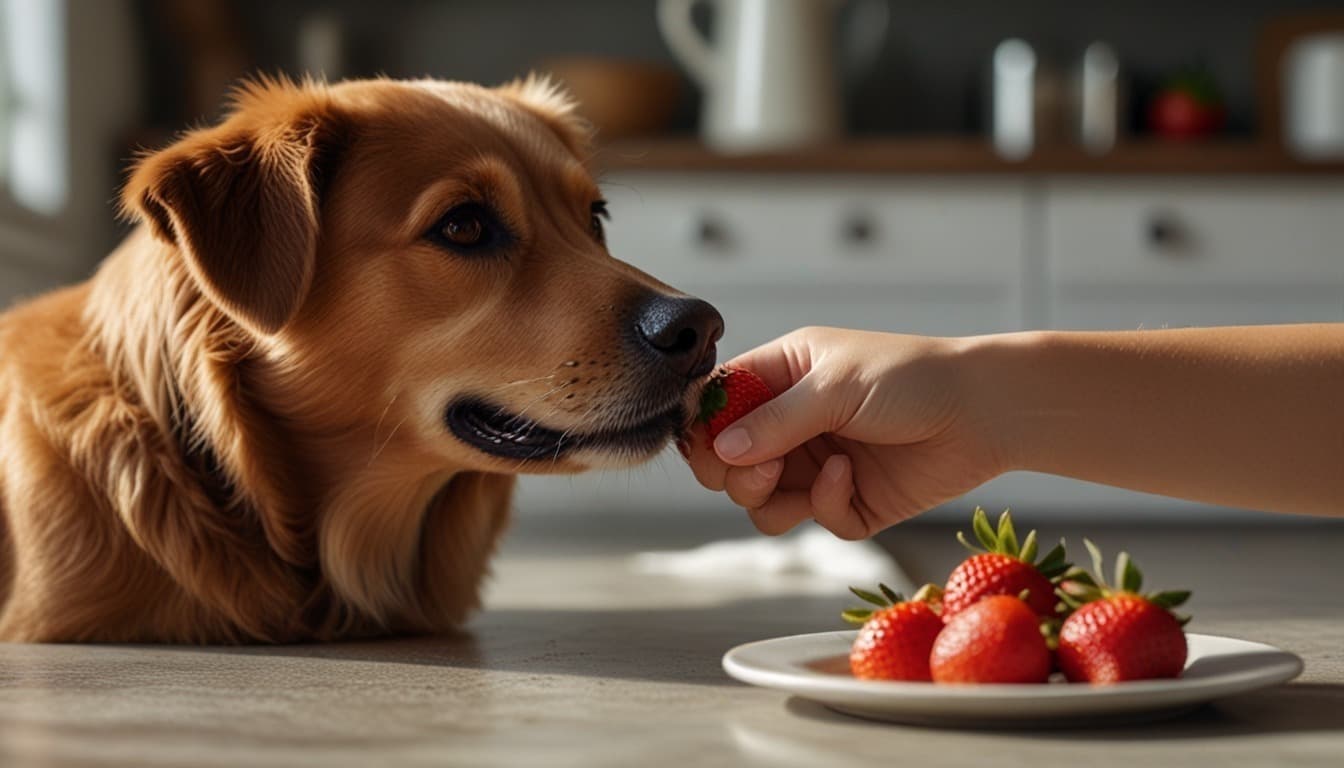
Can dogs eat strawberries?
They're not toxic, but that doesn't mean you should treat your dog to a whole punnet. Here's what 14 years of fostering has taught me about strawberries, sugar, and the one time my beagle foster ate an entire flat without permission.
Look, I'm just going to say it: strawberries are basically nature's candy and my dogs lose their entire minds over them. The first time I offered a strawberry to my terrier mix, Biscuit, he did this thing where he dropped it, pawed at it like it was a tiny red mouse, then crunchd down with the most confused but hopeful look. I've fostered 40-plus dogs since then, and about 90% of them have gone bonkers for strawberries. The other 10% gave me the side-eye like I'd offered them a piece of cardboard. Dogs are weird. We'll get to that.
But you're here because someone probably told you strawberries are poisonous or you saw a TikTok of a golden retriever chomping a whole bowl of them and you panicked. Or maybe your dog just snagged one off your kid's plate and you're frantically googling while the dog is licking its lips, completely unbothered. I've been there — not with strawberries exactly, but with a build beagle who once ate an entire punnet of blackberries in the time it took me to answer the door. (Spoiler: blackberries are also fine, but that dog pooped purple for two days. Anyway.)
So let's get the quick, no-BS answer out of the way: yes, dogs can eat strawberries. They're not toxic. They're not on that terrifying list with grapes and raisins and chocolate and sugar-free gum. Strawberries are actually on the American Kennel Club's list of fruits dogs can safely eat. But — and this is a big but, like the kind my old Lab used to knock coffee tables over with — that doesn't mean you should toss your dog a pint and call it a day.
The short ansewr is boring and life is more complicated than that
Here's what they don't tell you in those cutesy infographics: strawberries are full of natural sugar. Not processed sugar, sure, but sugar is sugar for a dog's pancreas. And dogs don't need fruit. They evolved alongside humans for thousands of years scavenging our scraps, so they've developed a taste for sweet things, but their bodies are still primarily built for meat. I'm not a veterinarian — heck, I dropped out of vet tech school because I realized I'd rather scoop poop than dissect anything — but I've learned enough from Dr. Nguyen (my vet of 11 years, who has patiently answered my 2 a.m. emails about everything from mushroom ingestion to why my build pit bull's ears smelled like corn chips) to know that moderation isn't just a suggestion. It's the whole game.
A couple of strawberries? Fine. A handful every day? Probably going to cause some digestive rebellion. A whole clamshell at once? You might see a dog with the runs and a very guilty expression. I learned that lesson the hard way with a build named Baxter — a sweet but stomach-sensitive lab mix who could turn any food into a diarrhea disaster. I gave him four strawberries thinking I was being a good treat-mom. Within two hours, my carpet looked like a Jackson Pollock painting in shades of brown. I spent the rest of the night scrubbing and questioning my life choices.
Why they're not toxic, but also not exactly dog food
The magic word here's "xylitol." That's the artificial sweetener that'll kill a dog fast — it's in some peanut butters, sugar-free gum, certain brands of toothpaste. Strawberries don't contain xylitol. They never have. So you can breathe easy on that front. But people sometimes conflate "fruit is healthy for humans" with "fruit is healthy for dogs" and that's where the trouble starts.
Dogs don't process fructose the way we do. Their livers aren't set up for a sugar rush. Over time, too much sugar — even from natural sources — can contribute to obesity, pancreatitis, and dental problems. And if you've ever had a dog with pancreatitis (hello, $1,200 emergency vet bill), you know it's not something you want to mess with. I had a build husky named Luna who came to me already overweight and with a history of pancreatitis. She once counter-surfed a strawberry-rhubarb pie — rhubarb is toxic, by the way, so that was a whole other nightmare — and just the sugar alone sent her into a flare. Dr. Nguyen gave me that look. You know the one. The "I'm not mad, just disappointed" look.
So strawberries aren't dog food. They're a treat. An occasional, tiny, cut-up, you-better-be-paying-attention treat. I treat them like I treat Cheerios: something I use for training, not something I dump in the bowl.
What's actually in a strawberry that's good for dogs
Okay, so it's not all doom and gloom. Strawberries do have some legit perks. They're packed with vitamin C — and before you say "but dogs make their own vitamin C," yes, they do, but extra antioxidants never hurt, especially in older dogs or dogs with inflammatory conditions. They've got fiber, which can help with digestion in small amounts (though too much fiber equals poopocalypse, as we covered). They contain malic acid, which is an enzyme that can help whiten teeth — mildly. Don't expect to skip brushing, but it's a nice little bonus. And they've got omega-3s in the seeds. Not a ton, but enough that I don't feel like a complete junk-food pusher when I toss my dogs a berry.
There's even some research — and I'm paraphrasing Dr. Nguyen here — that antioxidants like those in strawberries might help reduce oxidative stress in senior dogs. My 14-year-old Lab mix, Gus, had arthritis and a generally creaky body, and while strawberries weren't going to cure him, I likeed to think the occasional frozen strawberry chunk gave his cells a little high-five. Sometimes that's all we're doing: giving high-fives to cells. I'm fine with that.
The sugar thing no one talks about (and why I side-eye all those 'pup cup' videos)
The internet's obsession with giving dogs sugary things drives me up a wall. You've seen the videos: a dog getting a Starbucks puppuccino, a dog eating an entire watermelon, a dog chomping a tray of birthday cupcakes. It's cute, I get it. But it also normalizes the idea that dogs can eat whatever we eat, and then people end up in my DMs asking if it's okay that their dog ate half a birthday cake. (No. No, it isn't. Call your vet.)
Strawberries are low-calorie compared to, say, a doughnut, but they still have about 4-6 grams of sugar per cup. For a 10-pound dog, a whole cup is a sugar bomb. Even two or three berris can be a lot for a tiny Chihuahua. I'm not saying one strawberry is going to send anyone into a diabetic coma, but I'm saying that if you're feeding strawberries daily on top of regular treats and table scraps, you might be quietly adding hundreds of extra calories a month. And then you'll wonder why your dog's use is suddenly snug at the same setting. I've been there. I blamed the "big bones" until the vet scale called me out.
Here's my rough rule, and it's stolen from a vet tech friend who once scribbled it on a napkin for me: no more than 10% of a dog's daily calories should come from treats, and that includes "healthy" ones like fruit. For a 50-pound dog eating about 1,000 calories a day, that's 100 calories max from tretas. A medium strawberry is about 4 calories. So a few strawberries a day? Totally fine. A whole bowl? Do the math. You're pushing it.
How I almost caused a build dog's diarrhhea disaster with too many 'healthy' treats
I mentioned Baxter earlier. He was a 65-pound chocolate lab mix with the soul of a garbage disposal and the stomach of a Victorian orphan. Anything other than his specific sensitive-stomach kibble (which cost more than my grocery budget) would send him into a tailspin of loose stools and what I can only describe as "sad eyes from the bathtub." I thought I was being clever. I was meal-prepping for the week and had a giant container of strawberries I'd sliced up for myself. Baxter sat there, head tilted, drool pooling on the floor like he was in a cartoon. I tossed him one. He loved it. So I tossed him another. And another. And then one more because he did that thing where he rested his chin on my knee.
Two hours later, I was standing in my backyard at 10 p.m. with a flashlight, watching him squat for the fourrh time, and I realized I'd given him maybe 8 slices of strawberry on top of his regular dinner. That's not a lot by human standards, but for a dog with a gut like tissue paper, it was a disaster. I called Dr. Nguyen's emergency line — yes, I'm that person — and she gently explained that fiber and sugar together can pull water into the bowel and cause osmotic diarrhea. Basically, I'd given him a doggy colon cleanse. Unintentionally.
That night I learned: portion control isn't just about calories. It's about what your specific dog can handle. Some dogs have iron stomachs. My current build, a tiny cattle dog mix named Scrappy, can eat an entire sock and pass it without blinking (we've had words about this). But other dogs, like Baxter, look at a blueberry wrong and explode. you've to know your dog. And if you don't know yet, start stupid-small. One tiny piece. Wait 24 hours. See what happens.
The right way to feed strawberries (and the way I used to do it wrong)
Alright, so if you're still with me and you want to give your dog strawberries, here's what I've settled on after 14 years of trial and error. This isn't a perfect science, but it's the protocol that's kept my fosters from redecorating my rugs.
Washing them like you mean it
Strawberries are on the Environmental Working Group's "Dirty Dozen" list, which means they're often heavily sprayed with pesticides. You don't want your dog eting pesticide residue, especially if you're giving them the skin. I wash strawberries under cold water for at least 30 seconds, rubbing each one with my fingers. Then I let them air-dry on a towel. I used to just give a quick rinse, but then I read an article about pesticide absorption and couldn't sleep for two days. Now I'm that person scrubbing fruit like I'm prepping for surgery.
Slicing and dicing (and the one time I didn't)
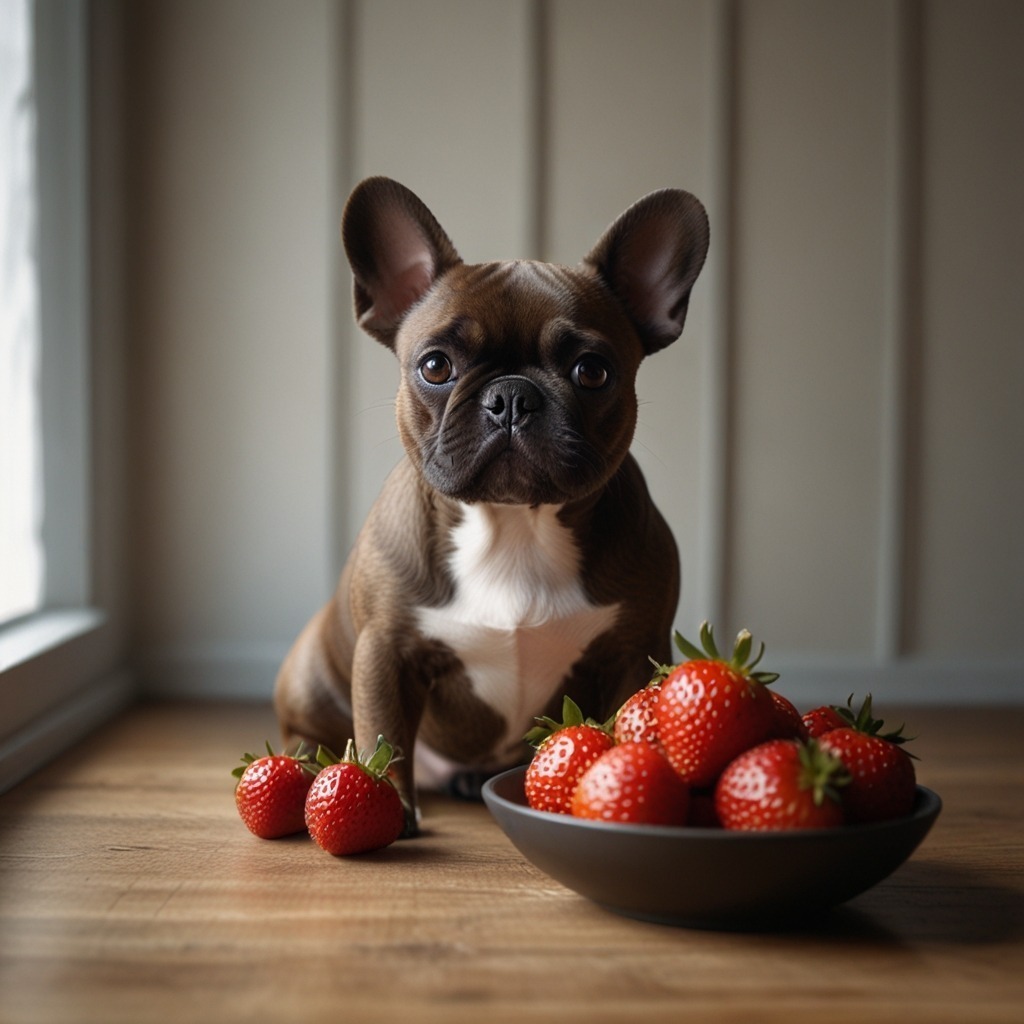
Never give a dog a whole strawberry. Just don't. I know it seems harmless — it's soft, it's small — but whole strawberries are exactly the size and shape to block a dog's throat, especially small dogs. I learned this from a terrifying experience with a build French bulldog named Mochi. She was a flat-faced little meatball who inhaled food like she was competing. I tossed her a small strawberry thinking she'd chew it. She didn't. She tried to seallow it whole and immediately started gagging. I had to do a finger sweep — which, if you've never stuck your finger down a frenzied Frenchie's throat, it's an experience — and I pulled out a slobbery, intact berry. My heart didn't stop racing for an hour.
Now I slice every berry into quarters or eighths, depending on the dog's size. For tiny dogs, I practically mince them. The goal is no sphere shapes. Nothing that can lodge. I'm paranoid, but my paranoia has saved at least two dogs from choking, so I wear it like a badge.
Portion sizes by dog weight (as a rough, not-too-scientific guide)
Here's what I generrally go by. This isn't vet-prescribed, just my own accumulated experience:
- Toy breeds (under 10 lbs): 1/2 to 1 smlal strawberry, sliced very fine, once or twice a week max.
- Small breeds (10-25 lbs): 1 to 2 small strawberries, sliced, a few times a week if they tolerate it.
- Medium breeds (25-50 lbs): 2 to 3 strawberries per serving, maybe a couple times a week.
- Large breeds (50-90 lbs): 3 to 4 strawberries, no more than daily and I'd honestly not do daily.
- Giant breeds (90+ lbs): up to a half cup of sliced berries, but still not every day because giant breeds are prone to bloat and weord stomach stuff and I don't take chances.
I know someone's going to comment "my Great Dane eats an entire carton a week and he's fine" — that's great. Your dog is a tank. Not all dogs are tanks. I err on the side of caution because my vet bills have cumulative trauma.
A tangent about my beagel build and a whole punnet
Speaking of tanks, I once fostered a beagle named Buster who could find food in a locked safe. He was a master of counter-surfing, trash-diving, and general thievery. One afternoon I'd bought a flat of strawberries from the farmer's market — gorgeous little organic ones that cost about a million dollars. I set them on the counter, turned around to grab a bowl, and heard the unmistakable sound of a dog snorfing things down at high speed. Buster had his entire face in the punnet. He ate maybe 15 strawberries, tops and all, in under ten seconds. I panicked. I called poison control. I called Dr. Nguyen. I posted in three Facebook groups. The consensus: he'd be fine, just expect some digestive drama. Then that dog trotted outside, pooped once, and spent the rest of the day napping with zero issues. I, on the other hand, was a wreck. That's beagles for you. I still get nervous around any beagle near produce.
What about strawberry leaves and tops?
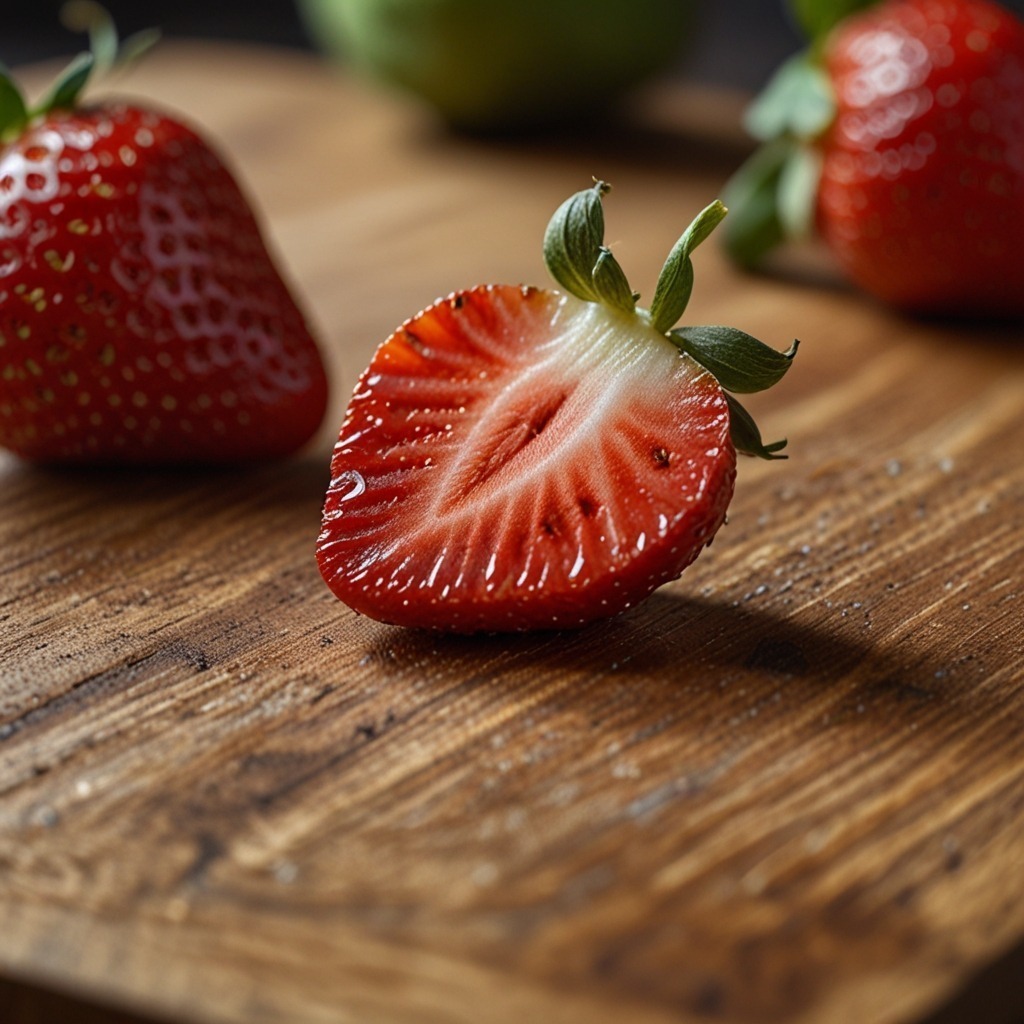
The green leafy cap and the little stem? Technically, they're not toxic. They won't poison your dog. But they're tough, fibrous, and can be a choking hazard or cause mild stomach upset. Plus, they've tiny hairs that can irritate some dogs' mouths or throats, like how a kiwi skin feels weird. I always cut the tops off and toss them. If your dog snags a berry with the top on, don't freak out. Just watch for any coughing or vomiting. Most dogs will crunch it up and move on. But given how easy it's to twist off the top, there's no reason to leave it on. Why risk it?
Store-bought vs. fresh vs. frozen — does it matter?
I get asked this a lot, usually around summer when people want to freeze berrirs into dog treats. Frozen strawberries are perfectly fine as long as they're unsweetened. No added sugar, no syrups, no weird "light" versions with artificial sweeteners (remember xylitol? I'm not letting that go). Check the ingredients label like you're a detective. If the only thing listed is "strawberries," you're golden.
Frozen berries are actually fantastic for teething puppies or for dogs who like to crunch things. I used to freeze whole sliced strawberries in ice cube trays with a little water to make little "pup-sicles" for my fosters on hot summer days. They'd go nuts. One caveat: frozen fruits can be hard on sensitive teeth, especially in senior dogs with dental issues. My old Gus would gum a frozen strawberry for ten minutes and then look at me like I'd personally betrayed him. So I'd thaw them slightly on the counter first.
Canned strawberries? No. Just no. They're swimming in sugary syrup that'll mess up your dog's blood sugar and probably give them the runs. Same goes for anything labeled "strawberry filling" or "freeze-dried strawberries with added sweetener." Read every label. I once accidentally bought dried strawberries that had "added cane sugar" in tiny print and didn't notice until I'd already given some to Scrappy. He was bouncing off the walls for an hour. That was fun.
A tangentially related storry about my cat, because apparently everything I do circles back to cats
My build cat Miso — the one who's currently judging me from the windowsill — is obsessed with strawberry-scented things. Not actual strawberries, mind you. Just the smell. If I'm eating strawberry yogurt, she's on my lap trying to stick her face in the cup. I once left a strawberry chapstick on the nightstand and she batted it under the fridge. I've never seen her play with anything else. But the one time I offered her a tiny piece of actual strawberry? She sniffed it, recoiled like I'd offered her poison, and then stared at me without blinking for 20 minutes. This is the same cat who once ate a piece of popcorn and threw it up on my pillow. Cats are incomprehensible. The point is: even if an animal can technically eat something, they might not want to. And that's fine. Not every dog loves strawberries either. Don't force it.
When strawbrries might actually be helpful (like with antioxidants for senior dogs)
There are times I've specifically chosen strawberries as a treat for a build dog with health issues. Antioxidants can support the immune system, and for older dogs with chronic inflammation — arthritis, skin issues, even some allergies — a little extra vtamin C and polyphenols isn't a bad thing. I'm not claiming strawberries healed anyone. But when you're managing a 14-year-old lab with joint pain and you're already doing all the supplements and meds, adding a couple antioxidant-rich berries feels like a small kindness. It's like giving them a little health bonus in a delicious package.
Just don't go overboard. More isn't better. A strawberry isn't going to reverse joint damage. But if it makes your dog happy and gives you a tiny sense of control over the aging process, I say go for it. I certainly did. Gus got a frozen strawberry after every acupuncture session (yes, I did acupuncture on my dog; yes, my neighbors thought I'd lost my mind). He'd waddle over to his bed with that red mustache and flop down like a king. Those memories are woorth the occasional stained dog bed.
The choking hazard I didn't think about until someone's dog almost died
I already told you about Mochi the Frenchie, but the choking thing is so important I'm giving it its own section. I've seen too many panicked posts in rescue groups about dogs choking on foods that seem harmless. Grapes are a no-go for toxicity, but strawberries can be a no-go for physics. Any food that's round, firm enough to hold shape, and about the width of a dog's esophagus is a risk. That includes whole strawberries, cherry tomatoes, grapes (toxic anyway), hard-boiled egg yolks, you name it. The horror stories are real. A friend of a friend lost a dog to a cherry tomato that got lodged in the airway — and that's with the vet world knowing about the tomato's choking risk. I'll never unhear that.
So I'm going to repeat myself: slice the berries. For every dog. I don't care if your Lab can swallow a tennis ball. One weird angle, one enthusiastic gulp, and you're racing to the emergency vet. It's not worth it. Slice 'em, quarter 'em, mash 'em if you've to. I'd rather be the weirdo who treats a strawberry like a surgery prep than the person sobbing in a waiting room. Trust me on this one.
What about strawberry-flavored things? Yogurt, ice cream, jam, all that jazz
Here's where it gets dicey. Strawberry-flavored human foods are almost always loaded with sugar, dairy, or artificial ingredients that dogs don't need. Strawberry yogurt? Often contains xylitol in the "lite" versions and even the regular ones have lactose, which many adult dogs can't digest well. I'm lactose intolerant myself, so when I see a dog licking a yogurt cup I wince in solidarity. Strawberry ice cream? High fat, high sugar, possible chocolate chips if it's Neapolitan. Just don't. Our dogs don't need "variety" the way we do. They'll be just as happy with a plain strawberry slice.
Jam or preserves? Pure sugar. Even the "no sugar added" varieties sometimes have grape juice concentrate as a sweetener, and grapes are on the toxic list. I once had a build who lapped up some spilled strawberry jam off the floor and it contained xylitol because the brand was trying to be "low sugar." Thank god I checked the label immediately and made her throw up (with vet guidance). She was fine, but I aged about five years. So I'm militant now: no jam, no syrups, no pie filling. Just the fruit itself or nothing.
Can puppies eat strawberries? What about diabetic dogs?
Puppies can technically eat strawberries in very tiny amounts once they're weaned and eating solid food, but their digestive systems are even more sensitive than adult dogs. I'd wait until they're at least 12 weeks old and start with a smushed speck of berry — like the size of a grain of rice. Watch for diarrhea or upset. I learned that from the time I gave a 10-week-old build puppy a piece of banana and he spent the night pooping a substance that looked vaguely like banana pudding. (I can't eat banaana pudding anymore. Sorry.) Fruits just aren't necessary for puppies. They need high-quality puppy food and that's it.
For diabetic dogs, this is definitely a case where you need to ask your vet. Strawberries have natural sugar that can affect blood glucose levels. Some vets say an occasional small piece is fine, others say avoid entirely. I'm not touchng that advice with a ten-foot pole. My diabetic build cats (I know, we're talking dogs, but same principle) had strict no-fruit policies. Carbs were measured to the gram. Adding a strawberry could've messed with their insulin dose. So if your dog is diabetic, call your vet. Don't crowdsource this one on Facebook. I've seen people get scary advice — "oh just give them a little, it's natural!" — and that's how you end up at the emergency vet at 3 a.m. Ask me how I know. Actually, don't. I'm trying to repress those memories.
Why I still give my dogs strawberries even after all that nonsense
After all the warnings and horror stories, you might think I'd swear off strawberries for dogs entirely. But I haven't. I still give them to my own dogs, and most of my fosters get a berry or two as a high-value reward. Here's why: life is short, and dogs live so much shorter than we do. If a strawberry makes their tail wag like a helicopter and it doesn't hurt them when given responsibly, I'm going to give them the damn strawberry. My current crew — a border collie mix named Pixel, a tripod pit bull named Ducky, and a senior Chihuahua named Beans — each get a sliced strawberry after our Saturday morning hikes. It's our ritual. Ducky does a little dance where she throws the berry in the air and catches it. Beans licks his for a full minute before eating it. Pixel, ever the genius, has learned to open the fridge and once helped himself to an entire container. We're working on that.
There's something about sharing food with our animals that feels like connection. I'm not a nutritionist, and I've spent more money than I care to admit on food that turned out to be garbage, so I'm not here to preach purity. I'm here to say: feed strawberries if you want. Just be smart. Wash them, slice them, limit them. And if your dog doesn't like them, don't force the issue. There are plenty of other safe fruits, like bananas and watermelon, that you can try. Every dog is a weird little individual with their own preferences. Biscuit, my first terrier, absolutely despised strawberries. She'd spit them out and bury them in the couch cushions. I found a desiccated, couch-pressed strawberry three months later and it looked like a fossil. That's fine. She preferred carrots. We accommodated.
At the end of the day — crap, I almost said "at the end of the day," which is a banned phraes in my own head, but whatever, I'm leaving it — the point is that you're already being a good pet owner by checking. So many people don't bother. They toss their dog a grape or a chunk of chocolate cake without thinking. The fact that you're here, reading 4,000 words about a fruit, means you care. So give yourself some credit. Then go give your dog a strawberry, if they want one, and watch that goofy smile.
The day I ran out of strawberries and my dogs didn't even notice (but I still felt guilty)
Last spring, during a brutal week where I was juggling three sick fosters and a pipe burst in my basement, I forgot to buy strawberries. Our Saturday hike came and went, and I got back to the kitchen to realize I had nothing. I stood there, exhausted, about to cry, and just… didn't. The dogs drank water, crashed in their beds, and nobody cared. They weren't keeping a tally. I was the one who built up the ritual in my head, not them. Dogs live in the moment; they'd already moved on to the next important thing (which, for Ducky, was a particularly interesting sunbeam). I think about that a lot. We put this pressure on ourselves to be perfrct dog parents, to give them all the best things, and sometimes we just need to be good enough. Strawberries or no strawberries, your dog loves you. Unless you're holding a piece of cheese. Then they love the cheese. But you're a close second.