The Day My Vet Asked If My Cat Was 'Gravy-Trained' — and the 18-Month Journey to a Cat Who Could Lick His Own Butt Again
When my foster cat Brick arrived at 22 pounds, he couldn't reach his own butt. Here's the messy, frustrating truth about safe cat weight loss — from a $60 diet food fail to the kitchen scale that actually saved him.
The build cat who couldn't reach his own butthole
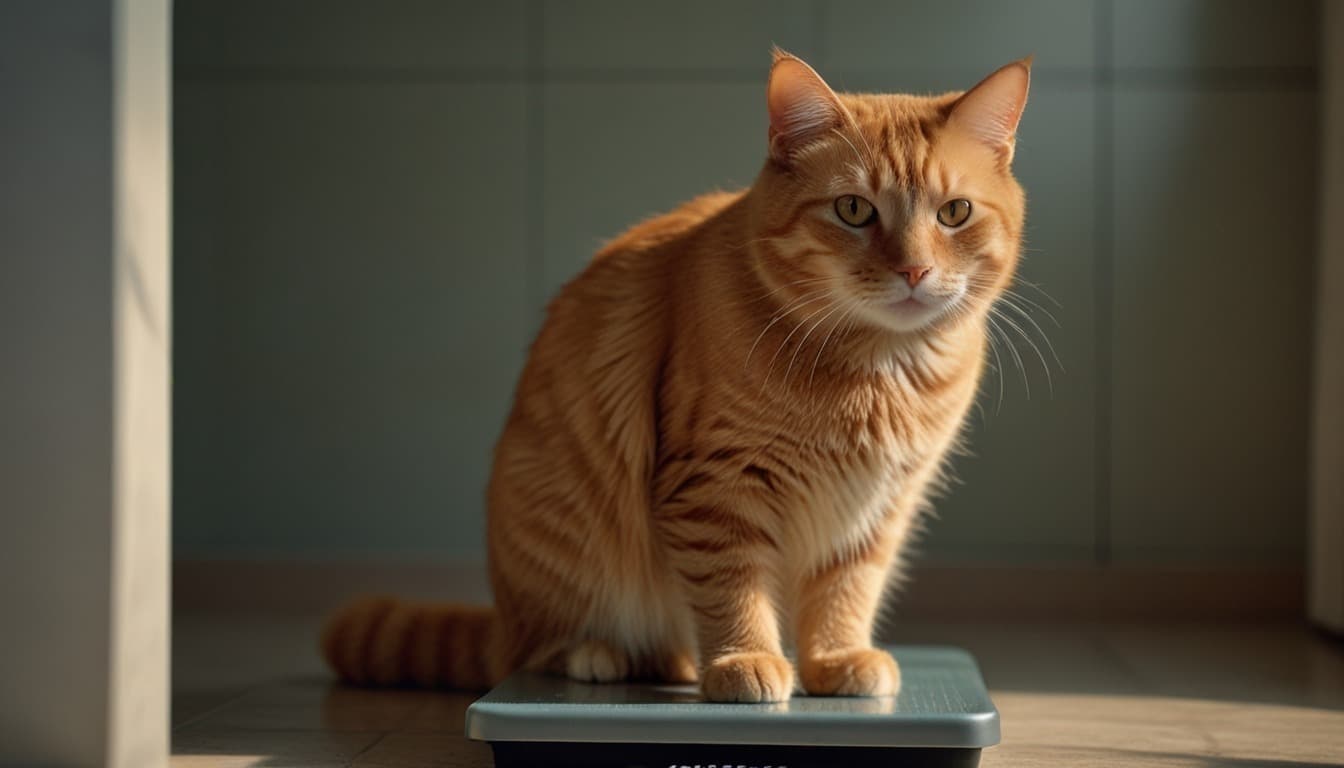
His surrender paperwork said his name was Brick. I didn't get the joke until I lifted the carrier and felt my spine protest. Twenty-two pounds of orange tabby stared up at me with the resigned expression of a baked potato that knws it's about to be microwaved. Brick could walk — barely — but he couldn't groom his back half. His belly dragged on the floor when he waddled. And the smell… let's just say I got real familiar with unscented baby wipes in those first few weeks. I'd wipe him down twice a day, muttering apologies he didn't care about.
The previous owners had free-fed him dry kibble for six years, topped with whatever canned gravy they were eating. "He just loves his treats," the woman had said when she handed him over, like that explained a cat nearly three times the size he should have been. I smiled and nodded and silently cursed every pet food commercial that shows a happy fat cat as a sign of love. That cat wasn't happy. He couldn't jump onto a sofa. He panted after walking fifteen feet. And when he tried to clean himself, he'd topple sideways like a ship in a storm. He was a medical emergency waiting to happen, and I knew it. I'd been fostering for over a decade at that point, and I'd dealt with underweight cats, sick cats, traumatized cats — but a cat this dangerously obese was new territory, and honestly, I was terrified I'd mess it up.
I'm not a vet. I'm just someone who's made every cat-feeding mistake short of actually baking them a lasagna. And the only reason I'm writing this is becausse I eventually figured out how to help Brick drop seven pounds over 18 months — safely, slowly, without him hating me or developing hepatic lipidosis. It was a road paved with terrible commercial diet food, a kitchen scale that got more use than my stove, and one very angry vet visit that I'll get to later. This isn't one of those "10 easy tips" lists. It's the messy, frustrating, "why the hell does nobody talk about this" truth about cat weight loss. Let's just start at the beginning, which was the day my vet, Dr. Nguyen — the saint who has put up with my panic calls through three dogs and a divorce — looked at Brick and said, "So, was he gravy-trained?" I'd never heard the phrase before. I've now, and I hate it. Gravy-trained. Meaning they add wet food or gravy mix-ins to dry kibble so the cat won't ignore the dry food. It teaches the cat to wait for the good stuff, and the owners keep piling more on because the cat whines. It's a cycle of carbohydrate-laden junk and emotional blackmail, and it creates cats who are basically furry balloons.
I thought I knew what 'free-feeding' meant. I was wrong
Here's the thing about cat weight gain: it happens so slowly you don't notice until your cat can't fit through the cat flap anymore. I learned that the hard way with my own cat years before Brick, a gray tuxedo named Miso. Miso was my first build fail, and I frer-fed him dry food because that's what I'd always done. Fill the bowl, let him graze. He was two years old and fluffy, and I didn't realize that underneath all that floof, he was turning into a beanbag chair. My vet at the time said, "He's a little heavy. Maybe cut back a bit." But I didn't have a number. I'd pet him and think, he's just big-boned. The truth is, indoor cats burn roughly the same calories as a houseplant. They sleep 16 hours a day, and if you give them constant access to food that's calorically dense and low in water, they'll eat out of boredom the same way I eat cheese at midnight. Grazing is for cows, not cats.
Brick was a different level. His previous family had left a 5-pound gravity feeder out at all times, the kind that looks like a water cooler but dispenses regret. They said he was "finicky" and needed wet food mixed in to entice him. So he'd been getting a quarter can of Fancy Feast gravy mixed into a bowl of high-carb kibble twice a day, plus whatever trickled out of the gravity feeder. I did the calorie math later — he was probably consuming 450 calories a day. A neutered, sedentary cat his size should've been eating around 200-220 for weight loss. So yeah, he was literally eating for two. No wonder he looked like a furry ottoman.
What kills me is that the owners thought they were beimg kind. They loved him. They just didn't know what a healthy cat shape looked like. And honestly, a lot of us don't. I see it all the time in the rescue: people bring in cats they think are "just fluffy" and the vet has to explain that no, a cat should have a visible waist when you look from above, and you should be able to feel their ribs with a light touch — not dig for them like you're searching for treasure. If your cat has a primordial pouch that swings side-to-side when they walk? That's one thing. If their entire body swings? That's a problem.
The expensive $60 bag of 'light' kibble was a spectacular failure
My first move was the one every well-meaning owner makes: I went to the pet store and bought a pricey bag of "weight management" dry food. It had a picture of a sleek cat on it, promised fewer calories, and cost more than my own groceries. Brick hated it. He'd sniff the bowl, look at me with betrayal in his eyes, and walk away. So I did what any sucker does — I mixed it with the wet food he loved, thinking I was clever. But the wet food alone was enough calories for a meal, and the "light" kibble was still 320 calories a cup. I was just piling on more. For about three weeks, Brick maintained his weight perfectly. Not a single ounce lost. I felt like an idiot.
Wait, I'm getting ahead of myself. Let me back up to the vet visit where Dr. Nguyen actually laughed — not at me, but at the "light" food I'd brought in a baggie. She shook the kibbles in her palm and said, "Sarah, this is still mostly corn and pea protein. Cats are obligate carnivores. They don't need this stuff. It's making him soft and full, not lean." That's when she explained the concept of metabolic adaptation — where a cat's body, when deprived of quality protein but sill stuffed with carbs, hangs onto fat and starts burning muscle instead. A fat cat can actually be malnourished. That idea haunted me.
For a while I tried just cutting portions of that stupid diet kibble. Brick responded by screaming at 4 a.m. He'd knock things off my nightstand — a book, my phone, a full glass of water. He discovered that bapping the blinds made a satisfying rattle. I caved so many times I lost count. I'd shuffle to the kitchen half-asleep and pour a tablespoon of kbble into the bowl, hating myself. This went on for two months. I didn't win those months. Brick did. He was a fat, manipulative genius and I was his food slave.
The calorie math that made me want to scream
Eventually I calmed down enough to google "how many calories does a cat need to lose weight" and found a formula that made my brain want to evacuate my skull. It goes something like: (cat's ideal weight in kg to the power of 0.75) × 70 = resting energy requirement. Then you multiply by a factor for neutered indoor cats (1.0–1.2) to get maintenance. For weight loss, you feed 80% of maintenance. Brick's ideal weight was about 12 pounds (5.5 kg). That math gave me roughly 200 calories a day for slow, steady loss. Two hundred calories. That's like, one and a half cans of pâté, or less than half a cup of most dry foods. No wonder he was fat. I'd been easily doubling that without trying.
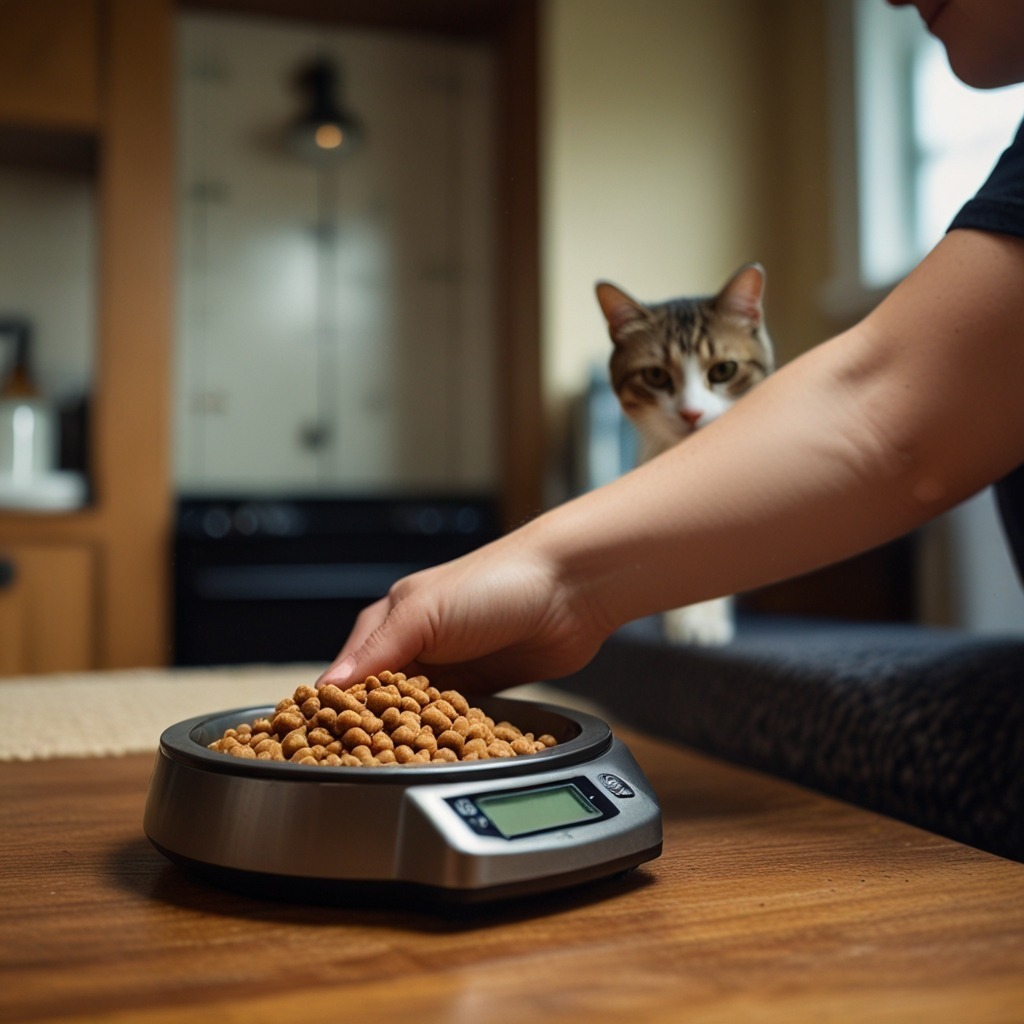
I weighed out his food on a digital kitchen scale — the same one I use for my own failed baking attempts — and it changed everything. No more guessing with measuring cups. Kibble density varies wildly. One "cup" of one brand could be 100 calories more than another. If you're not weighing, you're gambling. I made a spreadsheet. Yes, I'm that person. But honestly, seeing the numbers kept me sane. I'd weigh him once every two weeks (more often and you'll go nuts with daily fluctuations), and adjust down or up by 5-10 calories if the loss stalled. It took four months to lose half a pound. HALF A POUND. That's a safe rate, about 0.5% body weight per week. Faster than that and you risk hepatic lipidosis, a fancy term for "your cat's liver just gave up because fat flooded it." More on that nightmare later.
One thing nobody tells you: you've to be patient enough to watch a cat lose weight slower than paint dries. Cats didn't get fat in a week, and they shouldn't get thin in a week. But our brains want results, so we cut too drastically. I've caught myself doing it. One week I'd think, "he's fine, maybe I'll drop to 180 calories," and then I'd picture his liver failing and I'd immediately put an extra gram of food back in the bowl. It's a constant mental fight.
Actually, speaking of hepatic lipidosis — let me tell you about the cat that taught me that lesson before Brick. Her name was Dumpling, and she wasn't even mine. She was a build from a hoarding case who came to me underweight, finally started eating, and then stopped cold when I tried to switch her food too fast. Within three days she was yellow. I rushed her to the emergency vet and they had to intubate her. The vet explained that when an obese cat suddenly stops eating, their body panics and dumps fat into the liver, which can't process it. It can be fatal in days. I never forgot that. So when I work with a cat like Brick, I'd rather lose weight at a glacial pace than risk that train wreck. That's also why I'll scream it from the rooftops: if your overweight cat goes more than 24 hours without eating, that's an emergency. Not something to Google, not something to wait out. Vet. Now. I've got a whole post about that panic-induced lesson with a kitten, but that's a different kind of digestive horror show.
Here's what actually worked (after I stopped being an idiot)
Okay, so after the diet food disaster and the screaming, I completely overhauled my approach. And the spoiler is this: the stuff that workeed was way simpler and way cheaper than the $60 bag of corn pellets.
Wet food: the hill I'll die on
Cats are desert animals. They're designed to get most of their water from their prey. Dry food is 10% moisture; wet food is 78%–82%. That's a huge difference. When a cat eats dry food, they don't drink enough to compensate, so they live in a constant state of mild dehydration. That messes with their kidneys and their satiety signals. Wet food, especially pâté or minced varieties, fills them up with water and protein, not carbs. Brick switched to 100% wet food — I picked a few brands with high animal protein, no corn/wheat/soy, and around 90–110 calories per 3-ounce can. He got 1.5 cans split into three meals a day (breakfast, after-work, bedtime) plus a tiny midnight snack of 10 freeze-dried chicken bits because he'd trained me so thoroughly that I just surrendered. The midnight snack was 15 calories and it bought me sleep. Worth it.
Now — transitioning to wet food is a whole process if your cat is a kibble addict. I learned that the hard way with Miso, who once pooped on my rug because I switched too fast. I covered that mess in another post, but the short version: mix a teaspoon of the new food into the old food, increase by a teaspoon every 2–3 days, and don't rush it even if you're impatient. Brick took three weeks to fully switch. Three weeks of mixing, coaxing, and occasionally warming the food up in the microwave for 10 seconds to make it stinkier and more appealing. Stinks up the kitchen like low tide, but cats love it.
The scale in my kitchen that saveed my cat's life
I already mentioned weighing his food, but I want to emphasize how non-negotiable this is. If you're using a measuring cup, you could be off by 30% or more. I weigh his meals to the gram every single day. It sounds obsessive, and it's, but it's also the reason he lost weight without plateaus that lasted months on end. I'd weigh him every two weeks on a baby scale I bought for $30. If he didn't drop at least 0.1–0.2 ppunds, I'd tweak his intake down by 10 calories and wait two more weeks. Slow. Methodical. Boring. But effective.
This is also where an automatic feeder can help — if your cat isn't a mechanical genius like mine. I've a whole rant about the eleven feeders I tested before finding three that survived my cats' coordinated attacks. But for single-cat households, a microchip feeder can be a big deal for portion control. If you've got multiple cats and one is a food thief, you know the pain of separating meals. Been there. It's like living with tiny furry bank robbers.
Puzzle feeders: a love-hate relationship
I'm not going to pretend puzzle feeders solve everything. They don't. But they slow down eating and add a tiny bit of mental effort that burns, maybe, three calories. Still, Brick went from inhaling his meals in 45 seconds to spending 15 minutes batting a food-dispensing ball around the living room. It helped with boredom, which helped with the screaming. I used the Trixie activity board and a couple of simple balls that dispense kibble-sized treats. But here's the catch: if your cat is too fat to move much, they won't interact. Brick ignored puzzles for six weeks because bending over hurt his joints. I had to prop them on a low box at first. There's no shame in adapting things. I've had 40+ build cats and the one thing they all hated was my first scratching post, so I get that you gotta find what works for the specific animal.
Exercise: you can't walk a cat, but you can sure as hell make them chase a string
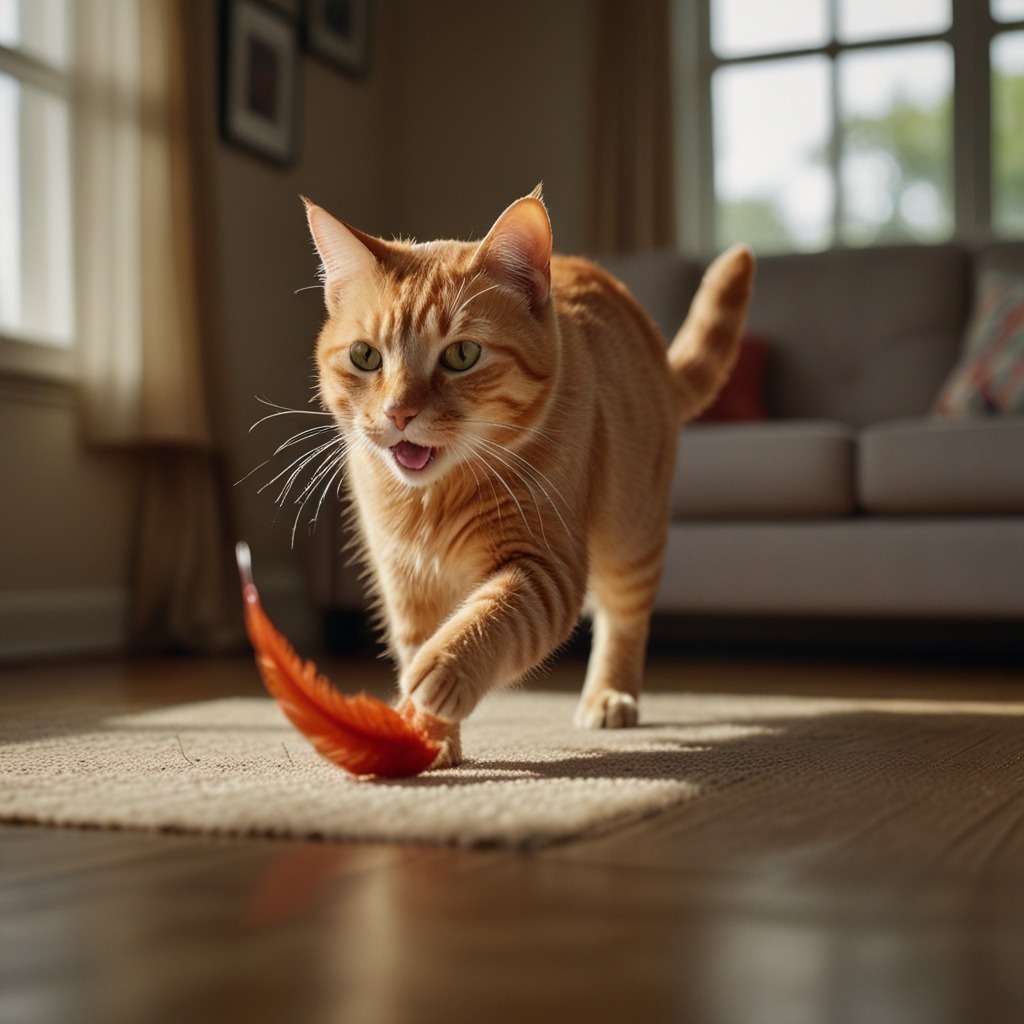
You can't put a cat on a treadmill, but you can do five-minute play sessions two or three times a day. For Brick, the magic wand toy was Da Bird — the one with the feathers that spin and make a fluttering sound. He'd watch it with those huge eyes and then, very slowly, he'd lift one paw. At first, he couldn't even swat without falling over. I'd cheer like a maniac when he managed two steps. It took months of short, loe-intensity play to build any stamina. Sometimes he'd just lie on his side and bat lazily until I accepted that was all he had. That's fine. Any movement counts. I also took him on "hallway adventures" — I'd carry him to the far end of the apartment and he'd waddle back. It was pathetic and adorable. Over time, the waddle became a trot.
One afternoon, he jumped onto the couch for the first time without me having to lift his back end like a climsy forklift. I literally cried into my coffee. My neighbor probably thought I'd lost it. But when you've wiped a cat's butt for months because he physically couldn't reach it, you take the wins where you can.
The time a build ca'ts weight loss taught me that gravity feeders are the devil
I want to circle back to a tangent that still infuriates me. About a year after Brick hit his goal, I took in a pair of bonded seniors from a family moving overseas. Both were overweight, both had been on gravity feeders their entire lives. The male, Gizmo, was a 17-pound tuxedo who would eat until he vomited, then eat the vomit, then go back for more. I'm not even kidding. The female, Penny, was more moderate but had early diabetes that the owners hadn't noticed because "she drinks a lot but that's normal, right?" Wrong. So very wrong. Polyuria and polydipsia — peeing and drinking a ton — are classic signs of feline diabetes, and those are directly linked to obesity and high-carb diets. I got them both on wet-food-only with measured meals, and within three months Pennny's blood glucose normalized enough that we avoided insulin. That's not always possible, but it's shocking how much a diet change alone can do. I wish every new cat owner got a broochure that said: "If you free-feed dry food, your cat will become an addict and possibly a diabetic. Regards, the Feline Pancreas." But we don't live in that world. We live in a world where pet stores sell "weight control" formulas that are 40% carbohydrates because rice is cheap. I just can't.
Which is my way of saying: if your cat needs to lose weight, step one is looking at what they're eating. Not just calories — the composition. A lot of "diet" foods are just lower-fat versions of the same high-carb garbage. Fat doesn't make cats fat; excess calories and carbs do. Cats turn protein and fat into fuel. Carbs spike insulin and get stored as fat. It's not that different from humans, honestly. I've watched friends put their cats on weight-loss prescription dry foods that cost $80 a bag and have corn as the second ingredient, and I've to bite my tongue because I'm not a vet and I can't prescribe. But I can privately rage while writing an article on my kitchen table, and that's what this is.
What the vet said that made me cry (and then laugh)
Six months into Brick's journey, we'd lost about 2.5 pounds. He was down to 19.5, which is still obese for a medium-framed cat, but his mobility had improved so much that he could now reach his lower back with his tongue. I'd stopped the daily wipes. One day at a recheck, Dr. Nguyen palpated his belly and said, "You know, I can feel ribs now without having to guess where they're. That's a good sign." Then she paused and added, "You're doing the hardest part. Most owners give up by now. He's lucky he found you." I started ugly-crying right there in the exam room, and she handed me a tissue without missing a beat. Vets are unsung heroes. They see so many animals suffering from love that's just… misdirected. I'm not being dramatic. I've seen cats suffocated by too much food and too little understanding. Brick's case wasn't neglect — it was a lack of education. The same kind I had with Miso years ago, which I wrote about when his fur came out in clumps because I was feeding him twice a day but the wrong stuff. That lesson was expensive and humbling. But I'm proof you can learn, and I'm proof you can course-correct without being perfect.
She also warned me about something I hadn't considered: loose skin. As Brick lost weight, his primordial pouch became more pronounced, and the skin around his belly hung lower. That's normal. That's not "he's still fat." I see people in forums freaking out that their cat lost weight but now has a hanging belly. That's skin elasticity. Cats don't do ab workouts. Give it time. If you're unsure, run your hand along the sides — you should feel ribs with a thin fat layer, and behind that, a waist tuck. Trust your hands, not your eyes. Cats are masters of looking chubby even when they're fit.
He can lick his own butt now, and I've retired from butt-wiping duty
It's been 18 months since Brick waddled into my life smelling like a petting zoo. He now weighs 14.8 pounds — a little over ideal, but my vet is thrilled and says this is a healthy maintenance weight for his frame. He jumps onto the bed unassisted. He chases the laser pointer without wheezing. He grooms himself head to tail, and I haven't touched a baby wipe in six months. Most importantly, his bloodwork came back clean: no diabetes, no liver issues, no joint inflammation markers that had been elevated at his first visit. The cost of his food is about $2.50 a day, which is cheaper than the "light" kibble + vet bills I was racking up. Funny how that works.
I'm not going to pretend it was easy. There were nights I almost gave up, mornings I woke up to a toppled lamp and cat screams, weeks where the scale didn't budge. But the reward is a cat who is alive, comfortable, and no longer a ticking time bomb for hepatic lipidosis. If you're staring at your own chunky cat right now, feeling guilty, don't. Start small. Call your vet. Get a scale. Wean off the dry food slowly. Measure in grams. And for the love of all that's holy, don't let anyone convince you that a fat cat is a happy cat. Happy cats can lick their own butts. That's the bar. Aim for the butt.