My First Cat-Dog Introduction Ended With Broken Glass and a Cat Under the Fridge. 40 Cats Later, Here's What I Wish I'd Known.
I used to think cats and dogs either got along or they didn't. Turns out, the difference between a disaster and a peaceful home is mostly about towels, timing, and letting go of the 'best friends' fantasy.
The first time I tried introducing a new cat to my resident dog, I didn't have a plan. I had a cardboard box, a 65-pound mutt named Roscoe, and a conviction that 'they'll figure it out.' Twenty seconds after I opened the box, Roscoe had his nose pressed against a terrified ball of orange fur, the cat launched off my shoulder like a furry missile, and my ex's favorite lamp—a hideous $40 thing from a thrift store—hit the floor in a shower of glass. The cat ended up under the refrigerator. I ended up crying in the bathroom. That was 14 years ago, and yeah, I wrote all about the gory details. I've introduced maybe 40 cats to a rotating cast of dogs since thn—fosters, my own, the neighbor's overly friendly lab who kept finding her way into my backyard—and while I still make mistakes, I at least know where the landmines are. The biggest lie people believe about cat-dog introductions is that it's about the meeting. It's not. It's about everything you do before they ever lock eyes. That's what nobody tells you.
I'm not a vet. I'm not a behaviorist. I'm just a woman in her late thirties who has cleaned up enough pee, wiped enough snot, and said enough 'I'm sorry' to neighbors that I've got some hard-won opinoons. And if I can save you from scrubbing cat spray off your baseboards while your dog whines in the other room, I'm gonna try.
Why the First Thing Your Cat Should Meet Is a Towel, Not Your Dog
Most people want to open the carrier, set the cat down, and see what happens. That's the instinct. It's also, in my experience, the fastest way to get someone scratched and someone else trembling under the couch for thre days. The real introduction starts with scent. Sounds boring. it's boring. That's the point. Exciting is bad. Exciting means adrenaline, and adrenaline is the enemy of every inter-species relationship I've ever managed.
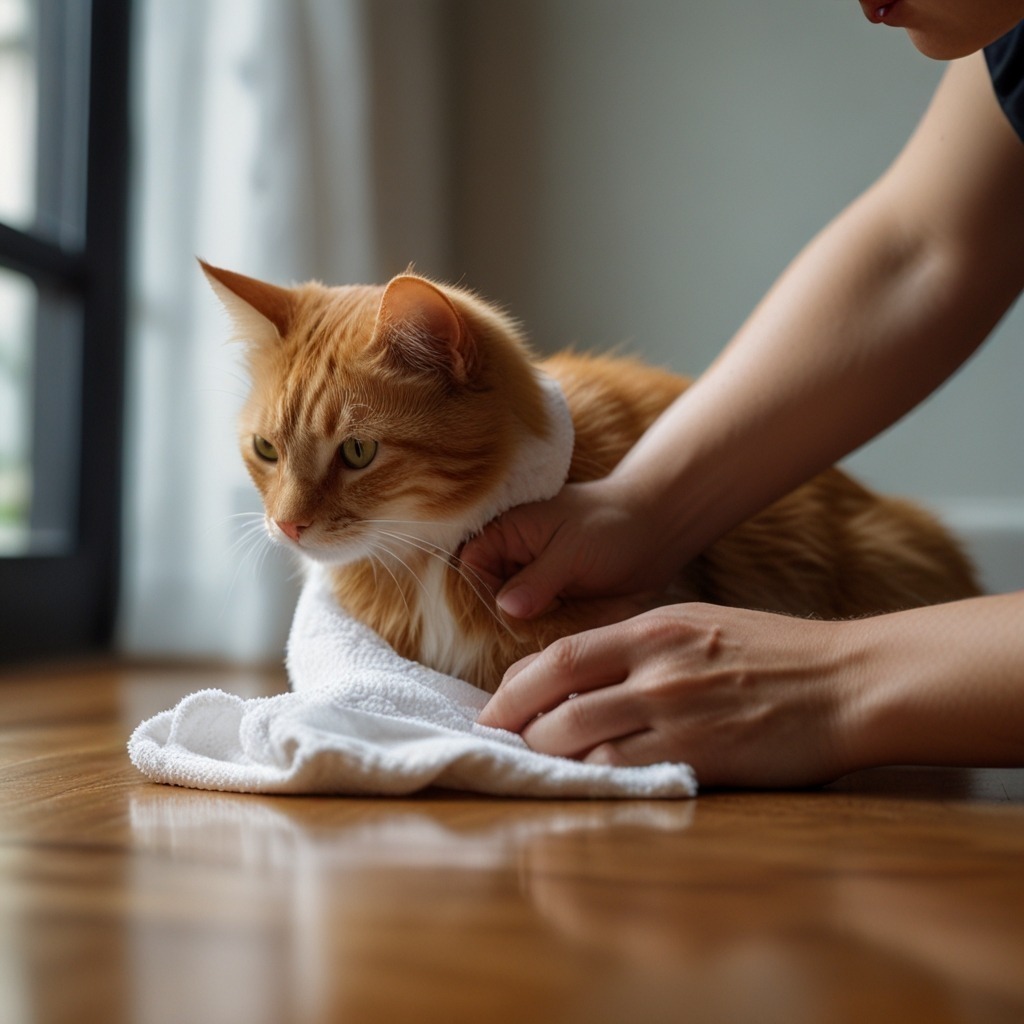
Here's what I do now, and it's so dumb-simple you'll think I'm joking. I'm not. The day the cat comes home—before I even bring the carrier inside—I take an old hand towel, rub it on my dog's neck, chest, and behind his ears, then fold it and put it into a ziploc bag. Later, once the cat is settled into her separate room (you've a separate room ready, right? We'll get to that), I drape that stinky towel over a chair or near her food bowl. The cat investigates it on her own terms. No pressure. Just smell. The next day, I do the reverse: rub a fresh towel on the cat, particularly along her cheeks where the scent glands are, and let the dog sniff it while I feed him treats. Boring as hell. But it works.
This little towel tango tells each animal 'there's another creature in the house, and the world hasn't ended.' I've had dogs who'd never met a cat in their lives go from rigid stares to lazy tail wags over the course of four days of towel-swapping. It's not magic. It's just giving their brains time to process without the therat of an actual face-to-face.
I Know You Want Them to Be Best Friennds Immediately. They Won't Be.
Get that fantasy out of your head right now. Every time I've rushed things because I wanted that Instagram-worthy snuggle pic, I've ended up with a build cat who hid behind the water heater for six weeks and a dog who paced so much he wore a path in my carpet. The goal of the first week isn't friendship. It's not even tolerance. It's 'I acknowledge your existence and I'm not going to lose my mind.' That's the bar. Set it low. Your future self will thank you.
The Scent-Swap Tanggo: What I Do Before the Cat Even Sees the Dog
This is the part I used to skip, and I paid for it every time. After that lamp disaster, I still thought the key was just 'going slower.' But slower means nothing if you're still letting them see each other before their noses have had a conversation. I now spend a minimum of three days—sometimes a week, sometimes two—on scent work before any visuals. Here's the breakdown.
Step 1: The Stinky Towel Routine (Again, Important)
I already mentioned it, but I'm repeating it because it's that foundational. Do the hand-towel swap every 12 hours or so. I'll often rub a towel on the dog right after a walk, when he's relaxed and a little musky. The cat gets a towwel rub after a meal. I don't force either animal to interact with the cloth—I just leave it where they'll encounter it naturally. If the cat hisses at the towel, fine. His reaction is information. If the dog tries to shred the cat-scented towel, I redirect with a treat and try again later. The goal is neutral interest or mild curiosity, not obsession.
Step 2: The Room Swap No One Talks About
Once the cat seems comfortable enough to leave her safe room for short explorations (maybe day three or four), I shut the dog in a bedroom with a stuffed Kong and let the cat wander the house. The cat gets to rub her face on everything—the couch, the doorframes, the dog's bed—depositing scent like a tiny property developer. Then I put the cat back in her room and let the dog out to sniff the new smells. This is the 'room swap.' I do this daily for several days. The dog gets to discover that the cat's scent is now part of his territory, but always when the cat isn't there, so there's zero threat. The cat learns the layout of the house without a predator breathing down her neck.
I'll be honest: this part is a logistical hassle, especially if you've a small house and a dog who screams when crated. I once did room swaps in a 600-square-foot apartment with a beagle who howled like I'd abandoned him forever whenever I put him in the bathroom for fifteen minutes. It was… a lot. But the alternative is worse. The time my dog coornered a build cat behind the couch because I let them see each other too soon still makes me cringe. That cat never relaxed again in my house. All because I was impatient.
Step 3: The Food Bowl Test I Stole From a Shelter Volunteer
I learned this from a tired-looking volunteer named Beth at the county shelter, and it's one of those tricks that seems too simple to work until it does. Once you've done a few days of towels and room swaps, you place the animals' food bowls on opposite sides of a closed door—the cat's door. At first, the bowls are three feet away from the door. You feed them at the same time. They can hear each other eatign, they can smell each other under the door, but they can't see anything. After a couple days, you inch the bowls closer. The goal is eventually to have both animals eating calmly within a foot of that door. If either one stops eating, freezes, growls, or hisses, you moved too fast. Back up the bowls.
Food is the great mediator. A dog who will happily scarf his kibble six inches from a closed door with a cat on the other side is a dog whose brain has stsrted to associate the cat's presence with good things. Same for the cat. This is classical conditioning, and it's boring and slow and it works almost every time.
The Time Miso Peed on My Pillow Because I Rushed This Step
Here's a story that still makes me wince. About six years ago, I took in a tiny black cat named Miso—nervous little thing with giant ears and a tail that never stopped twitching. I'd been doing introductions for a while, felt cocky. I did the towel thinng for two days, then thought, 'Eh, she seems relaxed.' I let her see my dog Tucker through a cracked door on day three. She flattened herself to the floor, pupils like dinner plates. I should have stopped there. I didn't. I let Tucker sniff at the door for maybe ten seconds. He wagged his tail. Miso bolted to the back of the closet.
That night, I found that she'd peed directly on my pillow. Not on the sheets, not on the floor—targeted my pillow like she was writing a complaint letter. It was 100% my fault. I'd pushed her too fast, and srress made her bladder betray her. I ended up having to put her back in her room and start the whole process over from towels, only this time for two weeks, not two days. The lesson: scared cats will protest in ways that are expensive and gross, and you deserve it.

Why Baby Gates Are Useless (And What Actually Works)
You'll see a million blog posts recommending baby gates for visual introductions. I own three baby gates. they're all in my garage, gathering dust. A healthy cat can clear a standatd baby gate without thinking about it. A stressed cat will launch herself over it in a panic and land on the other side, where the dog is, and now you've a chase situation. I've also seen dogs—even small ones—climb or knock over cheap pressure-mounted gates when they're over-aroused. For large dogs, a gate is basically a suggestion. My old roommate's pit mix, bless her sweet blocky head, once simply bulldozed through a 'heavy-duty' gate because she saw a squirrel. A cat on the other side would've been no different.
What I use now, if I need a physical barrier during visual intros, is a tall pet gate—the kind that bolts into the doorframe and has a cat door at the bottom that can stay locked. Even then, I drape a blanket over the top half so the dog can't see over it, and I only use it for dogs who aren't jumpers. For jumpers or seriously aroused dogs, I skip the barrier entirely and rely on a leash and distance. More on that later. Bottom lime: if you're gonna use a gate, don't trust it for a second. And never leave the animals unsupervised with just a gate between them.
The Cat Who Decided the Dog Was a Piece of Furniture
Occasionally—and I mean occasionally—you get a cat who simply doesn't care. I fostered a one-eyed gray tabby named Poplin who, within twelve hours of arriving, sauntered out of her room, walked past my 70-pound dog Gus while he was napping, and started eating from his food bowl. Gus, who is pathologically mild-mannered, lifted his head, blinked, and went back to sleep. Poplin then sat on the dog bed next to him and washed her face. That was the entire introduction. I was prepared for a three-week protocol and she decided it was unnecessary.
I tell you this not to give you false hope but to remind you that cats are individuals. The protocol exists for the cats who need it. Poplin was a stray who'd apparently been around dogs her whole life. She smelled Gus and thought, 'Whatever.' The cat you're bringing home might be a Cat Poplin. Or she might be a Miso, who required two months before she'd walk through a room with a sleeping dog in it. You don't get to pick, so you prepare for the worst and hope for the indifferent.
The Visual Introduction That Almost Cost Me a Friendship
Okay, so you've done the towels, you've done the room swaps, both animals are eating calmly on opposite sides of the door, and the cat no longer flattens herself into a pancake when she hears the dog bark. Now you're ready for them to see each other. This is where most people screw up—not because they're dumb, but because they think 'visual introduction' means 'put the cat in the living room and hold your breath.'
I once let a friend convinced of the 'just let them work it out' method handle things while I ran to the store, and I came back to a chaos scene straight out of a cartoon: dog zooming, cat suctioned to the top of the curtains, my friend bleeding from a scratch on her forearm. That cat never trusted me again. And the friendship was strained for a while. Wee're fine now, but I don't let anyone else manage introductions anymore.
Distance Is Your Friend
For the first visual meeting, I put the dog on a leash, with a use (not a collar that he can slip), and I've him lie down or sit in a stay on the far side of the room. The cat stays in her carrier, or behind a secure barrier, or even just in her room with the door open an inch. The point is they can see each other but there's a lot of space and no possibility of contact. I'm talking fifteen feet minimum. I treat the dog continuously for calm behavior—lookign at the cat is fine, but staring rigidly or whining means we break and try again later. We keep these sessions short: maybe one or two minutes at first. Then I put the cat away and the dog gets a big jackpot reward. Then we try again in a few hours.
The First Glimpse Should Be Two Seconds
I can't emphasize this enough. Short sessions. Two seconds might be too dramatic, but thirty seconds is plenty for a first look. You want to end each session on a positive note, before anyone gets overstimulated. If you wait until the dog starts lunging or the cat starts growling, you've already gone too long; you're training them that seeing each other is stressful. You want to curate a series of experiences where nothing bad happens. It's tedious. It's also the only way I've ever gotten a reactive dog and a fearful cat to coexist peacefully.
What a Stressed Cat Looks Like (And It's Not Just Hissing)
People think if the cat isn't hissing, shr's fine. Nope. A stressed cat might freeze, flatten her ears, tuck her tail, pant with her mouth open, or just crouch and stare without moving. Dilated pupils are a classic sign. Some cats get diarrhea the next day, which is a delayed stress response—I've linked changes in digestion to stress enough times that I now watch the litter box like a hawk. If you notice sudden pooping outside the box, it often traces back to social stress, not just dietary issues. If I see any of those signs during a session, I end it immediately—no drama, just calm removal—and we take a day off from visuals.
The Mistake of Holding Your Cat
I used to hold the cat during introductions because I thought she'd feel safer. I was wrong. A startled cat uses claws to launch herself away, and your arms become the launchpad. I've the scars to prove it. Plus, if you're nervous, the cat feels that and gets more nervous. Let the cat be on her own four fert, or inside a carrier. That way she controls her own distance and doesn't associate you with a terrifying experience.
When It's Not Working: The Signs You're Moving Too Fast
Even with the best protocol, sometimes things go sideways. The dog might start obsessing—pacing by the door, whining for hours, forgetting his basic commands. The cat might stop eating, or hide in her litter box (a desperate move), or start overgrooming. If any of this happens, you slam the brakes. No more visuals for a week. You go back to just towels and food behind doors. Mayve you even restart entirely. I've reset introductions four times with one particularly traumatized cat, and it took three months before she'd walk calmly through the house. But she got there. Rushing would've cemented her fear permanently.
If the dog is so aroused that he can't even take treats when he smells the cat, that's a major red flag. That's not aggression—it's overarousal, and it can still lead to disaster. For those dogs, I bring in a trainer if I can, or I accept that this dog might never safely live with a cat. It's heartbreaking to say that, but I've had one build dog I had to place in a cat-free home because his prey drive was too intense. I couldn't train out generations of instinct. Better to be honest than to risk a dead cat.
The Day Gus Finally Licked the Kitten's Head (And I Ruineed the Moment With a Sneeze)
We'll end on a good one. Three years ago, I brought home a scrappy little kitten—build fail, obviously—who I named Pippin. My senior dog Gus, who is approximately the size and personality of a slow-moving ottoman, had been through a dozen introductions with me. He knew the drill. But Pippin was feral-ish, terrified of everything, and spent the first two weeks in my bathroom, hissing at shadows. I did the full protocol: towels, room swaps, food bowls at the door. For three full weeks. Gus just sighed a lot and looked at me like 'another one, really?'
Then one afternoon, I had Pippin in a mesh playpen in the living room—it was a safe visual, because Gus was snoozing on the other side of the room. Pippin, for reasons known only to her, climbed the mesh wall like a tiny mountaineer and dropped onto the floor. I froze. Gus looked up. And Pippin, instead of running, just walked over to Gus and sat down an inch from his nose. My heart stopped. Gus sniffed her for what felt like an hour, then gave one slow lick across her forehead. I sneezed—loudly—and Pippin skittered backward, but the spell was broken in the best way. They've been attached ever since. The introduction didn't take three weeks; it took several months of patient, unsexy work. And it was worth every damn minute.