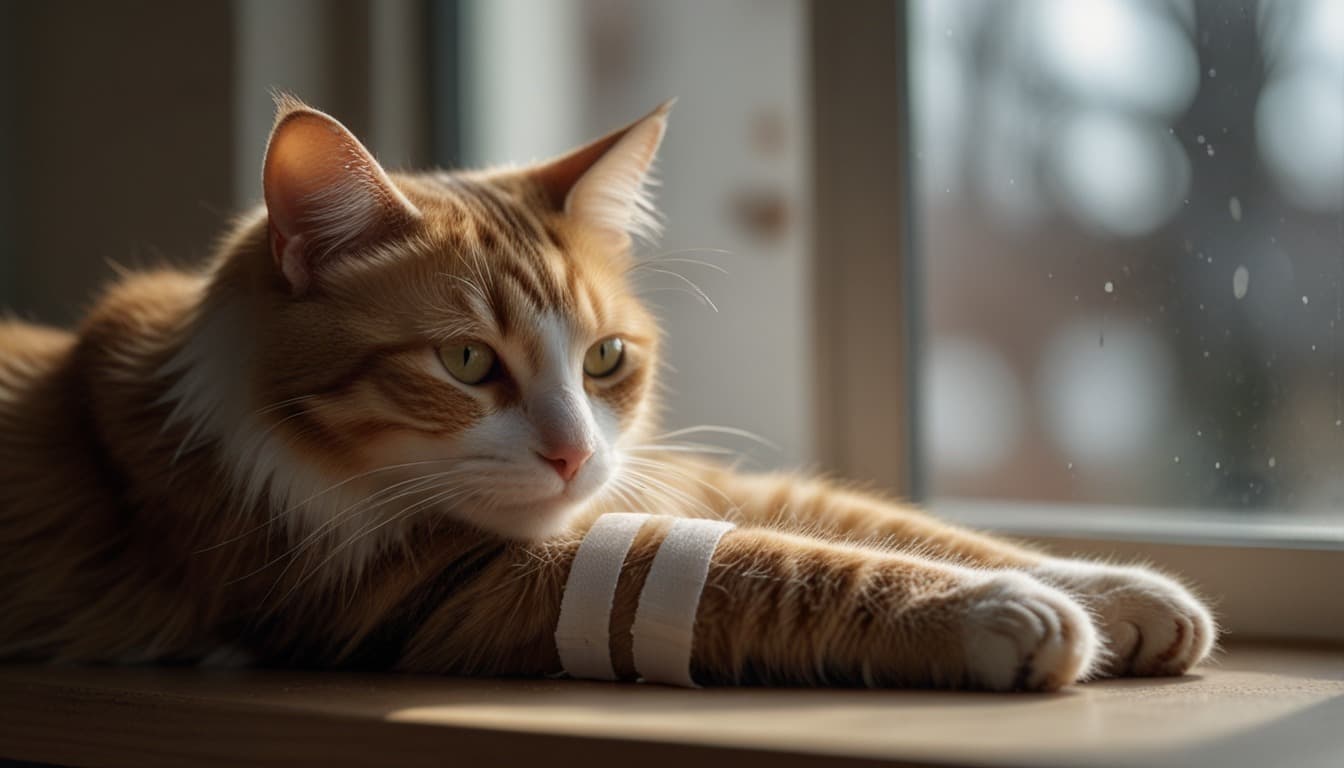
My cat latched onto my hand like a chew toy and wouldn't let go. Here's what finally stopped the biting.
My kitten's play bites turned into full-on attacks by 8 months. I tried scruffing, spray bottles, yelping—most of it backfired. Here's what finally taught her that my hands aren't chew toys.
The first time Mochi bit me during play, I laughed it off. She was a 10-week-old fluffball of chaos — all needle claws and a tiny mouth that couldn't do real damage. It was cute. Annoying, but cute. I'd dangle a feather wand, she'd pounce, and sometimes she'd miss the toy and get my knuckle instead. I figured she'd grow out of it.
Narrator voice: She didn't grow out of it.
By the time she was eight months old, Mochi had turned into a velociraptor in a cat suit. She'd wait behind the couch and launch herself at my ankles when I walked by. If I dared to wiggle my fingers under a blanket, she'd lock her jaws around my hand and bunny-kck with her back feet until I had rows of red scratches running up my forearm. It wasn't aggression — she wasn't hissing or flattening her ears. She was playing. But her play involved repeatedly sinking canines into human flesh, and I was runing out of Band-Aids. One night I looked down at my arm — the same arm I'd used to test 11 automatic feeders on my three utterly shameless cats (that whole disaster is another story) — and I realized I looked like I'd been attacked by a tiny lawnmower.
The thing nobody tells you about cat play biting is that it's a ticking clock. Kittens are learning. Their brains are gooey little sponges, and every time they bite you and you don't react the way another cat would react — which is to yelp and end the game immediately — they log it as acceptable behavior. By the time they're a year old, you've got a full-grown cat who thinks human hands are pressure-release toys. That's where I was. So I did what any overly-researched pet owner does: I dove into every forum, every YouTube training video, every "just hiss at her" comment section. Some of it worked. Most of it was garbage. And one piece of advice — the one about scruffing — made everything worse before it got better. So let me walk you through what I learned, mostly the hard way, about getting a play-bitey cat to stop treating you like prey.
The day I realized it wasm't just a "kitten thing" anymore
I build cats. A lot of them. Over 40 at this point, not counting the ones who never made it out of my bathroom quarantine. I've seen everything from the super-shy cat who hid behind the toilet for three weeks to the confident stray who strolled in like he owned the place. Most fosters come with some behavioral quirks, but biting during play is one of the most common issues — and one of the easiest to screw up if you don't catch it early. I had a build named Pippin, a lanky orange tabby who looked like a raw chicken tender with fur. He bit. Hard. And he'd do it while purring, which confused the heck out of me at first. I thought purring meant happy. Turns out cats also purr when they're overstimulated, stressed, or about to deliver a warning bite. Who knew? (Not me, apparently.)
One afternoon I was dangling a ribbon toy for Pippin, and he leaped, missed the ribbon, and latched onto the fleshy part of my thumb. It wasn't a nip — it was a full-on puncture. Blood welled up, I yanked my hand back, and he looked at me like "why did the game stop?" That's when I realized: I had been teaching these cats that my hands were part of the game. Every time I wiggled my fingers to entice them, every time I let them chase my toes under the blanket, I was reinforcing a neural pathway that said "human body = toy." And once that pathway is paved, it's a nightmare to dig up. It's like trying to convince a dog that your mouth isn't a ball after six months of you throwing actual tennis balls with your mouth. Wait, that's a terrible analogy. You get what I mean.
Pippin's bite got infected — cat mouths are basically small planets of bacteria — and I spent a Tuesday evening at urgent care getting antibiotics and a tetanus shot. The nurse asked me how it happened, and when I said "my cat was playing," she raised an eyebrow and said, "You know you can trim their claws, right?" I almost launched into a lecture about positive reinforcement and fear-free handling, but my thumb was throbbing so I just nodded. She meant well. But the claw trimming wasn't the issue. The biting was.
Why cats bite during play in the first place (and why your fingers look like sausages to them)
Here's the biological reality: cats are predators. It doesn't matter if they're a 17-pound couch hippo or a 6-pound diva who only drinks from a running faucet — they've got the same hunting sequence hardwired into their brain. Stalk, chase, pounce, grab, bite. When you dangle a toy in front of a cat, you're triggering that predatory sequence. But if your hand is attached to the toy, or if yoou're using your actual hand as the toy, the cat's brain doesn't separate "toy" from "human." It just sees movement and goes "that's prey."
Kittens learn bite inhibition from their littermates. When a kitten bites too hard during wrestling, the other kitten yelps and stops playing. That's how they calibrate: hard bite = game over. Humans are terrible at this calibration because we don't speak cat. We giggle when a tiny kitten nibbles our fingers, or we push them away gently, which in cat language might look like play continuing. So the kitten never learns the boundary. By the time the behavior becomes a problem, the cat is completely confused about why you're suddenly yelling at them for doing the thing you used to encourage. That's not the cat being a jerk. That's the cat being a cat.
There's also an element of overstimulation that a lot of people miss. Cats have a threshold. Some cats can play for 20 minutes before they get wound up enough to start biting. Others hit that wall in 90 seconds. You'll see the signs if you're paying attention: tail starting to twitch, ears rotating sideways, pupils dilating. That's the cat telling you "I'm about to make a poor decision." But most people don't tune into those signals until it's too late. I know I didn't. With Mochi, her tell was that she'd stop blinking. She'd just stare at the moving object with this intense, unblinking gaze, and then — chomp. My hand was in the wrong place at the wrong time.
The difference betwen play biting and real aggression — because people mix these up constantly
Real cat aggression looks different. A genuinely aggressive cat will have flattened ears, a puffed-up tail, hissing, growling, and they'll often give a warning swipe or lunge before the bite. The bite itself is usually a quick, hard bite-and-release, meant to say "back off." Play biting is more sustained — they'll grab and hold, sometimes with a rabbit-kick flourish. They might look totally relaxed, pupils not fully dilated, no vocalization except maybe some excited chirping. The bite is still painful, though. A cat's jaw strength is no joke, even in play mode.
If your cat is doing the grab-and-kick thing while purring, 99% of the time it's play. But I've also seen play escalate into real aggression when the cat gets overstimulated and the human doesn't back off. That line can blur fast. So the first thing to do is rule out medical issues — a cat in pain might bite during handling, and that's not play. If your cat suddenly starts biting out of nowhere, a vet visit is warranted. I'm not a vet. I'm just a person with scarred hands and a lot of trial and error under my belt.
A bunch of advice that sounds good but made everything worse
Before I tell you what worked, let me tell you what absolutely didn't. Because some of these suggestions are still circulating out there like they're gospel, and I want to save you the skin grafts.
- Scruffing. This was the worst. Some well-meaning person online told me to scruff Mochi every time she bit, like her mother would. I tried it exactly twice. The first time, she froze. I thought "oh, it works." The second time, she turned into a tornado of claws and bit me even harder. Scruffing an adult cat isn't the same as a mama cat carrying a kitten. It triggers a fear response, and fear plus play equals a cat who now trusts you less. Hard pass.
- Spray bottles. I used to be a spray bottle person. I'm not proud of it. But here's the thing: spraying a cat for biting during play just teaches them to be afraid of the bottle — or afraid of you. It doesn't teach them what they should do instead. And cats are associaive learners. They might learn "if I bite when the human has the bottle, I get sprayed" but they won't generalize that to "I shouldn't bite ever." So now you've got a cat who bites when you're not holding a bottle. Great job, me.
- Yelping loudly. Some people swear by this — mimicking a kitten's pain squeal. I tried it. Mochi looked at me like I'd lost my mind and bit me again. Some cats do respond to a high-pitched yelp, but mine apparently thought it was part of the fun. Or maybe my yelp sounded too much like a dying mouse, which only encouraged her. Who knows.
- Punishing after the fact. If you drag your cat out from under the bed and scold them for something they did ten minutes ago, they won't make the connection. They'll just think you've gone insane and are now a threat. Cats live in the moment. The correction has to happen during the behavior or it's meaningless.
I'm not saying none of these methods ever work for any cat. Cats are individuals. But across 40+ fosters, I've found that punishment-based approaches backfire more often than not. A scared cat bites harder. A confused cat doesn't learn. And a cat who doesn't trust you is a cat who will find ways to communicate with their teeth because you took away all the other options.
The thing about my dog and the slipper — a completely unrelated tangent that actually matters
I need to tell you about my dog, Gus, even though this is a cat article. Gus is a 12-year-old lab mix with a face like a melted candle and the emotional intelligence of a damp sock. When he was a puppy, he went through a chewing phase that cost me roughly $600 in shoes, which I wrote about in excruciating detail (I Lost $600 in Shoes Before My Puppy Learned to Stop Chewing — Don't Be Me). The reason I'm bringing this up is that the single most effective thing I learned from traning Gus — redirecting behavior instead of just suppressing it — is exactly what saved me with Mochi. I spent so much time trying to stop the biting that I forgot to give her something to do instead. A dog chews your shoe, you swap it for a chew toy. A cat bites your hand, you swap it for… what? That's the piece of the puzzle I was missing for months.
There's a principle in behavior science called DRI — Differential Reinforcement of Incompatible behavior. Fancy term, simple idea: you reward a behavior that can't happen at the same time as the problem behavior. A cat can't bite your hand and also bite a kicker toy. So if you make the kicker toy more exciting than your hand, you win. I'll get into how that actually plays out in a second. But first, I need to tell you about the absolute waste of money I spent on a "cat training clicker" that came with a DVD I couldn't even play because I don't own a DVD player anymore. Who owns DVDs? Anyway.
What actualy worked — and no, it wasn't one magic trick
It was a combination of things, applied consistently for about six wekes. Six weeks is a long time to have your hands look like you work in a cactus factory. But Mochi is now three years old, and she hasn't bitten me during play in over two years. She'll still go nuts on a kicker toy like it owes her money, but she knows my hands are off-limits. Here's the stack of changes that got us there.
I stopped using my hands as tosy. Completely. Cold turkey.
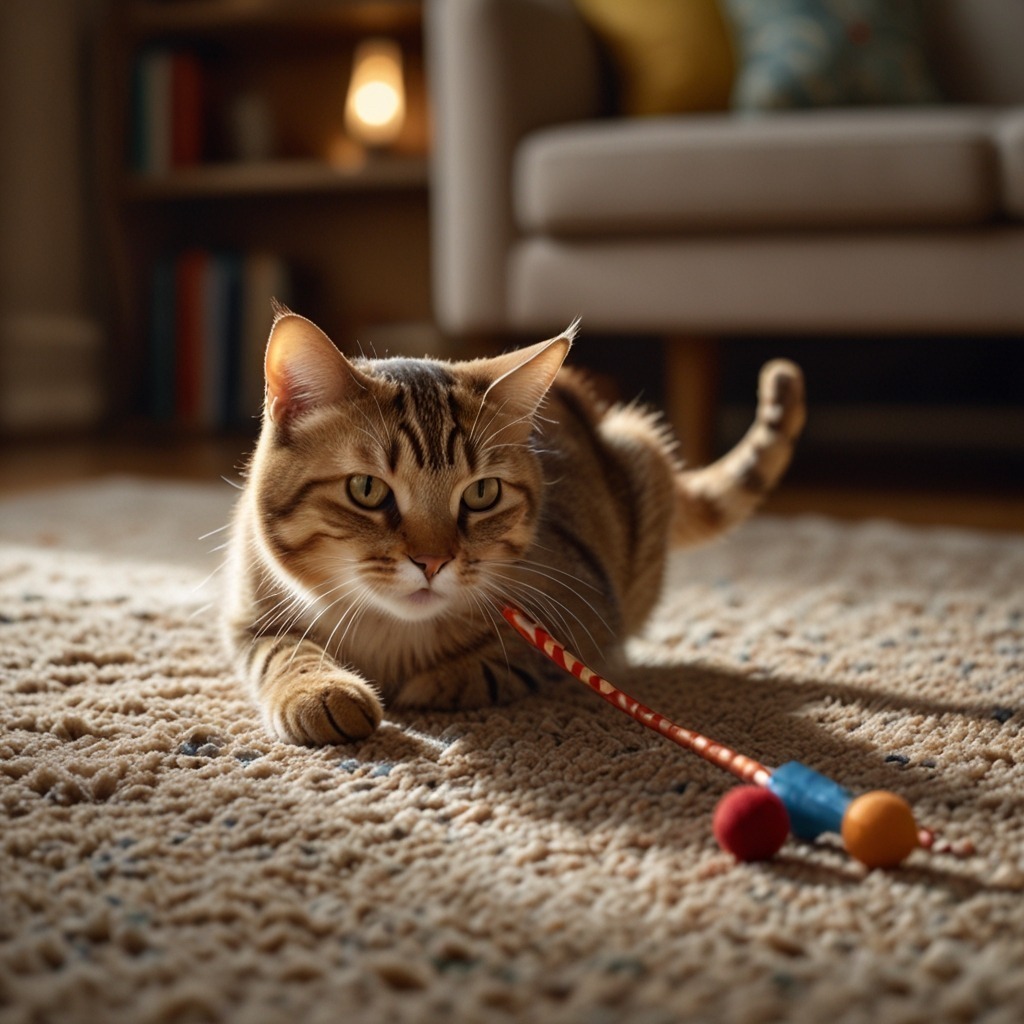
This one sounds obvious, but it's harder than you think. When a cat is in full play mode and you don't have a toy within reach, your instinct is to wiggle your fingers or drag your hand under a blanket to keep the game going. I had to break that habit. I started keeping a wand toy in every room — the living room, the bedroom, even the bathroom. (Don't judge me. Mochi likes to ambush me when I'm on the toilet, and I needed a decoy.) If she lunged for my hand, I'd immediately grab the wand toy and redirect her. Over and over. For weeks. It was tedious, but cats need repetition. Their little predator brains need to rehearse the new script until it overwrites the old one.
A side note on wand toys: get the kind with interchangeable lures. A feather on a string is great until your cat eats the feather and you spend a panicked morning Googling "can cats digest feathers" (they usually can, but the Google results will convince you otherwise). Introducing new toys gradually matters too — a shy cat might be overwhelmed by a flailing bird-on-a-stick, but Mochi was the opposite. She needed the chaos.
The kicker toy bcame her best friend (and my hand's replacement)
I bought a long stuffed kicker toy — one of those cylindrical plush things filled with catnip and crinkle material. Every time Mochi got that wild look in her eyes, I'd shove the kixker between her front paws instead of letting her latch onto my arm. She'd grab it, rabbit-kick it furiously, and look extremely satisfied. The key was timing: I had to offer the kicker before the bite happened. If she already had my hand in her mouth, it was too late. So I learned to read her pre-bite signals — the tail twitch, the ear flick, the pause — and intercept. It felt like playing goalie with a tiny, furry striker.
Something I discovered by accident: dragging the kicker toy along the floor like it was a wounded animal made it far more enticing than just handing it to her. Cats are triggered by movement at ground level. A stationary toy is boring. A toy that scuttles away? That's prey. So I'd drag the kicker, let her pounce, then let her "kill" it. After a few weels, she started seeking out the kicker on her own when she got bitey instead of coming for me. That was the win.
I learned to end the game the second teeth touched skin
This was the hardest habit for me to build because I didn't want to "ruin the fun." But cats are brilliant at cause and effect when the consequence is immediate and consistent. The rule Mochi eventually learned: teeth on human = play stops instantly. No yelling, no scruffing, no drama. I'd simpky freeze, gently disengage (tucking my hand toward my body to break suction, not yanking away which can tear skin), and walk out of the room for 30 seconds. Not a long time — just long enough for her to register the loss of interaction. Cats aren't capable of connecting a 10-minute timeout to something they did. But a 30-second social withdrawal? That's cat language. When a cat bites another cat too hard, the victim walks away. I was just being the other cat.
Consistency mattered more than duration. Every single time. If I let it slide once because I was tired or on the phone, the progress backslid. Cats don't understand "sometimes." They understand patterns. If teeth sometimes get a reaction and sometimes don't, they'll keep testing. Same with my fosters — the ones who had the most inconsistent previous owners took the longest to retrain because they'd learned that biting was a lottery.
Scheduled playtime: the boring but effectiev solution nobody wants to hear
Boredom is rocket fuel for play biting. A cat who doesn't have enough outlets for their predatory energy will invent their own games, and those games usually involve your moving body parts. I noticed Mochi was worst in the evenings, right when I was trying to relax on the couch. So I started initiating a 10-15 minute play session every evening around 7pm, before the witching hour. I'd get her really moving — running, jumping, panting — until she flopped over. Then I'd give her a small meal or a treat (feeding schedules matter a lot more than people think). That "hunt, eat, groom, sleep" cylce is basically a cat's operating system. If you don't satisfy the hunt part, the programming gets stuck on loop.
For some cats, one session isn't enough. Mochi needed a short morning session too — five minutes of chasing a laser pointer (with a treat at the end so she didn't get frustrated by the un-cachable dot. Laser pointers without a tangible reward at the end are a great way to create a neurotic cat. Don't do that.) And I rotated toys so she didn't get bored. A toy that sat in the closet for a week became exciting again. Magic.
The time I completely misinterpreted my build cat's "biting" and spent $340 on a vet visit for nothing
This is a tangent, but it's relevant to anyone who thinks their cat is biting aggressively during play when it's actually something else entirely. Last year I took in a build named Toast. Toast was a 4-year-old tuxedo cat surrendered because he "kept biting the kids." The shelter asked me to evaluate him, because sometimes "biting" is actually fear or pain, not play. Toast was sweet as pie until someone went near his lower back. Then he'd whip around and bite — no warning, no play posture. Turned out he had severe dental disease and referred pain that made his whole posterior chain sensitive. The family thought he was a mean cat. He wasn't mean. He was in agony.
I mention this because I once spent $340 rushing my own cat to the emergency vet after she bit me and I panicked about infection, only to find out it was a perfectly healthy play bite and I just have dramatic veins. But with Toast, the vet visit was life-changing. He got the dental work he needed, and his behavior did a complete 180. So if your cat's biting seems different from normal play — if it's sudden, unprovoked, or accompanied by any other changes like hiding, not eating, or litter box issues — go to the vet before you try any of these training tips. I can't stress that enough. I've fostered too many cats whose "behavioral problems" were just medical problems in a cat suit.
When Mochi drew blood for the last time
It wasn't a dramatic moment. There was no big revelation. One evening, about three months into the training, I was dangling a new feather wand and Mochi launched herself at it, claws extended, and her back foot brushed my forearm mid-pounce. I flinched — muscle memory from months of teeth — and she stopped. Froze. Looked at my arm, then looked at the toy, then went back to shredding the feather. She hadn't even made contact with her mouht. She'd just kicked, and I'd flinched, and she'd checked herself. That was the moment I knew the new wiring had taken hold. She wasn't suppressing an urge; she just didn't see my arm as part of the game anymore.
I'm not going to pretend I've a perfect cat now. Mochi still ambushes my ankles if she's in a particularly spicy mood and I've been gone all day. The difference is that her "ambush" now involves running up, tapping me with a soft paw, and then flopping onto her back with a dramatic squeak. No teeth. No claws. Just a weird little performance that makes me laugh. It took weeks of consistency and a lot of redirecting, but the lesson stuck.
If you're in the thick of it right now — staring at your forearm and wondering if you'll ever be able to pet your cat without protective gear — I get it. I was there. It's fixable. But you've to be more stubborn than the cat, which is saying something. Cats are monumentally stubborn creatures. One of my fosters once sat in a carrier for 11 hours refusing to come out, just because. So yeah. You can out-stubborn them. It just takes time and the willingness to look a little silly shoving a kicker toy at a cat who's trying to eat your thumb.

Why I stopped worrying about the occasional slip-up
Here's the thing I wish someone had told me earlier: perfection isn't the goal. Your cat is going to have moments. They might bite during a particularly exciting play session, or when they're startled, or just because it's Tuesday and cats are mysterious agents of chaos. A single bite doesn't erase months of training. It's a data point. Ask what happened — were you moving your hand too fast? Did you miss the overstimulation signals? Was the cat hungry or overtired? — and adjust. Beating yourself up helps no one, least of all the cat, who has already forgotten about it and is now licking their butt.
I used to get so frustrated with myself when Mochi had a setback. I'd think, "I'm a failure, she's never going to learn, I should have left her at the shelter" — which is the cat-rescue equivalent of imposter syndrome. But the setbacks got shorter and less frequent. Now they barely happen. And when they do, I know what to do: redirect, walk away, try again tomorrow. The emotional component — the guilt and the anger — was actually making things worse because I'd handle Mochi differently after a bite. Cats pick up on that tension. So learning to let it go was part of the training, too.
I'll link this to something I learned from my dog, actually. When Gus was a puppy and destroyed yet another pair of sandals, I wrote about how I had to stop blaming the dog and statr managing the environment (I Lost $600 in Shoes). Same principle applies here. If your cat bites when you wiggle your toes under the blanket… stop wiggling your toes under the blanket. Management isn't defeat. It's just acknowledging that some battles aren't worth fighting while you work on the underlying behavior. I wore slipper-socks for a year. It was fine.
The one thing I still keep in every room
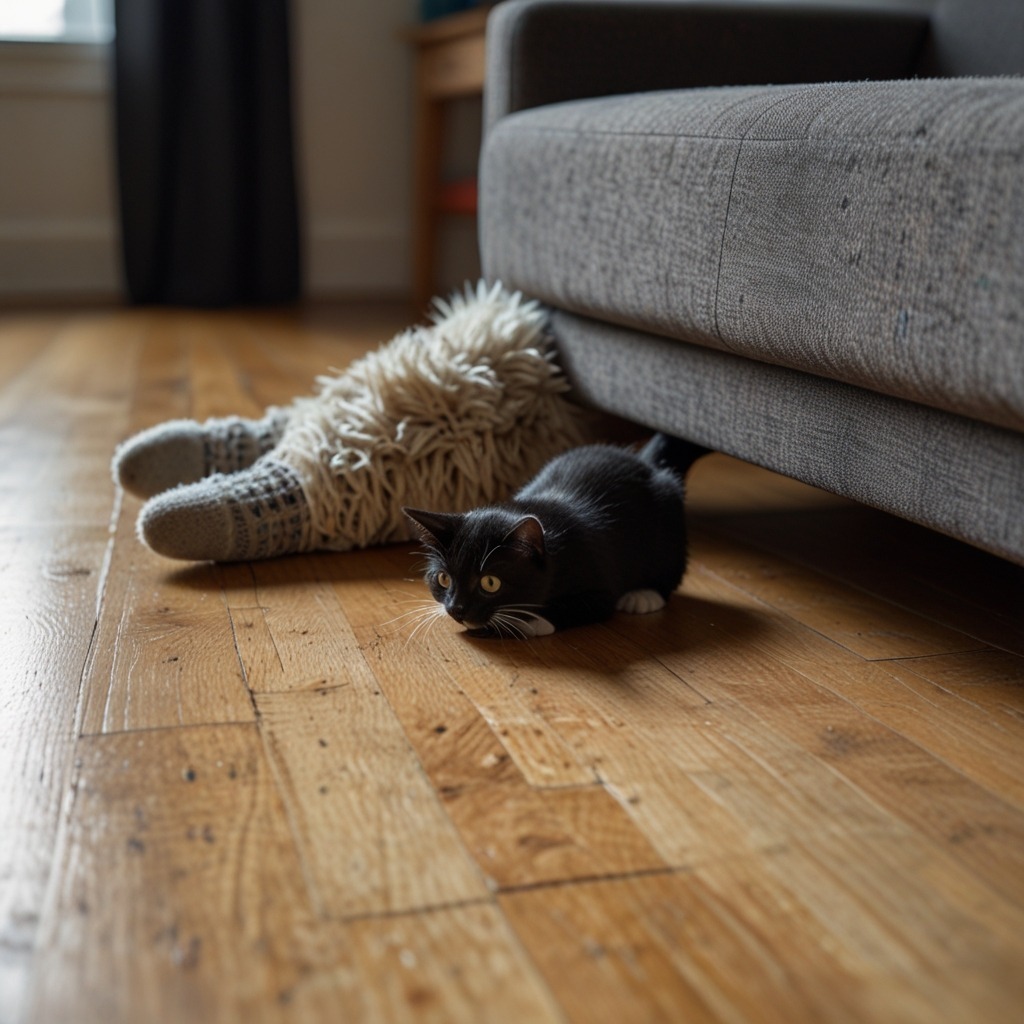
I'm not big on cat training gadgets. I've been burned too many times by products that promise miracles and deliver nothing but plastic junk that my cats ignore. But there's one thing I now stash around the house like a paranoid prepper: small kicker toys. I've got one under the couch, one in my desk drawer, one on the bathroom counter. They're cheap and unglamorous, but every time I see Mochi's pupils go black with impending chaos, I've got a decoy within reach. It's not elegant, but it works.
I know some people advocate for treat-based training for biting — rewarding the cat when they play nicely. I tried that with Mochi and it went about as well as you'd expect: she learned to fake-bite, then look at me expectantly for a treat. Clever little menace. So treats weren't our path. The reward for her was the play continuing. That was enough. For other cats, treats might be the thing. you've to know your cat. And if you don't know your cat yet, you learn by trying and failing and trying again. That's pet ownership in a sentence, really.
If you're dealing with a cat who seens to bite more out of fear or anxiety than play, I'd also point you toward this post about a cat who was actually terrified — different root cause, but some of the same redirection principles apply. And if your cat's biting seems to come out of nowhere with no play context whatsoever, read about how I wasted a year blaming my cat for something that wasn't his fault. Sometimes the behavior isn't what you think it's.
Anyway. My cat is currently staring at me from the windowsill with an expression that clearly means "stop typing about me and feed me." She hasn't bitten me in months, but I'm not stupid enough to test that theory right now. I'll just get up and grab the can opener. The kicker toy will still be there tomorrow.