I Thought My Cat Peed on the Couch Because He Hated Me—Turns Out He Had a UTI and I Was the Jerk
I spent weeks convinced my foster cat Gus was peeing on my bed out of spite. The vet handed me a $240 bill and a diagnosis that made me feel like the biggest idiot in rescue. From UTIs to litter box placement, here's what I learned the gross, expensive, humbling way.
The first time I found cat urine on my pillow, I cried. Then I yelled at the cat. Then I googled "can cats be evil" at 2 a.m. — which, I'll tell you right now, isn't a productive rabbit hole. But if you're reading this, you've probably been there. Standing in your living room at dawn, holding a urine-soaked slipper, staring at a cat who's peacefully licking his butt like norhing happened. And you're wondering: why? Is it spite? Is it a brooken brain? Did I do something wrong?
Spoiler: maybe, maybe not. I've fostered over 40 cats. I've scrubbed more cat pee out of more surfaces than I care to remember—carpets, bedding, a keyboard, once a toaster (don't ask). And I've made every damn mistake in the book. Spray bottles. Punishment. Yelling. Chaning litter every other day like a maniac. So when I say I get it, I mean it in the bone-deep way of someone who has cried into a paper towel roll at 3 a.m. while a build cat named Gus serenely watched from the dresser.
Here's the thing that took me way too long to learn: your cat isn't peeing outside the box because he's an asshole. He's peeing outside the box because something is wrong. And your job—our job—is to figure out what. So let me walk you through the messy, frustrating, occasionally rage-inducing journey I took with Gus, a 4-year-old orange tabby who arrived in my rescue smelling of despair and immediately aimed a stream of urine at my laptop bag.
The vet visit I put off for three weeks because I was sure it was behavioral
I'm not proud of this. Gus moved in, and within 48 hours he'd peed on my gym bag, behind the TV stand, and directly into one of my houseplants. My first thought, the one that I clung to like a moron, was: He's marking. He's stressed. He'll settle. So I bought a Feliway diffuser. I kept him in a separate room. I cleaned up the puddles with whatever spray was under the sink. Nothing changed. A week later, he peed on the dog bed while my senior lab was still in it. That should've been my clue that something was medically wrong—healthy cats don't generally choose to urinate six inches from a 60-pound animal unless they're desperate—but I was too deep into the "behavior problem" narrative to see it.
Then one morning I noticed pink-tinged urine on the tile. Not a lot. Just a drop. And my stomach dropped, because I've been around the block enough times to know what that means. Bladder inflammation. Possibly crystals. Possibly an infection. I called my vet, Dr. Chen—who has patiently endured my panicked calls for over a decade through three dogs, a divorce, and more build cats than I can count—and she got me in that afternoon.
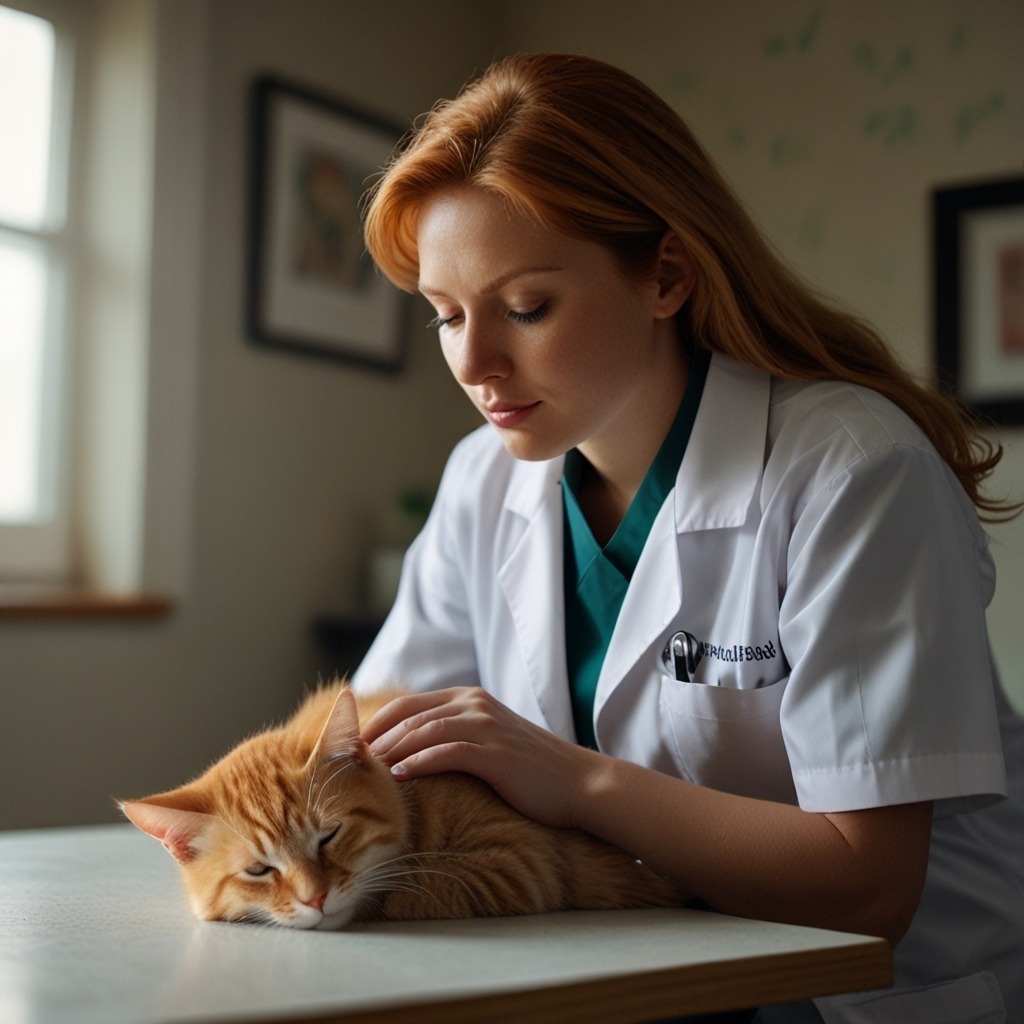
Gus had a raging urinary tract infection and the beginning of struvite crystals. His bladder wall was so inflamed that every time he peed, it burned. Dr. Chen explained that cats don't understand cause and effect the way we do; they just know the litter box hurts, so they avoid the litter box. They find somewhere soft or cool—a pillow, your laundry pile, the bathtub—and they go there because it doesn't hurt as much. It's not spite. It's self-preservation. I left the clinic with antibiotics, anti-inflammatories, a special urinary diet, and a bill for $240 that I really should've spent three weeks earlier. Gus was back to using the box within four days of starting treatment, because the problem wasn't his brain or my housekeeping—it was his bladder.
I tell you this because it's the single most common mistake I see. Someone's cat pees on the bathmat, and they immediately decide the cat is angry about the new baby or the move or the fact that they went on vacation. They Google "cat revenge peeing" and buy a spray bottle and double down on punishment, while the cat is sitting there with a UTI so painful he can't even squat. Before you do anything else—before you change the litter, buy a new box, or convince yourself your cat is punishing you—go to the vet. Get a urinalysis. Rule out infection, crystals, bladder stones, kidney disease, diabetes, hyperthyroidism, arthritis that makes climbing into a high-sided box excruciating. All of those can cause inappropriate elimination, and none of them can be solved with a new brand of clumping litter.
I've had fosters with blocked urethras who would've died within 48 hours if I'd kept treating it like a grudge. I've had senior cats peeing on the floor because thier joints were so bad they physically couldn't step over the lip of the box. I've had diabetic cats with urine so sweet and sticky they developed infections that made elimination feel like passing razor blades. Medical first. Always. If your vet gives the all-clear, then you can start the detective work. But if you skip this step, you could be wasting weeks—or, in the worst cades, letting a treatable condition turn fatal while you argue with a cat who literally can't help himself.
I wrote about another build, a cat named Smudge, who peed on everything I owned for six solid months and nearly broke me. (That whole saga is here, if you need to feel less alone.) Gus's case was different—more acute, more obviously medical once I pulled my head out of my you-know-what—but both taught me the same thing: you've to stop taking it personally and start treatig it like a symptom, not a moral failing.
When I blamed the cat for my own laziness
Okay. So you've been to the vet. No infection, no crystals, no diabetes. The cat is medically fine. Now what? Now you look in the mirror and ask yourself a deeply uncomfortable question: Is this my fault?
I once fostered a dainty Siamese mix named Mochi who refused to use a litter box that hadn't been scooped within the past two hours. I'm not exaggerating. If there was one clump in that box, she would stand next to it and scream, and if I didn't respond fast enough, she'd pee on the bathmat. Two hours. I worked at a shelter back then and I'd come home exhausted and sometimes I'd forget to scoop before bed. Mochi made sure I remembered. And look, I hated it—coming home to urine on the bathmat at 11 p.m. after a double shift—but she wasn't wrong. How would you feel about a toilet that only flushed twice a day?
Cats are fastidious. Some will tolerate a moderately dirty box; others will vote with their bladder the moment conditions aren't pristine. The rule of thumb I give everyone: scoop at least once a day, ideally twice. Completely dump the litter and scrub the box with unscented soap and hot water once a week. If the plastic is scratched and holding onto odor—and it will, after a few months—replace the box. They're cheap. Your carpet isn't.
The time I thought Gus was punishing me and my neighbor said something that made me want to scream
Here's a tangent, and I swear it connects. My neighbor Becky—we'll call her Becky—has a beautiful gray cat named Luna who started peeing on her boyfriend's laundry. Specifically the boyfriend's. Specifically when the boyfriend stayed over. Becky was convinced Luna was jealous. "She's marking her territory," Becky told me over the fence one afternoon. "She wants him gone." I tried to gently suggest that maybe Luna was stressed by the new person in her space, or that the boyfriend's detergent smelled weird to her, or that the laundry pile happened to be in the spot where the litter box used to be. Becky wasn't havig it. She was certain Luna was a fluffy little Machiavelli waging a psychological campaign against her relationship, and she responded accordingly—squirting Luna with water, yelling, locking her out of the bedroom. The peeing got worse. Luna started doing it on the couch, then Becky's pillow. Becky eventually rehomed her, because "she just wouldn't stop." I think about that cat a lot.
Here's what I wish I'd said more forcefully: cats don't pee out of spite. They aren't capable of the kind of complex emotional calculus required to think, Becyk forgot to refill my water bowl, therefore I'll ruin her sofa. What they are capable of is profound stress. A new person in the home shakes the entire social structure. A pile of laundry that smells strongly of unfamiliar human might read as a territorial threat. If the litter box is in a spot Luna no longer feels safe accessing—say, the bedroom where the intimidating boyfriend is now sleeping—she'll find somewhere else to go. If Becky had sepnt half the energy she put into being offended and put it into understanding what Luna was actualy communicating, she might still have her cat.
I see this all the time, and it makes me want to bang my head against a wall. People assign human motives to feline behavior because it's easier than accepting that we've built a confusing, stressful environment and then blamed the animal for not coping silently. Gus never once peed on my stuff because he was angry at me. He peed on my stuff because he was in pain, or because the litter I bought was scented and he hated it, or because I'd moved his box next to the washing machine and the spin cycle terrified him. Once I stopped asking "why is he doing this TO me" and started asking "why is he doing this AT ALL," everything changed.
The boyfriend's socks that almost ended a relationship
Back to Becky for a second—because honestly I'm still mad about it. The boyfriend's socks. Luna peed on them three times in one week. Becly interpreted this as a direct message: I reject this man and his sock-wearing ways. What was more likely happening? The boyfriend's socks smelled like his feet, which smelled unlike anything Luna recognized as family. They were soft, absorbent, and left on the floor in a spot Luna had used before afrer a previous UTI (yes, Becky hadn't taken her to the vet either). The scent of old urine—trace amounts, undetectable to human noses but screamingly obvious to a cat—was drawing her back to that exact location. Cats are creatures of habit and scent; once a spot smells like urine, it becomes a bathroom forever unless you break the odor down with an enzyme cleaner. Becky had been using vinegar, which barely touches cat pee and definitely doesn't destroy the proteins that signal "pee here" to a feline brain. So Luna kept returning, and Becky kept getting angrier, and the whole thing spiraled into a tragic mess that could have been avoided with a $12 bottle of Nature's Miracle and a single vet appointment.
Okay. I'm done yelling about Becky. But I'm leaing this in because every time I talk about inappropriate urination, someone in the comments says "my cat is doing it for revenge" and I need you to know: that isn't a thing. Let it go. Now lrt's talk about what actually does matter.
The litter box graveyard under my bathroom sink
By year three of fostering, I had accumulated an absurd collection of litter boxes. Covered ones, open ones, top-entry ones, a self-cleaning monstrosity that cost more than my first car and scared the absolute crap out of every cat who walked past it. Most of them ended up stacked under the bathroom sink like a plastic mausoleum of failed experiments. What I learned, the hard way, is that what I want in a litter box—convenience, odor control, not having to look at cat turds—is almst the exact opposite of what a cat wants.
Cats, by and large, want an open box. A covered box traps odors (which is good for you, but claustrophobic and ammonia-heavy for them) and creates a single entry and exit point. In a multi-cat household, that's a disaster. A cat using a covered box can be ambushed by a housemate on the way out. Even in a single-cat home, the instinct remains: they want to see threats coming. I switched to open boxes exclusively and immediately saw a drop in accidents.
Then there's the litter itself. Oh, the litters I've tried. (I wrote a whole deep-dive on that here, if you want to see me lose my mind over silica particles.) Some cats hate scented litter. Some hate the texture of crystals. Some will only use clumping clay so fine it feels like beach sand. Gus turned out to be a clumping unscented purist. Anything with "fresh scent" or "lavender" sent him straight to my closet floor. I also learned—from the tracking disaster years—that some litters create a trail of grit from box to bed that ruins your life, but that's a separate problem. For urination issues, the key is finding a litter your cat wants to step in.
The pine pellet disaster of 2019
Briefly, and with lingering shame: I once switched all my build cats to pine pellet litter because it was cheap and biodegradable and someone on a forum said it was "life-changing." The pellets were large and hard. One cat took one look, walked to my bed, and peed directly on my pillow while maintaining eye contact. I took that as feedback. Cats don't universally like pine pellets. Many of them hate stepping on what feels like gravel. Don't be me.
How deep should the litter be?
Two to three inches. Not a light dusting, not a full half-foot you've to scoop like an archaeologist. Some cats like to dig. Some barely cover anything. But if there's not enough litter to absorb urine and provide a satisfying scratching surface, they may seek alternative substrates—like your carpet, which feels nice and diggable. If your cat is suddenly peeing on rugs, try ading an extra inch of litter and see what happens. That alone fixed one of my short-term fosters overnight.
Location, location, location — where I put the box that finally made Gus use it
Gus was a nervous cat. He'd been surrendered twice, and he'd learned that the world wasn't a safe place. In his first build home where he started peeing everywhere, his box was tucked in a dark corner of the laundry room, right next to the dryer. When that thing kicked on during a spin cycle, it sounded like a small earthquake. No wonder he found alternative spots. I moved his box to a quiet corner of my home office—low traffic, good sightlines, two escape routes—and watched him transform. Suddenly the box wasn't a death trap. It was a safe zone.
The general rule: boxes should be in quiet, accessible locations, not next to loud appliances or in high-traffic hallways. If you've multiple floors, you need at least one box per floor. If you've multiple cats, you need at least as many boxes as cats plus one, spread throughout the house so no one can guard a single bathroom resource. I know that sounds like a lot. I live with three boxes for two resident cats and whatever insane build constellation is currently passing though. Yes, my house sometimes looks like a litter box showroom. Nobody pees on the couch.
I also learned—after a particularly bad week with a build who peed exclusively on the bathmat—that some cats don't want their box near their food and water. Would you eat dinner in the bathroom? Probably not. Put the box in a separate area, or at least across the room.
And while we're on the topic of litter box logistics, this is the setup that finally stopped litter tracking through my entire apartment. Because solving the peeing problem is step one; not feeling like you live in a sandbox is step two.
The day Gus peed on my bed while I was in it
It was 3 a.m. I was half-asleep. I felt something warm spreading near my feet, and for a groggy second I thought my dog had drooled. Then the smell hit. Gus was crouched at the foot of the bed, finishing up, ears half-flat like he knew this wasn't ideal but also he had to go somewhere. I didn't yell. I didn't cry. I just lay there. I'd done everything right that week—scooped twice a day, moved the box to a quiet hallway, weaned him onto the litter he preferred, given him the all-clear from the vet after his UTI resolved. And still he peed on my duvet at three in the goddamn morning. I felt like a failure. I called the rescue coordinator the next day and asked if we should move him to a different home. She said, "Give him one more week." That week changed everything, but not in the way I expected.
The enzyme cleaner that saved my sannity (and the $20 I wasted on vinegar first)
Let me tell you about urine. Cat urine contains uric acid, crystals, and proteins that don't break down with regular household cleaners. If you wipe up pee with vinegar, or a standard all-purpose spray, or even bleeach (which just oxidizes the surface without destroying the underlying uric salts), you're leaving behind microscopic residue that your cat can still smell. To them, that spot still says toilet. And they'll return to it. Over and over. That's why so many cats develop "favorite" pee spots. It's not preference—it's chemical memory.
I learned this lesson from a dog, ironically. A few years ago, my build lab mix, Dozer, who had a bladder the size of a thimble, peed on my bed one night when I'd slept through his whining. I stripped the sheets, doused the mattress in vinegar, patted myself on the back. Two nights later, he peed there again. I repeated the process. Again. Finally a trainer asked me what I was using to clean it, and when I said "vinegar," she made a sound like I'd admitted to feeding him chocolate. "You need an enzyme cleaner," she said. "Vinegar doesn't break down urine proteins. It just makes it smell like pickle pee." She was right. One treatment with an actual enzyme-based urine destroyer—the kind sold specifically for pet accidents—and Dozer never peed on the bed again.
That experience saved my butt with Gus. Every spot he'd peed on in those first chaotic weeks got a full soaking in enzyme cleaner, left to dry completely, then treated again if the blacklight still showed residue. Blacklights, by the way: buy one. They're $10 on Amazon and they'll reveal pee parches you didn't know existed, including ones your cat is still visiting at night while you think everything is fine.
The process is tedious. You soak the area, let it dry naturally (don't rush it with a hairdryer—the enzymes need time to do their work), and cross your fingers. For carpet, you may need to pull up the pad underneath because urnie soaks through. For hardwood, you may need to sand and reseal if it's gotten into the grain. I'm not going to sugarcoat it: cat pee is a formidable opponent. But if you don't eliminate the scent trail, no amount of litter box perfection will keep your cat from returning to the scene of the crime.
What my nose learned the hard way
there's a particular stage of partial urine breakdown that smells, to my nose, exactly like ammonia with a hint of maple syrup. It means you didn't get it all. When that scent reappears a day after cleaning, you've to re-treat. I've gone through whole gallons of enzyme cleaner on a single mattress before. That mattress eventually went to the dump. Some battles you just lose.
What changed when I added one more litter box (and a third, and a fourth)
My house isn't huge. At the time of Gus's reign of terror, I had two resident cats, one other build, and three dogs. I had two litter boxes—one in the bathroom, one in the laundry room—and I thought that was plenty because I scooped constantly and the boxes were big. But a behaviorist I consulted (after the bed-peeing incident) explained that cats don't see it that way. To a cat, a single box in a single location is one resource. If another cat is lounging in the hallway near the bathroom, a lower-ranking cat like Gus might not feel safe passing them to reach the box. He'd hold it. And hold it. And evenutally his bladder would scream so loud he'd just go wherever he was.
I added a third box in my office. Then a fourth in the corner of the living room, partially hidden behind a plant. The new boxes were spread out, giving Gus multiple safe routes. Within three days, the accidents dropped by half. By the end of two weeks, they'd stopped entirely, aside from one night when I'd accidentally closed the office door and he couldn't access his favorite box. (That one was on me.)
The "n+1" rule—one box per cat plus one extra—osn't a suggestion. It's math. And in multi-level homes, you need at least one per floor. Yes, your house will look like a litter box emporium. Yes, your guests will judge you. Those guests have never had to scrub cat urine out of baseboards. Ignore them.
The day I stopped taking it personally and started listening to my cat
So we'd ruled out medical causes. We'd upgraded the litter situation. We'd distributed boxes like Easter eggs. And Gus was mostly doing okay. But there were still occasionl accidents—less frequent, but still happening. That's when I had to look at a much softer, less obvious factor: stress.
Gus was a cat who'd been surrendered twice. He wasn't a confident animal. He startled at loud voices, hid when visitors came, and got visibly anxious when the dogs wrestled too close to his perch. Even after his physical environment was perfect, his emotional environment was tenuous. I added a Feliway Optimum diffuser in the room where he spent the most time, thinking it was probably a placebo for me, not him. Within a week, he was sleeping on the couch instead of under it. Within two weeks, the accidents had dropped to zero.
I'm not saying Feliway is a miracle. I've had cats it did absolutely nothing for. But for Gus, it took the edge off enough that he could relax. Combined with a few other changes—a tall cat tree by the window so he could watch birds, some dedicated one-on-one playtime with a wand toy every evening—he slowly started acting like a cat instead of a small, furry panic attack. And soon, peeing outside the box wasn't his only communication strategy anymore.
Why Gus needed a window perch more than I needed my sanity
I'm a person who values a clean, uncluttered windowsill. Gus valued a high place where he could monitor the chipmunk situation. He won. I installed a suction-cup perch, and he spent hours there, tail twitching, visibly decompressing. That seemingly unrelated enrichment was, I'm convinced, part of the solution. Bored, stressed cats act out. A tired, stimulated cat is more likely to use the litter box and then take a nap. If you've addressed everything else and your cat is still struggling, consider whether he has enough to do during the day. Puzzle feeders, window seats, interactive playtime—these aren't luxuries. They're mental health.
The morning I found pee in the box and nearly cried in my coffee
About a month into the whole saga, I stumbled into the kitchen at 6 a.m., half-blind without my glasses, and almost missed it. The office litter box—the one Gus preferred—had a fresh wet clump. No puddles anywhere else. No damp bathmat, no suspiciously fragrant laundry. Just a box, used exactly as intended. I stood there holding my coffee mug and honestly got a little choked up. Because after weeks of vet visits and cleaning and reconfiguring my entire house and feeling like a total failure, something was working. He wasn't broken. I wasn't a terrible build mom. We'd just had to figure out what he was trying to say.
Gus stayed with me for another four months before being adopted by a lovely retired couple who were happy to keep three boxes for one spoiled cat. He never peed outside the box again, not once, because the problem was never him. It was the pain, the fear, the environment, the communication gap. You're not fighting your cat when you're cleaning up his mess at midnight. You're failing to translate him. And the moment you stop taking it personally and start listening, you'll find the answer. It might be antibiotics. It might be an extra box in a quieter corner. It might be an enzyme cleaner and a blacklight and a whole lot of patience. But it won't be punishment, and it won't be revenge, and it damn sure won't be spite.
Your cat isn't trying to ruin your life. He's just trying to tell you something. The rest is on you.