I Thought Double Coats Were Just Fluffy. Then I Met a Persian Named Marshmallow.
I once filled a grocery bag with fur and the cat looked identical. Here's what double coats are really like, and everything I've messed up so you don't have to.
The first time I brushed a double-coated cat, I honestly thought I'd broken something. I was fostering this massive, cloud-like Persian named Marshmallow—not his real name, but he had the personality of a toasted marshmallow, all gooey and sweet until you touched a mat, then he'd unleash some demonic hiss. I'd been running a slicker brush over him for a solid twenty minutes, and the pile of fur on my floor was big enough to stuff a throw pillow. But Marshmallow? He looked exactly the same. I'm not kidding. I picked up his tail and peeked at his hindquarters, expecting bare patches or at least some kind of visible progress. Nope. Fluff, everywhere. I honestly panicked and checked his skin for bald spots. I even texted my vet tech friend a photo of the fur mountain with the caption "Is he dying?" Her response was three letters: "LOL."
I learned, very quickly, that double coats are a whole different beast. And if you're here because you just adopted a cat who seems to produce fur like a cotton candy machine, or you're staring at a mat the size of a golf ball and wondering if you can just cut it out, I feel you. I've made every mistake. I've used the wrong brush, the wrong shampoo, and I once caused a screaming match between a cat and a blow dryer that I'm still not over. This isn't a perfect guide. This is the stuff I wish someone had told me, yelled at me, maybe texted me at 2 a.m. when I was crying into a pile of cat hair.
Wait, what even IS a double coat?
Most people think a double coat just means extra fluff. That's like calling a hurricane "a bit of wind." A double coat is two distinct layers of fur working together: the outer guard hairs and the dense, soft undercoat. The guard hairs are longer, coarser, and kind of waterproof—they're your cat's raincoat. The undercoat is the fluffy stuff underneath, the insulation that keeps them warm in winter and, believe it or not, cool in summer. It traps air, and that air acts like a thermal barrier. When you look at a double-coated cat, you're seeing the guard hairs. The undercoat is hidden underneath, packed tight to tthe skin.
I know, I know—some of you're thinking, "My cat's just a regular shorthair, but she sheds like crazy. Is she double-coated?" Honestly, maybe. A lot of cats technically have a double coat, even if it's not as obvious as a Persian's. The domestic shorthair lounging on your keyboard could have a thin undercoat that sheds in waves. But the cats we're really talking about here—the ones that make you wonder if you should buy stock in lint rollers—are breeds with a pronounced double layer. Persians, Maine Coons, Norwegian Forest Cats, Siberians, Ragdolls, British Shorthairs, Himalayans, and even some mixed breeds that inherited the genes. If you run your finers backward through their fur and it springs back into place like a memory foam mattress, you're probably dealing with a double coat.
Dr. Nguyen once told me, "Think of the undercoat as the insulation in your attic. You don't want to rip it all out at once." She's been right abuot everything except my questionable dating choices.
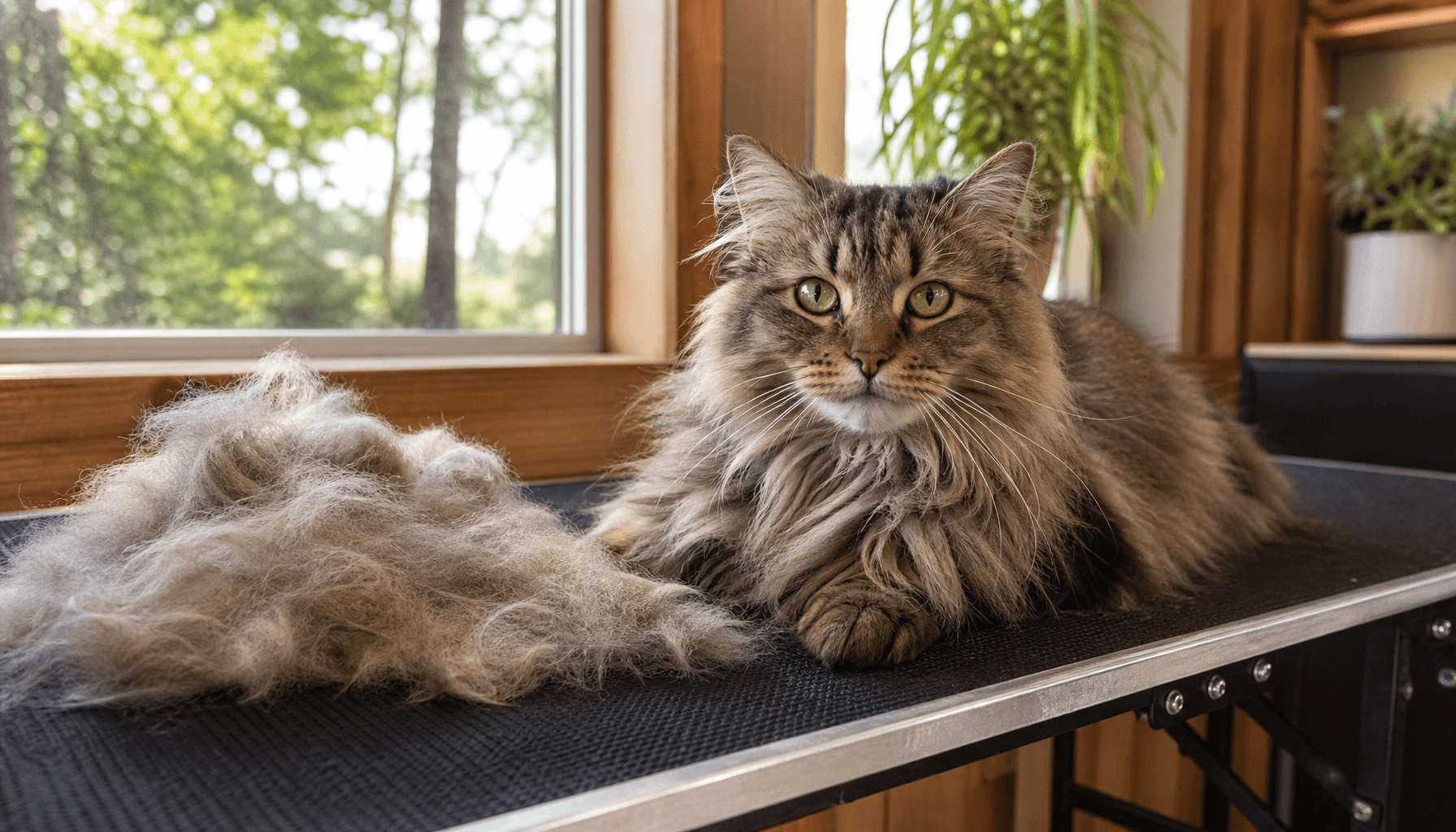
Here's the thing that tripped me up: the undercoat sheds seasonally, but the guard hairs don't shed nearly as much. So when you brush, you're pulling out mountains of that soft undercoat while the top coat stays put. That's why my cat looked the same after twenty minutes—I wasn't removing length, I was removing density. And because the undercoat is so fine, it mats like crazy if you ignore it. A single tangled undercoat strand can turn into a felted helmet on your cat's flank within a week. I learned that the hard way, on a build cat who shall remain nameless… until later in this post.
Guard hairs are your cat's raincoat
Guard hairs are the longer, stiff hairs you can see. They're designed to repel water and protect the undercoat from getting soaked. In a double-coated cat, these hairs don't mat easily, but they'll trap the shed undercoat against the skin if you don't brush. Ever seen a cat with a sleek top coat that looks fine, but when you tocuh it you feel lumpy mats underneath? That's the undercoat packed down, and the guard hairs are just lying on top like a rug hiding a mess. I spent an embarrassing amount of time thinking my cat was mat-free because I could run a comb over the surface and it looked smooth. Nah. you've to get deep.
The undercoat: fluffy chaos
The undercoat is the cat's secret weapon—and your mortal enemy. It's made of fine, wavy hairs that interlock. That interlocking is great for keeping your cat warm, but it also means that when it sheds, it forms little dreadlocks. If you've ever found a tiny mat that, when pulled apart, reveals a network of fur like a spiderweb, you've met the undercoat. These mats can pull on the skin, which is painful, and they restrict airflow. On a humid day, they can trap moisture and lead to hot spots or yeast infections. I once let a mat on a build cat's belly go unnoticed for a few weeks (I was scared to flip him over, full disclosure) and when I finally got a comb through it, the skin underneath was red and moist. Cue the guilt and a vet visit. That cat needed an antibiotic cream. I still feel kind of sick thinking about it. So yeah, the undercoat isn't just an aesthetic issue.
Breeds that sneak up on you with a double coat
You're probably aware of Persians and Maine Coons. What surprised me was learning that British Shorthairs have a plush double coat—they don't look as dramatically fluffy, but oh, do they pack an undercoat. The same goes for American Bobtails, Scottish Folds, and even some Siamese mixes can carry a denser undercoat than you'd expect. The point is, if your cat sheds in clumps and you can pluck a tuft of cottony fur from their rump without resistance, you're in double-coat territory. Even some alley cats have this. I fostered a gray tuxedo stray who I was sure was just a shorthair. Three days later, my couch looked like a sheep had exploded. She had a sneaky double coat that nobody saw coming.
Tools I actuaally use (and the ones I threw in the trash)
I've a drawer full of grooming tools that I bought in a panic, convinced each one would be The One. Most of them are now gathering dust, or I gave them to a neighbor who didn't know any better. Let me save you the money.
Speaking of junk, I once bought a $40 "self-cleaning" slicker brush from an Instagram ad. The button that was supposed to retract the bristles got jammed after three uses, and I spent ten minutes trying to pry cat fur out of the mechanism with a seam ripper. I'm not proud of the swearing that happened. That brush now lives in the back of my closet next to a pair of leggings I'll never wear again. I don't know why I keep it—proof that I'm an idiot, maybe. Bottom line: don't fall for gimmicks. You need simple, effective tools and a little patience.
Actually, scratch that—let me back up. Before I even list the tools, I need to say this: no matter what brush you use, if your cat hates it, you'll get nowhere. Invest in treeats, a calm voice, and the willingness to stop when they've had enough. Grooming a double coat isn't a race. It's a negotiation.
The slicker brush that changed my life
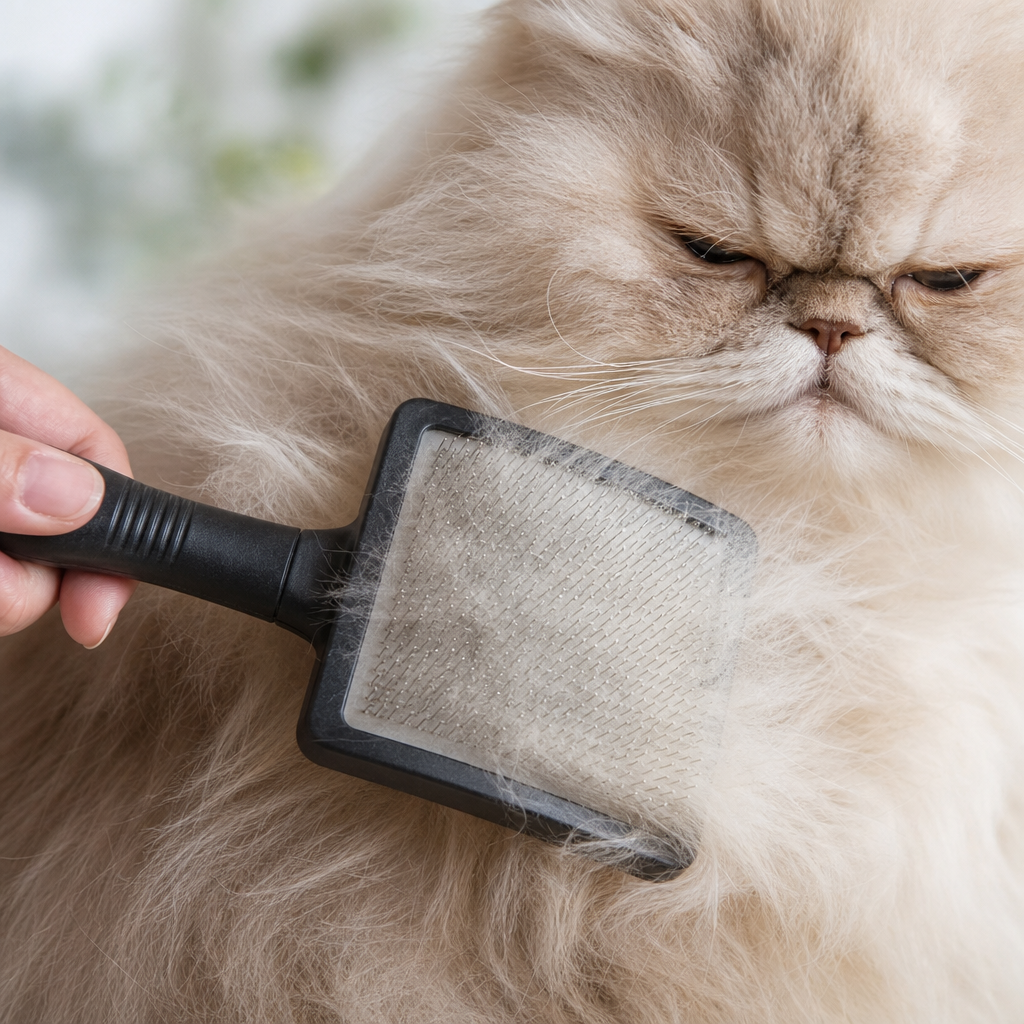
For double coats, you want a slicker brush with fine wire bristles that are bent at an angle. Not the kind with straight bristles—those are too harsh and don't grip the undercoat properly. The angled ones gently hook into the undercoat and pull out the loose fur without tearing the guard hairs. I use one with a flexible head that conforms to the body. The first time I used a good slicker on a Norwegian Forest Cat, I pulled out a whole second cat's worth of fur in five minutes. The cat purred so loud I thought he was snoring. That's the test: if they purr, you're doing it right. (Or they're just weird. Cats are weird.)
Undercoat rake: the fur magnet
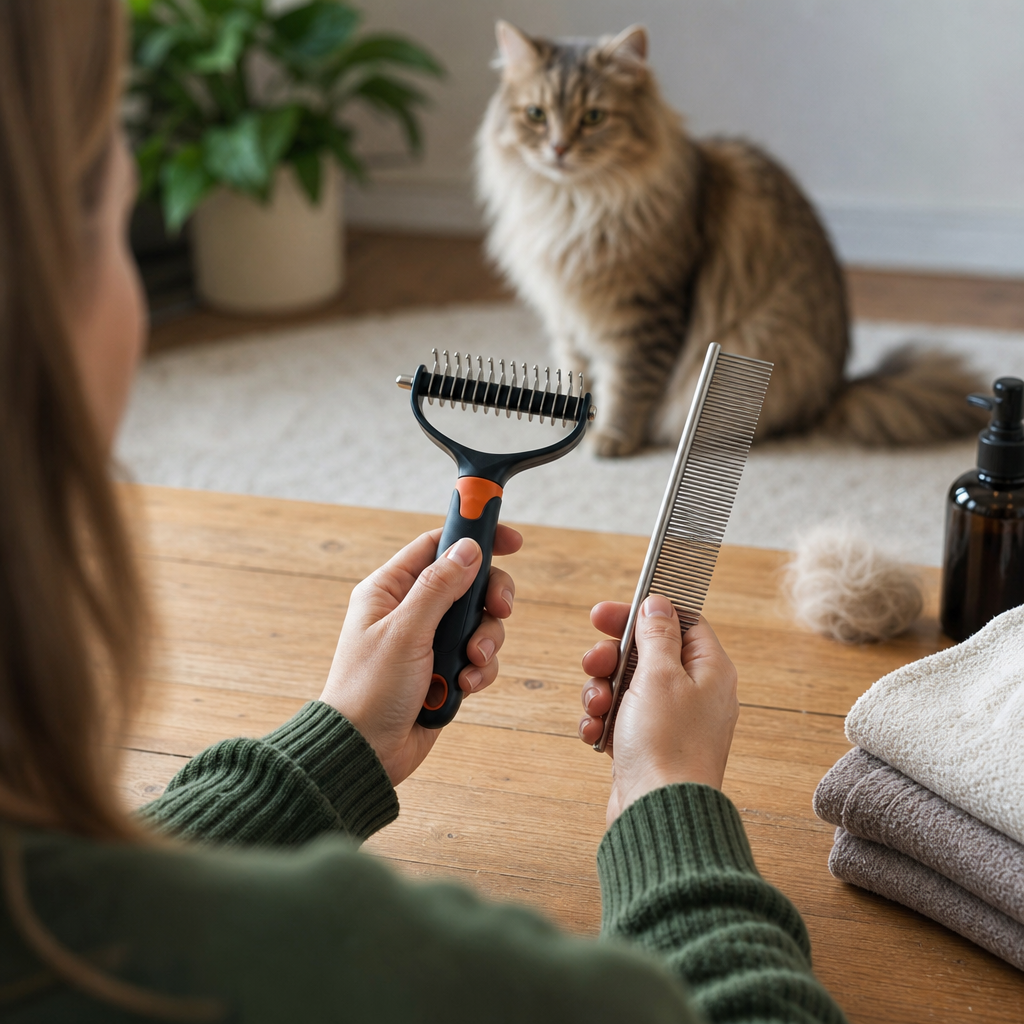
This is the MVP. An undercoat rake has metal teeth set in a row, and it's designed to reach through the guard hairs and pull out the dead undercoat without cutting or damaging the top coat. It looks a little medieval, but it works like magic. You'll use it after a pass with the slicker. Just glide it through, following the direction of the fur, and watch the fluff accumulate. I've used rakes on double-coated dogs too—totally different texture, but the idea's the same. Some rakes have rotating teeth that release the fur so you don't have to pick it out with your fingers every five seconds. Those are worth the extra few bucks. I swear I've saved hours of my life thanks to that feature.
A metal comb for finishing
After the slicker and rake, I go through with a wide-toothed metal comb. This catches any tiny mats I missed and smooths down the guard hairs. It's also how I check my work—if I can run the comb from root to tip without snagging, we're done. If I hit a snag, I go back with the rake on that spot. A metal comb will also help you find hidden mats in places like armpits and behind the ears that your fingers might miss. I've started doing a full body comb-out on every double-coated cat before I even think about putting the brushes away. It adds five minutes, and it's saved me from finding a mat the size of a dime three days later that's suddenly turned into a lobster-sized chunk.
Dematting tools: proceed with caution
This is where I get twitchy. Some dematting tools have blades that literally cut the mat out. If you're not careful, you can slice your cat's skin or leave a bald spot that will take months to grow back. I've done it. I've cried about it. The cat didn't seem to notice, but I did. If a mat is too big or too close to the skin, I now just use blunt-tipped scissors or a mat splitter—a tool that has a single protected blade that splits the mat apart so you can comb it out gradually. Patience is everything. If the cat squirms, stop. I've learned to only demat in increments, with breaks and bribes. It's not worth a bloodied ear or a broken trust.
The gadgets that are total crap
Furminator-style tools that look like a hacksaw blade? Some people swear by them, but on a double coat, they can actually cut the guard hairs and damage the top coat. I tried one on a Ragdoll and the fur grew back patchy and weord for almost a year. Never again. Also skip the silicone grooming gloves that promise to remove fur with a flick. They're okay for bonding, but they barely touch the undercoat on a double-coated cat. You'll just end up with a glove full of loose hair while the rest stays firmly embedded in your cat's sides. Save your money for good steel tools.
A good brush makes their coat shime like you wouldn't believe—I've seen my build cats go from dusty mop to glossy magazine spread just with the right tool and a decent diet. (I wrote about how a dull coat can signal bigger problems over here.)
Bath time: or, how to convince your cat water isn't lava.
Not every double-coated cat needs a bath. If your cat is healthy and grooms herself, brushing might be enough. But some cats get greasy, dandruffy, or—let's be real—poop-butt. I've fostered a senior Persian who couldn't reach her backend anymore, and the situation was… fragrant. She got baths. I've also bathed cats before a big mat-removal session because wet fur is easier to work conditioner into and gently tease apart. But you've to do it right, or you'll set your relationship back six months and end up with a terrified cat who now associates the bathroom with trauma.
Brush before you bathe (don't make my mistake)
If you wet a mat, it tightens. I learned this when I thought I'd be smart and wash a cat firrst to "loosen" the tangles. Nope. The water caused the mats to shrink into granite-hard knots that I then had to cut out. Now I always, always brush and comb the cat thoroughly before any water touches them. Remove every tangle. Get the undercoat loose. Only then do I even think about turning on the tap. This is non-negotiable. I don't care if the cat gives you the death glare the whole time—you'll thank me later.
Shampoo that won't set their skin on fire
My neighbor once told me she'd never bathed her cat in seven years because "cats clean themselves." That cat had a matted butt the size of a baseball and smelled like stale corn chips. I'm not saying you need to dunk your cat weekly, but double-coated cats sometimes need help. Especially if they're oledr or overweight and can't reach their back end. I learned that the hard way when I adopted a senior Persian who couldn't contort like she used to.
Point is, if you do bathe, use a cat-specific shampoo that's gentle, moisturizing, and free of harsh detergents. No dish soap, no dog shampoo (cats can be sensitive). I've gone through dozens of shampoos because my fosters are often raw and miserable from allergies or neglect. The ones that didn't make things worse are the same ones I use on double-coated cats—I detailed that whole experiment here. The TL;DR: look for oatmeal, aloe, and no artificial fragrance. Double-coated cats have sensitive skin uder all that fur, and you don't want to strip their natural oils. A conditioner is crucial—a spray-on leave-in conditioner can help prevent static and make brushing afterward easier.
Drying: the part where friendships are tested
You can't let a double-coated cat air-dry completely. If the undercoat stays damp, it can mat and even mildew. I'm not making that up. A damp undercoat is a breeding ground for bacteria. I use a microfiber towel to squeeze out as much water as possible—never rub, it causes tangles—then a low-heat blow dryer. I know, I know. Cats hate blow dryers. My trick is to start with the dryer off, just laying on the counter with treats nearby. Then I turn it on low from across the room while petting them. It's a process. Some cats will never tolerate it, in which case I towel-dry obsessively and keep the room warm until they're barely damp. With my senior Persian, I'd wrap her in a towel burrito and watch Netflix while she dried. She'd fall asleep. It was actually kind of adorable. If your cat loathes the dryer, don't force it. A damp cat in a warm room is better than a stressed, scratched-up human.
Once they're dry, the coat will look amazing—fluffy and soft and almost unreal. That's when I like to give them a final comb and just admire my work. I've written about how a heaalthy coat reflects overall health, and bath time can be a turning point in that secret journey.
The matting nightmare
Matting is the boogeyman of double coats. It starts so small—a little tangle behind the ear, a tuft in the armpit. Then one day you pet your cat and dicover what feels like a piece of felted wool glued to their side. How? How did that happen in a week? The undercoat strikes again.
I once missed a mat on a build kitten's inner thigh because I was too shy to flip her over and really inspect. By the time I found it, the mat had pulled the skin up into the knot—a "mat ball" that was literally tugging on her fesh. The vet had to sedate her to shave it off. I sat in the waiting room feeling like the worst human on earth. The vet tech said it happens all the time, but I didn't believe her. Anyway, now I'm obsessive about checking every nook and cranny. Armpits, groin, behind ears, between toes, under the tail. Those spots I'll check twice.
Why that tiny smarl turns into a golf ball overnight
Loose undercoat doesn't just fall out; it gets trapped by the guard hairs. As the cat moves, friction causes that loose fur to wrap around itself, forming a tiny knot. Add a little moisture (maybe the cat drools in its sleep) or some ditt, and suddenly you've a solid mat. The mat grows because it catches more shedding fur. The skin underneath gets no air, can become moist, and then you're looking at potential bacterial or yeast infections. I've seen cats with mats so tight they restricted movement. If you've ever noticed your cat walking a little stiffly and realized a mat in their armpit is pulling, you know that sinking feeling.
If the skin is already red or oozy, you're beyond at-home grooming. You might be dealing with something like feline eczema or a secondary skin infection—I've got a whole post on recognizing those symptoms and treatment options here. Don't try to yank out a mat over irritated skin. You'll just make it worse.
Armpits, groin, and other places you forget to check
I now have a checkist when grooming: under the chin (where collars rub), behind the front leggs, the "armpit" area where the leg meets the body, the flanks, the belly, the britches (back of hind legs), and the base of the tail. I'll run the metal comb through each zone. If I feel a snag, I'll work it out slowly with a dematting splitter, holding the fur as close to the skin as possible so that if the cat jerks, I'm pulling on the mat, not the skin. It's a two-person job sometimes. I recruit my partner with a Churu treat to distract while I work. Bribery isn't beneath me.
Why shaving a double coat is a terrible idea
I get why people do it. They see a fluffy cat in summer and think, "Oh, they must be hot. Let's shave them." Please don't. That undercoat is thermal regulation. It keeps them warm in winter and cool in summer. Removing it disrupts their natural temperature control. The guard hairs may never grow back the same, and the coat can come in patchy and weird. I've seen shaved Persians with a permanent "punk rocck" look because their guard hairs didn't regenerate properly. It's not cute—it's a lifelong coat defect.
The myth of the summer shave
Vets don't recommend shaving double-coated cats unless there's a medical reason—like severe matting that can't be saed, or a skin condition requiring topical treatment. Even then, they try to preserve the integrity of the coat. I've had a vet sedate a cat and meticulously shave only the matted patches, leaving the rest intact. The cat looked like a poodle with patches, but she healed and the fur grew back normally. If you shave a double coat down to the skin, you're removing the protective barrier against sun, insects, and temperature extremes.
What actually happens when you strip that insulation
The undercoat grows faster than the guard hairs. After shaving, the undercoat may grow back thick while the guard hairs struggle to catch up. This can cause a dense, cottony coat that mats even worse than before. It's a vicious cycle. Some groomers do something called a "comb-out" or "de-shedding treatment" that removes undercoat without cutting fur, and that's fine. But shaving with a clipper bldae close to the skin? I woudn't. Just don't. And if a groomer suggests a "lion cut" for a double-coated cat, ask them why they want to destroy your cat's coat. Okay, maybe be a little politer. But seriously, question it.
Grooming frequency: the honest answer
I brush my double-coated cats properly at least twice a week, sometimes more during shedding season. The big shed fest around spring and fall? I'll do a quick daily slicker pass. The cats honestly seem to enjoy it—once they trust the process. If you wait a month, you're asking for mats. Short, frequent sessions keep everything under control and reduce hairballs and random tufts on your furniture. There's no magic number. Watch your cat, feel their coat regularly, and don't let it get away from you.
A quick story about Sophie
Sophie was a long-haired calico I fostered two years ago. She arrived with mats so bad she couldn't lift her tail. We were still in the early days of trying to get the two cats used to each other (a whole circus), and Sophie was already stressed. Grooming her was a disaster. I'd touch a brush and she'd bolt. It took three weeks, a cat behaviorist, and a cocktail of gabapentin and patience to finally remove those mats. Sophie went to a new home with a strict groming schedule. She now tolerates brushing because her new owner does it daily with a treat afterward. I learned that sometimes the emotional state of the cat is the real obstacle, not the fur.
When to call a pro
If you've got a severely matted cat, a cat that turns violent, or you're just in over your head—call a professional groomer or your vet. It's not a failure. It's recognizing when your skill set ends and a sedated shave might be kinder than a months-long struggle. I've done it. No judgment.