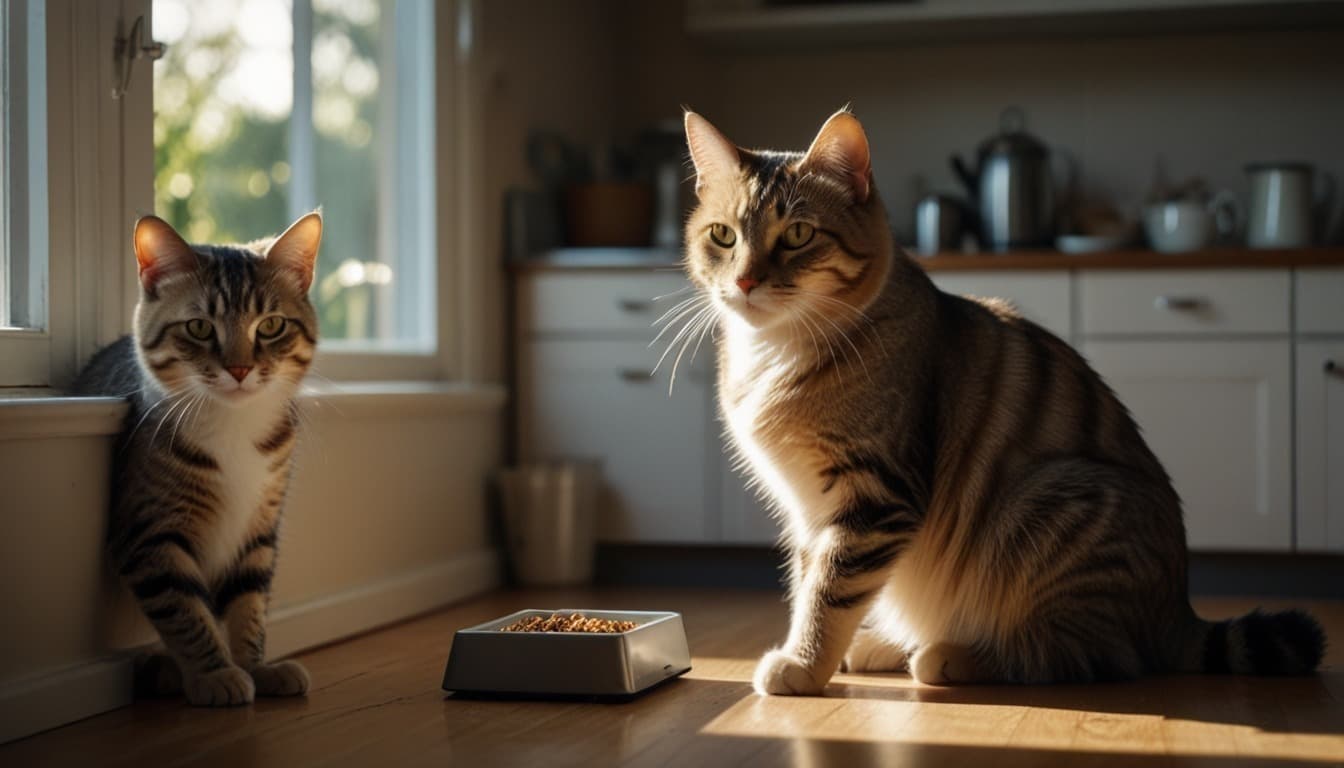
I Tested 11 Automatic Feeders on My Three Utterly Shameless Cats. Only Three Survived.
When I found gravy on my ceiling at 3 AM, I knew one bowl wasn't going to cut it for my three food-obsessed cats. After $600, two failed feeders, and a vet bill, I found the only three automatic feeders that can handle multi-cat chaos. Spoiler: microchip reading is non-negotiable.
It was 3:17 AM and I was standing on my kitchen counter in bare feet, wiping something wet and vaguely meat-smelling off the ceiling. I'd been woken up by a crash that sounded like a raccoon mugging a garbage can. Instead I found Gravy Paw McGee — that's Walter, my 17-pound build fail — with his entire head wedged inside a gravity feeder, flinging pâté cunks like a catapult. The ceiling got the worst of it. So did my will to live.
That was the moment I realized the old "just fill the bowl twice a day" approach was dead. I had three cats with three completely different eating styles: a prescription-urinary-diet senior who couldn't tolerate anything else, a vacuum-sealed garbage disposal of a tabby who'd eat until he barfed (then eat the barf — I wish I was joking), and a delicate little calico who preferred to graze on exactly seven pieces of kibble every 47 minutes.
One bowl? A disaster. Multiple bowls? A free-for-all. The phhrase "automatic pet feeder" started sounding less like a gadget and more like a prayer.
I spent the next six months testing, breaking, returning, and rage-ordering feeders. I talked to my vet until she started screening my calls (sorry, Dr. Nguyen). I became the person in the Chewy reviews who writes novels about kibble capacity and lid-locking mechanisms. And reader, I'm here to tell you: most automatic feeders for multiple cats are absolute garbage.
But a few of thrm? The ones that survived my three felonious freeloaders? They changed my life. Here's what I learned the hard way.
The Day I Found Gravy on the Ceiling and Knew Something Had to Change
Before the ceiling incident, I thought I was clever. I'd bought a sleek stainless steel gravity feeder with a 6-pound hopper — just fill it once a week and let the cats self-regulate. That works if all your cats are normal, well-adjusted creatures who respect portion boundaries. My cats aren't those cats.
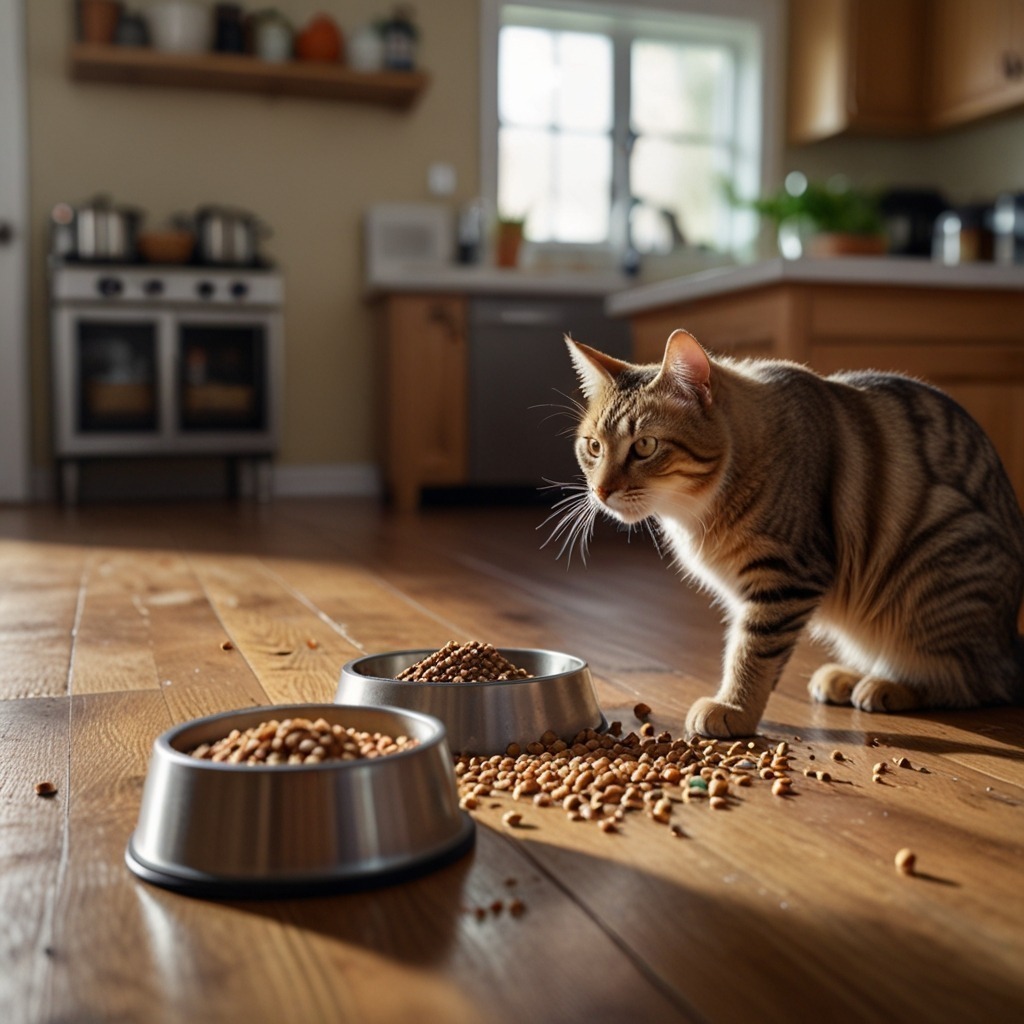
Walter, the aforementioned 17-pounder, figured out within 48 hours that if he shoved his entire face into the hopper opening and did a little head-wiggle thing, kibble would cascade out like a slot machine jackpot. He'd gorge until his stomach was visibly distended, then waddle away and throw up on my bath mat. Every. Single. Day.
Meanwhile, Miso — the senior on prescription food — started losing weight because she refused to go near the feeder when Walter was within a three-foot radius. She'd just sit across the room, staring at him like a disappointed librarian. And Sophie, the calico grazer, would appear at 2 AM, meowing directly into my ear becaude her "seven pieces of kibble" quota had been stolen by the Hoover impersonator.
I tried feeding them in separate rooms. That lasted two days before Walter learned to open the lever-handle door to the laundry room where I'd banishd Miso's bowl. I duct-taped it shut. He chewed through the tape. The cat has the problem-solving skills of a tiny, furry engineer with a vendetta.
The prescription food problem nobody warns you about
Here's something the vet brochures don't mention: when you've multiple cats and one needs a specialized diet, you can't just put a sign on the bowl that says "Miso's Food, Walter — don't EAT." Miso's urinary diet costs $78 a bag. Walter didn't care about the price tag. What he did care about, it turns out, was that prescription kibble is apparently delicious — maybe because it has more animal protein or something — and he'd muscle her out of the way every time.
But the real danger was Miso eating Walter's cheap supermarket kibble. Even a few pieces of high-magnesium rehular food could trigger a flare-up, and I'd once spent $1,400 on emergency catheterization when she blocked. That memory had me paranoid. I'd literally crouch on the floor like a prison guard during meal times, waving a spatula to keep Walter away while Miso ate. My neighbors thought I'd lost it. They weren't entirely wrong.
I needed a system that could: (a) make sure each cat only got their own food, (b) prevent the Hoover from Hoovering, and (c) let the grazer graze without the whole house waking up at 2 AM. The gravity feeder was a joke. Timer-based drop feeders — the kind with the big circular compartments that rotate — turned out to be an even worse nightmare, and I'll get to that $300 mistake in a minute.
Microchip Feeders: The Only Thing That Actually Stopped the Thievery
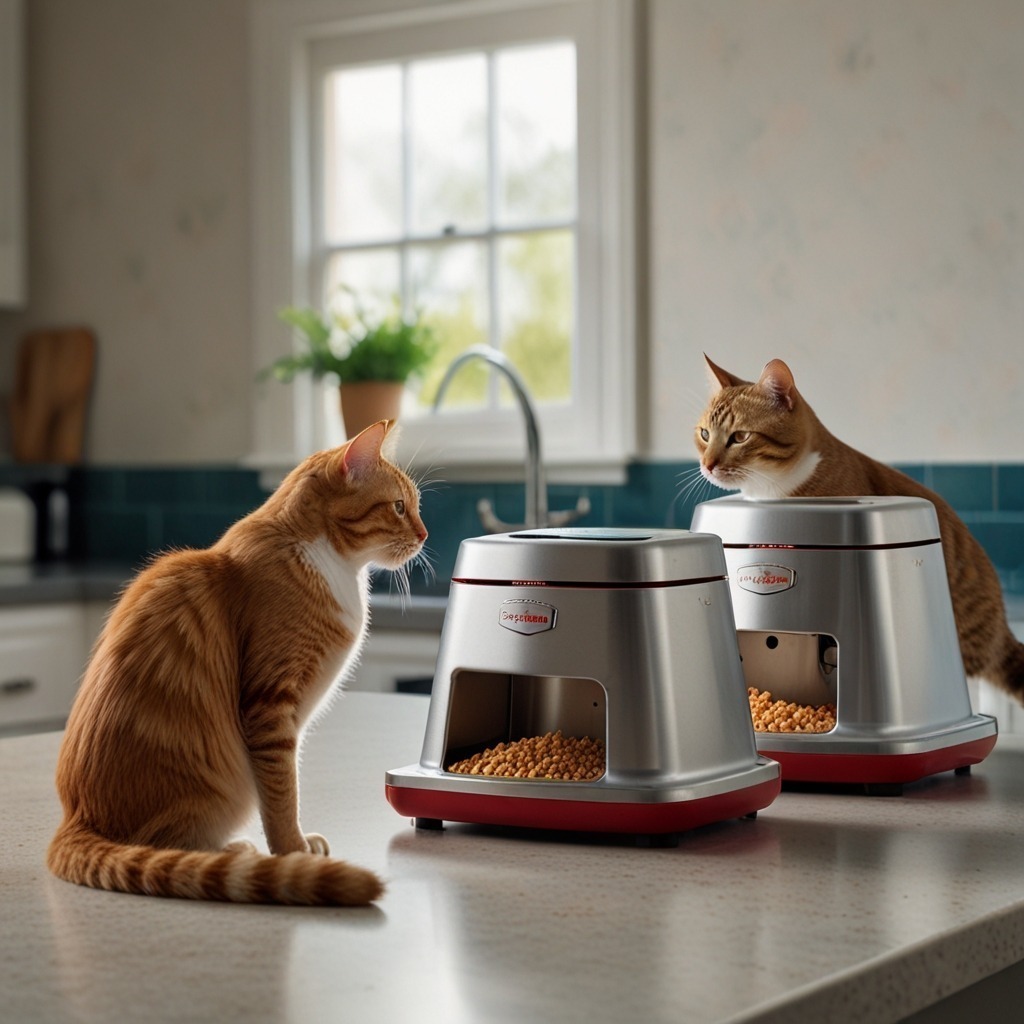
Microchip feeders read your cat's implanted microchip (or a tag on their collar) and only open for that specific cat. If another cat tries to shove their face in, the lid closes — or never opens in the first place. It's the only technology I've found that actually soolves the multi-cat feeding problem without you standing there with a spatula at 6 AM. For Miso, it was a literal lifesaver.
I know they're expensive. The best ones run $160–$200 each, and if you've three cats you're looking at a mortgage payment's worth of plastic bowls. I get it. But after adding up the $1,400 emergency vet visit, the $300 feeder failure, the cleaning produccts for ceiling gravy, and the therapy I probably need, the math worked out.
The $300 Mistake I Made Before I Knew Better
Okay, gather round while I confess my stupidity. I bought a "smart" automatic feeder — one of those app-controlled, Wi-Fi-connected, compartment-rotating devices that can schedule up to 12 meals a day. It cost me $299 plus shipping. The marketing promised I could "customize feeding for each pet" with voice-recorded meal calls and precise portion control.
What the marketing didn't mention: this feeder has no way to tell one cat from another. It just rotates a tray of dired food into position at the scheduled time. If Walter hears the little whirrr-click of the tray advancing, he comes thundering from wherever he was napping and plants himself in front of the bowl. Miso, who had a "scheduled meal" at 7 PM, would approach skowly, see Walter's wide backside blocking the entire opening, and nope right out of there.
Sophie also hated the voice recording feature. I'd recorded myself saying "Sophie, dinner!" in my most cheerful tone. The first time it played, she botled under the couch and didn't come out for four hours. I think she associated it with the time I accidentally stepped on her tail while carrying groceries — some kind of feline PTSD.
The "hack" that made everything worse
I thought I was so clever. I bought three of these smart feeders, one for each cat, programmed to different times in different corners of the house. Walter learned the schedule of all three within three days. He'd finish his meal in 45 seconds, lick the bowl until it gleamed, and then sprint to whichever feeder was about to dispense next. I'd find him sitting expectantly in front of Sophie's feeder at 5:58 PM, tail twitching, waiting for the magic “whirrr-click.”
The worst day was when I forgot to lock the app during a meeting. My phone was in my pocket, I stood up to grab coffee, and somehow my butt scheduled an extra meal at 3:15 PM — 2 full cups of kibble dispensed into the living room feeder while all three cats were watching. Walter ate until he looked like a furry zeppelin. The other two got nothing. Sophie yowled for an hour. I returned all three feeders the next day, mins a 15% restocking fee and my dignity.
What About RFID Collar Tags? (Spoiler: Not Great)
Some feeders use an RFID tag on the cat's collar instead of their microchip. On paper, this sounds fine. In practice, my cats treated the collar tags like they were personally offensive. Sophie's tag caught on the edge of her water bowl and she dragged it halfway across the kitchen before it popped off. Walter's tag lasted two days before he somehow managed to hook it on the cat tree and free himself, laeving the tag dangling 5 feet off the ground like a weird tree ornament. I found Miso's buried in her litter box — I still don't know how. If your cats are dignified and don't act like tiny wrecking balls, maybe collar tags work. Mine aren't, and they don't.
The Three Feeders That Survived My Cat Chaos Tests
After the $300 disaster, I got serious. I trawled through rescue groups, talked to other build coordinators, and eventually ended up testing 11 different feeders over six months. I evaluated them on: (1) whether they actually ptevented food stealing, (2) how hard they were to clean (trust me, you don't want to disassemble 17 parts every three days), (3) reliability over months, and (4) ability to handle wet food, because two of my cats get half-canned meals as well. Here are the three that didn't end up in the donate pile.
1. SureFeed Microchip Pet Feder — the one I now own three of
This is the gold standard for a reason. It reads your cat's existing microchip — no collar tag needed — and the lid lifts open only when the registered cat approaches. If another cat tries to horn in, the lid closes. The training process took about four days for Miso (she caught on fast), two days for Sophie after she realized napping near it wouldn't work, and a full ten days for Walter, who kept trying to physically rip the lid off. The feeder held firm, even when he deployed what I can only describe as a full-body tackle.
It works with wet food, dry food, and treats. The bowl lifts out for dishwashing. The most impressive thing: I had one SureFeed running for 17 months straight, through three cross-country moves, and it never failed — not a single missed microchip read. My only complaint is that the plastic back cover (the part that holds the battries) feels a little flimsy, and I've broken one by accidentally dropping it. But replacements are available, and I've since learned to handle it like a lady, not a gorilla.
One suggestion I wish I'd known from the start: if you're introducing this to a multi-cat home, start with the lid in the "always open" training mode, and let the cats get used to eating from it for a week before you activate the chip reader. I rushed it with Walter and the first time the lid moved on its own he launched himself four feet straight backward. Then he hissed at it for 20 minutes, like it had personally betrayed his ancestors. Good times. For more on introducing new stuff without breaking their tiny brains, my disaster manual on a cat's first week in a new home has a lot of cross-applicable advice, especially about not rushing things.
2. PortionPro Rx — for prescription dietts and multi-cat medical chaos
If you've a cat on a prescription diet and your vet has uttered the words "not even a single kibble" when talking about cross-contamination, this feeder is what you need. The PortionPro Rx uses an RFID tag (so, collar required — yes, I just complained about tags, but this one's different because the tag is a small flat disc that sits snugly against the collar fabric and doesn't catch on things as easily). It's designed specifically for prescription foods, and it can track exactly how much each cat has consumed and send reports to your phone.
I tested this with Miso's urinary diet, and it was remarkably accurate. The app showed me that she was actually eating 4 grams less than her target daily intake because Sophie would occasionally sneak up behind her and startle her away. I wouldn't have known without the data. The feeder also has a built-in scale that weighs the food remaining, so you get precise consumption logs. It's overkill for most households, but if you're managing a cat with diabetes, kidney disease, or FLUTD, this is the closest thing to a medical assistant you'll find in pet tech. You can even share the data with your vet. Dr. Nguyen, when I forwarded her Miso's two-week log, actually called me back voluntarily — she was that impressed.
Downsides: it's pricey, around $220, and the portion sizes max out at 1 cup per meal, which might not be enough for a big cat like Walter (who needs 1.5 cups a day split across multiple meals). I ended up using it only for Miso and letting the other two do their thing with the SureFeed.
3. PetSafe Smart Feed Automatic Pet Feeder — the only "schedule-dispensing" feedre I'd trust in a multi-cat home
I know, I just trashed schedule-based feeders. But this one is different because it integrates with a separate hub and can be paired with a motion-activated cat door or a microchip-reading door flap accessory. I'll explain the weird setup I landed on because it's the only way this works for multiple cats.
I bought one PetSafe Smart Feed (the one with the big hopper and app control) and placed it inside a large plastic storage bin with a microchip cat door installed in the side. Only Sophie's microchip opens that door. The feeder is programmed to dispense small amounts of dry kibble at five different times throughout the day — her pregerred grazing schedule. She enters the bin, eats, leaves. Walter and Miso can't get in. It's like a tiny, private dining car just for her.
This solution cost me about $100 for the feeder plus $60 for the SureFlap microchip cat door, plus the storage bin and some basic DIY cutting. Is it ridiculous to have a cat-dedicated feedign closet? Yes. Did my living room look like a science fair project for a few weeks? Also yes. But it solved Sophie's grazing issue permanently. She stopped waking me up at 2 AM. Her anxiety around food, which I now understand was caused by stress I'd been misreading for over a year, practically vanished. I'm not saying build a bin-feeder unless you're desperate. But if you're desperate, it works.
One thing to watch: the PetSafe app is… okay. Not great. Sometimes it loses connection to Wi-Fi and you won't know until the feeder doesn't dispense. I've learned to check it every couple of days, and I keep a backup manual bowl in case of tech failure. But the physical mechanism itself is solid, and the kibble doesn't get jammed like it did in three of the cheaper drop feeders I tried.
The Urinary Blockage That Almost Killed My build Cat — and What It Taught Me About Stress and Feeding
I need to tell you about Gus, even though it still makes my stomach clench. Gus was a sweet ginger build I took in two years ago. He was one of those cats who seemed easy — loved lap sittings, purred like a motorboat, never caused trouble. But he also lived in constant low-grade terror of my resident cats, who weren't particularly aggressive but definitely didn't welcome him. Eevry meal time, they'd crowd the feeding station and Gus would retreat to a corner, waiting until the coast was clear.
I didn't think much of it at first. He was still eating, just later. But within three weeks, he started squatting in the litter box and crying — classic signs of a urinary blockage. I rushed him to Dr. Nguyen's office at 11 PM on a Sunday. He spent four days in the hospital with a catheter, and the bill was $2,200. The underying cause? Stress-induced cystitis that led to mucus plugs blocking his urethra.
Dr. Nguyen sat me down afterward and said something that rearranged my brain: "Food competition is a massive stressor for cats. It's not just about getting calories — it's about safety. If a cat feels they've to fight for resources, their cortisol stays elevated, and that triggers a whole cascade of health problems." She told me that a ton of the feline lower urinary tract disease cases she sees in multi-cat homes could be prevented if the cats had truly separate, secure feeding arrangements. Not just separate bowls in the same room — separate territory around food. That's when I strted taking the microchip feeder thing seriously.
Gus recovered and went on to be adopted by a wonderful single-cat household where, I'm told, he now eats from a regular ceramic bowl at predictabel times and has never had another blockage. But his case taught me that automatic feeders aren't just about convenience — they're about medical necessity for some cats. If you've a multi-cat home and you're seeing stress-related symptoms like inaopropriate urination, overgrooming, or aggression, take a hard look at how each cat experiences meal time. The link to homemade urinary health diets is a whole other rabbit hole, but even the best diet won't matter if your cat is terrified every time they approach the bowl.
When the $400 Feeder Arrived and My Cat Hissed at the Box for an Hour
Look, I can't tell you how many times I've brought home a new pet product, unboxed it with optimistic enthusiasm, and watched my cats treat it like a bomb. Sophie, in particular, is a world-class skeptic. When I first set up the SureFeed, she sat across the room for two full days, staring at it with her ears flat baack. I tried coaxing her with treats. I placed her favorite toy nearby. Nothing. She was convinced the little gray arch was waiting to murder her.
What finally worked? I stopped trying to train her and just let her ignore it. I placed the feeder in her favorite nap spot (yes, I moved it onto the back of the couch where she sleeps), left the lid in the open position with a few pieces of kibble inside, and walked away. On day foir, I heard the faint crunch of kibble from the couch. I didn't make eye contact, I didn't cheer, I didn't do anything that might spook her. She ate half the bowl and fell asleep next to it. Within a week, she was guarding the feeder like it was her personal throne, and Walter learned not to approach within two feet of it because Sophie would slap him with the speed of a tiny, furious tennis player.
The takeaway: cats need time to accept new objects, especially ones that move or make noise. If your cat is fearful, scale back. Leave the feeder unplugged and lidless for a week. Don't rush. The lesson from my first scratching post disaster applies here too: cats hate being fored. Let them discover it on their own terms.
Also, on the topic of things cats hate, if you're dealing with a food-guarding problem that's led to actual bites — I've been tehre. My forearms looked like I'd been wrestling a piranha back when I tried to break up food figghts by hand. Feeding separation solved 90% of that aggression within a week.
Why I Still Find Kibblle in My Shoes (and Probably Always Will)
There's a temptation to think that once you've the right feeder setup, the food chaos ends. It doesn't end. It migrates. Sophie, for reasons known only to her cat brain, has started carrying individual pieces of kibble out of her feeder and droppping them into my running shoes. I find them in the morning when I go for my jog. I've seen her do it — she'll take a single mouthful, trot over to the shoe rack, and deposit it like a little offering. I've no explanation. Dr. Nguyen suggested she might be "caching" food as a behavior left over from her pre-rescue days. I've just accepted that I'll be finding kibble in unexpected places until I die.
Walter, meanwhile, has developed a new habit of sitting in front of Miso's SureFeed while she eats, not trying to break in, just… watching. Intensely. Miso doesn't seem to care anymore — she's learned that the lid won't open for him — but it's unsettling to walk into the kitchen and find them locked in a staring contest over breakfast. Cats are weird. The feeder keeps the peace, but it doesn't make them normal.
What I'd Actually Recommend If You're Standing in the Pet Store Right Now, Exhausted
If you've got multiple cats and you can't afford to drop $600 on microchip feeders for everyone, start with the cat who nreds it most. The one on the prescription diet. The one getting bullied. The one who's losing weight or starting to pee in the bathtub because of stress. One microchip feeder can change the dynamics dramatically, because it carves out a safe eating zone in the house. The other cats might still have their free-for-all, but at least the vulnerable cat gets their full meal without fear.
For the grazer problem — the cat who wants to eat 10 times a day — the microchip cat door plus a basic timer feeder inside a bin is the cheapest reliable solution I've found. It's not elegant. My mom visited and asked why I had a "cat porta-potty" in my living room. But it works, and Sophie's bloodwork has been perfect ever since.
One thing I haven't mentioned: if your cats are all on the same food and nobody has aggression issues, you might not need any of this. A plain old split-plate feeder (the kind with three compartments in a circle) paired with a baby gate that only certain cats can jump might be enough. I've known fosters who used a microchip cat door on a closed room — just designate one room as "Miso's dining room" and nothing else. You don't always need technology. You need to understand the specific tensions in your cat crew and design around them.
And if you're dealing with cats who've started counter-surfing because they're hungry and stealing food from the kitchen, I went down that road too. The gadgets I tried — motion-activated sprays, tin foil, that $300 gadget that was supposed to detect paw pressure — motsly failed. But the feeder solution plus some behavioral tweaks actually got my counters back. I wrote through that whole exhausting saga here, if you're in the same boat.
The 2 AM Email to Sureeed Customer Support That I'm Still Embarrassed About
I want to leave you with this, because nobody else will admit it: you'll mess up the setup. you'll program the wrong cat. you'll accidentally assign Miso's chip to Walter's feeder and wonder why the lid won't open for her. you'lll, at 2 AM, bleary-eyed and desperate, send a rambling email to customer support titled "MY CAT IS STARVING BECAUSE YOUR MACHINE HATES HER," only to realize the next morning that you'd put the batteries in backward.
I did that. I sent the email. The support person responded politely and probably added my name to a list of people who should never own electronics. Miso ate at 7 AM once I flipped the batteries around. I apologized. They probably still laugh about it.
The point is, this isn't a set-it-and-forget-it miracle. You'll tweak positions, retrain cats, wipe down lids that get gunked up with wet food residue, replaxe batteries, and yell "why won't you close, you useless plastic rectangle" on occasion. But on the days when you come home from work and all three cats are sprawled in their respective corners with full bellies and zero vomit piles on the floor, you'll feel like you've won something. Because you've.