I Raised 12 Kittens in a 500-Square-Foot Apartment and Only Lost One Security Deposit (Here’s the Messy, Exhausting Truth)
You don’t need a big house to raise a kitten, but you do need a strategy for the 3 a.m. zoomies, the litter dust on your pillow, and the scratching that can eat your security deposit. I’ve fostered a dozen kittens in my tiny apartment and I’ll tell you exactly what I wish I’d known before the first
When I tell people I’ve fostered a dozen kittens in a one-bedroom apartment — 500-ish square feet, badly painted walls, a radiator that screams at 4 a.m. — they look at me like I’ve confessed to running a black-market circus. "But where do you put the litter boxes?" they ask. "Doesn't it smell?" "What about the furniture?" They imagine a scene straight out of a feline horror movie: shredded curtains, overturned houseplants, my landlord weeping into a stack of eviction papers.
Honestly? Some days they wern't wrong. The morning I woke up to a build kitten named Pippin dangling from my living room curtains by one claw, screaming like a tiny, fuzzy fire alarm while his brother Bean used my favorite lamp as a launchpad — I did briefly question my life choices. The lamp shattered. Pippin let go, landed on my head, and then peed a little on my pillow out of sheer panic. My landlord (who lived downstairs) texted me at 7:02 a.m.: "Everything okay up there?" I was 27, covered in kitten pee, and already mentally calculating how much a new lamp would cost out of my definitely-not-getting-back security deposit.
That was five years and roughly 12 kittens ago. I've made every mistake. I've cried into a lint roller at 3 a.m. while a tiny furball did parkour off my face. I've spent money on gimmicky "apartment-friendly" products that were absolute garbage. I've also, against all odds, managed to raise incredibly sweet, well-adjusted cats in a space smaller than most people's garages — and I only lost one securrity deposit along the way (the lamp incident started a cascade, but we'll get to that). So if you're sitting there staring at your 600-square-foot box wondering if you're selfish for wanting a kitten, knock it off. You're not selfish. You're just going to need a plan — and not the one you'll find on the first page of Google.
The First 48 Hours in a Tiny Apartment: Why Your Bathorom Is About to Become Kitten Command Central
Mistake number one everyone makes when bringing a kitten into an apartment: giving them free reign too fast. I get it. You've kitten-proofed (you think). You've set up a cute little bed and a food bowl and a scratching post. The whole place is maybe 500 square feet — how lost can a kitten get? Let me tell you about Miso, the third build I ever took home. Miso was a scrawny grey tabby who weighed maybe a pound and a half. I opened her carrier in the middle of my living room, expecting a timid little exploration. Instead she shot under the couch like a furry bullet, then squeezed herself behind the refrigerator — a gap I didn't even know existed — and stayed there, silent, for fourteen hours. I spent the entire nihgt crawling around on my stomach with a flashlight, convinced she'd somehow teleported into the walls. (She hadn't. She was wedged behind the fridge, hissing at the compressor whenever it kicked on.)
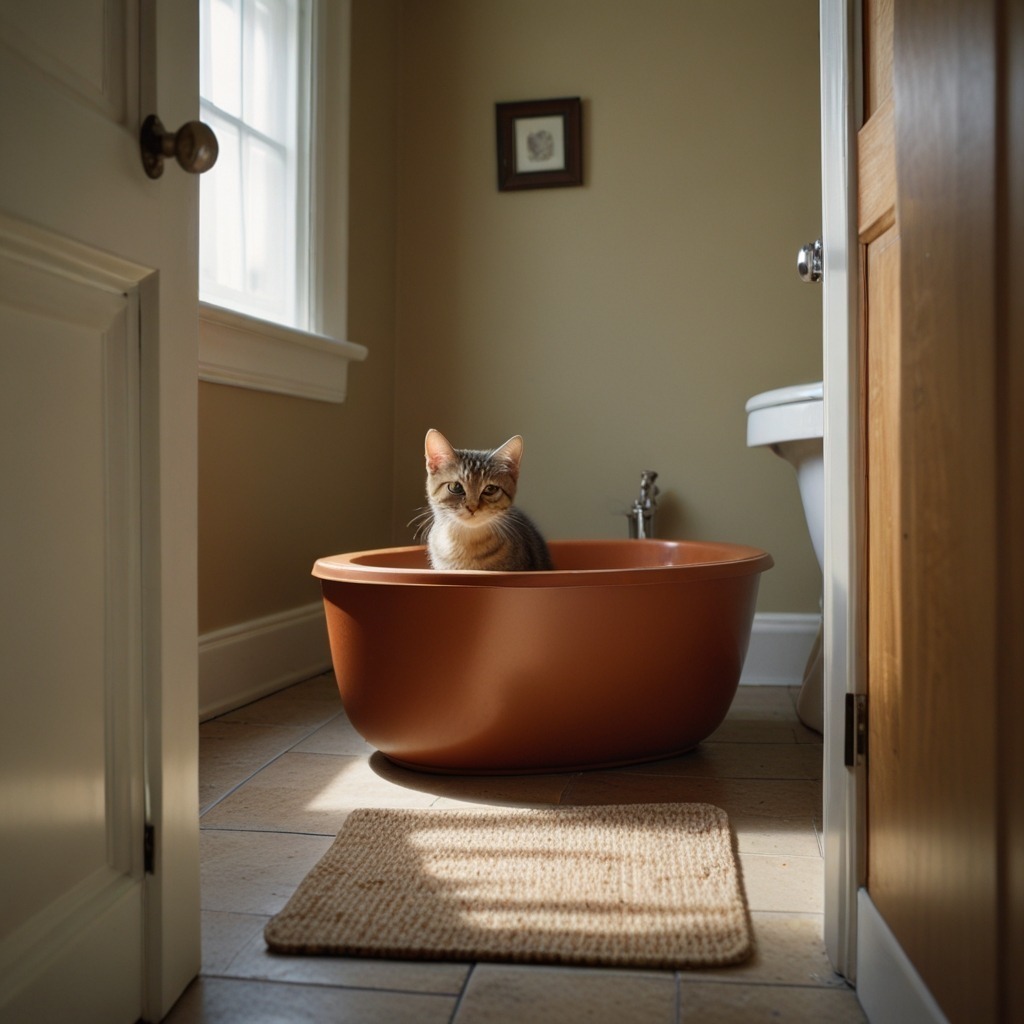
In an apartment, the hidey-holes are infinite. Under the stove. Behind the stacked washer-dryer unit that's never been moved. Inside the box spring of your bed (they'll tear the faabric and cllimb right up). The gap between the kitchen cabinets and the ceiling. I once found a kitten named Toast snoozing inside my bathroom vanity after he'd crawled through the plumbing cutout. I had to unscrew the access panel to get him out. So here's what I do now for every single build, no exceptions: the bathroom becomes the kitten decompression chamber for at least the first three days, sometimes a full week. Not a punishment — a sanctuary. Small, quiet, predictable. Litter box in one corner, food and water in the other, a soft carrier or box with a blanket, and a couple of safe toys. The door stays shut. I visit frequently — sit on the floor, read a book out loud, let them climb on me — but they don't roam the apartment until they're confident in that one small room. It sounds counterintuitive when you're already cramped for space, but trust me, a kitten who's overwhelmed will find places you didn't know existed and you'll be panic-googling "how to lure a cat out of a wall" at 2 a.m. (The answer, by the way, is stinky wet food and patience — not fire department extraction, which I absolutely considered.)
That bathroom also lets you monitor the essentials without scanning an entire apartment. Is she eating? Pooping? Peeing? You'll know within hours because the evidence is right there on the tile. I can't tell you how many times a new build parent has called me panicked because their kitten hasn't used the litter box in 36 hours, only to discover the kitten had been using the back of a closet they never check. The bathroom strategy solves that.
Litter Boxes in Apartments: Why I Lost a Security Deposit (and a Friendship)
Okay, we've to talk about the single most contentious topic in apartment kitten ownership, and it's not the 3 a.m. zoomies — it's the poop. Apartment living means you can't just tuck a litter box in a distant basement or a mudroom. It's going to be in your living space, probably within nose-reach of where you eat, sleep, and binge Netflix. I've tried every configuration known to humanity. I've hidden boxes in closets, cabinets, decorative chests, under bathroom sinks. I've built DIY litter box furniture out of IKEA hacks. I've spent more money on mats, liners, and "odor-eliminating" gadgets than I've on my own wardrobe. And I still vividly remember the niight my friend Jen came over for dinner, took one step inside, and said — with the kind of brutal honesty you only get from someone who's known you since college — "Sarah, your apartment smells like a pet store." I wanted to die. Right there on my entryway rug, which, coincidentally, probably had some litter dust ground into it.
Here's what I've learned through 12 kittens and a whole lot of trial and error. First, the number of boxes matters more than you think. The standard rule is one box per cat plus one extra. In an apartment, finding space for two boxes when you only have one kitten feels insane. I used to push back against that hard. But with a single kitten, especially one still learning, having one box in the bathroom and a second in the living area — even a small, low-sided one tucked behind a chair — drastically reduces the chances of "accidents" on your stuff. Kittens have tiny bladders and zero warning system. When they realize they've to go, they've to go now, and if the only box is all the way across the apartment, they'll sometimes just pee on whatever's closest. I learned this the hard way when a kitten named Fig used my lsundry basket as a backup toilet three times before I wised up and added a second box in the bedroom. (Yes, I ended up linking back to the time I had a cat who peed on absolutely everything — sometimes adding boxes is the fix, sometimes not, but it's always step one.)
Second, the litter itself. In a small apartment, a dusty, scented, heavy-clay litter will make you miserable. The dust settles on every surface — your coffee table, your laptop keyboard, probably your toothbrush. The artificial perfume mixes with cat urine and creates a smell I can only describe as "floral ammonia nightmare." After years of this, I switched to a lightweight, unscented, low-tracking litter and it genuinely changed my life. I wrote an entire post about the tracking war that'll give you the specifics, but the short version is: avoid clay-based litters with heavy perfumes; look for something plant-based or pellet-style; and get a mat that actually works. I use one with a honeycomb pattern that traps the particles before they reach my floor. Does my apaartment still occasionally have a stray granule near the box? Yes. Does it smell like a pet store? Not anymore. Jen came back six months later and said it smelled "surprisingly normal." High praise.
Third, scooping schedule. In an apartment, you can't skip a day. You just can't. I scoop at least twice a day — morning and right before bed. With a kitten who's eating wet food and producing softer stools, maybe three times. A litter box in a small space amplifies odor fast. I also fully dump and scrub the box with unscented soap and hot water every single week, sometimes more often if I'm using a non-clumping litter. I know that sounds exhausting. it's. But it's the price of cohabitating with a poop machine in 500 square feet. And honestly, a clean box also dramatically reduces the chance your kitten will decide to pee on your pillow out of spite, which I've definitely dealt with before.
The One Week I Tried to Be a "Cool Cat Mom" and Leash-Trained a Kitten in My Hallway
This section isn't advice. This is a cautionary tale for anyone who thinks, "Oh, I live in an apartment so I'll just leash-train my kitten and take her on walks like a little dog!" I thought that. I bought an adorable tiny use — hot pink, adjustable, sized for a hamster, basically. I watched YouTube videos. I spent three days getting my build kitten Waffles used to the use inside, and she seemed fine. She flopped over a few times in classic "I've forgotten how to use my legs" cat fashion, but eventually she was trotting around the living room dragging her leassh behind her like a champ. I was so proud. I imagined us strolling through the park together, people stopping to coo, me looking like the kind of person who has her life together.
Day one of actual hallway walking lasted approximately 90 seconds. I opened my apartment door. Waffles took one look at the long, fluorescent-lit corridor, heard a neighbor's door slam two floors up, and pancaked to the floor like she'd been shot. I gently tugged the leash. She played dead. I picked her up, carried her to the stairwell, and set her down to see if she'd explore. Instead, she shot back toward my apartment so fast the leash burned through my fingers and she ended up pressed against the wrong door, yowling. My neighbor opened it, saw me and a panicked kitten, and just slowly closed the door again without a word. I took Waffles back inside, removed the use, and she didn't come out from under the bed for six hours. That was the end of my cool-cat-mom walking fantasy. Some kittens might take to it. Mine thought the hallway was a murder tunnel. I decided that in an apartment, a cat tree by the window and some vigorous wand-toy sessions were a way better use of everyone's time. Anyway — tangent over. Back to stuff that actually works.
The Scratching Post That Saved My Couch (and the $80 Cat Tree She Completely Ignored)
If you rent, your furniture is under siege the second a kitten's claws come out. I know people who've lost entire sofas, door frames, and the edges of kitchen cabinets to tiny, needle-sharp talons. I came close. The first kitten I ever fostered, a little black whirlwind named Nyx, took one look at the expensive sisal-wrapped post I'd bought and decided it was boring. Instead, she chose to shred the arm of my secondhand velvet couch. I tried the spray bottle method (don't do that — it just maakes your cat scared of you, not the couch). I tried double-sided tape (she chewed it). I tried those plastic corner guards (she pried them off with her teeth). Then, in a fit of desperation, I dragged the scratching post directly in front of the ruined couch arm and rubbed it with catnip. Nyx sniffed it, dug her claws in, and never touched the couch again. The location mattered more than the object. Kittens want to scratch where they already hang out, not in some random corner you've designated as "the scratching zone." I now put posts right next to every piece of funiture they've shown interest in destroying — yes, my living room looks like a forest of sisal towers, but my security deposit is intact.
I've also discovered that different kittens have strong texture preferences. Some go nuts for corrugated cardboard scratchers that lie flat on the floor. Some like vertical sisal. Some prefer those angled ramps. I keep a cheap cardboard scratcher in every room because at $6 a pop, it's way cheaper than a new couch arm. And when a kitten picks a surface I don't approve of, I don't fight the instinct — I redirect it. That's a whole philosophy I eventually wrote about when I finally got my own cat to stop using the couch after two years of trying everything. The tl;dr is: give them something better right next to the "bad" spot, and make it irresistible with catnip, treats, or praise. It's so stupidly simple that I wanted to scream when I realized I'd wasted two years and a lot of money on fancy deterrent sprays.
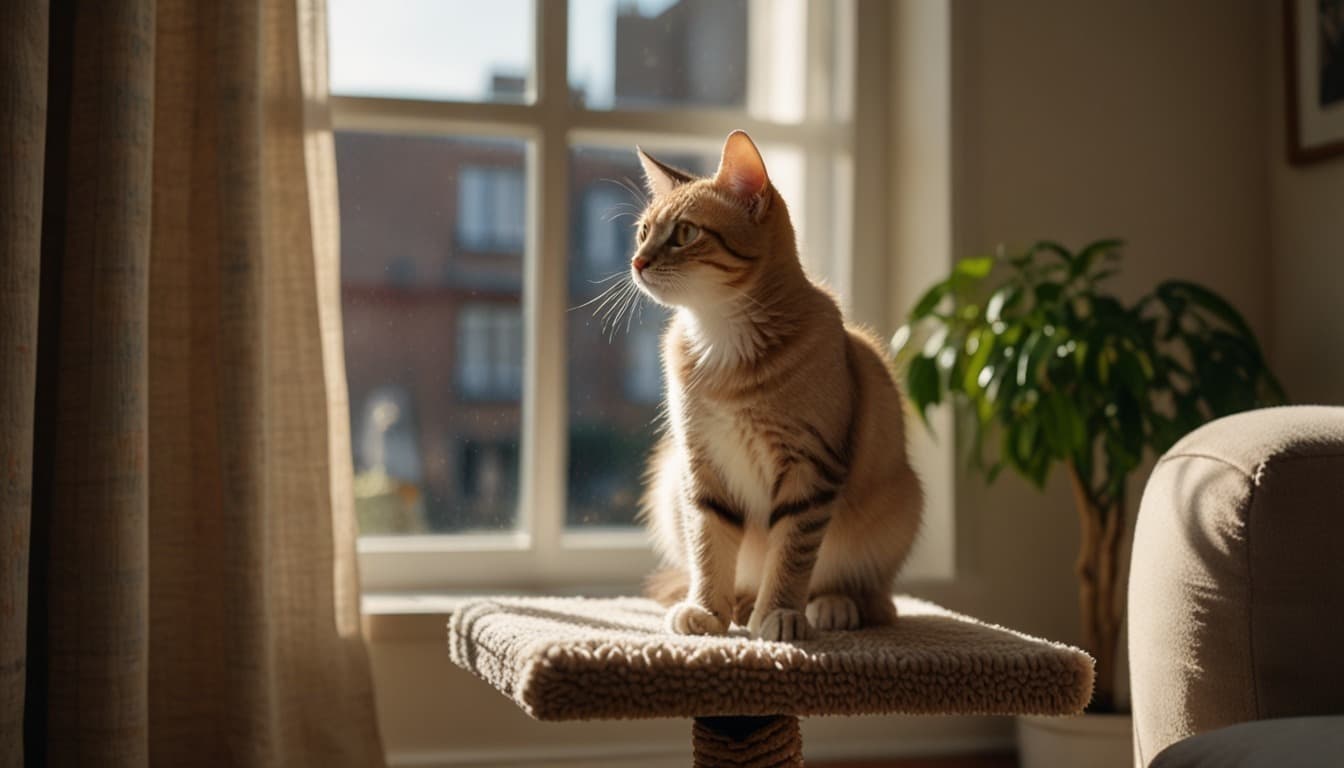
Also: tall cat trees. Not the little 3-foot ones that wobble. A kitten needs vertical territory, especially in an apartment where floor space is limited. I've a 6-foot cat tree wedged next to my window, and it's been the single best investment I've made. Kittens sleep up there, survey their kingdom, and get their climbing energy out without scaling my curtains. When Bean and Pippin were in their tornado phase, that tree saved my sanity. They'd race each other to the top, bat at the dangling toy, and collapse in a heap on the highest platform, exhausted. Ten minutes of that, and my lamp survived another day.
The $340 Vet Bill That Tauhht Me About Kitten-Proofing (Spoiler: I Was the Hazard)
Apartment kitten-proofing is different from house kitten-proofing. you've fewer rooms, but more hidden dangers crammed into a small footprint. Cords everywhere — laptops, phones, lamps, intternet routers. Blinds with those dangly pull-cords that kittens see as the world's greatest toy. Radiators with gaps a curious paw can slip into. Balconies, if you're lucky enough to have one, that are basically ground-floor escape hatches with a deadly drop. Kitchen appliances that seem sealed but have motor vents at the back where a kitten can burn themselves (I'm never forgetting Miso behind the fridge).
I'll tell you the exact moment I got serious about this. A build kitten named Crumb — tiny, orange, seemingly made of rubber — chewed through my laptop charger while it was plugged in. I didn't notice until the cord sparked and the breaker tripped and I smelled burning plastic. Crumb was fine, thank god, but I had to take him to the emergency vet for an oral exam to make sure he hadn't burned his mouth. $340 later, the vet said he was perfectly healthy and that I'd gotten very, very lucky. The bill included $97 for "hazard ingestion consultation," which felt like a polite way of saying "stop being an idiot." I went home that night and spent three hours cord-proofing every inch of my apartment with plastic tubing and bitter apple spray. I also installed childproof outlet covers on the lower sockets because Crumb had also started trying to bat at the prongs of unplugged cords. Toddler logic, all of it.
A quick checklist of things I now do for every kitten in my apartment: secure all dangling blind cords by tying them up high or cutting the loop. Cover or block access to radiators with a plywood barrier or a mesh screen. If you've a balcony, cat-proof netting is non-negotiable — kittens can squeeze through railings you'd swear were too narrow. Houseplants: check every single one against the ASPCA toxic plant list. I once had to rush a kitten to the vet after he took a single chomp out of a lily leaf; lilies are death sentences for cats, and I hadn't even thought about the bouquet on my coffee table. All cleaning supplies go in a cabinet with a child lock. All string, floss, hair teis, and rubber bands go in drawers because a swallowed linear object can mean a $3,000 foreign body surgery you don't want to explain to a pet insurance adjuster.
But here's the thing nobody warns you about: you're the hazard. In a small apartment, you're always moving — walking from the kitchen to the couch, opening and closing doors, kicking off shoes. Kittens are tiny and silent and they'll be exactly where your foot is about to land. I've stepped on more kitten paws than I care to admit. I've also sat on a kitten who'd crawled under a throw pillow. Now, I shuffle-walk in my own home, scanning the floor like a paranoid penguin, and I always pat the couch before I sit. Not kidding. The $340 charger incident was scary, but the guilt of crushing a tiny paw because I wasn't paying attention? That stayed with me longer.

Neighbors, Noise, and the 3 a.m. Wall-of-Death Routine
Kittens are crepuscular — they're most active at dawn and dusk. In an apartment with shared walls, this is a diplomatic crisis waiting to happen. When Pippin and Bean were at peak chaos, they'd launch into what I call the "wall of death" routine at exactly 3:14 a.m. every single morning. That's when they'd sprint from one end of the apartment to the othre, skid across the hardwood, slam into the bedroom door, then tear back in the opposite direction, all while making sounds like a herd of tiny elephants. My downstairs landlord texted me more than once: "Are you okay? It sounds like you're moving furniture." I wasn't moving furniture. I was lying in bed, trying to remember if my lease said anything about "excessive pet noise" and whether kittens counted.
I tried everything. Playing with them for an hour before bed (helped a little, but not enough). Ignoring them (lol, impossible when one is using your face as a springboard). Shutting them out of the bedroom (they both body-slammed the door and cried until I caved). What finally worked — and I hate that it took me weeks to figure this out — was a combination of a strict evening routine plus strategic apartment layout. An hour before my bedtime, I'd do a high-intensity play session with a wand toy until the kittens were panting. Then a small meal — something about the act of eating triggers that post-hunt grooming and sleep cycle. Then I'd shut down the most tempting "track" areas: I put a baby gate across the hallway that broke up their sprint ptah. It was only 30 inches tall, but it was enough to disrupt the momentum. Suddenly, the wall of death became a half-hearted trot that ended in confusion. They still played at night, but it wasn't a thunderstorm anymore. My landlord stopped texting. I sent him an apology bottle of wine and he said the noise was "much improved." I also added thick rugs with dense padding underneath in the high-traffic zones, which dampened the pitter-patter significantly. If I hadn't been renting, I'd've installed carpet tiles in the hallway, but rugs were the next best thing.
Also worth mentioning: if you've paper-thin walls like I do, a white noise machine or a loud fan in your bedroom can mask the 3 a.m. chaos for your own sanity. I used a box fan for years before I finally caved and bought a Dohm sound machine. That way, even if the kittens were doing trapeze acts in the living room, I could actually sleep through it. Your neighbors, on the other hand — that's where the rug padding and the evening play routine really matter. I've also found that keeping the kittens in the bedroom with me overnight, rather than giving them full apartment access, reduces noise for neighbors below. They'd still play, but on carpet instead of hardwood, and the room was smaller so the velocity was lower. I'd wake up with a kitten on my head, but at least nobody was banging on the ceiling.
The build Who Ate an Entore Bowl of Dry Food and Then Projectile-Vomited on My Only Clean Sweater
Kitten nutrition in an apartment shouldn't be complicated, but I managed to screw it up in a spectacularly gross way. Early on, I listened to some online advice that said kittens should always have access to unlimited dry food because they're growing. So I left out a big bowl of high-quality kitten kibble and went about my day. My build at the time, a ravenous little goblin named Biscuit, hoovered the entire bowl — probably a cup and a half — in under two minutes while I was in the shower. I came out to find her belly distended like a fuzzy beach ball and, seconds later, she projectile-vomited partially-rehydrated kibble all over my bed, which included my one clean sweater I'd laid out for work. The smell was indescribable. I called my vet, Dr. Nguyen, in a panic, convinced Biscuit had bloat or an obstruction. Dr. Nguyen — who's put up with my panic calls for 11 years — calmly told me she'd just eaten too much too fast and that kittens are "opportunistic vacuums with no self-regulation." She suggested smaller, more frequent meals.
Now, all my kitten fosters get scheduled meals: four to five small portions a day until they're about six months old, then three times a day. Wet food is the backbone because it helps with hydration (kittens are terrible drinkers) and it's easier to portion-control. I still offer some dry food for dental health and convenience, but never free-choice in a giant bowl. It's either in a puzzle feeder — which slows them down and provides mental stimulation in a small space — or I hand-feed a small measured amount as treats during training. The puzzle feeder has the added bonus of giving them something to do when I'm not home, which is critical in an apartment where boredom leads to destruction. I own three different puzzle feeders now and rotate them so they don't get boring. The one with the little cups they've to scoop food out of is my favorite because it takes them a solid 20 minutes to figure out.
I also keep a close eye on their weight. I know we're talking about kittens, but apartment cats are at higher risk of becoming overweight because there's just less space to roam and burn off calories. I've seen too many apartment cats balloon up by their first birthday because their owners kept feeding them like they were growing babies long after growth plates had closed. I've a whole saga about putting a cat on a diet that I'm not eager to repeat with a kitten. So I weigh my fosters weekly on a kitchen scale until they're too big, then switch to a baby scale. If the weight is climbing too fast, I dial back the portions slightly and increase playtime. It's easier to prevent obesity than to fix it later, and in an apartment where every calorie counts, you've got to be mindful.
The Time My build Kitten Beame Best Friends With My Neighbor's Bass Practice
This is a weird tangent but it's also kind of relevant. I had a neighbor — same guy who texted about the noise — who was a jazz bassist. He practiced every afternoon, the low notes rumbling through my floorboards. At first, I worried the vibrations would terrify my build kittens. But instead, one of them, a little grey girl named Mochi, became absolutely fascinated. Whenever he started playing, she'd press her ear to the floor, tail twitching, and then do this funny little prancing dance. Eventually, I introduced them (he was a cat guy himself) and she'd sit on his lap while he practiced. It became a weird little ritual. The point being: kittens adapt to apartment quirks in ways you can't predict. Noise from neighbors, street sounds, the elevator ding — they absorb it all as normal if they're exposed early in a low-stress way. I've had fosters who grew up next to construction sites and were utterly unflappable by the time they were adults. So don't tiptoe around your apartment trying to create a silent sanctuary. Play your music, run the blender, let your friends visit. A well-socialized apartment kitten learns that life is a bit noisy, and that's okay.
That said, there's one noise that consistently freaks them out: the vacuum. In a small apartment, there's no escaping it, and for weeks I'd have kittens hiding for hours after I cleaned. I finally started doing counter-conditioning — I'd let them see the vacuum from across the room while feeding them high-value treaats, without turning it on. Then I'd turn it on in a different room and slowly work closer. It took time, but eventually they'd just watch warily from the top of their cat tree instead of vanishing for the day. Small wins. I needed my apartment clean, and I needed my kittens to not think a Dyson was a murder robot. So I recommend that for all apartment cats — it's really not optional. More about that over in my post about bathing a husky if you want a laugh, but the desensitization principle is the same. Sound habituation is a pain, but you'll thank yourself when you can actualky clean your floors without triggering a feline panic attack.
When the Curtani-Climbing Stopped and I Finally Got My Security Deposit Back
Pippin, the curtain-dangling kitten from the beginning, turned into the chillest adult cat I've ever had. At about eight months old, he just… stopped. Stopped climbing the curtains, stopped body-slamming the door at 3 a.m., stopped trying to fit his head into the radiator. He'd still chase a wand toy until he panted, but the manic, crackhead energy settled into something more manageable. That's the thing nobody tells you about raising a kitten in an apartment: the crazy phase is temporary. For six months, maybe a year, you'll want to tear your hair out and your security deposit will feel like a lost cause. But if you've set up the space right — safe, enriched, with appropriate outlets for every natural behavior — you come out the other side with a cat who's completely bonded to you and perfectly content in a small footprint.
I did get my security deposit back from that apartment, by the way. I filled the curtain-claw holes with spackle, steam-cleaned the rugs, and patched the one spot where Crumb had ripped a chunk out of the linoleum in the bathroom (that was a fun conversation with my landlord). The only evidence I'd ever fostered a dozen kittens was some stubborn litter dust in the baseboard cracks and a single claw mark on the windowsill that I couldn't sand away. Not bad for 500 square feet. So when people ask me if an apartment is too small for a kitten, I tell them what I wish someone had told me years ago: the size of the space matters way less than what you put inside it. Cat trees, scratching posts, puzzle toys, a clean litter box, and a whole lot of patience — that's the apartment kitten formula. The rest is just sweeping up litter and laughing at the chaos while it lasts.