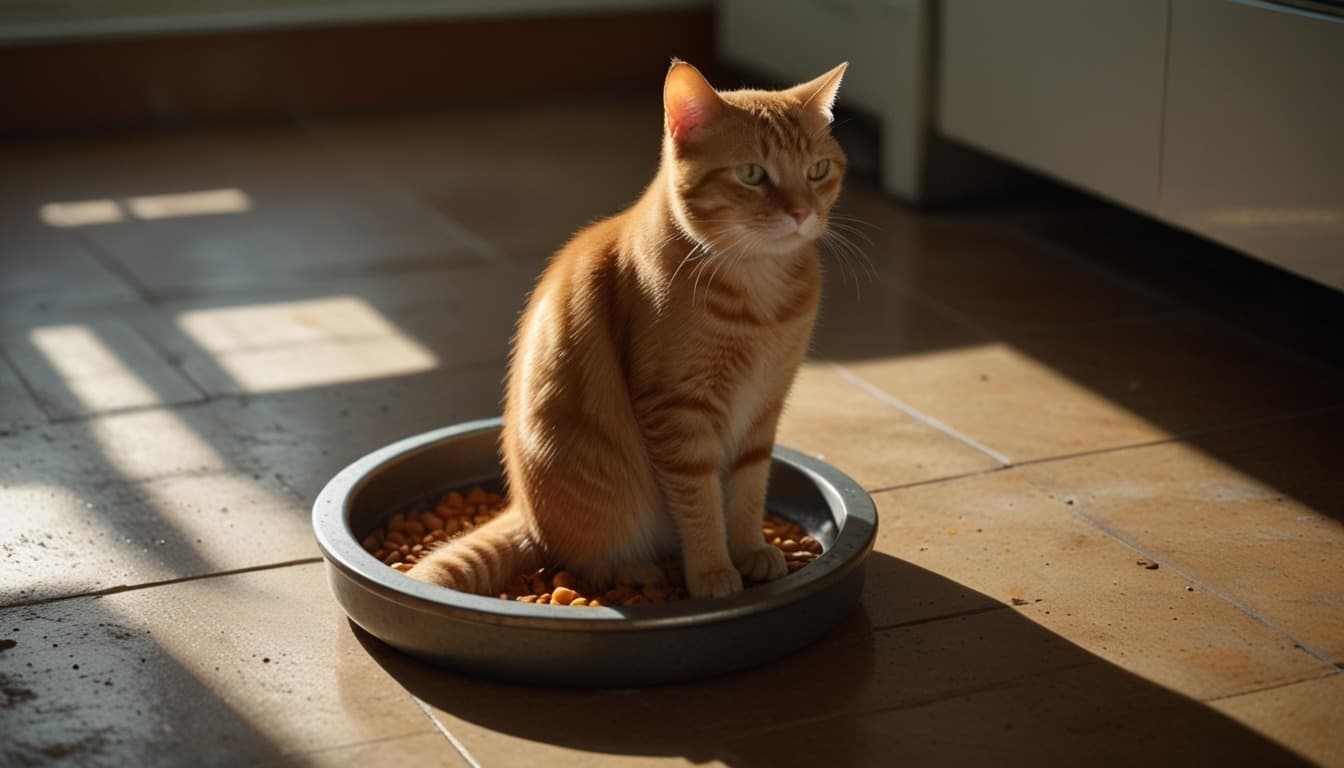
I Put Miso on a Diet and All I Got Was a Fatter, Angrier Cat — Here’s What Finally Worked
My cat Miso hit 18 pounds and the vet just told me to feed less. Six months later he was 20 pounds and howling at 4 AM. The real fix wasn't less kibble — it was a $2 can of wet food I'd been ignoring.
The first time the vet said "Miso needs to lose weight," I laughed. This was back when he was just a chunky little orange meatball who could still jump onto the counter without sounding like a dump truck hitting a pothole. He was 14 pounds — maybe with a little primordial pouch that jiggled when he trotted. I figured the vet was being dramatic. So I nodded, took the handout about "Body Condition Score 9" and "kcal per cup," and promptly did… nothing.
Six months later, Miso weighed 18 pounds. He couldn't groom his own butt. I'd find little dingleberry disasters on the bathroom rug. He'd try to reach his back and just sort of topple over, then glare at me like I'd pushed him. That's when I got serious — and then spent the next year making every freaking mistake you can make with a fat cat.
I'm not a vet. I'm just someoen who's fostered 40+ cats, cleaned up after all of them, and had one particular orange monster teach me that cat weight loss isn't as simple as "feed less." Here's the whole messy story, the $340 vet bill, the diet food that made him fatter, and the one thing that actually got the scale moving — slowly, safely, without turning my sweet boy into a hangry demon.
The morning Miso couldn't lick his own butt
It was a Tuesday. I remember because I had a build kitten with explosive diarrhea — a whole other horror, which I've written about — and I was already on my last nerve. Miso waddled into the kitchen, sat down, tried to twist around for a routnie grooming session, and just… couldn't. His belly was in the way. He strained for a second, gave up, and walked away with a tiny crumb of dried poop still stuck to his fur. That was the moment. I looked at him — really looked — and realized he'd turned from a pleasantly plump cat into something shaped like a furry ottoman.
I made an appointment with my vet, Dr. Nguyen — she's put up with my panic calls for 11 years, through three dogs and a divorce — and she didn't mince words. "He's obese. He's at risk for diabetes, arthritis, hepatic lipidosis if he ever stops eating for more than a day. His joints are screaming. Lose the weight, Sarah." She handed me a diet plan. Cut his dry food by 25%. Easy, right?
The hunger howls began at 3 AM
The first week of the diet, Miso turned into a tiny furry terrorist. He'd scream at the food bowl at 3 AM — a sound I'd only ever heard from the cats with hyperthyroidism at the shelter. He'd knock things off my nightstand. He'd follow me to the bathroom and yowl while I peed. I was sleeping in 90-minute bursts, which is the same hell I'd gone through with a yowling build kitten, so I already knew every trick in the book — but nothing worked. He'd just sit there, staring at the EMPTY bolw, screaming like I'd personally insulted his ancestors.
And here's the thing: he didn't lose any freaking weight. After a month of calorie restriction, I weighed him on the baby scale I'd bought for the fosters (yes, I'm that person — you can get a good one for $40, just do it). Eighteen pouds on the dot. No change. He was just hungrier, angrier, and somehow my guilt was converting into extra calories floating through the air into his fur.
Cutting portions without changing WHAT you're feeding is like giving a person half a donut for every meal and wondering why they're starving and not losing weight.
The $90 diet kibble that made him fatter
I'm going to name-drop because I'm still mad about it. The vet clinic sold a prescription "weight management" dry food that cost me $90 for an 8-pound bag. It was low-calorie, high-fiber, and smelled exactly like cardboard that had been pissed on by a nervous hamster. Miso hated it. He'd eat it only when he was absolutely desperate, which meant he'd binge at weird hours and then cry the rest of the day. His coat got dull. His poops were the size of hockey pucks. And — I swear on my favorite spatula — he GAINED a pound in two months.
I ran into my friend Jen at the shelter one weekend. Jen's a vet tech who's seen more overweight cats than I've had hot dinners. I told her about Miso. She looked at the inggredient list on the prescription bag and said, "That's mostly corn gluten meal and powdered cellulose. It's filler. Your cat's a carnivore, Sarah. He's eating cardboard and his body is holding onto every scrap of fat because he thinks there's a famine."
Something clicked. I'd been so focused on CALORIES that I forgot to think about what those calories were made of. I'd fallen for the same trap I'd seen a thousand times with dog food — the idea that a "light" formula is automatically good. I even wrote about a similar disaster with my senior dog Gus, who turned into a sausage on "light" kibble, which you can read here if you want to feel better about your own mistakes. The pet food industry is full of garbge dressed up as medicine, and I'd been a sucker twice.
Wait, let me back up — the thing about cat merabolisms you won't hear from the kibble bag
Cats are obligate carnivores. That doesn't just mean they like meat. It means their entire metabolic system is built to run on protein and fat, with almost zero carbohydrates. In the wild, a cat's diet is about 2-3% carbs — mostly whatever's in the stomach of the mouse they just ate. But most dry cat foods, even the "grain-free" ones, are loaded with potato starch, pea protein, lentils, tapioca — all plant-based carbs that jack up blood sugar and make cats fat while leaving them starving for actual nutrition.
Here's a stat I wish I'd known earlier: a study in the Journal of Feline Medicine and Surgery found that cats fed high-protein, low-carb wet food lost more weight, maintained lean muscle mass better, and were SIGNIFICANTLY less hangry than cats fed high-fiber dry diets. The difference wasn't subtle. The wet-food cats actually looked satisfied after meals. The dry-food cats were scrounging for more within an hour.
I'm not saying all dry food is poison. I'm saying that if your cat needs to lose weight, pouring low-calorie kibble into a bowl and hoping for the best is like trying to drain a bathtub with a teaspoon. You might get there eventually, but your cat's going to scream the whole time and probably develop a stress-related condition while you're at it.
A quick and deeeply unscientific anecdote about my neighbor's diabetic cat
Okay, tangent, but it matters. My neighbor Linda had a cat named Butterball (she didn't name him, she inherited him, don't come for Linda). Butterball was 22 pounds and diabetic when I met him. Linda was giving him insulin shots twice a day and he was miserable. Her vet kept telling her to feed the prescription diabetic kibble — more carbs, more fiber, more nonsense. I finally — gently, over wine, while pretending not to be a know-it-all — suggested she try an all-wet, high-protein diet. She was terrified. "But his blood sugar!" She switched anyway, under vet supervision. Within six months, Butterball was off insulin completely. He lost five pounds without ever being hungry. The vet was stunned. Linda cried. I felt like a genius, except I'd only told her what a hundred cat nutritionists had been screaming into the void for years.
The point is: carbs are the enemy for most overweight cats. Not calories. Not fat. Carbs.
What finally worked (and the spreafsheet I'm embarrassed to admit I used)
All right. After the $90 kibble fiasxo, I sat down and did what I should have done from the start: I calculated Miso's actual daily energy needs based on his target weight, not his current weight, and I switched him entirely to wet food. I'm not a math person — I once cried in an 8th-grade algebra final — but even I could figure this out.
The formula most vets use is: Resting Energy Requirement (RER) = 70 x (ideal body weight in kg)^0.75. For Miso, who should weigh about 12 pounds (5.4 kg), that came out to roughly 180 kcal per day. I rounded up to 200 because he's a large-framed cat and I didn't want him dropping weight too fast and tanking his liver. (Hepatic lipidosis is a real, deadly thing that happens when fat cats crash-diet. don't starve your cat. I'll say that again later because it's terrifying and important.)
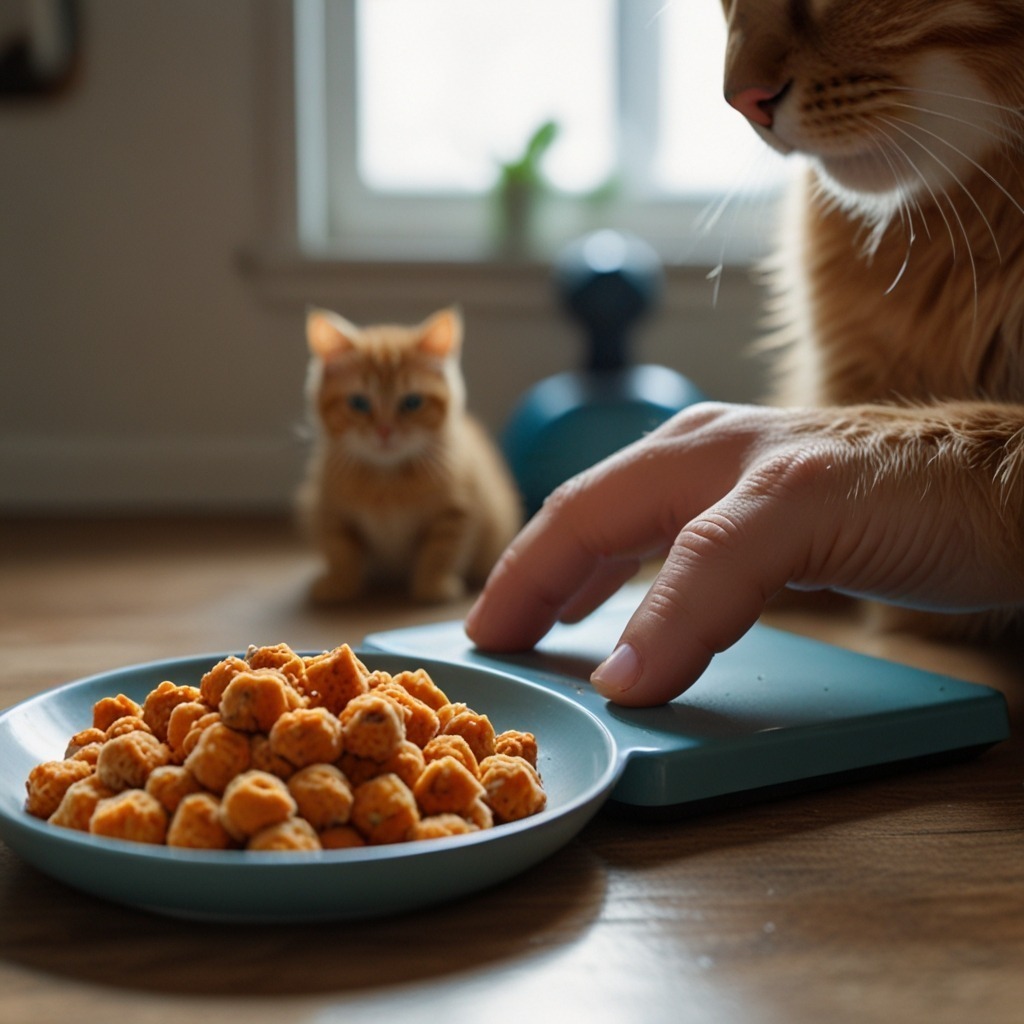
Then I looked at actual wet food labels. Not the "feeding guidelines" — those are designed to sell more food. I looked at the kcal per can. The pâté I settled on (a mid-range grain-free chicken formula that didn't smell like a dumpster fire) had about 90 kcal per 3-ounce can. Two cans a day, plus a few treats, put Miso right at 200 kcal. No guessing. No "about a handful." I used a kitchen scale at first. I'm not ashamed.
Why I quit dry food cold turkey (and the mess that followed)
Transitioning a kibble-addicted cat to wet food isn't for the faint of heart. Miso had been eating dry food his whole life. He looked at that first pate of pâté like I'd served him a slab of wet newspaper. He sniffed it. He pawed at it. He walked away. I panicked.
I spent about two weeks doing the slow-mix method — crumbling a few pieces of his old kibble on top, gradually reducing the crunch until he was eating straight wet food. There were setbacks. Once he pooped ON THE RUG in protest. The rug I loved. The rug my ex-mother-in-law gave me that I kept out of pure spire because it was actually gorgeous. I'm still bitter about that rug. But I'd rather replace a rug than watch Miso die of diabetes at 10, so I kept going.
(Speaking of food transitions gone wrong, I once switched Miso's food too fast and he pooped a Jackson Pollock all over my living room — I wrote about that horror show here. That was a complerely different incident. My house has seen things.)
The graze-o-matic disaster (a very short section)
I thought I was clever and bought an automatic feeder so Miso could get tiny meals throughout the day. I'd tested a bunch of them before and only three survived my other cats' attempts to break in — here's that whole saga. For Miso, I set it to drop a tablespoon of kibble every six hours. He learned to body-slam the machine until it dispensed an extra portion. I came home to a tipped-over feeder, kibble everywhere, and a cat who looked like he'd swallowed a basketball. Back to manual feeding.
The weigh-in that actually mattered
After three months of all-wet, high-protein, carefully measured meals, Miso had lost 1.8 pounds. That might sound like nothing. In cat weight-loss terms, it's perfect. Cats should lose no more than 1-2% of their body weight per week. For an 18-pound cat, that's about 0.7 to 1.4 pounds per month. Slow. Boring. Frustrating. But safe. His coat was shinier. He'd stopped screaming at 3 AM. He'd actually started playing again — batting at a feather wand for 90 seconds before collapsing, which was a 90-second improvement over his previous routine of "nap, eat, nap, glare."
And here's what surprised me: his energy levels. I hadn't realized how much his weight was dragging him down. He started climbing the cat tree again. He'd follow me around the house instead of just yelling from the couch. One morning I found him on top of the kitchn cabinets, surveying his kingdom like a fat orange gargoyle. I cried a little. Don't tell anyone.
The exercise paradox (or "how I learned to stop chasing my cat around with a laser" )
Everyone says "exercise your cat" like you can just put a treadmill in the living room and your 18-pound furball will hop on. The truth is, a severely overweight cat doesn't WANT to move. His joints hurt. His stamina is zero. If you try to make him run, you'll either injure him or destroy whatever bond you've. So stop wavnig that wand toy in his face like a maniac and meet him where he is.
For Miso, "exercise" started with me moving his food bowl to different spots around the house. Upstairs. Then downstairs. Then on a low chair. He had to waddle a few extra feet to eat, and that was enough at first. Later, I hid small portions in puzzle feeders — the kind where they've to bat a little cup to get the food out. He'd spend 10 minutes working for a tablespoon of wet food and then take a nap. It was pathetic. It was adorable. It worked.
I also learned that cats are crepuscular hunters — they're most active at dawn and dusk. Trying to make Miso exercise at 2 PM was a fool's errand. But right before his evening meal, when he was already a little hungry, he'd chase a feather toy for five minutes. That's all I needed. Five minures of movement, slowly building over months until he could play for 15 without sounding like a broken accordion.
A horrifying 72-hour tangent about hepatic lipidosis
I've to talk about this because it's the thing that scares me most about cat diets. A few years ago, a build cat named Smudge came to me obesse and depressed after his owner died. He stopped eating for three days — just stopped. By the time I rushed him to the vet, his skin was yellow and his liver enzymes were through the roof. Hepatic lipidosis, or fatty liver disease. It happens when an overweight cat's body starts breaking down fat too fast, flooding the liver with fat cells it can't process. Without aggressive treatment — often a feeding tube — it's fatal.
Smudge survived, thanks to a $2,000 emergency vet bill and a month of tube feeding. But I'll never, ever fogret Dr. Nguyen saying, "This is why you don't let fat cats go hungry." When people say cats can't lose weight fast, they're not being cautious. They're trying to prevent your cat's liver from killing itself. If your cat goes more than 24 hours without eating during a diet, stop the diet. Feed him whatever he'll eat — tuna juice, chicken baby food, anything — and call your vet. This isn't a drill.
Multiple cats, multiple body types, one big headache
I've three resident cats right now, plus whatever build is hiding under the bed. Ferding Miso a special diet while the others got their regular food was a logistical nightmare. The skinny senior cat needed to GAIN weight. The middle cat was perfect and I didn't want to screw her up. Miso, meanwhile, would bulldoze through any barrier to steal their food.
Here's what I ended up doing: separate feeding rooms. It's annoying. It takes 20 minutes twice a day. But it's the only way to control portions when you've a food thief. I'd put Miso in the bathroom with his measured meal, feed the skinny senior in the kitchen, and the middle cat in the bedroom. Doors closed. Timer set. Nobody got to graze. After a few weeks, they all accepted the routine. Even Miso stopped howling at the bathroom door — mostly.
If you absolutely can't do separate rooms, microchip-activated feeders are a thing. They're expensive and I'm still mad about the one time I tested a $250 feeder that locked out the wrong cat, but they can work for some households. For me, though, a door and a little patience were free.
The one thing I'll nevre do again (and it's not what you think)
Okay, I've talked about all the mechanics. Food, calories, vet checks. But the mistake I made over and over, the one that kept Miso fat for years, wasn't about nutrition. It was about guilt.
Food is how I show love. I'm a rescue person. I bottle-fed kittens, I nursed sick dogs, I've spoon-fed critical-care slurry to a dying cat at 2 AM. When an animal looks at me with big sad eyes, my instinct is to FEED IT. That came from a good place. But with Miso, my guilt-feeding was literally killing him. Every extra treat, every "oh he looks hungry" top-up of the bowl, every time I gave him cheese because he did a cute head tilt — I was shaving years off his life.
I had to completely reframe what love looks like for a fat cat. Now, when Miso begs, I give him attention instead of food. I rub his ears. I take him outside on a use (very slowly, just to sniff the grass). I give him a new cardboard box to destroy. I've learned that he's not actually hungry — he's bored, or anxius, or just wants me to look at him. And the weirdest part? He seems happier now. More engaged. He purrs more. He plays more. He's not the hangry demon I created with harsh calorie cuts. He's just a cat who finally has enough nutrition and enough stimulation that his whole world doesn't revolve around the food bowl.
Miso, 14 months later: not skinny, but he can groom his own tail now
He's 13.4 pounds today. Still a little chunky. Still has a floppy primordial pouch that swinggs when he runs. But he can reach his tail. He can jump onto the bed without a running start. Last week he caught a moth in midair — a fat, slow-motion leap that would've been physically impossible a year ago. I'm not aiming for a perfect body condition score. I'm aiming for a cat who can live another five years without insulin injections.
Weight loss in cats is slow, boring, and full of setbacks. It's not a 30-day challenge. It's not a special diet pill. It's measuring food, feeding actual meat, watching for liver problems, and forgiving yourself when you accidentally give them too many treats because they purred at you. If you're in the thick of it with your own orange meatball right now, just know: it took Miso two years to get fat. It took over a year to get him back to a healthy weight. And the only thing that ever made a real difference was switching to high-protein wet food and refusing to feel guilty about not filling the bowl to the brim.
Now if you'll excuse me, Miso just knocked something off the counter. Probably a spoon. Probably on purpose.