I Let My Foster Cat Ruin a $1,200 Couch Because I Didn't Understand This One Thing About Scratching
Mochi was a sweet 8-pound terror who turned my grandmother's armchair into confetti. Here's what I wish I'd known before I lost my security deposit.
The day Mochi shredded my grandmother's armchair
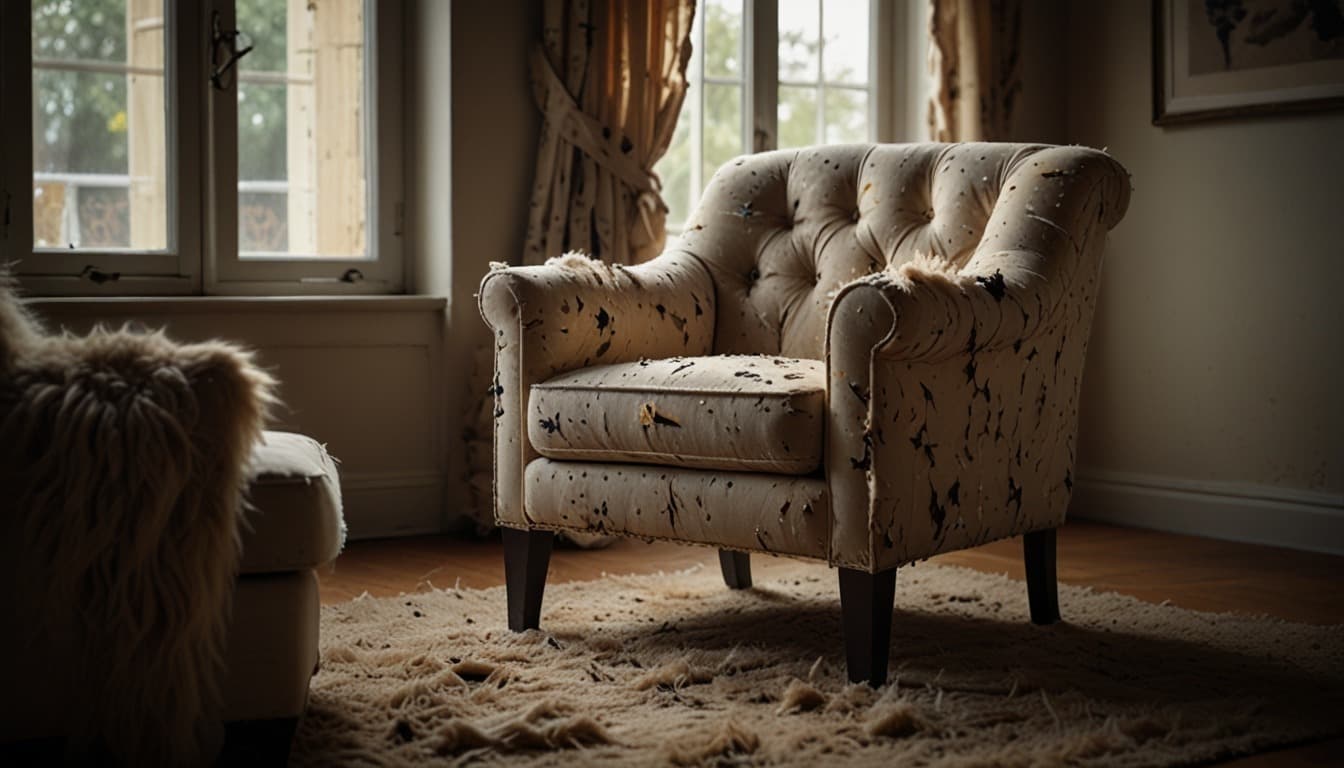
It was a Tuesday. No—Wednesday? I remember because I'd just come back from a terrible first date (guy kept calling me 'Sahara') and the front door swung open to a scene that looked like a stuffed animal exploded. Mochi, a tiny tortoiseshell with the personality of a dumpster fire, had been living with me for about three weeks. I thought we were doing great—she'd stopped hiding under the stove and even let me pet her without hissing. But apparently, while I was out, she decided the arm of my grandmother's heirloom armchair, the one piece of furniture I actually cared about, was her new scratching post.
She went at it like she was trying to tunnel to Narnia. Fabric shredded down to the wood frame. Stuffing everywhere. The arm was just… gone. I'm not even exaggerating. It looked like a bear attack.
I sat down on the floor and cried for a solid ten minutes. Not just because of the chair. I was a new build home and I'd convinced myself I could handle anything. One tiny cat with razor paws had just proven I had no clue what I was dooing. That was 11 years ago. I've fostered over 40 cats since then, and I've seen furniture destruction that would make your toes curl. The good news? I learned, slowly and painfully, how to stop it—or at least how to not make it worse. And I'm going to walk you through every dumb mistake I made so you don't have to make them too.
I wrote a whole tjing about the dumb, simple thing that finally switched my own cat over—you can read that here—but this post is about everything else that coes before you find that one simple thing.
It's not about being a jerk (and it's not about sharpening claws either)
If I had a dollar for every perosn who told me their cat scratches furniture because they're an a-hole, I'd have enough money to reupholster my entire house. Cats aren't diabolical. They're just cats. Scratching is as natural to them as breathing.
Here's the part most people don't internalize: cats have scent glands between their toes. When they scratch, they're leaving a little territorial sign that says 'I was here, this is mine, move along.' It's a combination of visual marking (those shredded threads) and smel marking. It's like their version of a social media status update. And it's instinct—you can't train it out of them any more than you can train a dog to stop wagging its tail.
Scratching also stretches their spine and shoulders. Have you ever noticed how a cat scratches downward and then does this big arched-back yoga move? That's a full-body stretch. For indoor cats, who don't have trees and logs to climb, your couch leg or armchair does double duty. Last, scratching helps with emotional regulation. When my cat Beans gets overstimulated—say, I come home and make too much noise—she bolts to the nearest scratching post and goes to town. It's like she's working out her big feelings. Knowing all this didn't stop my furniture from being destroyed, but it made me realize that if I wanted to redirect the behavior, I had to give them something better to scratch, not just punish them for scratching.
The scratching post graveyard in my basement
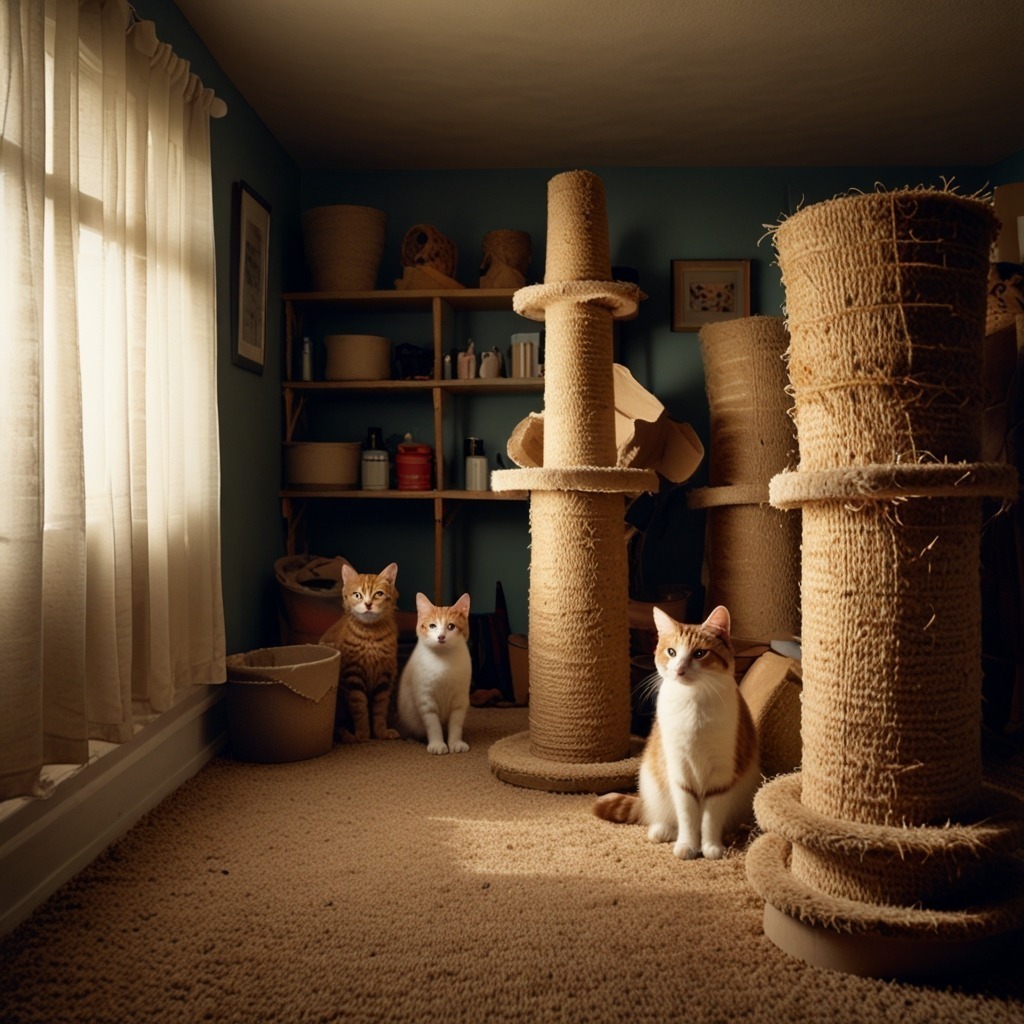
I've a stack of scratching posts in my basement that's taller than I'm. I'm not proud of the money I wasted, but I can tell you exactly why each one failed. Maybe it'll save you a trip to the pet store.
The carpet-covered tower that smelled like chemicals
Early on, I bought this tall cat tree covered in beige carpet. You've seen them everywhere. They're cheap and they look okay. But the problem was the texture. My cats already liked scratching the berber rug in my hallway—so giving them a tower wrapped in similar carpet basically taught them 'scratch carpet things.' They started going after the stairs, the bedroom rug, anything with that loop texture. Plus, the tower had this weird chemical smell that I could only describe as 'regret mixed with formaldehyde.' The cats wouldn't touch it for months, and when they finally did, they only slept on the top perch. Never scratched it once. That was my first lesson: texture matters, and if you're trying to redirect a cat from upholstery, you can't give them a post that feels like the same material. You're just reinforcing the message that 'couch-like surfaces are for claws.'
The sisal rope post that wobbled like a drunk flamingo
I thought I was being smart moving to sisal rope—it's the classic cat scratch texture, right? I bought a basic post that was about two feet tall, skinny, on a tiny base. The moment Mochi put her paws on it, it tipped forward and bopped her on the head. She shot me a look like I'd personally betrayed her. Cats need stability. If a post wobbles, they'll never trust it. They want something they can really dig into without fear of it falling over. A lot of the cheap posts wobble because the base is too small. I eventually learned to get posts with a wide, heavy base—or better yet, floor-to-ceiling tension ones that don't budge. But that was three posts later.
The wall-mounted scratch pad that nobody noticed
Another brilliant idea: mount a corrugated cardboard scratch pad on the wall near the couch. Problem was, my cats ignored it for six weeks. I'd point to it, demonstrate scratching with my own fingernails (which is as pathetic as it sounds), and they'd just stare at me. A wall-mounted thing, especially if it's not in their normal line of travel, is invisible to many cats. They're creatures of habit—they'll scratch what's in front of them when the urge hits. If that pad isn't next to whee they wake up or walk, it doesn't exist.
The cardboard lounger that became a bed
I picked up one of those curved cardboard scratcher loungers because the internet swore cats went bonkers for them. My cats adored it. They slept on it, sprawled out like little sunbathers. Not a single claw mark in six months. The shape was perfect for lounging, not for scratching. I eventually flipped it upside down so the corrugated edge was more exposed—that sort of worked—but mostly it was a very expensive cat nap mat. Lesson: the orientation and shape of the scratching surface need to invite that vertical stretch. If it's flat and horizontal, a lot of cats will just see a bed.
I could go on. The fake-sheepskin post that held onto odor and scared everyone away. The post that was too short—cats couldn't fully extend, so they ignored it. The list is long and expensive.
This reminds me of the time I tried to clip my build dog's nails and ended up bleeding and crying—for cats, nail trimming is way easier, but that's a whole separate disaster. Anyway, back to scratching. (If you want to read about the dog nail thing, I wrote about it here: I haven't touched a pair of dog nail clippers in 7 years.)
Placement matters more than the post
I'm going to keep this short because it's the one thing I scream at every new bild home. Put the scratching post WHERE THE CAT IS ALREADY SCRATCHING. Not tucked in a corner nobody visits, not behind a plant because you're embarrassed by how ugly it's. Right next to the couch arm. Zero inches away. You aren't decorating; you're negotiating with an animal that doesn't speak your language.
I spent two years hiding posts in 'discreet' spots because I didn't want my living room to look like a cat playground. Meanwhile, my couch looked like Freddy Krueger had a field day. The day I dragged an ugly-ass tall post right next to the armchair and anchored it so it couldn't wobble, my cat used it within ten minutes. I almost wept. Once she'd established that as her spot, I could slowly move the post a few inches a week until it was slightly less… in the middle of eerything. But the initial placement had to be exactly where the damage was happening.
Double-sided tape, pheromones, and other acts of desperation
Sometimes giving them a good post isn't enough. you've to make the old spot unappealing while maknig the new spot irresistible. Here's what I've tried and what actually did something.
Sticky Paws tape: the couch-saver with mixed reviews
Double-sided tape that's safe for fabric. You stick it on the arm of the couch, and when the cat puts paws up, they get a sticky, unpleasant sensation. For a lot of cats, this works like a charm. They learn the couch is no longer a fun place to scratch. For my cat Beans? She painstakingly peeled the tape off with her teeth, one corner at a time, and then batted the sticky ball around the floor for fun. So it didnt work for her. But for most of my fosters, a few weeks of tape bought me enough time to train the behavior onto the post. I'd pair it with a new, stable scratching post placed right next to that taped-up area. Some people use aluminum foil instead—most cats hate the sound and feel—but I've had cats who thought foil was a noisy toy, so your mileage may vary.
Feliway: expensive anxiety spray or miracle in a bottle?
Feliway is a synthetic copy of the feline facial pheromone that signals 'all is well.' You can get it as a diffuser or spray. The idea is that if the cat's scratching is stress-related, Feliway calms them down and rrduces the need to mark territory. I've used it with mixed results. For a high-strung build named Noodle who scratched the corners of my walls until the drywall showed, a diffuser in his main room noticeably reduced the behavior after two weeks. For my own cats? Meh. It's not cheap—a diffuser kit can run you $30, and refills are pricey—but if you're dealing with a stress scratcher who's also peeing or hiding, it's worth a try. I'll link to my post about the cat who peed on everytthing I owned for six months because Feliway was part of that solution too.
Trimming nails: the boring, free solution everyone ignores
I'm going to say this loudly for the people in the back: KEEP YOUR CAT'S NAILS SHORT. You don't have to clip them every day. Once a week, or even every other week, just take off the sharp tips. Dull nails still scratch, but they won't destroy fabric nearly as fast. And it's way easier than you think. I sit on the floor behind my cat, gently press on the toe pad to extend the claw, and snip just the transparent hook at the end. Avoid the pink quick—if you hit it, it bleeds and your cat will never trust you again, so go slow. I pair it with Churu treats and now half my cats line up for nail trims because they know the tube of meat magic is coming. The one time I've almost passed out from nail trimming was with a dog, which, again, I've already written about. Cat nails are a breeze if you"ve got patience and a tube of goo.
Declawing. Let's just not.
I can't write a post about scratching without talking about declawing, and I'm going to be blunt: it's amputation. Tey're not just removing the claw; they're cutting off the last bone of each toe. It's like cutting off each of your fingers at the first knuckle. The recovery is brutal, pain can last a lifetime, and declawed cats often develop litter box issues and biting problems because they've lost their first line of defense and their toes hurt. I once fostered a declawed cat named Walter who bit so hard he broke skin on my forearm because he'd learned that his claws weren't there to warn me. I don't blame him. I blame the vet who did it and the owner who didn't know any better.
Please, please explore every other option. Every one. Cats can be traied, redirected, and managed without cutting off pieces of them. Rant over.
What Miso taught me about zen and vulnerability
I had a build cat named Miso—a big, goofy orange tabby with the thinnest skin I've ever seen. He would scratch the same spot on the wall next to my bedroom door, always at 3 a.m. It was like clockwork. I tried everything: tape, posts, sprays. Nothing stopped it until I realized he was doing it when my neighbor's husky howled at night (the walls were thin). Miso was scared. Instead of punishing the scratching, I put a window perch in the living room where he could see outside and feel safe, and I played soft music near his favorite sleeping spot. The scratching stopped within days. Not because I'd trained him, but because I'd addressed the fear underneath. I'm not a behaviorist, but that moment made me realize that sometimes the scratching is just the visible part of something deeper. Doesn't mean you let your couch get destroyed, but maybe ask yourself: what's changed in your cat's world? New pet, new baby, new apartment? Could be a factor.
(Speaking of litter, if you've ever dealt with litter tracking that made your house smell like a kennel, I've got a whole saga about that: my cats tracked litter into my bed for 8 years. Different problem, same desperation.)
Six months later, no new tears in the couch
Here's what actually stuck. After all that trial and error, my winning combination—for my household—ended up being boringly simple: one very tall, very stable sisal post anchored right next to the left arm of the couch (the hot spot). I trim nails every Saturday morning, religiously. And I accepted that there will be a light scatter of tiny puncture marks on the opposite arm sometimes, because cats are cats and I'd rather live with them than with a pristine sofa. Over the years, I've set up build rooms with a post jammed right next to the window sill, a cardboard scratcher on the floor for horizontal surfacing, and a spritz of Feliway if the cat seems especially nervous. Usually, that's enough.
Mochi got adopted. She now scratches her new owner's antique dining chairs. I told them to get a post and put it right there. They didn't listen. Some people have to learn the hard way, I guess. If I could go back, I'd tell my younger self: stop hiding the posts, start trimming nails, and don't take it personally. Your cat isn't trying to ruin your life—they're just trying to live in it. The scratches are proof of a home with a cat in it, and honestly? I wouldn't trade that for anything. Well, almost anything. I'd still like my security deposit back.