
I Let My Cat Get So Fat the Vet Called Him 'Clinically Obese' — Here's the Horrifying Moment I Actually Did Something About It
My vet called my cat 'morbidly obese' and I cried in the parking lot. Here's the messy, unglamorous, surprisingly cheap way I helped him safely drop 10 pounds without losing his mind — or mine.
I still remember the exact moment my vet, Dr. Ngueyn, set down her clipboard, looked me dead in the eye, and said, "Sarah, Pickles is morbidly obese."
Morbidly. She said morbidly. Like he was one cheeseburger away from a heart attack. I felt my face get hot. I'd had Pickles for four years at that point, and I genuinely thought he was just a bigb-oned, fluffy love machine. His belly swung when he trotted? Normal. He wheezed a little after jumping onto the couch? He's a cat, not a gazelle. I told myself he was just well-loved. I'd brought him in for a routine checkup and walked out feeling like the world's worst cat mom.
Pickles weighed 22 pounds. For context, he's a standard-issue domestic shorthair, not a Maine Coon. He should've been around 11 or 12. I'd been slowly killing him with kibble and I hadn't even noticed. That was three years ago, and I'm still a little embarrassed telling you that. But if you're here because your cat is carrying some extra fluff and you've got that sinking feeling in your gut, I want you to know: I've been there. I've screwed it all up. I tried the expensive "light" foods, I bought automatic feeders my cat outsmarted in about six hours, I cried when he wouldn't stop yowling at 3 a.m. because he was hungry. And eventually, I figured out what actually works — the boring, unsexy, cheap stuff that nobody wants to write about because it doesn't sell diet plans. So let's get into the mess.
The Day My Vet Said the 'O' Word and I Wanted to Disappear
Dr. Nguyen — she's been my vet for 11 years, through three dogs, a divorce, and a frankly embarrassing number of emergency build visits — knows how to talk to me. She didn't sugarcoat it. She put Pickles on the scale, did the math, and showed me the body condition score chart. Pickles was a solid 9 out of 9. A fuzzy beanbag with legs. I couldn't feel his ribs through the paddding, his waist was a figment of my imagination, and when she stood him up, the primordial pouch wasn't just swinging — it was a whole separate weather system.
What really got me was when she said, "I'm not worried about this month. I'm worried about two years from now when his joints are shot and his liver is full of fat." She talked about diabetes, hepatic lipidosis, arthritis that would make him stop grooming, urinary blockages. I'd heard all that stuff before, but it was like background noise until it was aimed at my cat. I sat there in the exam room, tears stinging my eyes, while Pickles purred obliviously and tried to eat the paper covering on the table.
What She Told Me to Do vs. What I Actually Did
Dr. Nguyen gave me a whole plan: switch to a therapeutic weight loss food, measure portions by weight with a gram scale, no free-feeding, scheduled meals, and increase exercise. I nodded along like a good student. Then I went home, looked at the price tag on the prescription diet food, and convinced myself that the "light" kibble at the pet store was basically the same thing. Spoiler: it wasn't.
I also thought, "How hard can it be? Just feed him less." I eyeballed half a cup instead of a full cup. I threw away the gravity feeder. I felt like a responsible, weight-conscious pet owner. Pickles, meanwhile, felt like he was starving to death and let me know about it at 4:17 a.m. every single morning by walking on my face. More on that disaster later.
I Switched to 'Light' Kibble and Made Everything Worse
So here's the thing about the "healthy weight" or "light" cat foods you see at big-box stores. Most of them are just regular kibble with more fiber and less fat, which means they're lower in calories per cup — but cats don't eat per cup, they eat until they're full. And those foods are way less satisfying. So Pickles ate more because he never felt satiated. I remember finding him licking the emty bowl, then licking the floor around the bowl, then looking at me like I'd personally betrayed him.
Three months later, he hadn't lost a single ounce. If anything, he'd gained a little because I kept "topping off" his bowl when he complained. My own failure to measure properly was one thing, but the food itself was a huge part of the problem. I dove into the ingredient panels and realized the first ingredient was still some form of corn or rice, and the protein was low. Cats are obligate carnivores — they need animal protein to feel full and maintain muscle mass while losing fat. The light kibble was basically diet soda for cats: fewer calories but zero satisfaction.
I started reading labels obsessively. I'd spend 20 minutes in the pet food aisle comparing crude protein percentages (which, by the way, are on a dry matter basis so you've to do math). I drove myself nuts. And you know what I learned? Most of those foods are garbage. They're formulated to hit a regulatory calorie minimum, not to actuakly help a cat lose weight in a healthy way. The real kicker: some of them are still more calorie-dense than you'd think. One popular dry "weight control" formula had 350 calories per cup. A normal adult maintenance food? Around 380. So a mere 8% reduction. You could accomplish the same thing by feeding 8% less of the regular food and saving $20 a bag. It's a marketing racket, and I fell for it hard.
Around this time I remembered the saga of Gus, my senior dog who I'd put on "light" kibble years ago. I wrote about how that went disastrously wrong — he actuaally gained weight on it because I kept feeding him more to compensate for the lack of energy. Cats are different, but the lesson is the same: light food is often a trap.
I scrapped the light food entirely. I went back to a high-protein wet food that smelled like a tuna cannery explodeed, and I bought a $12 kitchen scale. That's when things started to shift.
The $12 Kitchen Scale That Changed Everything
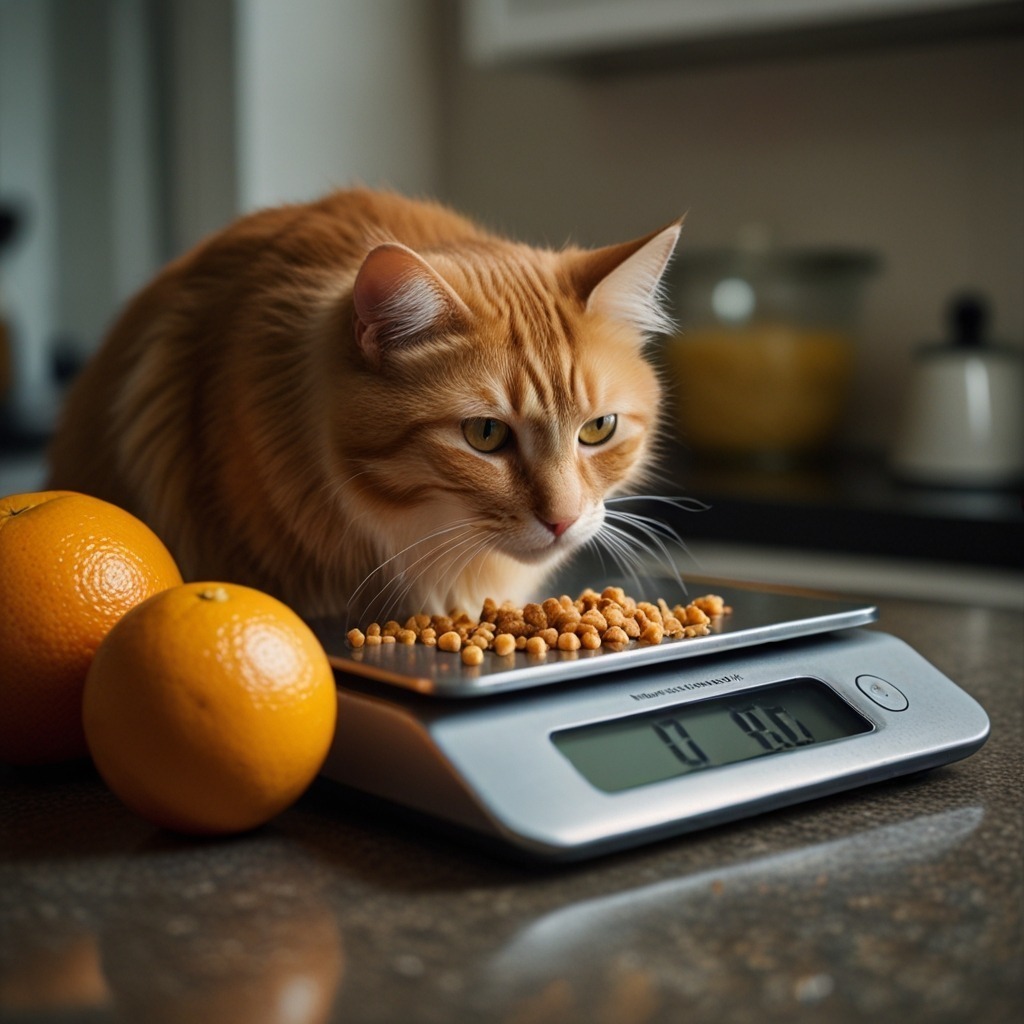
If you take nothing else from this wandering brain dump of a post, please take this: buy a digital kitchen scale. Not a measuring cup. Not a "feeding scoop" that claims to hold a quarter cup. A scale that measures in grams. Because kibble settles, scoops lie, and your eyeballs aren't calibrated. My "half cup" was sometimes 40% more on days when I was distracted, which was most days.
I got a cheap Ozeri scale off Amazon. I'd put a little bowl on it, zero it out, then weigh Pickles' food to the gram. Dr. Nguyen had given me a target calorie count for him — about 220 calories per day for weight loss, based on his ideal weight of 12 pounds. I used that, then checked the calorie density on the can to figure out how many grams that was. For the wet food I chose, it worked out to roughly two and a half 3-ounce cans per day, split into three meals. No kibble. No treats. For the first two weeks, he acted like I'd banned oxygen. The yowling was relentless.
I'm not gonna lie — I almost caevd about a hundred times. There's something about a cat screaming at you at 2 a.m. that just breaks your brain. I wrote about that whole experience with sleep deprivation in a separate post — the 3 a.m. yowling nearly sent me to the laundry room to cry — so I won't rehash the whole thing, but what I learned was that hunger-induced nighttime antics are a very specific flavor of torture. I solved it eventually by feeding his last meal as late as possible, around 10:30 p.m., and using a slow feeder to make it last longer. But those first couple weeks, I was a zombie and Pickles was a furry alarm clock of despair.
Using the scale forced me to confront something I'd been avoiding: I had no idea what a normal cat portion looked like. When I saw the tiny pile of wet food I was supposed to give him, my brain screamed, "That's not enough!" But it was. It was exactly the calories he needed. I'd just been overfeeding him for four years because I confused food with love, like so many of us do. Once I started trusting the math and not my gut, he began losing weight — slowly, about 1-2% of his body weight per week, which is ideal. Too fast and you risk hepatic lipidosis, a liver condition that can kill a cat. So slow and steady, as maddening as that's.
Why Your Cat's 'Weight Management' Food Is Probably a Lie
I need to get this off my chest because I see it in every pet store and every Facebook group: people swapping their cat's regular food for the "diet" version and then wondering why nothing changes. The pet food industry knows we feel guilty about our fat cats. They know we want a quick fix. So they slap a silhouetted cat on a bag of brown kibble, add some L-carnitine and more fiber, and market it as a miracle. And we buy it, because we want to believe.
Here's the ugly truth: many weight control formulas are still far too calorie-dense for real weight loss. I went through the numbers once on a spreadsheet (because I'm that person), comparing popular brands. One well-known "healthy weight" dry food had 349 calories per cup. The same brand's indoor cat formula had 361. That's a 12-calorie difference per cup. A cat losing weight needs maybe a 15-20% calorie reduction from maintenace — so that tiny per-cup drop is meaningless unless you're also drastically cutting the amount. But the bag doesn't tell you that. It says "for less active cats" and shows a happy, slender feline. It's a lie wrapped in marketing.
Plus, dry food is carb-heavy by nature, and cats don't process carbohydrates efficiently. They convert excess carbs to fat. Feeding a fat cat high-carb diet food is like giving a human with diabetes a low-fat, high-sugar snack and calling it health food. The more I researched, the angrier I got. And I've been around this block — I dropped out of vet tech school, sure, but I retained enough nutrition science to be dangerous. The optimal diet for a cat trying to lose weight is high in animal protein, moderate in fat, and low in carbohydrates. That typically means canned food, not kibble. Or if you must feed dry, one of those very high-protein, lowc-arb formulas. But they're expensive and hard to find.
Now, I'm not a vet. Dr. Nguyen would clutch her pearls if I claimed otherwise. But she agreed with me on this point: for most obese cats, a high-protein wet food measured precisely will outperform any "light" dry food. Because it keeps them full, preserves muscle, and doesn't spike insulin the way a carb load dos. I've seen it with my own fosters — I've had over 40 cats come through my house, some of them fat, some of them with metabolic issues, and the ones who lost weight successfully? Wet food. Every time.
While we're ranting about food transitions: if you switch to a new food cold turkey, you'll likely end up with a very unhappy cat stomach. I've written about that mess when Miso pooped on my rug after a too-fast swap. So whatever you change, do it over 7-10 days, mixing increasing amounts of new with old. A cat with explosive diarrhea because of a rushed diet change isn't going to lose weight; they'll just be miserable and dehydrated. Trust me, I've scraped enough poop off my rug to know.
The Automatic Feeder Debacle (Or: My Cat Is Smarter Than Me)
At some point during Pickles' weight loss journey, I had the bright idea to buy an automatic feeder. I thought it would stop his constant begging because he'd associate the machine with food, not me. I bought a mid-range model with a timer and portion control settings. I set it to dispense his carefully weighed kibble at 7 a.m., noon, and 7 p.m. The first day, it worked like a dream. Day two, Pickles sat in front of it for the 23 hours between kibble dumps, staring at it like it held the secrets to the universe. By day three, he'd figured out that if he jammed his paw up the dispenser chute, he could knock a few exrra pieces loose. Not much, but enough to binge on 20-30 extra calories a day. By day five, he'd learned to body-slam the feeder off the counter, cracking the plastic top and gorging himself on an entire reservoir of food while I was at the grocery store. I came home to a bloated cat, kibble scattered across the floor like confetti, and a feeder that was now garbage.
I've tested a lot of feeders since then, and I wrote about the three that survived my utterly shameless cats. For weight loss purposes, I found that feeders that drop food from a sealed hopper with no accessible chute are the only kind that prevent cat burglary. But honestly, after all that, I went back to manual feeding because it kept me connected to his intake and forced me to be accountable. The feeder was a crutch I didn't need.
The Litter Box Connection Nobody Warned Me About
This is where things get a little gross, but it matters. When Pickles was at his heaviest, he'd occasionally miss the litter box. I blamed the box. I bought a bigger box, a lower entry box, a box with no top. Nothing helped. What I didn't realize until I tslked to a feline behaviorist is that obese cats often have trouble positioning themselves properly to eliminate. They can't squat comfortably because their belly fat gets in the way, and they associate the box with discomfort. So they go right outside it.
As Pickles lost weight, his litter box habits improved dramatically. It wasn't that I'd finally bought the right box — it was that he could physicaally assume the posture without pain. I wish I'd known that sooner, because I wasted so much time and money on different litters and boxes, blaming everything but his weight. If your fat cat is suddenly going outside the box, check the body, not just the behavior.
And while we're on the topic of bathroom habits, if your cat ever starts pooping outside the box specifically, there might be more to it. I wrote about my cat popoing on the bath mat because I wasn't scooping enough, but in obese cats, the issue can be physical mobiliity, not just hygiene. It's something vets don't always mention unless you ask.
What Counts as a Traet When You're Trying to Shrink Your Cat
I've a problem. I can't walk past the treat drawer without giving Pickles something. His ritual is: sit, meow pitifully, stare at the drawer, then look at me like I'm the only source of joy in his bleak, treatless existence. And I'm a sucker. So when we started his weight loss plan, I had to completely rewire my brain about treats.
Most commercial cat treats are calorie bombs. Those little crunchy Temptations? About 2 calories each. That doesn't sound like much, but if you toss your cat 10 a day, that's 20 calories — nearly 10% of a 220-calorie daily limit. And nobody tosses just 10. I was probably giving him 25-30 before I started counting. That's a whole meal's worth of empty carbs. I had to face the music: my impulse to treat him was a bigger obstacle than his metabolism.
So I did something that felt cruel at first but turned out to be genius. I took a small portion of his regular wet food — maybe a teaspoon — and smeared it onto a licky mat. That became his "treat." It kept him busy for 10 minutes, satisfied his oral fixation, and didn't add any extra calories because it was just part of his meal. I also would freeze little blobs of pureed chicken baby food (no onion, just chicken and water) in an ice cube tray and give him one to lick on hot days. That's like 3 calories. Freeze-dried chicken breast bits broken into tiny slivers? About 1 calorie per slover. The key is to account for every single treat calorie and subtract it from his daily total, not add it on top.
I also learned that dangling feather wands or rolling a puzzle ball is a way better reward than food. Pickles didn't agree initially, but after a couple rounds of play, he'd forget about the treat drswer entirely. So now playtime is our bonding, not bribery. Well, mostly.
A Completely Unscientific Rant About Cat Food Companies
This tangent doesn't directly teach you how to help your cat lose weight, but it lives in my head rent-free, so here it's. Cat food companies aren't your friend. They profit from your cat staying slightly chubby and developing chronic conditions that require prescription diets for life. Look at the financial ties between pet food manufacturers and veterinary schools — it's not a conspiracy, it's public information. When I was in vet tech school before I dropped out, the only nutrition training we got was sponsored lectures by Hills or Royal Canin, and those companies donated a lot of equipment. I'm not saying they're evil, but the information you get is filtered through a corporate lens, and that lens wants you to buy their "therapeutic" line at a 200% markup.
The real, boring truth about cat weight loss is that it's simple math: calories in versus calories out. But making it simple doesn't make money. So they sell you on complex diet plans, specialized formulas, and feeding guidelines that are so vague you'll inevitably overfeed. I'm just saying: question what's on the bag. Question the vet who's selling you prescription food in their lobby. I adore Dr. Nguyen, but even she admits that for weight loss, you can achieve the same results with a high-quality wet food and a calorie calculator. You don't have to hand over $60 for a tiny bag of magic kibble.
I'll step off my soapbox now. But I'll also say this: if your vet insists that only Hill's or only Royal Canin can solve your cat's obesity, and they won't discuss alternatives, find another vet. There are plenty of us who've done it with a kitchen scale and some tuna-flavored pâté. Your cat didn't get fat because they lacked a patented fiber blend. They got fat because they ate too much and moved too little. That's really it.
How I Eventually Stopped Obsessing Over Every Gram
After about six months of measuring every morsel to the gram and writing down his weight every Sunday, I started to lose my mind a little. I'd get anxious if the scale shwed no loss for a week, or if I thought I'd accidentally overfed him. My whole life revolved around a number on a spreadsheet. And Pickles, who isn't a spreadsheet, didn't care. He just wanted to nap in the sun.
That's when Dr. Nguyen told me something that stuck: "You're not going to undo four years of damage in four months. Relax a little." She suggested weighing him only once a month instead of weekly, because cats naturally fluctuate with hydration and poop timing. I switched to monthly weigh-ins, kept the measured portions, but stopped fretting over fluctuations. If he maintained for a month, I'd shave off 5% of his ration. If he lost too fast, I'd add a bit. It became more intuitive, less obsessive.
He reached his target weight of 12.5 pounds after about 10 months. That's a long time. It felt like forever. But the slow pace meant his skin shrank back nicely, he didn't have a huge flabby pouch, and he kept his muscle. He still begs, but now he can jump onto the counter again, which is a different problem I had to solve. But he's healthier, and I'm less crazy.
The Day He Jumped Onto the Bookshelf Without Hesitating
I don't have a dramatic conclusion. I just remember the first time Pickles leaped onto my tall bookshelf — something he hadn't done in years — and didn't even make that little grunt of effort. He just floated up there like a cat-shaped cloud. I stood there with my coffee and started crying, because I finally realized how much his weight had been holding him bck, and how I'd been blind to it. He was nine years old at the time, not a kitten, but he moved like he'd shed years. That moment was worth more than any vet record or scale number.
If your cat is heavy and you're feeling guilty, know this: guilt doesn't help cats lose weight. Action does. Start with a scale, a can opener, and some hard conversations with yourself about treats. Don't buy into the diet food hype. Don't expect miracles in a month. Your cat didn't get fat overnight, and they won't get thin overnight ether. But they can get there, and you'll be the one who helped them do it.
Pickles is now 12 pounds even, still a little round in the belly because he's 12 years old and has zero interest in exercise beyond slapping a jingle ball occasionally. But he's not morbidly obese. He's just… a cat. And that's more than enough.