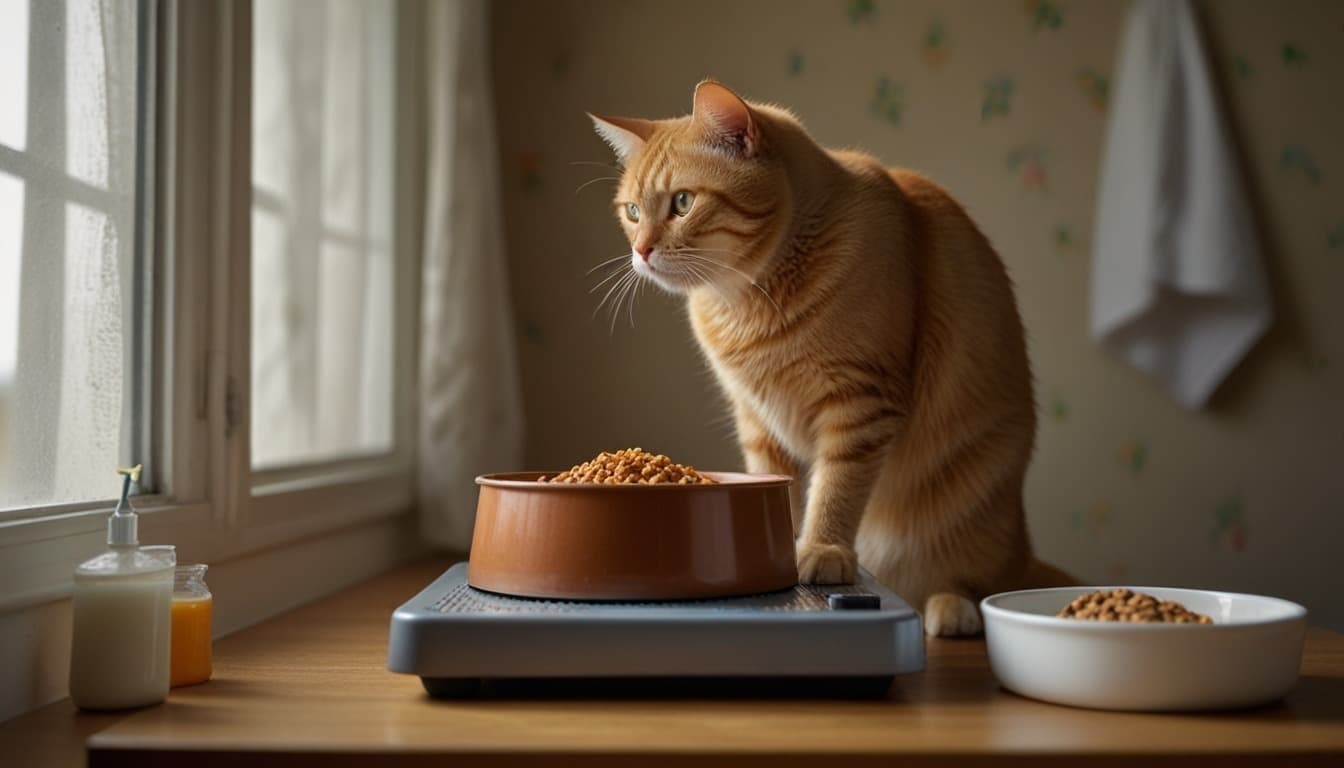
I fed my foster cat 'weight control' kibble for six months and he got fatter — here's the slow, non-crazy way we actually got the weight off
The measuring cup was lying, the 'weight control' kibble made him hungrier, and the cat wheel became a $200 laundry rack. Here’s what actually got my foster cat from 18 pounds to a healthy weight — slowly, safely, and without either of us losing our minds.
The vet said "he's fine" and I belieed her for two years
Pinto came to me as a 12-pound orange tabby with ears too big for his head and a purr like a lawnmower. He was a build, supposed to be temporary. That was four years ago. He's currently snoring on the armchair I said I'd never let the cats destroy, so you can guess how that went.
Somewhere around year two, I noticed he'd stopped jumping onto the kitchen counter. I thought, Finally, he's learned some manners. Turns out he physically couldn't. His belly was dragging when he walkrd, and when he sat, his back legs splayed out like a rotisserie chicken. I took him to the vet, worried about arthritis.
Dr. Nguyen — she's put up with my panic calls for 11 years, through three dogs and a divorce — gave him a once-over and said, "He's fine. Just a little… fluffy." She didn't say the word fat. So I nodded and went home and kept doing exactly what I'd been doing.
That was a mistake. A two-year, 6-pound mistake.
The rib test you can do at home (and why I failed it for two years)
You're supposed to be able to feel your cat's ribs with light pressure — like the bones in the back of your hand, not your knuckles. With Pinnto, I had to dig through a pelt of fluff and what felt like a down comforter to find anything solid. I told myself it was just his thick coat. Orange tabbies can be stocky, right? They're just… big-boned.
Except cats don't have big bones. they've small, delicate little skeletons underneath whaever we pile on them. And I was piling on a lot.
I've fostered over 40 cats. I should've known better. My neighbor's cat, Morris — a massive gray tuxedo who looked like a furry ottoman — had just been diagnosed with diabetes. The insulin shots, the special food, the constant vet visits. It was a nightmae and it was 100% caused by his weight. I watched her go through that and still didn't connect it to the 18-pound tabby on my couch. Denial is a hell of a drug.
When "fluffy" becomes a prroblem no one wants to name
Vets are sometimes too polite. I get it — they don't want to offend clients, and weight is a touchy subject. But when Dr. Nguyen finally levrled with me, it wasn't because she found her nerve. It was because Pinto had started snoring so loudly I couldn't hear the TV, and he'd developed a weird greasy patch at the base of his tail that he couldn't reach to clean anymore. I brought him in for the grease spot, and she said, very gently, "Sarah, he's obese. We need to talk."
Obese. Not fluffy. Not winter-weight. Not big-boned. Obese.
I felt like crap. I also felt defensive. I wanted to say, "But I buy the good food!" I wanted to say, "He's just a lazy cat!" Both things were sort of true and completely irrelevant. He was obese because I was feeding him too much. Period. The end. Nothing else mattered.
That same month, I was scrolling through my own site looking for a different post — I do that sometimes, trying to remember what I said about something — and I landed on the whole disaster with my dog Gus and "light" kibble. I'd made the same mistake with him, in a different species, and somehow managed to completely forget the lesson. If there were an award for repeating your own warnings, I'd have a shelf full of them.
The $30 kitchen scale that changed everytihng (and why I threw out the measuring cup)
Here's the thing nobody tells you aobut feeding cats: the measuring cup that comes with your kibble is a liar. A bold-faced, unapologetic liar.
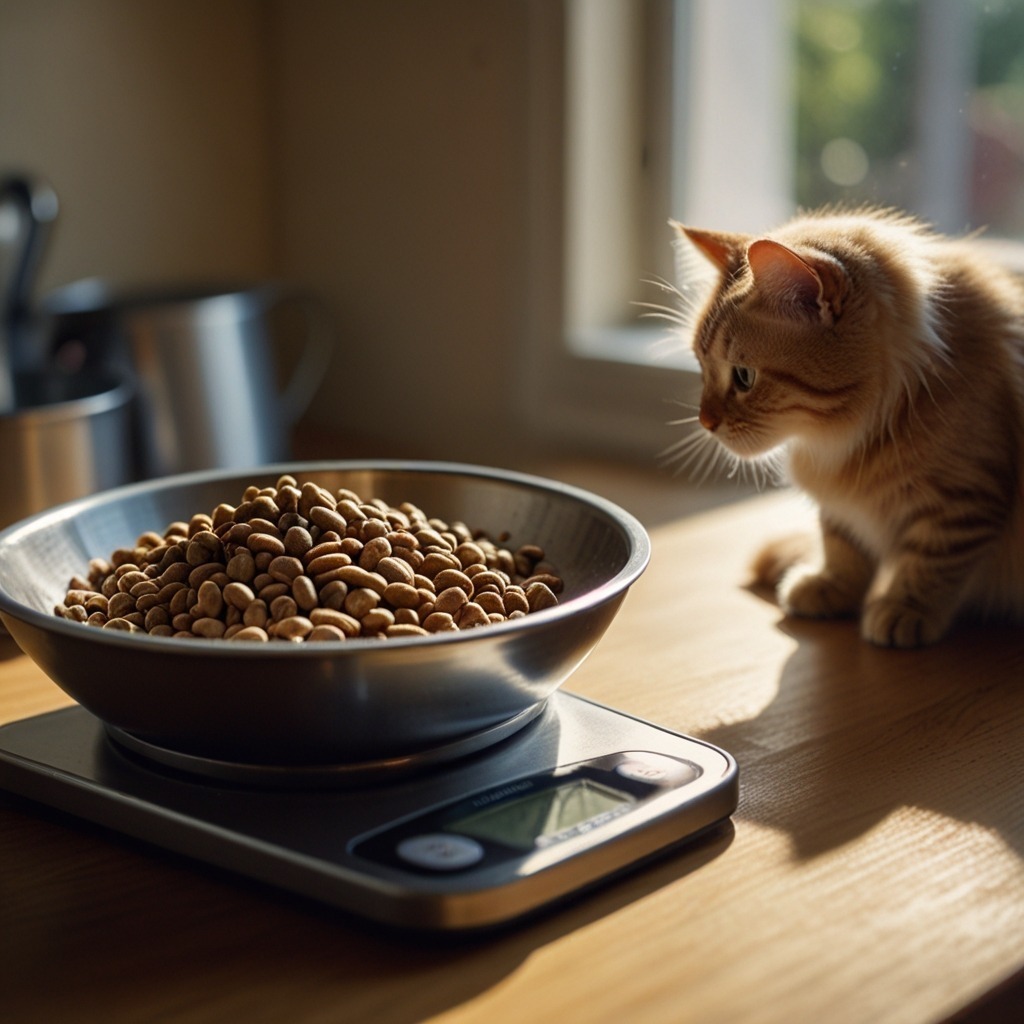
For months — yrars, really — I'd been scooping a "half cup" of dry food into Pinto's bowl twice a day. The bag said a half cup twice daily for a cat his size. Seemed straightforward. But a half cup depends on how packed the kibble is, how much it's settled in the bin, whether I heaped it or leveled it or just eyeballed it at 6 a.m. when I hadn't had coffee. Sometimes it was probably 45 grams. Sometimes it was probably 70. Pinto didn't care. Pinto just ate it.
I bought the kitchen scale on a whim, bexause I read something on a human nutrition forum about how measuring cups were useless for flour, and I thought, Huh, I woner if that's true for cat food too. it's. It absolutely is.
Why measuring cups are your cat's enemy
I weighed ten "half cups" of the same kibble, scooped the way I normally did. They ranged from 38 grams to 62 grams. The bag's feeding instructions said one cup was 100 grams and 350 calories. So my supposed "half cup" could've been anywhere from 133 calories to 217 calories. Twice a day, that's a potential swing of 168 calories — in a cat whose daily calorie goal should've been around 200. I was basically guessing. Badly.
Even if you level the cup carefully every time, kibble pieces are different sizes. Some settle into the cup more efficiently than others. you'll never, ever be accurate with a cup. I don't care how precise you're. I tested this exhaustively one afternoon while Pinto meowed at my ankles, and I realized I'd been accidentally overfeeding him by as much as 30% for two years.
Getting the right food amount — no, the bag is probably wrong
So here's what I did. I looked up a cat calorie calcualtor — there are a bunch online, and your vet can give you one — and figured out that Pinto, at 18 pounds, needed about 220 calories a day to lose weight slowly and safely. The bag of his weight-control kibble recommended 180 calories for weight loss at his size, which 1) I'd been massively overshooting anyway, and 2) ended up being too aggressive and made him miserable, which I'll get to in a minute.
I weighed his food in grams every single morning. Precisely 45 grams of that particular kibble came out to about 190 calories. I split it into three meals because I'd learned from my Maine Coon disaster that feeding a cat only twice a day can mess with their metabolism and overall health. Smaller, more frequent meals keep their blood sugar steadier and their hunger less desperate.
I also dug out the auromatic feeder I'd saved from the great automatic-feeder test I'd run a year earlier. That thing was a lifesaver for dispensing tiny portions at 3 a.m. when I refused to be conscious. The one I kept dispensed by weight, not by cup, which meant I didn't have to recalibrate anything. If you're goimg to use a feeder, get one that does grams. Everything else is a roulette wheel.
The first week of precise feeding, Pinto gave me a look I can only describe as "I'm calling the authorities." He knocked a full glass of water off my nightstand. He sat on my head at 4 a.m. and screamed directly into my ear. I'd dealt with that particular brand of drama before — it's basically the same playbook my cat Miso ran when I first fixed his 3 a.m. yowling, which I've written about at length. Cats, when they think they're starving, will absolutely terrotize you. I told myself it would pass.
It mostly did. After avout ten days, the theatrics dialed down from "operatic tragedy" to "low-grade grumbling." Progress.
Treats: the silent weigjt-gain assassin (and the one I still give)
I used to throw a few Temptations at Pinto every time he did something cute. Which, with cats, is approximately every 90 seconds. I never counted them. They were tiny. They were practically nothing. Right?
Wrong. One Temptation treat is about 2 calories. That doesn't sound like much until you realize I was giving him 15 to 20 a day — 40 extra calories. On a 200-calorie diet, that's a 20% increase. It's like me eating an extra cheeseburger every day and wondering why my jeans don't fit. My friend Beth once told me she gave her cat "just three treats a day" that turned out to be 15 calories each, 45 calories total — 25% over the cat's entire daily calorie allowance. She thought she was being disciplined. The treat bag had her in a chokehold.
The dream of a "healthy" treat
I tried switching to freeze-dried chicken, which felt virtuous. It's just meat! One ingredient! But freeze-dried chicken is calorie-dense as hell because all the water's removed. A tiny cube can be 5 calories. Giving five of those is 25 calories — still more than you think. And those "grain-free" salmon bites that the pet store markets as healthy? Same story. Healthy doesn't mean low-calorie. An avocado is healthy and it's 240 calories. Same principle.
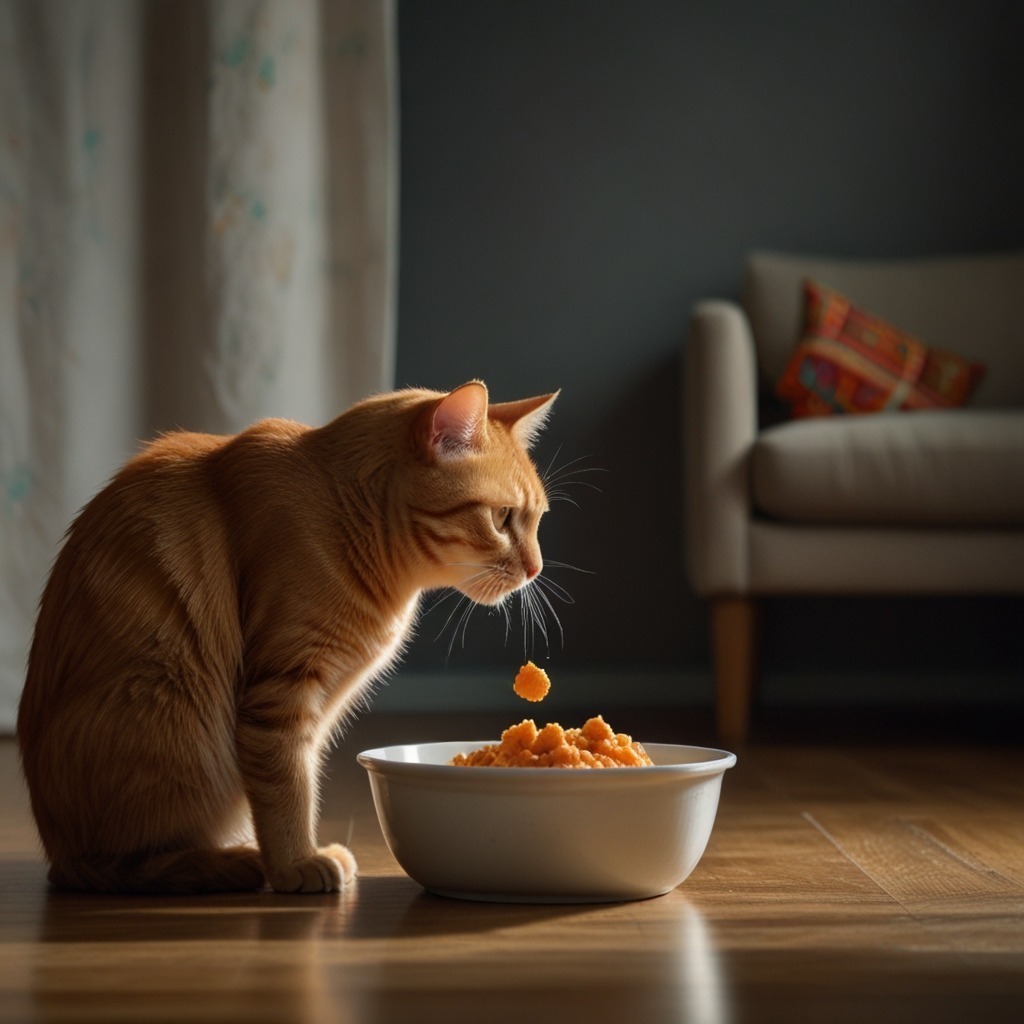
What I landed on was keeping a spoonful of Pinto's regular wet food (I'll get to the wet food switch) separate in the fridge and using those as "treats" — little pea-sized blobs that I could dole out during the day. They counted toward his daily calories. No extra math. I also found that plain, unsalted green beans cut into tiny bits worked for him, which is a trick I stole from a dog-obesity forum. Not every cat will eat a green bean, but Pinto was so food-obsessed he'd eat a pencil eraser if I offered it with enough enthusiasm. Experiment. Find something that counts as zero-calorie or close to it, and save the real treats for really big wins.
The 10% rule that nobody follows
All the veterinary guidelines say treats should make up no more than 10% of a cat's daily calories. For a cat on a 200-calorie weight-loss plan, that's 20 calories. That's maybe four Temptations and a tiny piece of chicken. Most peole are feeding three times that without realizing it. I was feeding five times that. If you're not tracking it, assume you're over the limit. You almost certainly are.
Why "diet" cat food made my build cat hungrier and crabbier
Here's where I really screwed up. Dr. Nguyen suggested a weight-management formula, so I grabbed a bag of a popular veterinary-brand "light" kibble and switched Pinto onto it. I figured, This is the stuff the vet recommends, this'll work. For six months, I fed him exactly the measured anount on the bag. He didn't lose a single ounce. Actually, I think he gained. And he was miserable — constantly hungry, pacing by his bowl, yowling like I'd abandoned him in a desert.
The problem, which I figured out after about four hours of frustrared Googling and a long chat with a veterinary nutritionist I'm lucky enough to know, is that "weight control" kibbles often replace fat with carbohydrates. Fat is satiating. Carbs aren't. So they'll drop the calorie count by removing fat and adding more plant-based fillers — rice, corn, peas, potatoes — which spike the cat's blood sugar and then crash it, leaving them hungry again in an hour. It's the feline equivalent of eating a big bowl of white pasta and wondering why you're starving at 3 p.m.
I'd made this exact misttake before with my dog Gus, who I wrote about in a post I apparently didn't re-read enough times. He turned into a sausage on "light" kibble because it was carb-heavy and his body just stored it all as fat. Same thing was happening to Pinto. I'd lrarned this lesson, and then I'd un-learned it, which is maybe the most infuriating thing about being human.
The wet food switch that finally moved the needle
The nutritionist told me, very simply, "Feed him a high-protein wet food. Cats are obligate carnivores. They need meat, not corn." So I switched Pinto to a good-quality pâté — the kind that's mostly named meat, not mysterious by-products or gravy full of wheat gluten. Wet food is naturally lower in carbs, higher in protein and moisture, and a whole lot more filling per calorie. A 5.5-ounce can of the stuff I picked was about 180 calories, and I could see him get full after eating it. He'd actually walk away from the bowl. With the weight-control kibble, he'd finish and immediately look at me like, That's it?
I made the switch slowly — two weeks of mixing increasing amounts of wet food into his dry, until he was on 100% wet. I'd learned the hard way with Miso that abrupt diet changes can turn your rug into a crime scene. Cats' digestive systems take time to adjust. Don't rush it.
The glucose roller coaster I didn't know I was causing
Think about it: a cat's natural diet is small animals — high protein, moderate fat, almost zero carbs. Their bodies aren't designed to process a 30% carbohydrate diet. When they eat a carb-heavy meal, their blood sugar spikes, their pancreas pumps out insulin, and the excess glucose gets stored as fat, fast. Then their blood sugar plummets and they're ravenous again three hours ltaer. On a high-protein, low-carb wet food, Pinto's blood sugar stayed steadier. He was less desperate between meals. He still wanted food — he's a food-motivated cat — but he wasn't clawing the cabinet doors like a tiny furry zombie.
The one sentence that made me rethink everything
About three weeks into the wet-food switch, I was on the phone with Dr. Nuyen, complaining that Pinto had only lost half a pound and I felt like a failure. She said, very calmly: "He doesn't need to lose weight fast. He just needs to stop gaining."
I sat there in silence for a second, and then I laughed beccause it was so obvious. I'd been treating this like a crash diet — trying to get the weight off as fast as possible so I could go back to "normal" feeding. But there's no finish line. Once a cat reaches a healthy weight, maintenance is just as much work. A slow, steady loss — like, a quarter-pound a month — isn't only safer (cats can develop hepatic lipidosis if they drop weight too fast) but also more sustainable. It gives their whole system time to adjust. It gives you time to build new habits that'll actually stick.
After that, I stopped weighing him every day. I stopped panicking. I just stuck with the plan.
I stopped free-feeding and my cat acted like I'd betrayed her
Before all this, Pinto had a gravity feeder filled with kibble at all times. I'd top it off whenever it got low. He grazed throughout the day. I thought this was fine because he wasn't scarfing it down like my dog does. But grazing made it impossible to know how much he was eating, and it meant his insulin was constantly being triggered, which is a fast track to insulin resistance and diabetes.
When I took the gravity feeder away and replaced it with three measured meals, Pinto lost his tiny orange mind. He sat where the feeder used to be and SCREAMEED. He knocked over the empty spot with his paw, over and over. He followed me into the kitchen and wove between my ankles, almost tripping me twice. I felt like a monster. But within two weeks — same as the kitchen-scale transition — he adjusted. He learned the schedule. He still acts like each meal is his last, but he's not panicking about the empty bowl anymore. He trusts that more food is coming. That's a big deal for a shelter cat.
The night Pinto dragged a rotisserie chicken off the counter and I realized we had a problem
This was about a month into the new routine. I'd set a rotisserie chicken on the counter to cool — maybe 10 feet from where Pinto was sleeping. I went to answer the door for a package delivery, and when I came back not two minutes later, the chicken was on the floor, the plastic container chewed open, and Pinto was dragging a drumstick toward the pantry like a hyena with a gazelle. I had to pry it out of his mouth. He hissed at me. He'd never hissed at me before.
That was the moment I truly understood how much of a stranglehold food had on him. It wasn't just about being chubby. He was desperate. The constant grazing, the carb-heavy diet, the sporadic feeding — I'd created a cat whose entire existence revolved around his next meal. He wasn't lazy. He was food-obsessed. And that's a much harder thing to fix than a number on a scale.
After the chicken incident, I started putting all human food in cabinets or the microwave before stepping away. I got a locking trash can. I also started using puzzle feeders for his meals — simple ones at first, just a ball he had to bat around to dispense kibble-sized wet-food chunks (I froze them into tiny pellets). It made him work for his food, which burned a few extra calories and, more importantly, gave his brain something to do besides fixate on when the next meal would appear. The puzzle feeder wasn't a magic bullet — his total daily calories didn't change — but his mood did. A little bit. Enough that he stopped trying to commit grand larceny.
The scale routine that kept me honest (and the vet visits I dreaded)
I bought a baby scale on Facebook Marketplace for $15. Every Wednesday morning, I weighed Pinto. I kept a little notebook on the fridge. Week 1: 18.2 lbs. Week 4: 17.9 lbs. Week 8: 17.5 lbs. It was agonizingly slow. Some weeks the number didn't budge at all, and I'd spend 20 minutes spiraling about whether I was still messing up.
Weigh-in Wednesdays
Wednesday became The Day. I'd set the scale on the bathroom floor, zero it out, and then place Pinto on it with as much dignity as I could muster (which was none; he squirmed and glared). I wrote down the number even when I hated it. The data kept me from lying to myself. If the scale hadn't moved for two weeks, I didn't cut his food — I just re-evaluated. Was I getting sloppy with treats? Had I started measurign less carefully? Almost always, there was a reason. I was the variable, not him.
When the scale didn't budge for three mortal weeks
Around month three, the scale stuck at 17.2 for three straight Wednesdays. I convined myself the scale was broken. I recalibrated it with a bag of flour. It was fine. I was just impatient. Dr. Nguyen reminded me that weight loss isn't linear — cats can lose fat but gain a little muscle, or retain water, or just… stall. She said to keep doing what I was doing and come back in a month. So I did. The fourth Wednesday, he was 16.9. The dam broke. I felt like I'd won the lottery. I called my mom. She didn't understand why I was crying over a cat losing 0.3 pounds, but she congratulated me anyway.
Exercise: you cna't outrun a food bowl (but here's what actually helped)
I tried to exercise Pinto more. I really did. I bought a cat wheel — one of those enormous hamster-wheel contraptions that cost more than my first car payment. I assembled it in the living room with great ceremony. Pinto sniffed it, got inside, walked for maybe ten seconds, and then exited and never looked at it again. For two years, it served as a very expensive laundry-drying rack until I finally sold it to a woman with an actual active cat.
Laser pointers and the guilt that follows
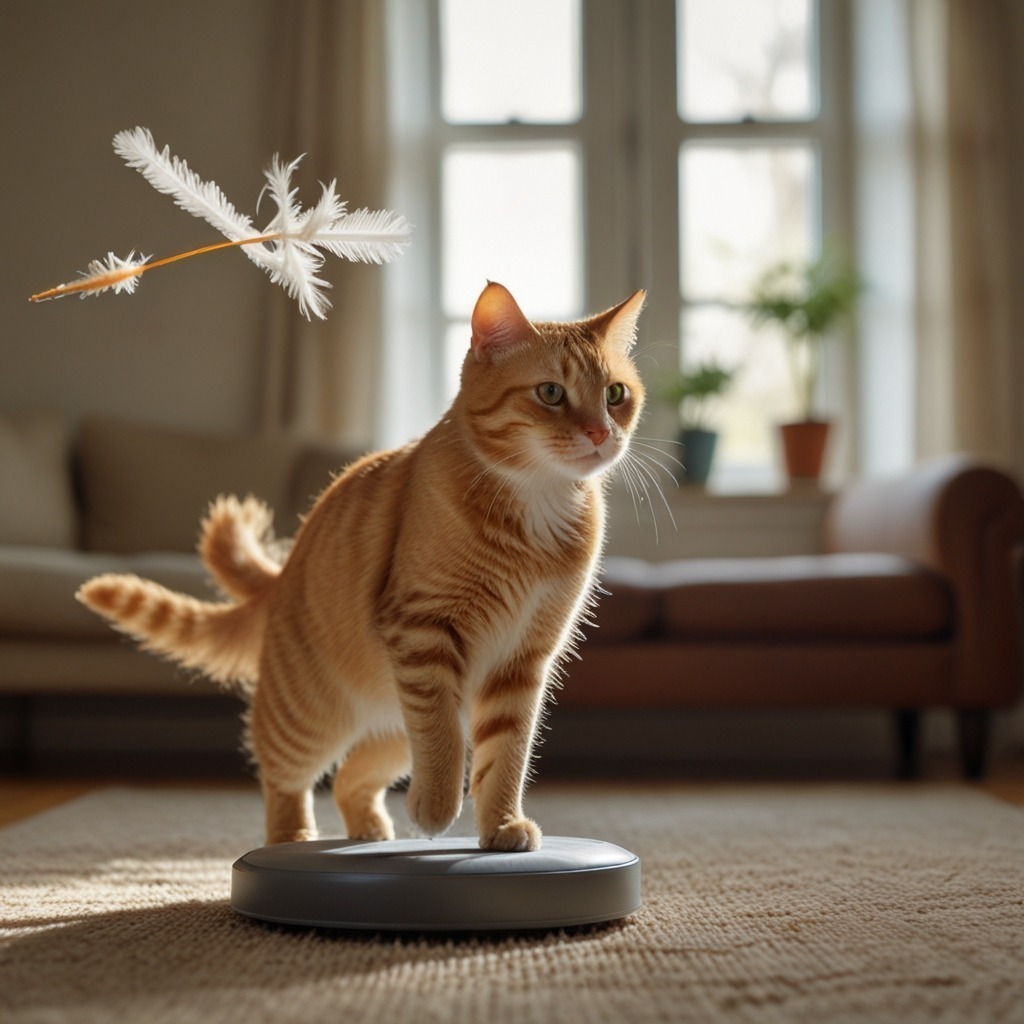
I used a laser pointer. He'd chase it for a few minutes, and I'd feel like a great pet owner. But I read that laser pointers can cause frustration and obsessive-compulsive behaviors in some cats because there's no "finish" — they never catch anything. I started ending laser sessinos by pointing the dot onto a physical toy he could pounce on and "kill." That helped. But honestly, the calorie burn from 10 minutes of play is negligible — maybe 5 calories if I'm being generous. You can't play a cat thin. That doesn't mean you shouldn't play with them — enrichment matters, movement matters for joint health and mental state — but it's not where the weight loss comes from.
Environmental enrichment that didn't cost $200
What actually helped, beyond the puzzle feeders I mentioned, was simple stuff: moving his food bowl to a different spot every meal so he had to walk to it, putting his wet food on an elevated surface so he had to jump up (once he could again), and scattering a few pieces of freeze-dried chicken around the house for him to "hunt" — counted precisely, of course. None of this made him drop pounds, but it kept him from being a sedentary lump, and I think it contributed to his overall sanity. A bored, hungry cat is a cat that screams into your ear at 4 a.m. A slightly less bored, hungry cat is slightly more tolerable.
What finally wroked for Pinto: the slowest weight loss in history
It took 14 months. Fourteen months to go from 18.2 pounds to 14.5. That's an average of about 0.26 pounds per month — a quarter of a pound. You could blink and miss it. But somewhere around month eight, I noticed he could jump onto the couch without a running start. Around month ten, he started grooming his whole back again, and the grasy patch disappeared. At month twelve, he chased a fly across the living room and actually caught it — something he hadn't done since he was a scrawny teenager.
We had setbacks. Christmas 2023, when my sister cat-sat and "felt bad for him" and gave him a can of Fancy Feast gravy lovers every single day because "he looked so sad." He gained half a pound in ten days. I came home to a noticeably rounder cat and a note that said, "Sorry, he was just so convincing." I wanted to be mad, but I'd been there. Cats are con artists. you've to cat-proof your entire village.
Today Pinto is 14.3 pounds, which Dr. Nguyen says is perfect for his frame. He still acts like he's never been fed in his life, but he's not desperate anymore. He naps. He plays a little. He sits on the arm of the couhc and cleans his paws without tipping over. I don't weigh him every Wednesday anymore — I do it once a month, just to make sure we're not drifting.
The thing I wish someone had told me at the start of all this is that cat weight loss is boring. It's repetitive. It's a scale and a notebook and a lot of hissing and a slow, grinding act of patience that doesn't make for a satisfying before-and-after post. The Instagram version would be a dramatic si-week transformation. The real version involved a rotisserie chicken heist, four months of slow progress, three weeks of plateauing, a Christmas setback, and a lot of me muttering "why did I get a cat" into my coffee.
He's currently asleep on my keyboard, which is a different problem entirely. But at least he's not obese while doing it.