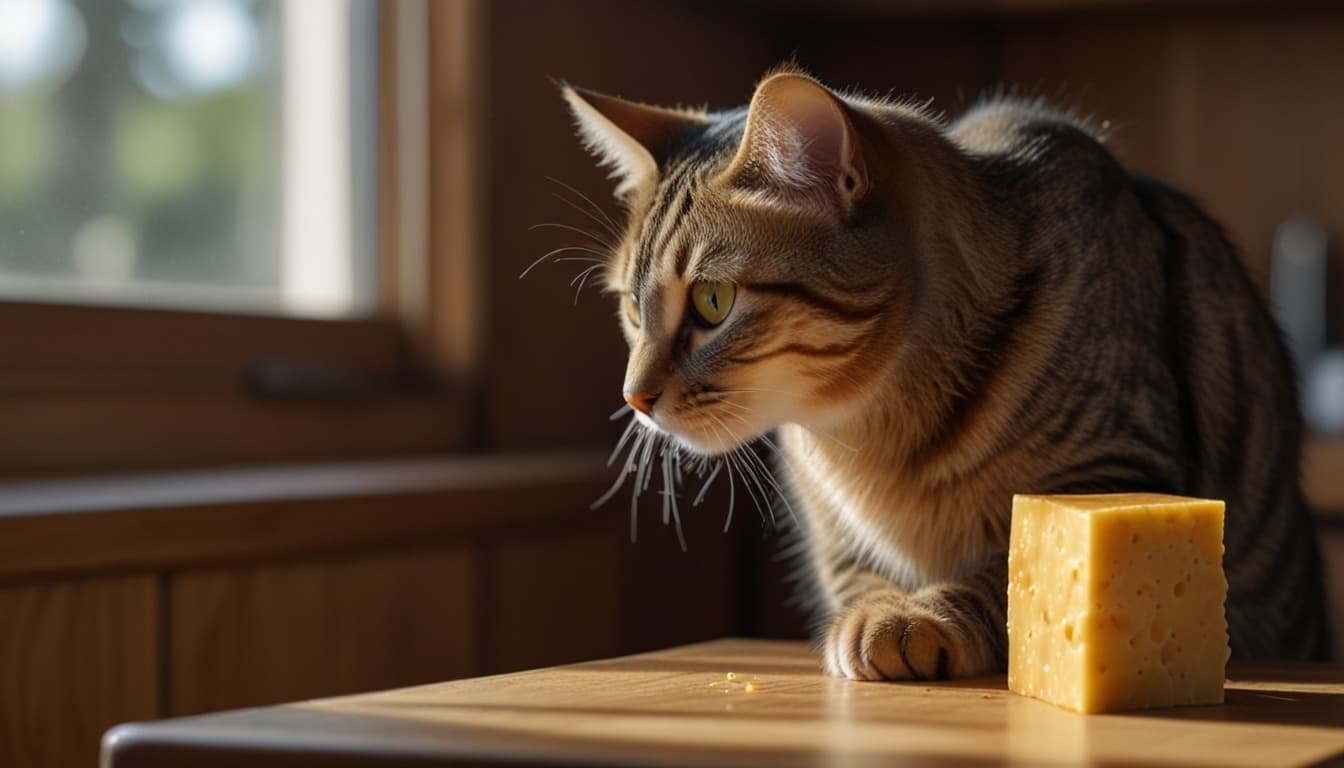
Can cats eat cheese?
So you dropped a cheese cube and your cat ate it before you could react. Is it an emergency? I've been there — with 40+ foster cats, one cream cheese disaster, and a cat who broke into the parmesan. Here's what you actually need to know.
Look, I get it. You're making a sandwich, you drop a tiny shred of chedar, and suddenly your cat — who normally judges you from the top of the fridge like you're a disappointing intern — turns into a furry little vacuum cleaner. The cheese is gone before you even process what happened. Then you panick. Should cats even eat cheese? Did I just poison my cat? Is this going to be a $400 emergency vet visit because of a cheddar molecule?
I've been there. More tmies than I want to admit. And not just with cheese — with onion rings, with a build kitten who licked a smear of cream cheese off my bagel when I wasn't looking, with a 17-pound tabby named Mochi who figured out how to open the refrigerator drawer where I kept the parmesan. (We'll get to Mochi. That cat was a menace and I still miss him.)
So can cats eat cheese? Technically, a tiny piece of hard cheese probably won't kill them. But should they? Almost never. And the "why" is a whole mess of evolutionary biology, digestive disappointment, and one very expensive Sunday morning I spent sobbing into a pile of laundry while my build cat Tiger had explosive diarrhea in my favorite shoes.
Let me back up. I'm not a vet. I'm a failed vet tech student who's fostered over 40 cats, made every feeding mistake known to mankind, and spent so much money on emergency vet visits that my credit card company once called to ask if I was "in distress." What I'm about to share is the real, no-BS truth about cats and dairy — dragged out of my own experience and too many late-night Google rabbit holes.
The 10-second answer for people who just dropped a cheese cube and need to know if they should scream
A small lick of hard cheese like cheddar or parmesan is unlikely to cause immediate, life-threatening harm to a healthy adult cat. A whole cube or slice? That's a digestive gamble. Soft cheeses like cream cheese or brie? Even riskier because of the higher lactose and fat content. Kittens are a whole different story — more on that later. But here's the thing: just because something won't kill your cat doesn't mean it's a good idea. I've learned that lesson the hard way, usually involving a carpet cleaner and shame.
Wait, aren't cats supposed to love milk?
This is where I could go on a rant about cartoons. Some animator in the 1940s decided to draw a cat lapping up a saucer of milk and now the entire human race thinks cats and dairy are a perfect match. They're not. Most adult cats are lacose intolerant. Their bodies don't produce enough lactase — the enzyme that breaks down lactose — after they're weaned. So that saucer of milk you saw in a Tom and Jerry episode? It's basically a recipe for gaseous regret and diarrhea. I wish someone had explained this to me before I let my first cat, a dopey orange boy named Cheese Puff (yes, the universe has a sense of humor), lick my cereal bowl clean every morning when I was 12. He had chronic soft stools for years and my mom just thought he was "sensitive." No, he was lactose intolerant and I was an idiot.
The lactose problem nobody talks about
Here's a number that stuck with me: around 50% of adult mammals lose the ability to produce lactase after infancy. Cats are obligate carnivores — their digestive systems evolved to process meat, not milk byproducts. A cat's small intestine simply isn't designed to handle lactose. When undigested lactose hits the large intestine, bacteria ferment it, causing gas, bloating, cramping, and the kind of diarrhea that makes you want to tear up your carpets and move to a new apartemnt. If you've never cleaned liquid cat poop out of a shag rug at 2am, consider yourself blessed.
But here's where it gets tricky: cheese is fermented and aged, so some types actually have less lactose than milk. Hard, aged cheeses like cheddar, parmesan, and Swiss are lower in lactose. Soft, fresh cheeses like mozzarella, ricotta, and cream cheese? Still packed with lactose. So if you're going to be a complete rule-breaker and give your cat a nibble of something cheesy, the type matters. I'm not recommending it. I'm just saying that when Mochi broke into the parmesan, I didn't panic quite as hard as when he got into the half-and-half.
That time I thought a little cream cheese was harmlesss and ended up with a $340 vet bill
Okay, let me tell you about Tiger. Tiger was a 3-year-old grey tabby I fostered about 7 years ago. He came to me from a hoarding situation — 47 cats in a two-bedroom trailer. He was underweight, skittish, and weirdly obsessed with human food. The first week I had him, he climbed onto the counter while I was making a sandwich and licked a smear of cream cheese right off the knife I'd set down. I figured, "Eh, it's just a lick."
Four hours later, Tiger was hunched in the corner of his litter box, straining and crying. By hour six, he'd vomited twice on my bathroom rug and was refusing to eat his actual cat food. I called my vet, Dr. Nguyen — who's been putting up with my panic calls for over a decade now — and she told me to bring him in. The diagnosis? Acute gastroenteritis, almost certainly triggered by that tiny swipe of dairy. The treatment involved subcutaneous fluids, anti-nausea medication, and a bill that made me seriously reconsider my life choices. Tiger recovered fine. My checking account didn't.
I think about that day a lot, especially when I see people online casually feeding their cats cheese cubes as "treats" or putting butter on their cat's paws for some dumb TikTok challenge. Look, I'm not here to judge anyone's pet parenting. But I've made the mistake so you don't have to. And if you're going to ignore every warning and give your cat cheese anyway, at least make it a minuscule piece of hard, aged cheese — not a spoonful of Philadelphia cream cheese like I did.
But she said "cats can have a little salami"
If you've been on the internet in the last five years, you've seen that meme. The audio of a little girl pleading "cats can have a little salami" over and over. It's funny. I've laughed at it. But the thing about memes is they normalize ideas that are actually terrible pet care. Salami is packed with sodium, fat, and preservatives — none of which your cat needs. Same deal with cheese. A "little" cheese might not cause immediate harm, but that doesn't make it a treat. Your cat isn't a tiny human. Your cat is a tiny predator who evolved to eat mice and birds, not artisanal cheese boards.
This is honestly where I get frustrated with pet food culture. We personify our animals so hard. We want them to enjoy the things we enjoy. We want to share. I get it — I really do. I once made a whole birthday "cake" out of tuna and mashed sweet potato for my dog and nobody showed up (I wrote about that disaster over here). But sharing your food is almost always about YOUR feelings, not your ca'ts nutritional needs. Cats don't need cheese. They need meat. End of story.
What's actuslly in cheese that makes it such a bad idea
Let's break this down beyond just lactose. Cheese is a nutrition nightmare for cats on multiple fronts, and I hate that I know this much about it.
Fat content: the silent pancreas destroyer
Most cheeses are incredibly high in fat. An ounce of cheddar has about 9 grams of fat. For a 10-pound cat who should be eating around 200-250 calories a day, that tiny piece of cheese is a caloric bomb. More than that, the high fat content can trigger pancreatitis — a painful, potentially life-threatening inflammation of the pancreas. I've had one build cat with pancreatitis and it was one of the scariest things I've ever dealt with. He stopped eating entirely, hid under the bed for three days, and needed a week of hospitalization. The vet couldn't pinpoint a single cause but mentioned that fatty human foods are a common trigger. So every time I see someone feeding their cat chunks of cheese, I want to hand them a photo of my build cat with an IV in his paw and say "this could be your cat."
Sodium: tiny kidneys, big problem
Cheese is loaded with salt. A one-ounce serving of cheddar has about 180mg of sodium. That might not sound like much to us, but a cat's daily sodium requirement is miniscule. Too much salt can lead to increased thirst, dehydration, and over tine, kidney damage. Cats are already prone to kidney disease — it's one of the leading causes of death in older cats. If you've ever watched a senior cat decline from kidney failure, you know it's a slow, heartbreaking process. Why would you add any extra strain to those tiny organs for the sake of a "treat"? This makes me think of my 14-year-old cat who was wasting away on senior kibble and I didn't notice until the vet showed me his ribs. That experience really made me rethink everything I thought I knew about cat nutrition, and salt intake was a huge part of that wake-up call.
Some cheeses are literally toxic (no, seriously)
Here's a fun one: cheeses that contain garlic, onion, or chives — and that includes a LOT of flavored cheeses, herb-crusted goat cheese logs, cheese spreads, you name it — are straight-up poisonous to cats. Onions and garlic, in any form (raw, cooked, powdered), damage a cat's red blood cells and can cause anemia. Even small amounts over time can build up. I once had a build cat, George, who ate half a block of garlic-herb boursin off the counter and I aged about 10 years in 4 seconds, not unlike the time my build dog ate 17 raisins. (Yes, raisins are toxic to dogs. The things we live through.) George ended up at the emergency vet getting induced vomiting while I sat in the waiting room, ugly-crying and Googling "can cats die from boursin." He was fine. I wasn't. And now I check evey cheese label like a paranoid lunatic before it even comes into my house.
Why the "but my cat loves cheede" argument doesn't hold up
This is the part where I try to be gentle because I know so many people say this. "But Fluffy LOVES cheese. She comes running when she hears the cheese drawer open." Yes, of course she does. Cheese is high in fat and protein — it smells intensely good to a cat's nose. Cats are attracted to fatty foods because in the wild, fat means energy-dense calories. That doesn't mean it's good for them. My build dog once ate an entire stick of butter, wrapper and all, and seemed ecstatic about the experience. His digeestive system was less enthused. Liking something isn't the same as being able to tolerate it.
Here's a tangent for you: I spent a year working at an animal shelter in my twenties and the number of surrendered cats with chronic diarrhea or vomiting who'd been fed table scraps their whole lives was staggering. Owners would drop off a cat with "mystery digestive problems" and casually mention that she "gets a little cheese every day as a treat" or "she loves when I share my ice cream." They never made the connection. And I get it — it's hard to connect a tiny daily habit with a chronic health issue. But cats are stoic. They hide discomfort until things are really bad. You might not even know your cat has stomach cramps unless you're paying very close attention. I wrote about this when I covered my build cat's stomach warzone and the food that finally stopped the carpet cleanups — sometimes the problem is hiding in plain sight.
So what cheeses are the "least bad" if you absolutely refuse to listen?
I'm going to answer this because I know if I don't, someone's going to take the blog post as permission to feed their cat a whole brie wheel. So here's the hierarchy of cheese risk, from "least terrible" to "absolutely not."
Hard, aged cheeses like parmesan, aged cheddar, and aged gouda. These have very little lactose because the aging process breaks most of it down. If you must give your cat a tiny nibble — and I mean a piece smaller than your pinky nail — these are the ones to pick. But this is still not a recommendation. I'm just harm-reducing here.
Semi-hard cheeses like regular cheddar, Swiss, and provolone. Lactose content is moderate. A tiny crumble might not cause disaster, but more than that's Russian roulette with a litter box.
Soft cheeses like mozzarella, ricotta, cottage cheese, cream cheese. High lactose, high moisture, high risk. Avoid. I can't stress this enough after my Tiger experience.
Blue cheeses like roquefort, gorgonzola, stilton. These are a hard no. Not just because of lactose and fat, but because the mold cultures can produce compounds that are toxic to some animals. Plus, a lot of blue cheeses are made with rennet from animal stomachs, which some cats can react poorly to. Honestly, just don't.
Anything with herbs, garlic, onion, chives, or "flavorings." Absolutely not. These are toxic. Put them away. Lock the frigde. George's boursin incident is forever seared into my memory and I won't let you make my mistake.
Now, if you're reading this and thinking "oh good, parmesan is okay, I'll just feed my cat parmesan every day" — stop. Reread the rest of this article. The fat. The salt. The empty calories. It's still junk food for a species that doesn't need it.
Wait, what about kittens? Can kittens eat cheese?
Kittens are even more sensitive than adult cats. Their digestive systems are fragile, still developing, and they're relying on nutrient-dense food to grow. Cheese — even a tiny bit — can cause diarrhea that leads to dangerous dehydration in a kitten. Also, kittens actually have more lactase than adults because they're still in the stage of digesting their mother's milk. But that doesn't mean they can handle cow's milk or cheese. The composition is completely differnet. Cow's milk has way more lactose and different protein structures than cat milk. I've seen build kittens get awful diarrhea from being mistakenly given cow's milk by well-meaning fosters. It's not pretty. So, no cheese for kittens. Just don't. If you need kitten care advice that won't make you cry, check out my guide on raising 12 kittens in a tiny apartment — cheese isn't on the menu.
What to do if your cat already ate cheesse (and you're currently freaking out)
Okay, deep breath. Let's assess. How much? What kind? Does the cheese contain garlic or onion? If so, call your vet immediately — don't wait for symptoms. If it was a plain hard cheese and just a tiny piece, monitor your cat closely for the next 12-24 hours. Watch for vomiting, diarrhea, lethargy, straining in the litterbox, refusal to eat, or any signs of abdominal pain (hunched posture, growling or hissing when you touch their belly). If you see any of these, call the vet. Don't be like me and wait until the cat is vomiting on the rug before you take action. I'm bad at my own advice. I've done that. I'm trying to be better.
For large amounts, especially of soft cheese or anything with flavorings, just go straight to the vet. I know emergency vet visits are expensive and I know it's 11pm and you're in pajamas. I've made that drive more times than I can count. It sucks. But I'd rather sit in a waiting room feeling like an idiot than stay home and wonder if my cat is going to be okay. The money hurts, but the guilt of inaction hurts worse. I learned that lesson when I spent $2,300 on allergy vet bills for my dog — only to discover the issue was his food. I've also spent a fortune on prevventable cat health crap (read my $14,000 confession). So I'm speaking from a place of painful financial experience.
Cheese alternatives that won't send you to the emergency vet at midnight
If you're desperate to give your cat a "special treat" because you're a human and you want to express love through food (again, I do this too, I'm not judging), here are some options that are actually safe in moderation:
- Freeze-dried meat treats — plain chicken, turkey, or salmon with zero additives. These are basically kitty crack and you don't have to worry about mysterious ingredients.
- Cooked, unseasoned chicken breast — a tiny piece as a reward. Plain. No oil, no salt, no seasoning.
- Commercial dental treats — at least these have some benefit beyond "tastes good."
- A small spoonful of plain, unsweetened pumpkin puree — some cats love it and it's actually good for digestion. (Some cats, mine included, will simply stare at you in disgust. Your mileage may vary.)
The real treat, honestly, is taking 10 minutes to play with your cat using a wand toy. Or brushing them. Or just sitting quietly and letting them knead your lap. Cats don't need food to feel loved. They need your attention. They need environmental enrichment. They need consistency. I know that sounds preachy. I'm trying to convince myself as much as I'm trying to convince you. I still catch myself wanting to give my cats "just a little something" from my plate. It's a hard habit to break. But every time I resist, I remember Tiger's cream cheese incident and the way he looked at me with those sad, watery eyes while the vet inserted an IV. That memory is a powerful cheese deterrent.
What finally workde for Mochi (and why I still lock the cheese drawer)
Mochi, the refrigerator-breaking tabby I mentioned earlier, was a food theif like no other. He once ate an entire bag of corn tortillas. He'd open cabinets with his paws, knock containers off shelves, and stare at you while slowly eating something he absolutely shouldn't have, daring you to intervene. I loved him like a complete fool. And for years, I kept cheese around the house without thinking twice. Mochi got into string cheese, shredded cheese, blocks of cheddar — you name it. I'd always panic, watch him closely, and he'd always be fine. Until he wasn't.
One night, when Mochi was about 11, he ate a chunk of extra-sharp cheddar (my fault, I left it on the counter while answering a phone call) and later that night, he vomited a foul-smelling liquid all over my bedspread. Then he did it again. And again. By morning, he was lethargic and wouldn't drink water. Off to the emergency vet we went. Turns out he'd developed pancreatitis and the fatty cheese was the trigger. He was hospitalized for two days. I spent $1,800 I didn't have. And I cried so hard in the vet's office that the receptionist brought me tissues and a cup of tea.
Mochi recovered. He lived another three happy, cheese-free years. I never left food on the counter again. I bought childproof locks for the fridge and cavinets. I became That Person at dinner parties who says "please don't feed the cat" before anyone even reaches for a cracker. And you know what? Mochi didn't suffer without cheese. He didn't pine for it. He ate his meat-based cat food, hunted dust bunnies, and cuddled on my pillow like he always had. The cheese was for me, not for him. That's the thing I keep coming back to: every "treat" I gave him was about my desire to make him happy, not about his actual needs. And it nearly killed him.
I don't have a tidy ending for this post. I'm sitting here at my kitchen table with three rescue dogs asleep at my feet and a build cat — a scrawny calico named Bug — eyeing me from the windowsill like she knows I'm about to open the fridge and maybe, just maybe, drop a shred of something. But I won't. Not this time. I've made enough mistakes for one lifetime. If you've made it this far, you probably care about your cat a lot. So do this one thing: put the cheese away. Give your cat a chin scratch instead. They'll be fine. They'll be better than fine. And you'll save yourself a $340 vet bill and a 2am carpet cleaning session. Trust me on this one.