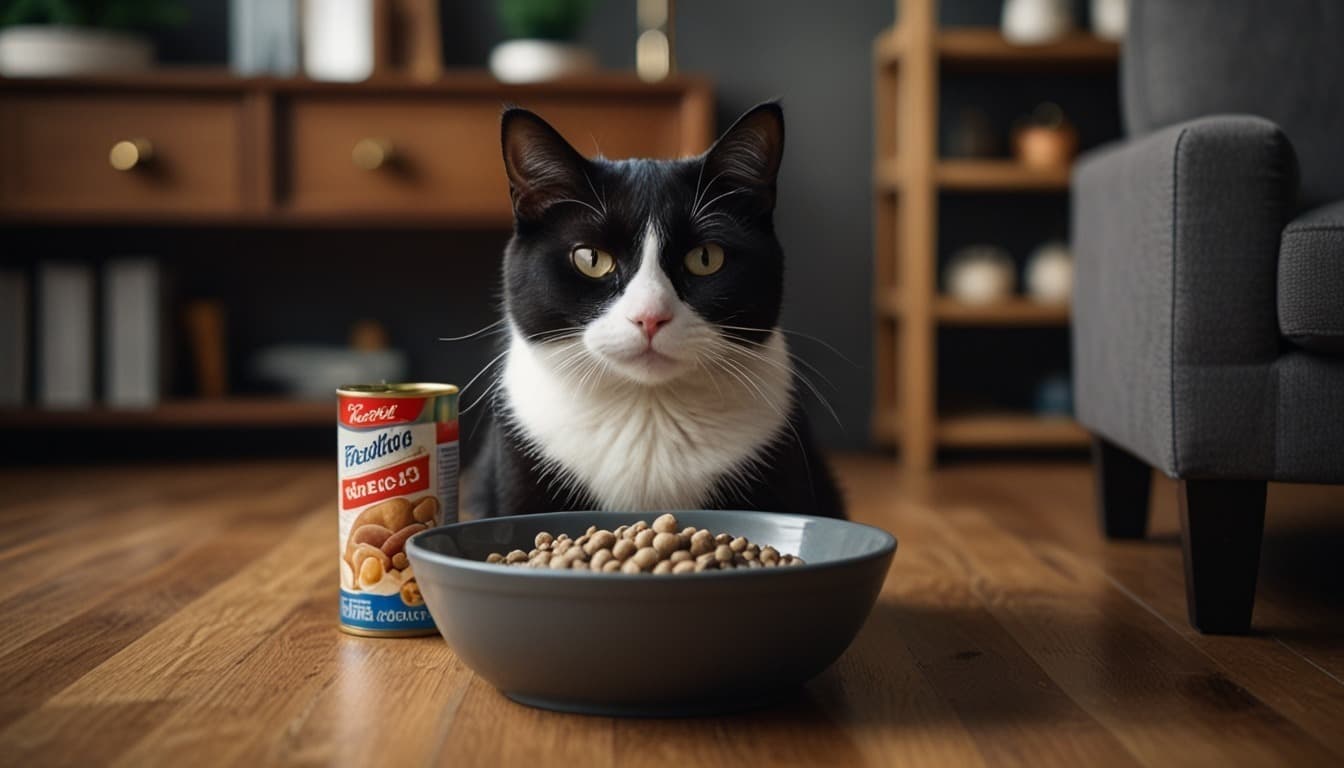
I Thought Switching Cat Food Was as Simple as Mixing Bowls. Then Miso Pooped on My Rug.
I thought switching cat food was a simple 7-day mix. Then my foster cat turned my bedroom rug into a crime scene. Here's what I learned about slow transitions, gut health, and the one thing that finally stopped the puking.
Miso came to me on a Wednesday in February with a coat that looked like a greasy dishrag and poop the color of mustard. Not bright mustard, like the fancy stuff. The sad, watery kind you get at a ballpark. He'd been surrendered to the shelter with a note that just said "can't afford the vet anymore" and his paperwork listed "suspected chicken allergy" and "underweight—needs to gain 1.5 lbs." I'd been fostering for over a decade by then, so I figured: I'll grab a bag of this limited-ingredient duck food the rescue recommended, mix it with whatever they'd been feeding him, and we'd be golden. Ten days, maybe a few soft stools. Whatever.
At 3:47 a.m. on Thursday morning, I woke up to the sound of liquid hitting capet. Not the polite little hairball gag you can sleep through. This was a firehose. Miso had backed himself into the corner of my bedroom, hunched like a gargoyle, and released what can only be described as a biohazard onto my beige wool rug. I stood there in my underwear, holding a roll of paper towels, thinking about how I'd been an absolute idiot because I'd done the food transition in four days instead of two weeks because I was impatient and frankly, I thought the "slow transition" advice was for sensitive little purebreds, not a former barn cat who'd probably eaten rats for breakfast. Mabye I was wrong.
So let's talk about what actually goes into switching your cat's food — and I don't mean the sanitized, five-bullet-point version you find on the back of a kibble bag. I mean the real, messy, "why is there shit on my ceiling fan" version. Because if you've ever tried to transition a cat who's either stubborn, allergic, recovering from malnutrition, or just a complete jerk about food (hi, Miso), you know it's not as simple as "gradually increase the new food over 7-10 days." It's a negotiation. Sometimes it's a hostage situation.
The thing I wish I'd understood sooenr is that a cat's digestive system doesn't just adapt to new ingredients — it has to rebuild an entire ecosystem of gut bacteria for each protein and carbohydrate source. When I talked to Dr. Nguyen about it later (she's put up with my 11 p.m. panic texts through three dogs, a divorce, and one build cat who ate an entire tube of silicone caulk), she explained it like this: "Imagine you've eaten nothing but pizza your whole life, and then someone hands you a kale salad. Your gut would riot." And yeah, Miso's gut rioted. All over my rug.
But we're getting ahead of ourselves.
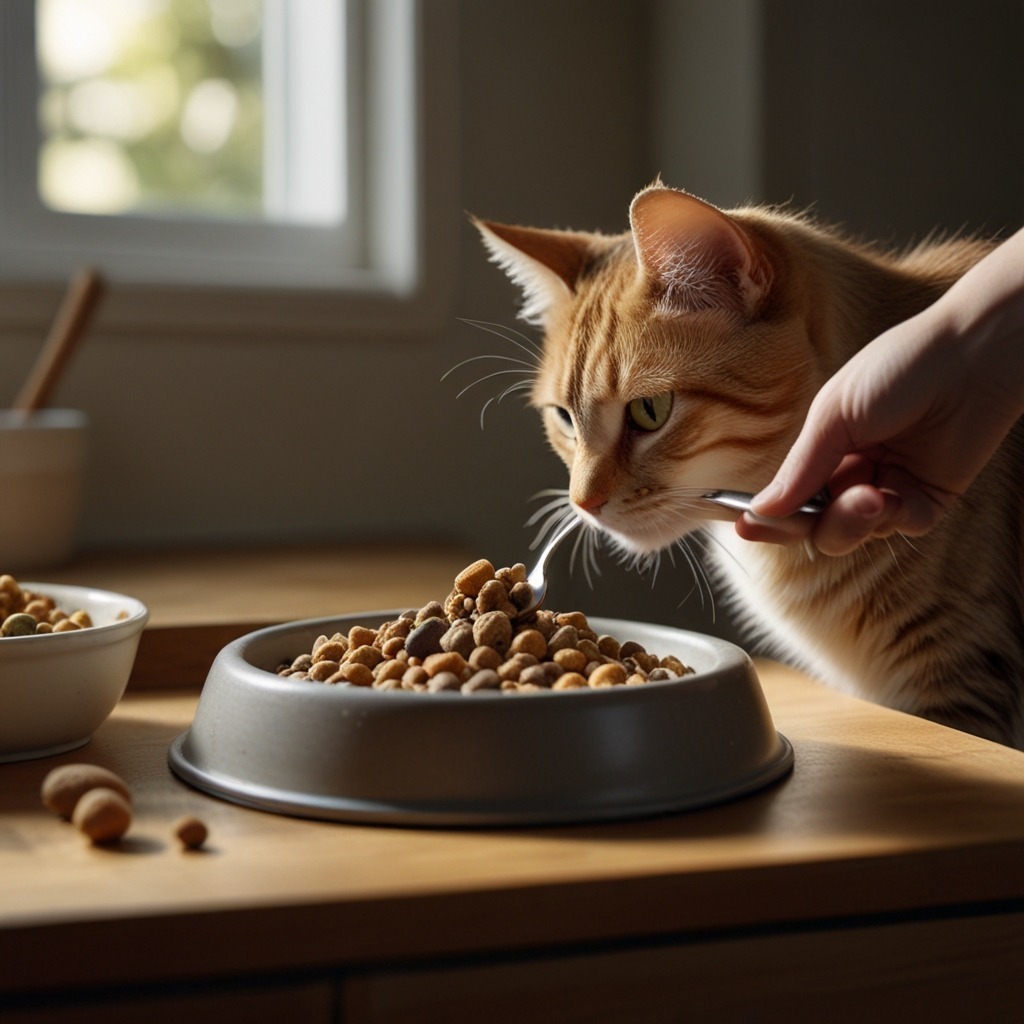
The first time I tried this, I nearly killed a cat
Not literally killed. But there was a moment around 4 a.m. that Thursday when I genuinely thought I might have broken him. He was sititng in his litter box, crying — not meowing, just this low, mournful yowl — and I was googling "how much diarrhea is too much diarrhea" on my phone with one hand while scrubbing a stain out of wool with the other. Turns out, if your cat has liquid stools more than five times in an hour, it's emergency vet time. We hit four and a half. I got lucky.
Here's the mistake I made: Miso's surrender papers said he was on some cheap grocery-store chicken kibble. The rescue gave me a bag of grain-free duck formula. They said "transition slowly." I nodded like I knew what that meant. What I actually did was put out 80% old food, 20% new food on Wednesday afternoon, then 50/50 by Thursday morning because he ate it all Wednesday night and seemed fine. Cats can handle a 48-hour switch if they're healthy, right? That's what I'd always thought. That's what I'd done with my own cats years ago and nobody died.
But Miso wasn't a healthy cat. He'd been eating the same crappy chicken kibble for probably his entire life. His gut microbiome was built for that exact formulation — the specific protein denaturation, the carbohydrate fillers, the synthetic vitamins. Throwing a copletely novel protein and different carb base into that system in under 24 hours was like… I don't know, like pouring diesel into a car that's only ever run on regular gasoline and expecting it to just hum along. I should've known better. I did know better. I was just lazy and I figured "he'll be fine." That's pretty much the tagline for 80% of my biggest build screw-ups, honestly.
If you're reading this and you've done a two-day switch and your cat is fine, I'm not here to judge. Some cats have iron stomachs. My own cat Barkley (build fail, orange tabby, brain the size of a walnut, sweetest creature alive) once ate an entire stick of butter and pooped once, slightly softer than usual, and then carried on with his day. But for every Barkley, there's a Miso. And the problem is, you don't know which one you've got until you're standing in a puddle of regret.
So here's what I should have done, and what I now do with every new build, no exceptions, even the ones who look like they could digest gravel. The actual slow transition, not the one on the bag.
The real timeline (that actually works for sensitive cats)
The classic advice is 7-10 days: 75% old / 25% new for days 1-3, 50/50 for days 4-6, 25% old / 75% new for days 7-9, 100% new on day 10. That's fine for stable, healthy cats. But Miso wasn't stable. He was underweight, his coat was garbage, his poops were already borderline yellow, and his entire system was on edge. For cats like him, I've learned to go slower — sometimes much slower. I'm talking 14-21 days, or even a full month if the cat has imflammatory bowel disease or a history of food sensitivities. And I don't just do increasing ratios by day; I do phases that respond to what the cat's stool looks like.
This is going to sound obsessive, but I now keep a poop journal for new fosters. I know, I know. My friends think I've lost it. But having a record of what came out and when means I can adjust the transition pace in real time instead of blindly following a schedule. On day one of a new transition, I start with literally 10% new food and 90% old. If the stool is normal the next day, I go to 20% new. If there's any softening at all, I stay at that ratio for two more days. I don't increase until I've had 48 hours of normal poop. This is the sort of tedious, unsexy advice that nobody wants to hear, but it's the only thing that's kept my rugs safe ever since the Miso Incident.
What about wet food vs. dry food switching?
Switching dry food to dry food is one thing. Switching wet to dry, dry to wet, or mixing in canned food? That's a whole different beast. Cats get a lot of their hydration from wet food, so if you're moving from dry to wet, you might see softer stools simply because there's more moisture in their system — not necessarily because the new food is causing a problem. That's normal. What's not normal is full on liquid diarrhea, mucus, or blood. That's when you back way off and probably call your vet.
If you're switching from wet to dry, you need to watch water intake. Cats are desert animals, evolutionarily. They don't have a strong thirst drive. If they've been getting moisture from their food their whole lives and suddenly you switch to dry kibble, they might not drink enough on their own. You'll see dehydration, concentrated urine, and sometimes constipation that looks like the cat is straining to poop but nothing's happening (which people mistake for diarrhea straining — fun fact, same posture, completely different problem). I've made this mistake. I once switched a build cat named Lucius from wet to dry over a week and he stopped pooping for three days. He just sat in the box, grunting. I thought he was blocked. $260 later, the vet was like "he's just constipated, give him some pumpkin and a water fountain." Which brings me to my first tangent.
Tangent #1: I now own three cat water fountains because I'm paranoid about dehydration. There's one in the living room, one in my bedroom, and one by the food station. My electric bill is ridiculous. My cats are peeing like racehorses. Nobody's had a UTI in two years. Worth it.
I'll get back to the actual transition stuff, but I want to mention something else that screwed me over: switching brands within the same "flavor." Just because the bag says "chicken formula" doesn't mean it's even remotely similar to another brand's "chicken formula." The protein sourcing, the rendering process, the fillers — they're all different enough that your cat's gut might treat it like a totally new food. I've seen cats blow up on a "chicken and rice" food from Brand A, then do fine on "chicken and rice" from Brand B. Don't assume familiarity.
The 'sprinkle method' that stopped the puking
Okay, so after Miso, I started experimenting. I wish I could tell you I discovered something genius, but honestly, it came from a Facebook group for IBD cats at 2 a.m. while I was panic-scrolling. Someone menrioned that for cats who vomit during transitions (not just diarrhea — actual throwing up), putting the new food on top as a literal sprinkle, not mixed in, can help.
The theory: When you mix the old and new food together, some cats will eat around the new food if they don't like the taste, and then the ratio is all off. But if you put a tiny sprinkle on top, they get a small tste while eating their regular food, and the exposure helps their digestive enzymes start adapting without the full shock of a mixed bowl. Anecdotally, I've tried this with four fosters since Miso, and three of them stopped vomiting within 24 hours. The fourth one just didn't like the new food at all and went on a hunger strike, which is a different problem entirely.
This isn't science-backed by a double-blind study or anything. I'm just telling you what seemed to work for my house full of furry weirdos. If you're dealing with a cat who instantly pukes up any new food, try the sprinkle: literally 5-6 kibbles on top of their normal meal, or a pea-sized bit of new wet food on top of the old. Let them eat that for three days. Then increase to two pea-sized bits. Annoyingly slow? Yes. Better than cleaning vomit out of your baseboards at 5 a.m.? Also yes.
A quick note about automatic feeders and food switches
If you use an automatic feeder (I tested a bunch of them, by the way, and some are absolute garbage — I wrote about the ones that survived my cats over here), you can't just dump a new food in and hope for the best. The ratio control goes out the window. What I do: I put the old food in the feeder and hand-feed the new food as a topper separately, so I know exactly how much of each they're getting. It's more work, but until you're at 100% new food, I don't trust a machine to get the gradation right.
Why your cat's refusal might not be pickiness — it could be pain
Here's a thing I learned the hard way with a build named Queenie: she wouldn't eat the new food. Just wouldn't touch it. I thought she was being a diva. Turns out she had a cracked molar I couldn't see, and the new kibble was larger and harder, so it hurt to chew. She'd eat the old food because it was smaller and she'd swallow it wjole, but the new one required actual mastication and she was in too much pain. She lost half a pound before I figured it out. I felt like the biggest jerk on the planet.
If your cat is refusing a new food, especially if it's a harder texture or bigger piece size, get their teeth checked. Seriously. I've wasted weeks playing the "let's try twelve different brands" game only to find out the cat's mouth was the problem the whole time. And while we're on the subject of mouth pain, if your cat's been scratching at their ears or face a lot — because allergies often cause itchy ears — you might be dealing with a food sensitivity rather than just a texture issue. I once spent $340 finding out my cat's hairball was actually a food reaction that made him overgroom to the point of vomiting on purpose. I wrote about that mess here. The point is: don't assume bhavioral pickiness when there could be a physical reason they're saying no.
What actually happens in a cat's gut when you switch food too fast
I'm not a vet, but I've read enough about feline GI physiology to be dangerous, and I'll try to explain this without sounding like a textbook. Cats are obligate carnivores. Their digestive tracts are short and acidic, designed to process meat quickly and efficiently. But they're also highly sensitive to changes in the type of fiber, fat, and protein structure they're digesting. When you switch foods abruptly, you're basically firing the entire staff of their gut microbiome — the bacteria that break down specific nutrients — and hiring a whole new crew overnight. The old crew was really good at breaking down that corn and chicken by-product meal. The new crew doesn't even know what duck and pea protein looks like. Chaos ensies. Undigested food particles reach the colon where they shouldn't, drawing water in (hence the diarrhea), or they ferment and cause gas and bloating, or they trigger an inflammatory response that leads to vomiting.
Then there's the pancreatic angle. A sudden high-fat meal can trigger pancreatitis in some cats, which is a whole nightmare of vomiting, lethargy, and a $500 emergency vet bill. This is why you don't just switch from a low-fat kibble to a rich, high-fat canned food overnight, even if the internet tells you canned is "better." It might be better long-term, but the transition has to account for the fat difference. I once tried to switch a build cat from dry food to a pâté with 12% fat content, and within 36 hours she was hunched up and drooling. Vet visit. Subcutaneous fluids. The works. I was out $440 because I didn't ramp the fat up slowly over two weeks.
The mictobiome and why some cats take forever to adjust
There's a whole new wave of research about the feline gut microbiome and how it influences not just digestion, but behavior, immunity, even coat quality. I think about this stuff more than a non-scientist should. When I fed my Maine Coon twice a day for a year and his fur started falling out in clumps, the vet told me it was partly a nutritional deficiency from the food I'd chosen and partly his gut just not absorbing nutrients properly. I wrote about that expensive lesson here. The point is, a slow transition isn't just about preventing diarrhea — it's about giving the microbiome time to shift population ratios so the cat can actually use the nutriets in the new food. Otherwise you're just paying for expensive poops.
If you want to support the microbiome during a transition, that's where probiotics come in. I'll get to that in a minute.
The one thing I wish I'd known about probiotics before this mess
Probiotics aren't magic. I used to think if I just sprinkled some probiotic powder on the food, it would cancel out all my bad transition decisions. It doesn't work like that. But a good probiotic, started a few days before the switch and continued through the transition, can genuinely reduce the severity of GI upset. The key word is "good." Most pet store probiotics are garbage — dead on arrival, the wrong strains for cats, or packed with fillers that cause more problems than they solve.
I'm not going to shill a speicfic brand, but I'll say this: look for products that list Enterococcus faecium SF68 and Bifidobacterium species, because those are the ones with actual reearch behind them for feline GI health. And if the probiotic is sitting on a shelf at room temperature, assume it's dead. Seriously. The good ones need refrigeration or come in a stabilized form that you can trust hasn't been sitting in a warehouse for 18 months. I learned this after buying a $40 bottle of "cat-specific" probiotics, giving them to a build, and seeing zero difference. Sent a sample to a friend who works in a lab (yes, I'm that person) and they said the colony counts were like 10% of what was labeled. So that was a fun waste of money.
There's also the prebiotic angle, and I'll be honest: I'm still figuring this out. Some cats do grreat with a little pumpkin or psyllium husk added to their food to help firm up stools during transition. Others get gassier. Trial and error. I now add a teaspoon of plain canned pumpkin (not pumpkin pie filling, mkae sure it says 100% pumpkin) to every build's food during the first week of a transition. It's not a miracle, but it helps. One of my build coordinators told me that's "old wives' tale nonsense" and I said fine, but Miso stopped pooping water when I added it, so I'm keeping it in the rotation.
Tangent #2: I once spent $38 on a bag of "gastrointestinal health" cat treats that were basially just expensive carbohydrate pellets with a dusting of chicken flavor. My cat ate them, got the runs, and I read the ingredients: wheat flour, corn gluten meal, soybean hulls. None of that helps a carnivore's gut. I was mad for a week. Don't be like me. Read the ingredients before you buy anything labeled "digestive support."
Miso's backstory (and why I was an idiot)
Alright, I should probably tell you why I was switching Miso's food in the first place, because I've been dancing around it. It wasn't a casual upgrade. His surrender papers said "suspected chicken allergy" based on chronic ear infections and poor coat quality, but no elimination diet had been done. The shelter vet recommended a novel protein — something he'd never eaten — to see if the symptoms cleared up. Duck was on sale. I grabbed it. What I didn't know, and what nobody told me, was that Miso had been eating chicken-based kibble for four years. His body literally didn't know how to digest anything else. His enzyme pathways were built for chicken. Same thing happens when you switcch a cat from a poultry-based diet to a red meat formula — the fat composition is different, the amino acid profile is different, and their gut just… panics.
I spent the next two weeks cleaning up after that panic. I went back to chicken (because you should never switch food twice in a row without a stabilization period), stabilized him over three days, then started a proper 21-day transition to duck. It was tedious. I was late to things because I had to be home to monitor his litter box. But by the end of it, his ears weren't as waxy, his coat was starting to look less like a grease trap, and he'd gained a few ounces.
The allergy didn't magically vanish, though. It took another two months and a food elimination trial to figure out he was also reactive to some thickener in wet food. I wrote about the whole process of accidentally blaming my cat for things that weren't his fault in another post, because it turns out a lot of behavioral issies are actually medical. But that's a different story.
What happened two weeks after the switch (and why I cried a little)
I'm not a crier. But around day 18 of the transition, Miso came and sat on my lap for the first time. Just hopped up, made a little trill sound, and curled into a ball. I looked down and realized his coat wasn't greasy anymore. His third eyelids weren't showing. He'd stopped doing that weird hunched-sitting thing that I'd thpught was a personality quirk but was probably just abdominal discomfort. He was a different cat. A cat who felt good.
I sat there with tears dripping onto his head, thinking about how I'd almost shortcut the porcess and how close I came to making him sicker. How many build cats before him had I transitioned too quickly and just chalked their loose stools up to "stress" or "sensitive stomachs" without actually giving their bodies time to adapt? Probably more than I want to admit.
People ask me all the time: "why can't I just switch my cat's food cold tureky?" And I get it. I'm impatient. You're impatient. The new food is sitting there, probably more expensive, probably better quality, and you want your cat to be healthier now. But every time I'm tempted, I think about Miso's mustard poop on my rug and how terrified he looked at 4 a.m., and I slow down. Another three days won't hurt. Another week might save you a $300 vet bill and your cat a lot of pain.
Miso still won't eat fish flavor, but at least he's not pooping on my rug
He's been with me for eight months now. I build-failed him, obviously. He eats his duck kibble, he gets a little canned food at night, and he haasn't had diarrhea since week three. He's still weird about food textures — won't touch pâté, only shreds or chunks in gravy, the little prince — but that's fine. I'll take a picky cat over a sick one any day.
If you're gearing up to switch your cat's food, just… go slow. Slower than you think. Watch the poop. Add a probiotic if you can. Don't be like me at 3:47 a.m. with your rug in the biohazard bag. And if you mess up, it's okay. I've messed up more times than I can count, and most cats bounce back if you stabilize them and start over. You're not a bad owner. You're just learning. We all are.