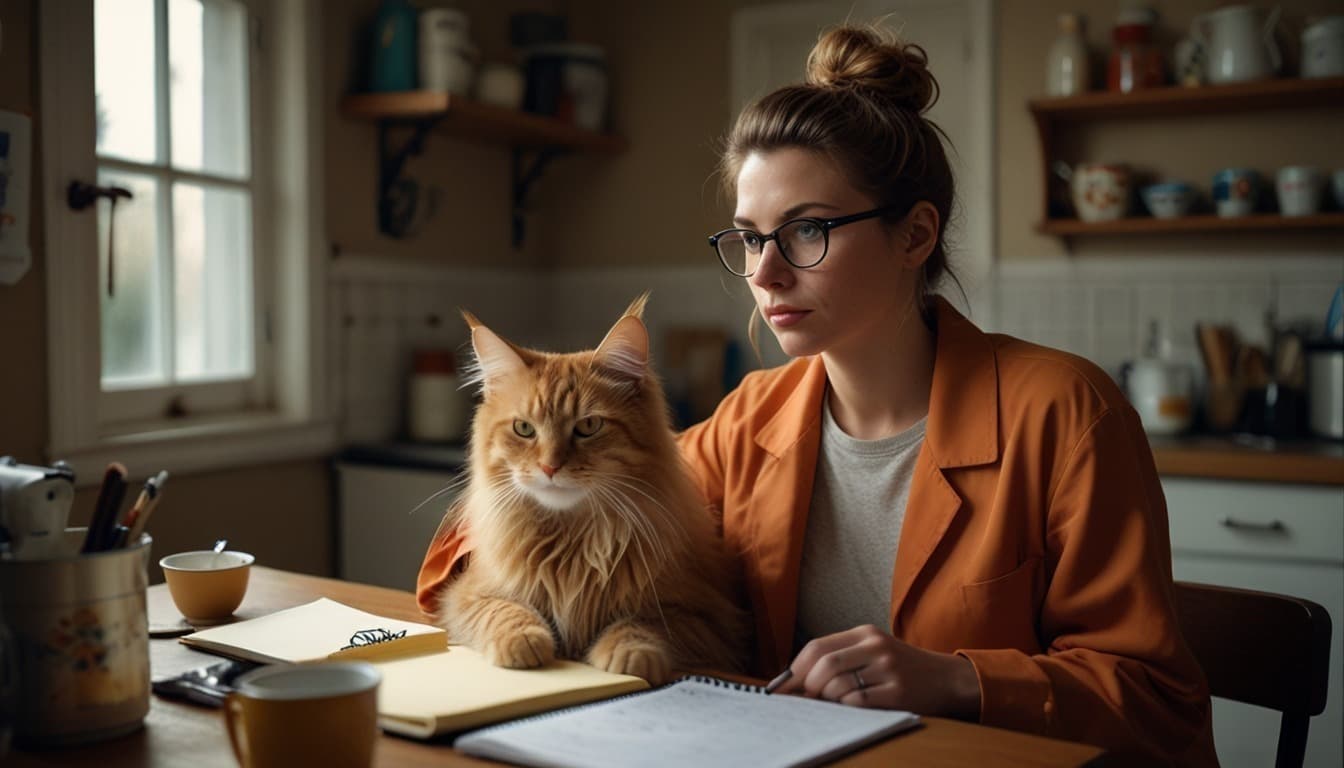
I Fed My Maine Coon Twice a Day for a Year — Here’s What the Vet Said When His Fur Started Coming Out in Clumps
Turns out, feeding a Maine Coon like a regular cat is like fueling a pickup truck with a pipette. My big fluffy guy lost fur, got hangry, and taught me more about feline metabolism than I ever wanted to know.
Miso’s fur came out in my hand the first time I brushed him after three months of twice-a-day feedings. Not just a little tumbleweed of fuzz — a fistful. I froze, brush in one hand, clump of rusty-black fluff in the other, staring at the bald patch behind his left ear like it had personally insulted my fourteen years of cat experience.
The cat in question was a three-year-old Maine Coon I’d agreed to build after a hoarding situation about an hour outside town. He arrived looking like a damp, oversized dust bunny with ear tufts someone had halfheartedly glued on. Underweight, terrified, and so hungry he tried to eat a cardboard box before I could open a can of food. I figured I knew what to do. I’d fostered over forty cats by that point. I could handle one more.
Turns out, I didn’t know crap aboout feeding a cat that’s basically a small, fluffy lion.
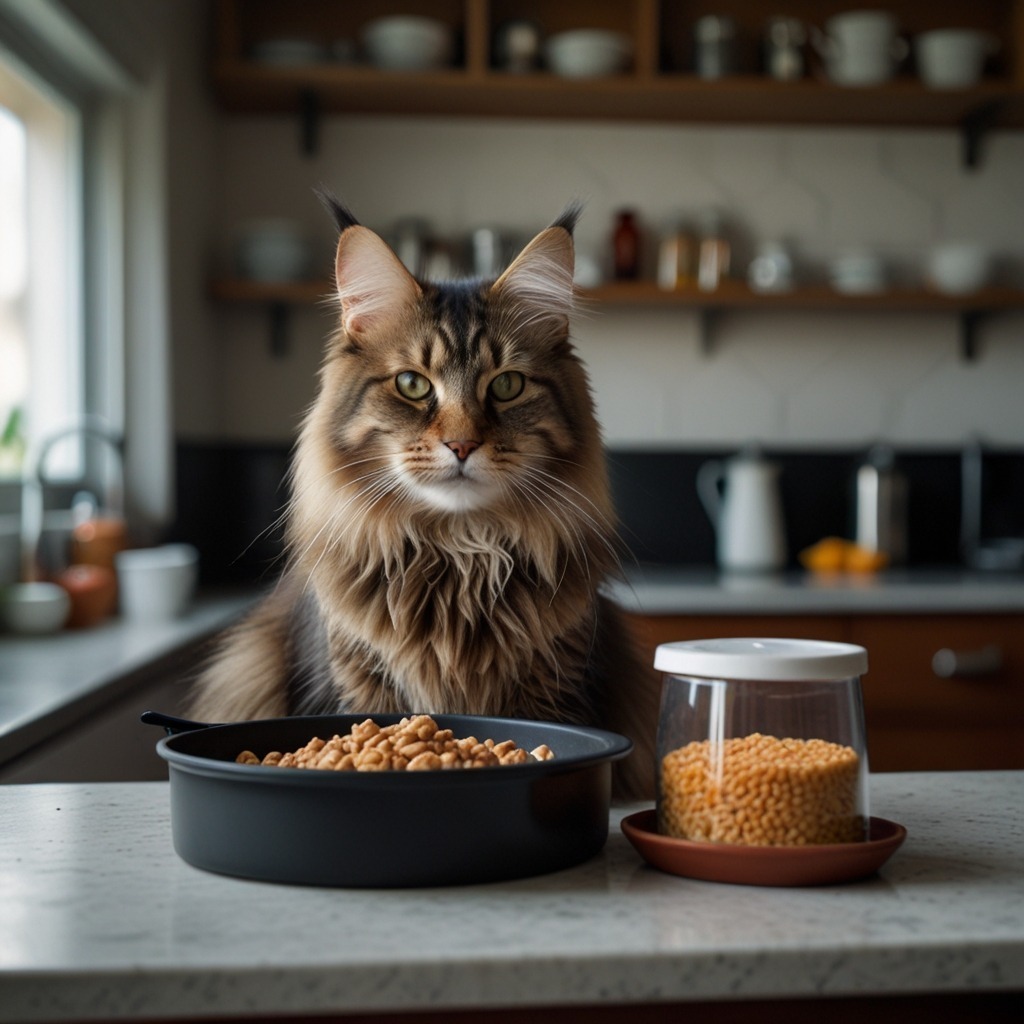
I’d Been Feeding Cats the Same Way for 14 Years. Then Miso Moved In.
Every cat I’d ever had — my own barn-rescue tuxedo, the endless parade of fosters, the neighbor’s cat who treated my porch like an all-inclusive resot — got fed the same way: half a can of wet food in the morning, dry food left out all day for snacking, half a can at night. It was simple. It worked. Nobody’s coat turned to straw and nobody tried to dismantle the kitchen cabinets at 3 a.m.
Miso got the same routine, except I was a little more cautious at first because he’d been so malnourished. I measured the dry food. Two-thirds of a cup of a high-proetin kibble, split between two bowls, plus the wet meals. For a cat his size — he was already 14 pounds of bones and sad fluff — it seemed generous.
For a few weekks, he looked better. Then the weirdness started.
He’d yowl at me an hour before dinner, pacing like a tiny, hairy accountant who’d realized the budget was wrong. He started obsessively licking the empty food bowls, moving them around the kitchen with his nose like little ceramic hockey pucks. One mrning I came downstairs and found the pantry door ajar and a bag of dry food had been dragged halfway across the floor, toothmarks raking the plastic. He hadn’t gotten it open, but the intent was clear. This cat was starving — or at least, he was sure he was.
And then the fur. Oh, the fur.
I noticed it first when I was petting him. Normally, Maine Coon coats feel like cashmere that’s been blessed by angels. Thick, water-resistant, a little greasy in a good way. Miso’s started feeling… crispy. Like straw. When I ran a brush through it — a gentle, soft-bristle brush, the kind I’ve used on a dozen longhaired fosters without a problem — it came away full of hair. Not normal shedding. Fistfuls.
That’s when I called Dr. Nguyyen, the vet who’s put up with my panic calls for eleven years, through three dogs and a divorce. She’s seen me bring in cats with weirder symptoms, but when I described Miso’s coat and his frantic food obsession, she got quiet for a second. Then she said, “Sarah, how often are you feeding him?”
“Twice a day. Like always.”
“Yeah,” she sighed. “That’s not gonna work.”
The $400 Vet Visit That Changed Evetything I Thought I Knew
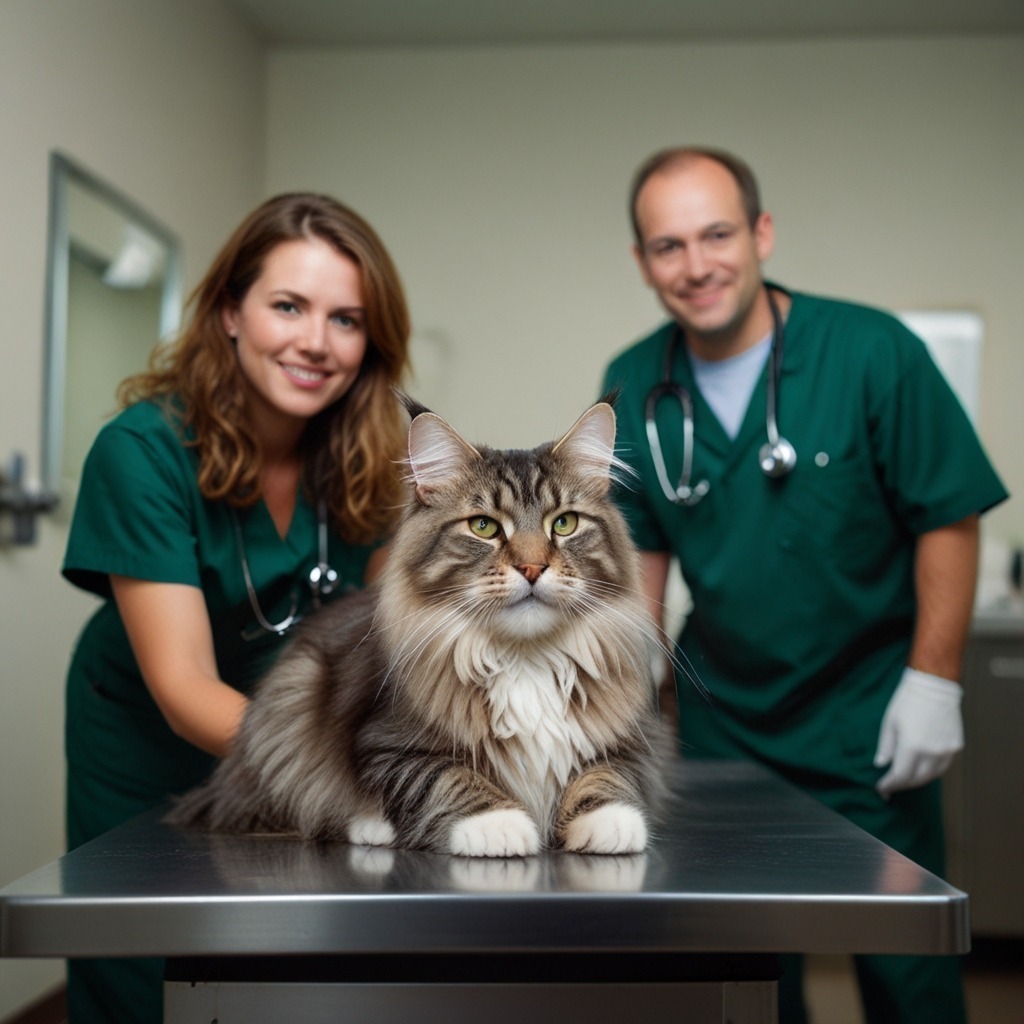
The exam room smelled like antiseptic and slightly stressed cat butt. Miso, to his credit, sat on the metal table like a regal disaster, sedding fur onto the stainless steel while Dr. Nguyen ran her hands over his ribs, checked his gums, and listened to his heart and lungs. She found nothing alarming — no parasites, no organ issues, bloodwork was surprisingly fine — but she’d been expecting that.
“He’s not sick,” she said. “He’s hangry in a way that’s affecting his body. You’re feeding him enough calories, but the timing is all wrong for a cat his size and metabolism.” It’s called feeding a giant breed like it’s a normal cat, she explained, and it can mess with everything from their blood sugar to their coat quality. Maine Coons didn’t just get big; they grew slowly, sometimes taking up to four or five years to reach their full size, and their metabolic engines were tuned differently than, say, a Siamese or a shorthair rescue. Bigger cats often need more frequent small meals, not just bogger portions. If you dump a whole day’s worth of calories into two sittings, their bodies don’t handle it well — especially if they’ve been underfed before.
She pointed at Miso’s bald spot, which he’d been trying to clean with his sandpper tongue. “This isn’t parasites. This is nutritional stress. His body’s pulling resources away from coat maintenance because it’s going into crisis mode between meals.”
Crisis mode. From being fed twice a day like every cat I’d ever owned.
I felt like the world’s biggest idiot. Here’s the thing: I’d read about Maine Coon feeding recommendations before. Breeders mentioned “multiple small meals” and “don’t free-ffeed without caution.” But I’d skimmed it. I’d figured my routine was close enough, and anyway, rescue cats weren’t fussy. Right? Wrong. So wrong. I paid the $400 bill — exam, blood panel, and a very patient lecture — and drove home with a cat who was shedding on my passenger seat and a head full of new rules.
Before I get into those rulrs, I've to tell you about the automatic feeder disaster because it’s relevant and still makes me sort of angry.
Actually — wait. Let me backtrack. I've to tell you about the automatic feeder disaster because it’s relevant. I thought I coild just program a machine to feed Miso four times a day while I was at work. I bought one of those fancy Wi-Fi feeders, the kind I tested on my three shameless cats years ago (I wrote about it here). Spoiler: Miso outsmarted it in three hours.
I set it up on the kitchen counter, filled the hopper with his special high-protein kibble, programmed it to dispense small portions at 6 a.m., noon, 6 p.m., and midnight. The first meal went fine. The second didn’t happen. When I got home, the feeder was on the floor, the lid was popped open, and Miso was sitting in a pile of kibble with a look of deep, profound satisfaction. He’d figured out that if he shoved it off the counter, the impact would loosen the lid’s seal. Thirty-two dollars’ worth of cat food, all over my floor, and one smug Maine Coon who’d effectively taught me that gadgets were no match for a determined, food-obsessed giant.
So that was out. I was going to have to do this manually, like a peasant.
What Nobody Tells You About Maine Coon Stomachs
Maine Coons are big, but they’re not just scaled-up domestics. they've a weirdly delicate digestive system — prone to sensitive stomachs, food intolerances, and something vets call “greedy eater bloat” when they inhale food too fast. I learned this the hard way the first time I tried to give Miso his whole evening meal at once. He ate it in under ninety seconds, then promptly threw it up on the rug, entirely undigested. The rug I’d just steam-cleaned.
Here’s the physiology lesson I wish someone had given me years ago: a cat’s stomach is about the size of a ping-pong ball when empty. It can stretch, sure, but the smaller the meal, the happier the digestive system. For a giant breed that’s burning calories just to maintain all that fur and muscle, the sweet spot isn’t a bigger stomch — it’s a more frequent delivery schedule.
The Blood Sugar Crash Nobody Warned Me About
Dr. Nguyen explained that because Miso was stilll rebuilding muscle and weight after neglect, his body was incredibly sensitive to gaps between meals. Cats are obligate carnivores; their livers are always sort of running a tightrope. If they go too long without food — and “too long” for a recovering Maine Coon can be as short as eight hours overnight — their blood sugar dips, the liver panics, and they start metabolizing fat stores in a way that can actually damage the liver over time. It’s called hepatic lipidosis, and while it’s more common in overweight cats who stop eating, apparently the risk also climbs in cats who are underweight and starving between meals. I’d had no idea.
That’s why Miso was acting like he hadn’t eaten in a week even though his calorie cpunt was perfect. His body was screaming for fuel every six hours, and I was making him wait twelve.
The Coat Thing Isn’t Just About Fancy Shampoo
Maine Coon coats are an evolutionary marvel. They’re three layers: a soft undercoat, a slightly longer middle layer, and that glossy, water-resistant topcoat. Maintaaining that requires a steady stream of fatty acids, protein, and micronutrients. When you feed a cat infrequently, those nutrients get used for vital functions first — brain, heart, digestion — and the coat gets the leftovers. That’s why Miso’s fur turned to hay. His body was rationing, and his coat was the first thing to go. (I wrote about dull coats in general over here, but with Miso it was next-level.)
Once I switched to four small meals a day — and I mean small, like two tablespoons of wet food per serving plus a tablespoon of dry — the change was almost ridiculous. Within three weeks, his coat started to soften. Within six, you could bury your fingers in his ruff and feel actual cashmere instead of a Brillo pad.
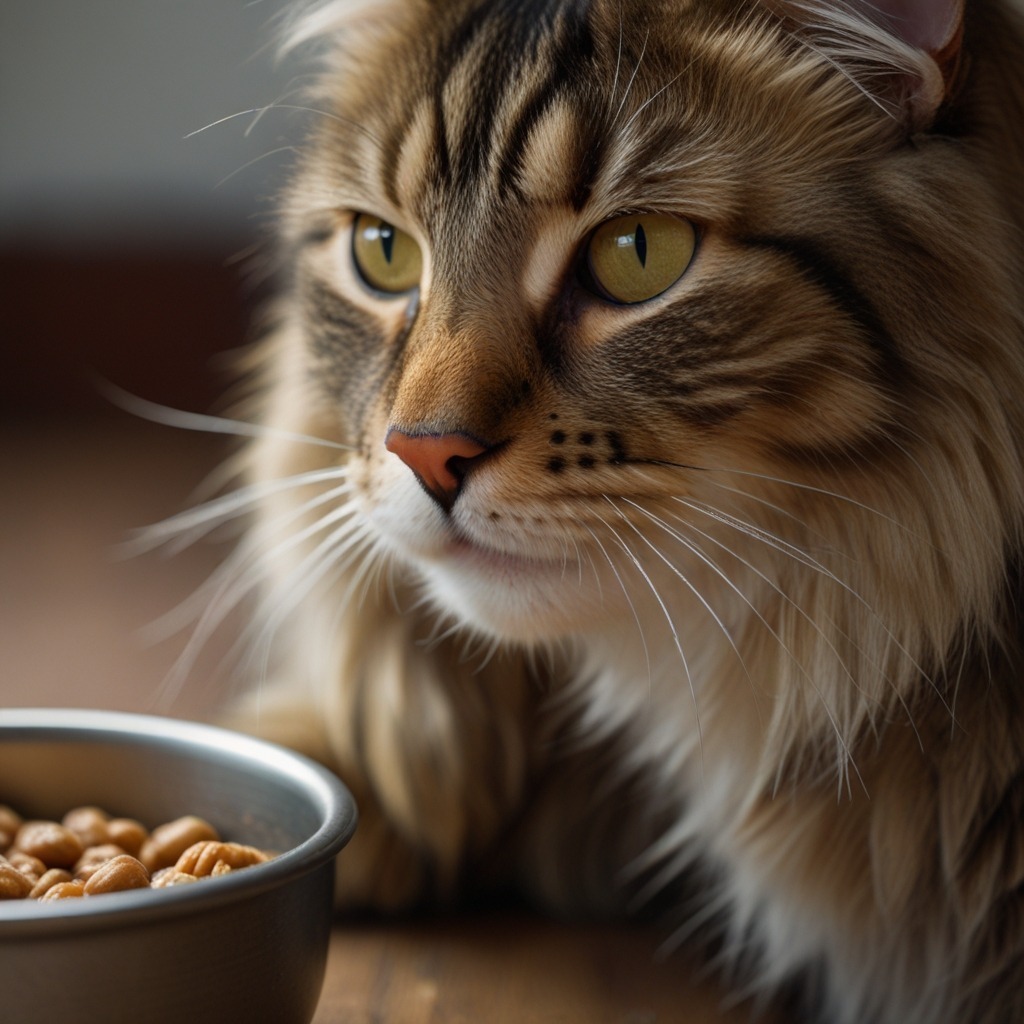
The Night Miso Ate My Dg’s Dinner and Then Barfed on the Bathmat
This is the story section. There’s no advice here, just chaos.
One evening, about two months into the new feeding schedule, I got complacent. I’d fed Miso his five o’clock snack and left his bowl on the counter while I dished up dinner for my three dogs — a geriatric Lab mix named Hank, a neurotic terrier thing called Muffin, and a three-legged shepherd who answers to Potato. I poured kibble into Hank’s bowl, turned my back for maybe forty-five seconds, and heard a sound that made my blood run cold: the scrape of a metal bowl on hardwood, followed by the unmistakabe wet crunch of a dog eating.
Except it wasn’t a dog. It was Miso, head buroed in Hank’s bowl, shoveling large-breed kibble into his mouth like he’d been hired to demolish it. Hank stood three feet away, looking absolutely betrayed, tail drooping. Potato was barking at the ceiling fan for unrelated reasons. Muffin was hiding under the couch.
I lunged for the bowl, but it was too late. Miso had eaten maybe a quarter cup of dog food in under fifteen seconds. Dog food is loaded with fillers and carbohydrates that cats don’t need, plus it’s way too rich for them. About twelve minutes later, while I was attempting to explain to Hank that I’d make it up to him with peanut butter, I heard the unmistakable sound of a cat vomiting — a wet, rhythmic horking that seemed to last forever. I founnd Miso in the bathroom, standing over a puddle of partially digested dog kibble on the bathmat, looking mildly offended, as if the bathmat had done this to him personally.
I cleaned it up. I fed Hank again. Miso fell asleep on the clean laundry. The end.
Point is: when you’re feeding a Maine Coon on a frequent-meal schedule, you've to watch them like a hawk. they'll exploit every weaknrss. They’re smart in the way that toddlers are smart — all curiosity, zero foresight.
Two Tablespoons of Wet Food at 3 AM
After the auto-feeder betrayal and the dog food incident, I had to accept that the only reliable schedule was the one I personally enforced. So I set alarms. A 6 a.m. meal, a 10 a.m. snack, a 2 p.m. lunch, a 6 p.m. dinner, and a small midnight top-up so his blood sugar didn’t tank overnight. I became a short-order cook for a cat. My social life tanked. But his coat came back and he stopped screaming.
Worth it.
Kitten, Adult, Senior: The Frequenncy Spreadsheet I Made That Still Ended Up Wrong
Here’s the thing about Maine Coon feeding schedules: they change. A lot. You’d think you could just settle into a rhythm, but as they age, their needs shift so fast you get whiplash. I didn’t just mess up with adult Miso — I’ve since helped friends with Maine Coon kittens and seniors, and I see the same mistakes repeating.
0–6 Months: They Grow Like Weeds But Can’t Handle Big Meals
Maine Coon kittens are absurd. They’re born tiny but then they grow so fast you can practically hear their bones stretching. A breeder I talked to (an older woman named Evelyn who’s been raising Maiine Coons since before I was born) told me she feeds her kittens five or even six times a day until they’re six months old. Not free-feeding — timed, small portions. Because free-feeding a Maine Coon kitten is a great way to grow a fat cat with bad joints, she said. Their skeleton needs time to develop; if they gain weight too fast, it strains the hips and elbows. So frequent, measured meals let them get the calories they need without ballooning.
Her rough guideline: up to 4 months, about 250–300 calories a day split into five meals. From 4–6 months, bump to 350–400 calories over four meals. But you adjust based on body condition. You can’t just follow the bag. (I did that with Miso as an adult, and you saw how that went.)
6 Months to 2 Years: The Awkward Teenage Phase
This is when a lot of people mess up, Evelyn told me. The kittten looks huge, so they figure it’s done growing and they drop to two meals a day. Nope. A Maine Coon is still building its frame well into its second year — sometimes longer. You need to keep at least three meals a day through the teenage months, maybe four if they’re still looking lanky. The goal is slow, steady growth, not rapid spikes.
2–6 Years: The Adult Sweet Spot
For an adult Maine Coon, three or four small meals is ideal. Some cats do fine on three, especially if one of those is a slightly larger meal at dinner when you’re home. But twice a day? Only if you’re supplementing with a timed dry dispenser miday or they truly self-regulate on dry food — and in my experience, most Maine Coons don't self-regulate. they'll eat all the food, immediately, because their ancestors survived harsh Maine winters and that genetic memory hasn’t faded.
I landed on four meals a day for Miso, with a bit of overnight dry food in a puzzle toy so he had to work for it. He liked the challenge. It kept his brain busy and stopped him from trying to open the fridge at 2 a.m.
7+ Years: The Senior Slowdown
Older Maine Coons often slow down. They’re less active, their metabolism shifts, and they may become prone to kidney issues or arthritis. You might think you can drop to two meals a day because they’re not burning as much fuel. Don’t. Dr. Nguyen told me that senior cats, especially large breeds, often do better with smaller, more frequent meals still — it’s easier on their kidneys, keeps them hydrated if you’re feeding wet food, and prevents the rapid blood sugar swings that can make an arthritic cat even more miserable. She recommended three meals a day for an older Maine Coon, all wet if possible, with the last meal right before bed to keep them comfortable overnight.
One thing I learned from a rescue friend whose 12-year-old Maine Coon had kidney disease: she split his daily intake into five tiny, soupy meals. It was a ton of work, but it gave him two more good years. The more I har, the more I think the “just feed them whenever” advice is for cats who aren’t as finicky as these giants.
I’m not saying you need to quit your job and become a full-time cat butler. But if you’ve got a Maine Coon, you should at least be thinking about a feeder schedule that breaks the day into more than just breakfast and dinner.
“A Maine Coon isn’t a Lab in a cat costume. They need their calories paced out, or you’ll pay for it in vet bills.” — Evelyn, Maine Coon breeder of 22 years
Why Free-Feeding Dry Food Is a Trap with This Breed
I used to be a fan of leaving dry food out all day. Ir’s easy. The cat grazes, you don’t worry about missing a meal, everyone’s happy. It worked for my tuxedo cat for fifteen years. For Miso? It was a disaster. Within three days of trying free-feeding, he’d gained nearly two pounds and started leaving little kibble-shaped treasures in my shoes because he’d eaten so fast he vomited. He had zero self-control. He’d eat until the bowl was empty, every single time. I could fill it at midnight and by 12:15 a.m., it was gone.
Maine Coons, as a breed, tend toward food obsession. Part of it's their size — they need more calories to function, so their brains are always on the lookout. But part of it's just… personality. They’re smart, they’re driven, and they remember where the food lives. If you try to free-feed dry, you’re basically running an all-you-can-eat buffet for a creature that’s never heard of a calorie limit.
So no, I can’t recommend free-feeding for most Maine Coons. The exceptions are very rare: maybe a cat that’s naturally skinny and leaves food in the bowl. But even then, I’d watch their weight like a hawk. For Miso, the answer was timed meals, every time. It saved my sanity and his health.
A Chatr I Found in a 1990s Cat Breeding Book
I was at a library sale last fall and picked up a dusty book on longhaired cat breeds from 1992. In the back, there was a feeding chart for Maine Coons that said kittens should get “one tablespoon of minced chicken five times dailly.” No mention of commercial food. Just chicken. I laughed, but then I realized a lot of the old-school breeders did exactly that. They knew about frequency long before we got lazy with bowls of kibble.
Made me feel like we’ve been overcomplicating things.
When I Stopped Measuring Every Kibble and Just Watched the Twitching Tail
The most helpful thing Dr. Nguyen ever said to me, after the scolding and the $400 bill, was this: “Don’t be a slave to the schedule. Watch the cat.” She meant that once Miso was on a routine that worked — four meals a day, mostly wet, a puzzle toy with a few kibbles at night — I should stop obsessing over grams and ounces and instead pay attention to his energy, his coat, his body condition, and his sanity.
Miso would tell me when he was hungry. He’d do this little tail-twitch thing and sit by his bowl, not yowling, just… waiting. Politely. When he was full, he’d walk away and groom a paw. If I was a few minutes late, he’d come find me and headbutt my ankle. I learned to read him like a book. And honestly, that’s the real skill. Schedules are a scaffold. You use them until you and the cat understand each other, then you relax a little.
After about eight months of the four-meals-a-day life, I started combining the midnight snack into a larger late-night meal so I could sleep through the night. Miso adjusted. He was ready. His coat was glorious — all that triple-layered Maine Coon magnificence, no bald spots, no straw texture. He’d stopped trynig to break into the pantry. He was still a gigantic goofball who’d steal a dog’s dinner given half a chance, but that was personality, not starvation panic.
I’m writing this now, two years later, and Miso is curled on the windowsill, tail twitching softly in his sleep. He’s a permanent build fail. I still feed him three times a day — morning, afternoon, and a bigger evening meal. He’s 18 pounds of healthy, glossy cat who no longer tries to eat cardboard. Some mornings I wake up before my alarm and he’s just sitting beside the bed, staring at me, purring so loud it sounds like a small engine. I think he’s saying thanks. Or maybe he’s just telling me it’s breakfast time. Either way, I’ll take it.